
Published: August 2025 | Last updated: April 2026 | Editorial review and quality control: Martina N.
Herpes vs. chlamydia: how do you tell the difference?
Herpes is a viral infection that produces recurring blister-like sores on the genitals, mouth, or surrounding skin and stays in the body for life, with antiviral medication used to manage outbreaks. Chlamydia is a bacterial infection that often produces no symptoms at all, but when it does shows up as unusual discharge, burning urination, or pelvic pain, and is curable with a short antibiotic course (typically 7 days of doxycycline). Symptom overlap is real, so the only way to know which infection (or both) you have is to test.
Key takeaways
- Most people with HSV-2 worldwide are unaware they carry it, and more than half of chlamydia infections produce no symptoms; the absence of symptoms is not the absence of infection.
- Chlamydia clears with about 7 days of antibiotics, while herpes is managed for life with antivirals; mistaking one for the other delays the right treatment by weeks.
Two of the most-searched sexually transmitted infections share a confusing trait: their early symptoms can look almost identical. Itching, burning during urination, vague discomfort during sex. Yet one is a bacterial infection that antibiotics will clear in a week, and the other is a lifelong viral infection your immune system manages without ever clearing. Confusing the two delays the right treatment, and in chlamydia’s case, that delay can quietly damage the reproductive system before any symptom appears.
This guide walks through what each infection actually does to the body, why the symptom overlap is real, what the test results tell you, and how to choose between testing one infection in isolation or screening for several at once. The short version: test based on exposure and risk, not on guesswork.
When the same itch could be either one
Herpes and chlamydia are two of the most reported sexually transmitted infections in the United States. The CDC chlamydia overview describes it as the most reported bacterial STI nationwide, while genital herpes is one of the most common viral infections worldwide, with the World Health Organization estimating about 520 million people aged 15 to 49 carry HSV-2. Despite their wildly different mechanisms, they often arrive in similar disguises: vague genital irritation, a burning sensation when urinating, or unexplained discomfort during sex.
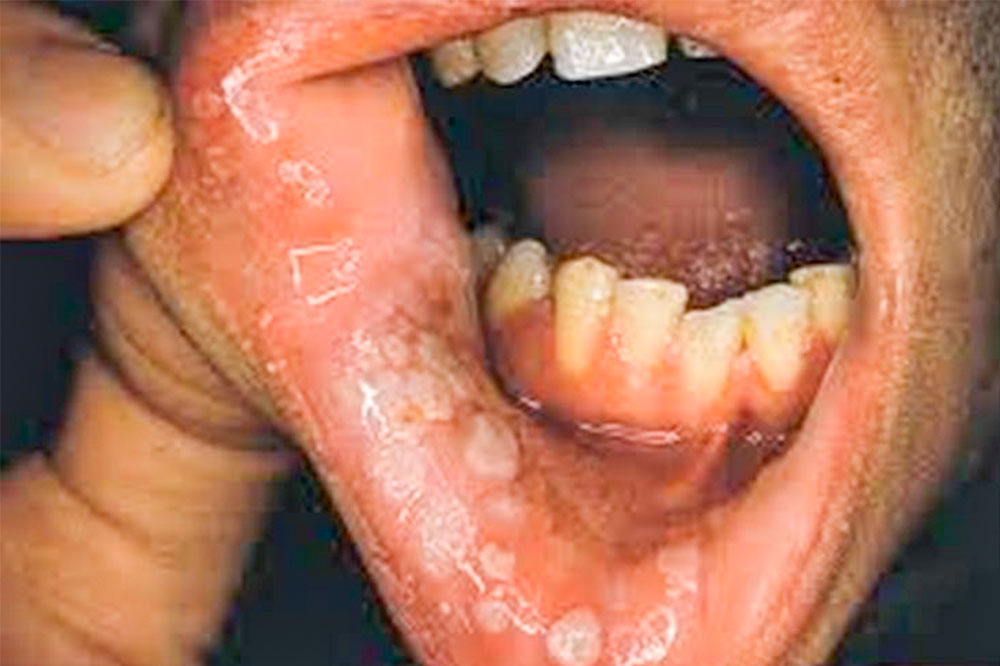
The reason this confuses so many people is that both infections produce mucosal inflammation in roughly the same anatomic neighborhood. Herpes (caused by herpes simplex virus types 1 and 2) reactivates from local sensory nerve cells and produces clusters of fluid-filled vesicles on or around the genitals, anus, thighs, or mouth. Chlamydia (caused by the bacterium Chlamydia trachomatis) infects mucosal surfaces in the urethra, cervix, throat, or rectum, and inflames them from the inside.
What looks like a “razor bump that won’t heal” might be the start of a herpes outbreak. What feels like “drinking too much coffee” might be chlamydial urethritis. Symptoms alone rarely settle the question; lab testing is what actually identifies which infection (or which combination) is responsible.
The WHO estimates the majority of HSV-2 carriers worldwide do not know they have the virus, and the CDC notes that most chlamydia infections produce no noticeable symptoms in either men or women. “I feel fine” is not evidence of being uninfected with either one.
Herpes: the virus that recurs, then quiets
Herpes simplex is a DNA virus that, after the initial infection, retreats into local sensory nerve ganglia and stays there for life. The body’s immune system controls it well most of the time, but stress, illness, hormonal shifts, friction, or sun exposure can trigger reactivation. When the virus travels back down the nerve to the skin, it produces the characteristic outbreak: tingling or itching first, then small red bumps, then clusters of painful fluid-filled blisters that ulcerate and crust over. A first outbreak typically heals over 2 to 4 weeks; recurrent outbreaks tend to be shorter and milder.
Two strains drive most genital infections. HSV-1 historically caused oral cold sores and HSV-2 caused genital infection, but oral sex has rearranged that pattern, and HSV-1 now accounts for a growing share of new genital herpes diagnoses, particularly in younger adults. According to the WHO 2023 herpes fact sheet, an estimated 3.8 billion people under age 50 carry HSV-1 globally and 520 million people aged 15 to 49 carry HSV-2.
The infection stays in the body for life and is managed with antivirals. Medications including acyclovir, valacyclovir, and famciclovir reduce outbreak frequency, shorten outbreak duration, and lower transmission risk to partners. Some people take antivirals only during flare-ups (episodic therapy); others take a daily low dose for ongoing suppression. The NHS genital herpes guidance notes that most people with herpes go on to have ordinary sexual relationships, with disclosure conversations and safer-sex practices doing far more to manage risk than the infection itself does to limit life.
Chlamydia: the silent infection that quietly damages
Chlamydia behaves opposite. Where herpes announces itself with visible sores at least some of the time, chlamydia usually announces nothing at all. The CDC chlamydia overview states that most chlamydia infections produce no noticeable symptoms, with a clear majority of women and men feeling nothing. When symptoms do appear, they include unusual genital discharge, burning during urination, pelvic pain or bleeding between periods (in women), testicular tenderness or swelling (in men), and rectal pain or discharge if the infection is in the rectum.
The danger of chlamydia is what it does in the background. Untreated, the bacterium can ascend the female reproductive tract and cause pelvic inflammatory disease (PID), scarring the fallopian tubes and creating a permanent risk of ectopic pregnancy and infertility. The CDC chlamydia overview notes that untreated infection can lead to PID and lasting fertility damage, and in men can progress to epididymitis with testicular pain and, more rarely, fertility impact.
Standard treatment, per the NHS chlamydia guidance, is doxycycline 100 mg twice daily for 7 days for most uncomplicated infections. Both sexual partners need to be treated to prevent reinfection, and patients are advised to abstain from sex during treatment and for 7 days afterward. Retesting at 3 months is recommended because reinfection from untreated partners is common.
Because most chlamydia infections cause no symptoms, the damage to fallopian tubes (and to fertility) often happens before anyone knows there is an infection at all. Annual screening for sexually active people under 25 and for older adults at higher risk is the practical safeguard against silent damage.
Why symptoms alone won’t tell you which is which
Three patterns repeatedly mislead people who try to self-diagnose:
- Both infections can cause burning during urination. Herpes does it because urine touches an open lesion; chlamydia does it because the urethra is inflamed from inside. The sensation feels almost identical to the person experiencing it.
- Herpes outbreaks can be very mild. A single small sore tucked along the labia, on the inner thigh, or in the buttocks crease is easy to mistake for an ingrown hair, an allergic reaction, a yeast infection, or razor irritation. Some first outbreaks are subtle enough that a person dismisses them entirely, then has a much milder recurrence months later that finally prompts testing.
- Chlamydia can have zero symptoms. Most infections do. The only reliable way someone with truly asymptomatic chlamydia learns about it is through testing, either as part of routine annual screening, partner notification, or a multi-infection panel after a possible exposure.
Compare the two infections side by side and the differences become easier to remember:
| Feature | Herpes (HSV-1, HSV-2) | Chlamydia |
|---|---|---|
| Cause | Virus (DNA virus, herpes simplex family) | Bacterium (Chlamydia trachomatis) |
| Typical symptoms | Recurring fluid-filled blisters that ulcerate and crust; tingling or itching prodrome | Often none; when present, abnormal discharge, burning urination, pelvic pain |
| Asymptomatic share | Most carriers worldwide are unaware (per WHO) | More than half of infections produce no symptoms (per CDC) |
| Time to first signs | 2 to 12 days after exposure, sometimes longer | 1 to 3 weeks after exposure, when symptoms appear at all |
| Curable? | No, lifelong; managed with antivirals | Yes, with about 7 days of doxycycline |
| Testing method | Lesion swab PCR during outbreak; HSV IgG blood antibody test (4 to 12 weeks after exposure) | Urine NAAT or genital swab; lateral-flow rapid kits at home |
| Main complications | Recurrent outbreaks; psychological burden; neonatal risk in active labor | PID, ectopic pregnancy, infertility, epididymitis |
How soon after exposure do symptoms and tests show?
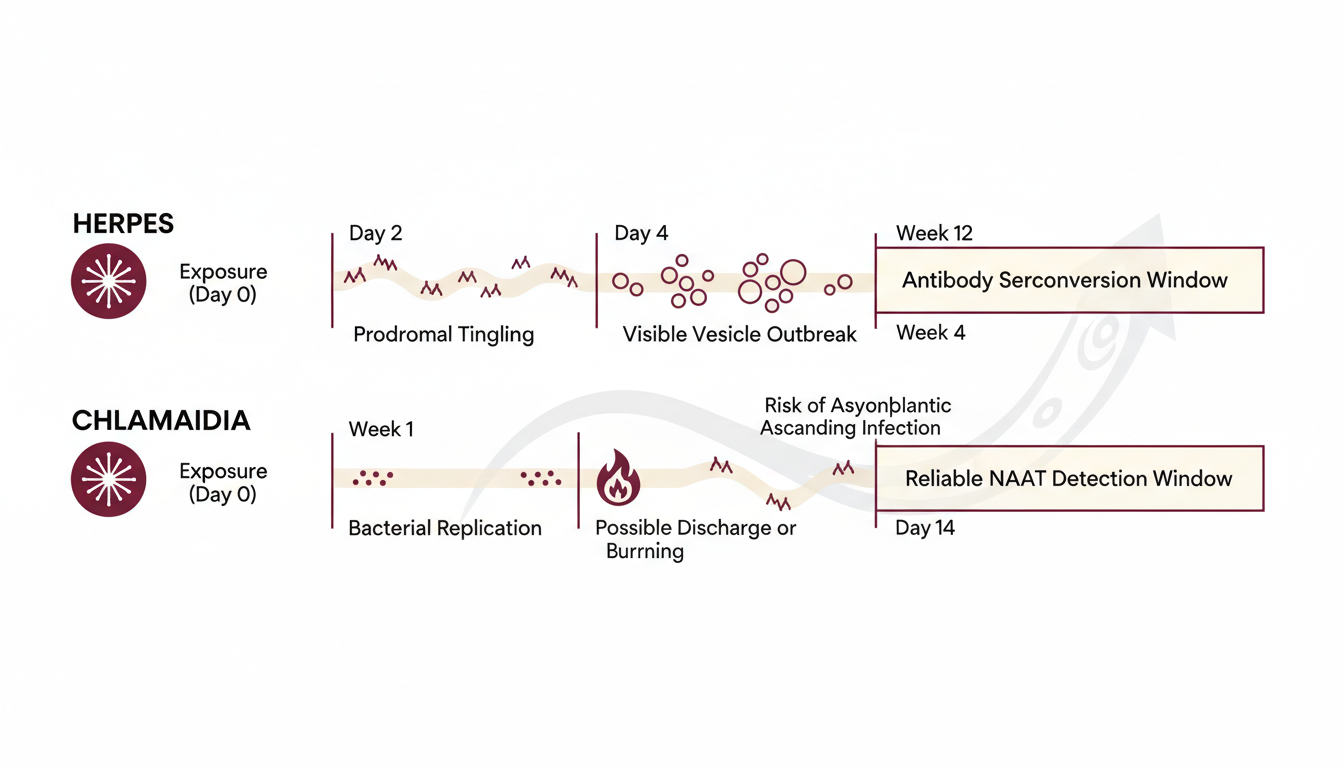
Timing rarely follows a clean rule. Herpes symptoms typically appear 2 to 12 days after the initial exposure, but the first noticeable outbreak can be delayed weeks, months, or even years if the immune system controls the early infection well. Chlamydia has an incubation period of roughly 1 to 3 weeks before symptoms appear (when they appear), and most people simply never feel anything.
For testing, the windows differ:
- Chlamydia is detectable by laboratory NAAT (nucleic acid amplification, the gold standard) within about 1 to 2 weeks after exposure. Home rapid tests using lateral-flow chemistry on a urine or self-collected swab share the same general window, with sensitivity strongest after symptoms emerge or 14 or more days post-exposure.
- Herpes blood tests detect IgG antibodies, which take roughly 4 to 12 weeks (occasionally longer) to develop reliably after a new infection. If you have an active sore, a swab PCR taken from the lesion is the more accurate diagnostic during that window. A negative herpes blood test taken too soon after a recent exposure does not rule out infection.
The implication is simple: test based on exposure timing, not on whether symptoms have shown up. The CDC chlamydia overview supports this approach because waiting for symptoms lets bacterial infections like chlamydia silently accumulate damage, and lets viral infections like herpes pass to partners during asymptomatic shedding.
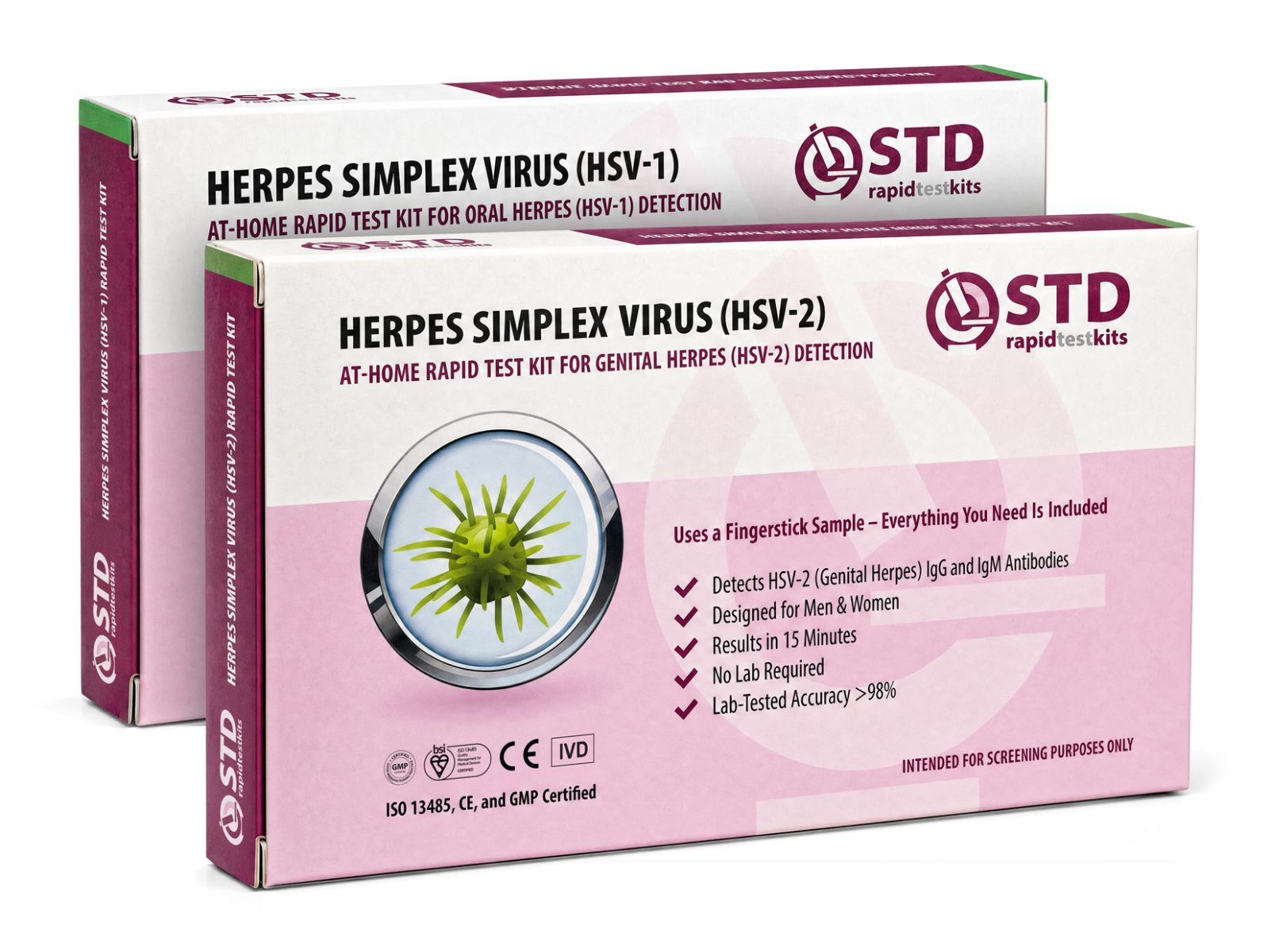
STD Rapid Test Kits sells at-home rapid lateral-flow tests for both infections discussed here. Relevant kits appear inline below, recommended by fit for the reader’s concern rather than commercial benefit.
Treatment: curable in one case, manageable in the other
The two infections diverge sharply at the treatment table.
Chlamydia is fully curable. Per the NHS chlamydia guidance, doxycycline 100 mg twice daily for 7 days is the first-line therapy for most uncomplicated infections; azithromycin 1 g as a single dose is used in selected situations such as pregnancy. Both sexual partners need treatment, and reinfection from an untreated partner is one of the most common reasons for a “second” diagnosis a few months later. Patients are advised to abstain from sex during treatment and for 7 days afterward, and to retest at 3 months to confirm clearance.
Herpes stays in the body for life; antivirals keep it well controlled. Three medications dominate, per the NHS genital herpes guidance: acyclovir (the original), valacyclovir (better oral absorption, twice-daily dosing), and famciclovir. Two regimens exist:
- Episodic therapy: a 1 to 5 day course taken at the first sign of an outbreak, which shortens duration and lowers symptom severity.
- Suppressive therapy: daily low-dose antivirals taken continuously, which reduces outbreak frequency substantially and lowers transmission risk to a partner. Clinical trial data summarised in the NHS genital herpes guidance shows daily suppressive therapy substantially lowers transmission risk in studied serodiscordant couples.
Both regimens are well tolerated and inexpensive in generic form. Suppressive therapy is most commonly used by people with frequent recurrences, those in serodiscordant relationships (where one partner has herpes and the other does not), and pregnant patients near term to reduce neonatal transmission risk.
When neither infection announces itself
The hardest cases to catch are the ones that produce no symptoms at all. With chlamydia, asymptomatic infection is the rule rather than the exception. With herpes, asymptomatic viral shedding (where the virus is present on the skin without a visible outbreak) drives a sizable share of new transmissions. Research tracking daily viral shedding with PCR has found that people with HSV-2 can shed the virus on a meaningful fraction of days even when they feel fine and have no visible sores, which is why transmission occurs in long-term partnerships where one partner appears asymptomatic.
This has practical consequences. A long-term partner can transmit herpes despite no visible outbreak in either of you. A new partner who recently tested chlamydia-negative may not have tested specifically for herpes, since most clinic STI panels do not include herpes blood antibody testing unless you ask for it by name. Both situations call for explicit conversation about what was tested and when, not assumptions.
If you want to know your herpes status, you usually have to request HSV-1 and HSV-2 IgG antibody testing by name. A “full panel” at most clinics screens for chlamydia, gonorrhea, syphilis, and HIV, but leaves herpes out unless you’re symptomatic or you specifically ask. This catches a lot of people off guard.
Stigma: what isn’t a medical symptom but still hurts
Both infections carry social weight, but they carry it differently. Chlamydia is curable, so the stigma tends to be brief: a positive test, a course of antibiotics, a partner notification, then it’s over. Herpes carries the heavier stigma because it stays. Surveys published in the journal Sexually Transmitted Infections and elsewhere have documented fear of rejection, anxiety about disclosure, and shame in real diagnostic cohorts.
The mismatch between perception and reality is striking. Herpes is more prevalent than the public realizes, with the majority of carriers globally unaware of their status. Outbreaks for most people are mild and infrequent, often declining over the first 1 to 2 years after diagnosis. Antiviral suppression makes transmission to a partner uncommon when used consistently and combined with other precautions. The diagnosis does not end someone’s romantic or sexual life.
Counseling research consistently finds that the partner being told usually reacts with concern and questions rather than rejection, particularly when the disclosure is paired with concrete information: how outbreaks are managed, how transmission risk is reduced with antivirals and condoms, and what testing the listening partner can choose to do. The conversation feels worse in anticipation than in practice for most people.
Why testing for both at once makes sense
Co-infection is common enough that most modern test panels are designed around it. People diagnosed with one STI are more likely than the general population to carry another, and many home and clinic panels now bundle chlamydia, gonorrhea, syphilis, HIV, herpes, and a few others.
Before relying on any combined panel, note that most clinic panels exclude herpes serology by default, so ask for HSV-1 and HSV-2 IgG by name if you want it. A negative herpes blood test in someone recently exposed also does not rule out infection, since antibodies take 4 to 12 weeks to develop. Interpret the result in light of when the possible exposure happened, and retest if needed.
Multi-infection home test kits use lateral-flow chemistry, which is meaningfully different from laboratory NAAT or PCR. The two are complementary rather than equivalent: lateral-flow trades some analytical sensitivity for speed, privacy, and the absence of a clinic visit. A positive home test is worth confirming with a clinic NAAT or PCR, and a negative test taken too soon after exposure is worth repeating after the appropriate window.
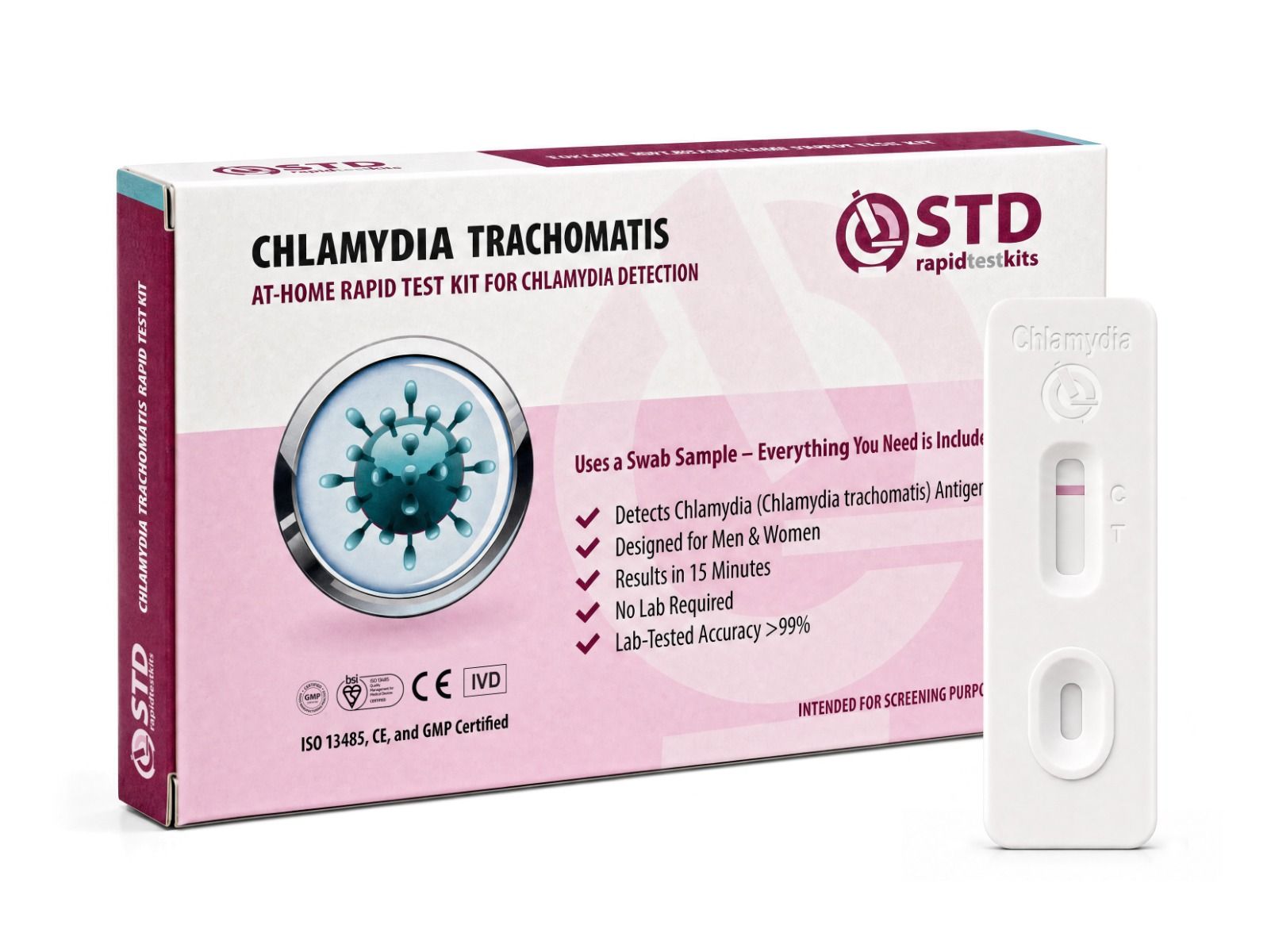

Home rapid tests have become accurate enough to use as a first-line screen, especially when the alternative is no testing at all. Lateral-flow strips give a result in about 15 minutes from a self-collected swab or a fingerstick blood drop. They are not identical to laboratory NAAT, which is more sensitive in early infection and at very low bacterial loads, but the workflow is meaningfully different: at home, on your schedule, with no clinic visit. For people who would otherwise delay testing for weeks or months, that workflow advantage often outweighs the small sensitivity gap.
Prevention: what condoms do and don’t catch
Condoms and dental dams are highly effective against chlamydia, since the infection spreads through fluid exchange across mucosal surfaces. Used consistently and correctly, they cut chlamydia transmission risk substantially.
Condoms are partially effective against herpes. The virus spreads through skin-to-skin contact, and a condom only covers the area it covers. Lesions on the inner thighs, buttocks, scrotum, or vulva can transmit the virus during sex even with a condom in use. Research summarised in the WHO herpes fact sheet describes consistent condom use as reducing without eliminating herpes transmission risk.
Other prevention pieces worth knowing:
- Daily antiviral suppression for the partner with herpes substantially lowers transmission risk in studied couples.
- Avoiding sex during a visible outbreak (and the 1 to 2 days of prodromal tingling before one) reduces transmission risk during the highest-shedding window.
- Routine testing every 3 to 6 months for sexually active people with multiple partners catches infections like chlamydia early, before complications develop.
- The HPV vaccine does not prevent herpes or chlamydia, though it is part of comprehensive sexual-health protection and worth its own conversation with a clinician.
Talking with a partner without making it a crisis
A diagnosis is information for two people, not just one. Framing the conversation around shared health rather than blame changes what it feels like for both sides. “I want us both to know what’s going on” reads very differently from “I have something to tell you.”
Practical phrasing that tends to work:
- For a new chlamydia diagnosis: “I tested positive for chlamydia. I’m being treated, and I want to make sure you get tested and treated too if you need to. We should hold off on sex until both of us finish treatment.”
- For ongoing herpes management: “I have herpes. I take medication that lowers the risk of passing it to a partner. I wanted to tell you so we can decide together what we’re comfortable with.”
Most people with herpes have only mild symptoms or no symptoms at all, and many do not know they have the infection. Antiviral medications can reduce symptoms and lower the risk of passing the virus to others.
Life after diagnosis
For chlamydia, life after diagnosis is usually a 7-day antibiotic course, a 7-day pause in sexual activity, a partner notification, and a follow-up retest at 3 months to confirm the infection cleared. The vast majority of people treated promptly never experience long-term complications.
For herpes, life after diagnosis settles into a pattern. Most people identify their personal triggers (stress, illness, hormonal shifts, friction, sun exposure) and learn to recognize the prodromal tingling that precedes an outbreak. Antivirals are kept on hand for episodic use, or taken daily for ongoing suppression. Outbreak frequency typically declines over the first 1 to 2 years post-diagnosis. Sexual relationships continue, including with partners who do not have herpes, with disclosure and standard precautions.
Pregnancy is possible and usually uncomplicated for both conditions when managed appropriately. Chlamydia treated early in pregnancy clears without lasting impact. Herpes is managed during pregnancy with late-pregnancy antiviral suppression and, in some cases, cesarean delivery if there is an active outbreak at labor; both approaches reduce neonatal herpes risk to very low levels.
Frequently asked questions
- Can I have both herpes and chlamydia at the same time?
- Yes. Co-infections are common enough that most modern STI panels test for several infections at once. A positive result for one is a strong reason to test for others, including herpes (which is often left out of standard panels unless you ask for it by name).
- Is chlamydia easier to treat than herpes?
- Yes, in the sense that chlamydia is curable with a short antibiotic course (typically 7 days of doxycycline), while herpes stays in the body for life. Herpes is managed long-term with antiviral medication that reduces outbreak frequency, severity, and transmission risk to partners.
- Can chlamydia cause cold sores?
- No. Cold sores around the mouth are caused by herpes simplex virus type 1 (HSV-1), not by chlamydia. Chlamydia infects mucosal surfaces in the urethra, cervix, throat, or rectum and does not produce skin sores.
- Can chlamydia spread through kissing?
- Chlamydia transmits through vaginal, anal, or oral sex via direct contact with infected mucosal surfaces. Kissing alone does not transmit it, though oral sex can introduce a chlamydia infection to the throat. Herpes, by contrast, can transmit through kissing when oral cold sores or asymptomatic shedding are present.
- Will my partner definitely catch herpes from me?
- Not necessarily. Daily antiviral suppression therapy substantially lowers transmission risk in studied serodiscordant couples, condom use lowers it further, and avoiding sex during outbreaks lowers it more. Many serodiscordant couples (one partner with herpes, one without) remain serodiscordant for years.
- How soon after possible exposure can I test?
- For chlamydia, a home swab is reliable from around day 14. For herpes, plan on waiting at least 12 weeks from exposure before a blood antibody result is conclusive. If you have an active sore before that window, a clinic-administered swab PCR can detect the virus directly.
- Can I have a healthy pregnancy with herpes or after chlamydia?
- Yes to both. Chlamydia caught and treated during pregnancy clears fully without lasting impact. For herpes, suppressive antivirals from around 36 weeks, and cesarean delivery if there is an active outbreak at labor, keep neonatal transmission risk very low. Discuss specifics with your OB early in the pregnancy.
- Do most clinic STI panels include herpes testing?
- No. Most “standard panels” at clinics test for chlamydia, gonorrhea, syphilis, and HIV, though they exclude herpes blood antibody testing unless you specifically request it. If you want to know your herpes status, ask for HSV-1 and HSV-2 IgG testing by name.
What to do next
If you suspect either infection, the most useful step is testing, not guessing. Symptom-based self-diagnosis is wrong often enough that medical guidance now favors testing on the basis of exposure and risk, not on the basis of waiting to feel something. A negative test is reassurance. A positive test is the starting point for a course of treatment that, in chlamydia’s case, ends the infection within a week, and in herpes’s case, gets you on a manageable maintenance plan.
An STI diagnosis is one piece of health information among many. The longer you wait without it, the more decisions get made without the full picture.
- World Health Organization. Herpes simplex virus fact sheet, including global prevalence estimates for HSV-1 and HSV-2, transmission patterns, and antiviral management.
- U.S. Centers for Disease Control and Prevention. Chlamydia overview covering symptoms, asymptomatic patterns, treatment, and complications including PID.
- U.S. Centers for Disease Control and Prevention. Genital herpes overview with information on transmission, asymptomatic shedding, and antiviral therapy.
- UK National Health Service. Chlamydia condition page, including standard treatment with doxycycline and recommended retesting interval.
- UK National Health Service. Genital herpes condition page covering outbreak patterns, antiviral medication, and pregnancy management.
- World Health Organization. Chlamydia fact sheet covering global epidemiology and recommended treatment.
