
Published: September 2025 | Last updated: May 2026 | Editorial review and quality control: Martina N.
Sex doesn't end at 60. Neither do sexually transmitted infections. According to U.S. Centers for Disease Control and Prevention surveillance, STI rates among adults aged 55 and older have climbed sharply over the past decade, with syphilis, gonorrhea, and reported herpes diagnoses all rising in that age band. Herpes simplex virus type 2 (HSV-2) is particularly easy to miss in older adults because postmenopausal skin reacts differently, classic outbreak symptoms are often muted, and many primary-care visits after 60 skip sexual-health screening entirely.
This article summarizes what current public-health guidance says about herpes in older adults: how it can present after menopause, why asymptomatic carriers drive most transmission, what testing pathways exist after 60, how Medicare coverage works, how to disclose a diagnosis to a partner, and what the emotional recovery typically looks like. The information is drawn from CDC, WHO, NHS, NIH MedlinePlus, and Medicare.gov guidance, summarized for a general adult reader. This article is published by stdrapidtestkits.com, which sells at-home STI testing kits; product mentions are placed where they genuinely fit the testing question being discussed.
Key Takeaways
- Herpes in older adults often shows up as cracked or itchy skin, persistent irritation, or vague soreness rather than the classic blister cluster, leading to misdiagnosis as eczema, candida, or postmenopausal dryness.
- Most people infected with HSV-2 in the United States are undiagnosed, per CDC estimates. Asymptomatic carriers can still transmit the virus, which makes lab testing the only reliable way to know your HSV status.
How Herpes Looks Different After Menopause
The textbook description of a herpes outbreak (a cluster of small fluid-filled blisters that ulcerate, crust, and heal over one to two weeks, with classic tingling or burning before the lesions appear) does not always match what older adults actually experience. Postmenopausal skin is thinner and less elastic. Vaginal pH and lubrication shift. Cellular immune response slows. The combined effect is a presentation that frequently gets called eczema, contact dermatitis, a yeast infection, or simple dryness when herpes is the underlying cause.
Atypical features that clinicians describe in older patients include persistent redness without obvious ulceration, fine cracks or fissures in the vulvar or scrotal skin, itchy patches that do not respond to moisturizer, prolonged post-coital irritation without a clear cause, and mild or absent pain even during what should be a primary outbreak. The classic prodrome of tingling or burning may be missing entirely.
This atypical pattern contributes to a diagnostic gap. Older patients are less likely than younger patients to receive a correct herpes diagnosis on the first clinical visit when comparable exposure histories are accounted for. Many cases come to attention only after weeks of unsuccessful treatment for unrelated skin conditions. Research on herpes serology also suggests that people who already carry HSV-1 (the cold-sore strain) may experience a milder initial HSV-2 episode due to partial cross-immunity, though responses vary widely between individuals.
For readers in their 60s or 70s noticing persistent itching, cracking, or recurring irritation that does not match the usual pattern of postmenopausal vaginal dryness, a herpes test is reasonable to consider. Vulvar lichen sclerosus, contact dermatitis, candidiasis, and HSV can all look similar. Testing distinguishes them in a way that visual inspection alone cannot, and the right next step depends on what is causing the symptoms.
- Persistent itching or redness with no obvious ulceration
- Fine cracks or fissures in vulvar or scrotal skin
- Patches that do not respond to moisturizer or over-the-counter steroid cream
- Prolonged post-coital irritation without a clear cause
- Mild or absent pain during what should be a primary outbreak
- Missing or unrecognized prodrome (tingling, burning) before any lesion appears
None of these prove herpes on their own. Lab testing is the only reliable way to separate HSV from look-alike skin conditions.

Asymptomatic HSV-2 and the Silent-Transmission Problem
A counterintuitive fact about HSV-2: most people who carry the virus do not know it. The CDC's herpes information page states that most people with genital herpes have no symptoms or have very mild symptoms that go unnoticed, and as a result most do not know they have a herpes infection.
That undiagnosed population is the engine of ongoing transmission. The herpes simplex virus stays dormant in sensory nerve ganglia between outbreaks and reactivates intermittently. During reactivation it can shed from the genital skin even when no lesion is visible. This is called asymptomatic viral shedding, and it accounts for a substantial share of new infections each year, according to the WHO Herpes Simplex Virus fact sheet, which notes that HSV-2 can be transmitted even when the skin looks normal.
The implications for older readers are direct. A partner with no visible sores can still transmit HSV-2. A partner who sincerely believes they are uninfected can be carrying the virus. A condom reduces but does not eliminate transmission risk because shedding can occur outside the area the condom covers. None of this is a counsel of fear; it is the underlying reason that the CDC, WHO, and NIH MedlinePlus all emphasize laboratory testing rather than visual inspection or partner self-report as the way to determine HSV status.
HSV travels along sensory nerves and stays dormant in nerve clusters between outbreaks. It periodically reactivates and travels back to the skin, where it can briefly shed (release virus particles) without producing a visible sore. Someone who sheds during these silent episodes can transmit HSV to a partner without realizing it. That is why testing rather than visual inspection is the way to confirm a partner's HSV status.
Why STD Rates Are Climbing Among Adults Over 55
This is not a rare phenomenon. According to the CDC's STI Surveillance reporting, infections among adults aged 55 and older have risen substantially over the past decade. Syphilis cases in the 55-plus group more than doubled between the mid-2010s and early 2020s. Gonorrhea diagnoses in older adults have also climbed sharply. Reliable U.S. surveillance data for herpes specifically is harder to come by because herpes is not nationally reportable, but seroprevalence studies and provider surveys consistently show that diagnosed cases in older adults are rising.
Several factors converge. More older adults are sexually active and have new partners after divorce, widowhood, or the dating-life pause that often followed long-term marriages of earlier decades. Erectile-function medications have extended sexual activity well into the 70s and 80s. Pregnancy is no longer a concern after menopause, and condom use drops sharply in this age band. Public health campaigns about safer sex are mostly aimed at younger audiences. Many primary-care visits for adults over 60 don't include routine STI screening unless the patient brings it up.
Adults over 65 are significantly less likely to receive regular STI screening than younger sexually active adults, even when new sexual partners are reported. The gap is part stigma, part clinical inertia, and part an artifact of how routine annual exams were structured back when most adults over 60 were assumed to be in long-term monogamous relationships. Today's older adults are more likely to be re-entering dating after a long marriage, which the screening defaults have not caught up with.
Retirement communities and active-adult communities deserve a specific mention. Social and romantic life in these settings is real, often vibrant, and frequently includes new sexual partnerships. Yet most retirement communities don't distribute condoms, post sexual-health information, or arrange on-site testing. The gap between actual sexual activity and the available sexual-health infrastructure is one of the clearer underrecognized public-health stories of the past decade.

Disclosing a Herpes Diagnosis to a Partner
The first conversation after a diagnosis is often the hardest. For older adults who came of age before HIV/AIDS reshaped public discussion of sexual health, talking about an STI with a new partner may feel completely unfamiliar territory. There is no template, no clinical script handed out at the moment of diagnosis, and often no one available to rehearse with. Public-health educators and sexual-health counselors recommend a five-step structure, summarized in the callout below.
For ongoing relationships, the conversation looks different. Long-term partners may have been exposed already without knowing it. Testing the partner is informative for both people: a positive result means the couple has likely shared the virus for years, and a negative result lets the couple plan precautions deliberately going forward.
The harder conversation is the one a person decides not to have. Hiding a known HSV-2 diagnosis from a sexual partner is both legally complicated in some jurisdictions and emotionally corrosive over time. Disclosure earlier rather than later tends to produce better outcomes than disclosure forced by a later outbreak.
- Lead with calm, factual information. Name the virus: "I tested positive for HSV-2, the virus that causes genital herpes."
- Give context. HSV-2 is common (CDC estimates roughly 1 in 8 U.S. adults aged 14 to 49 carry it), often asymptomatic, and manageable with antiviral medication.
- Outline what you do to reduce risk. Daily antiviral suppression (valacyclovir, acyclovir, or famciclovir), consistent condom use, and avoiding sex during prodrome or active outbreaks.
- Invite questions. Many partners have heard scary myths about herpes and benefit from a calm exchange more than a defensive monologue.
- Give the partner time. A pause to process is normal and does not mean rejection.
At-Home Testing vs Clinic Testing After 60
Several testing pathways are available, and the right choice depends on what question the test is being asked to answer.
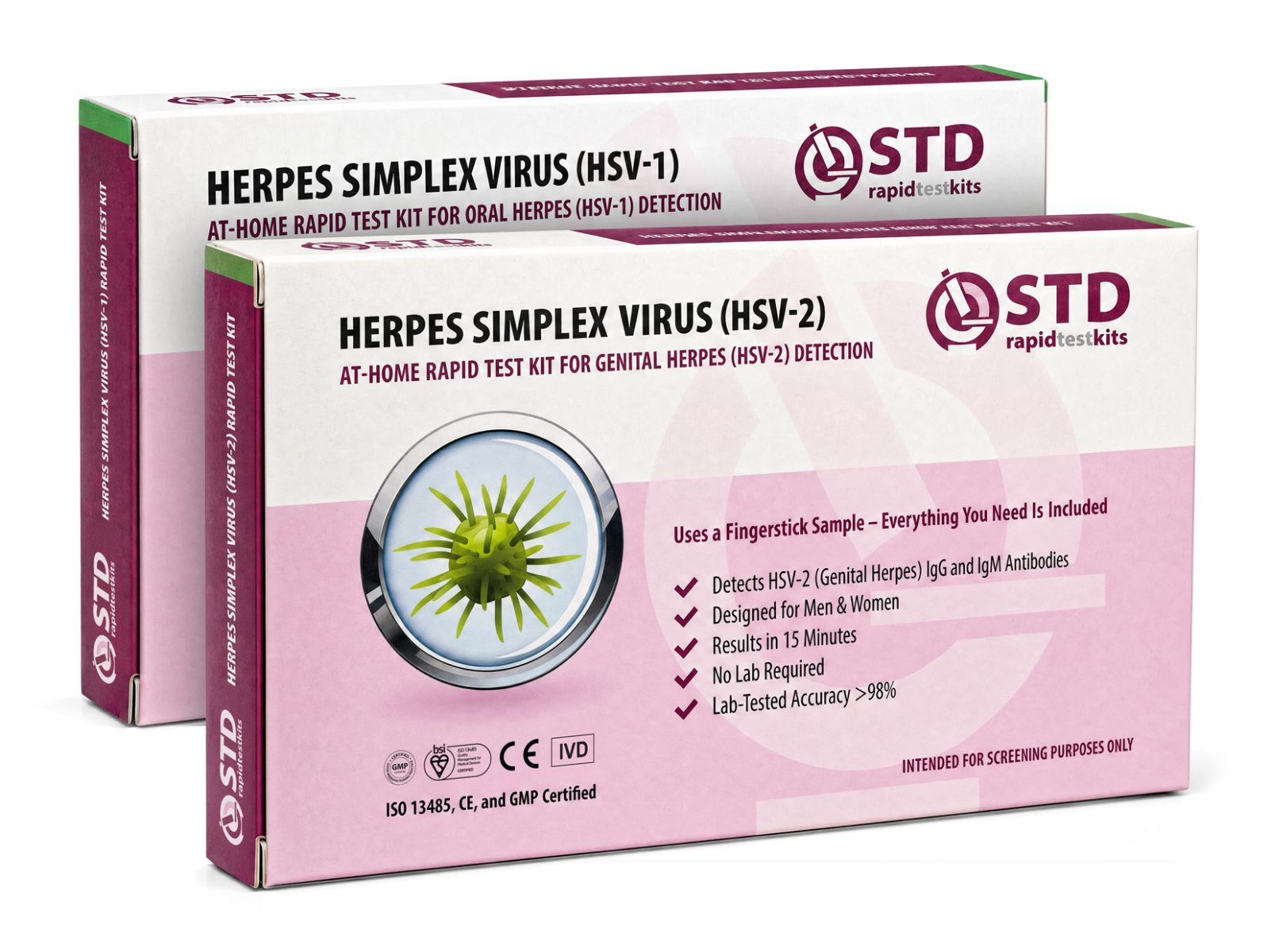
At-home rapid lateral-flow blood tests for HSV-1 and HSV-2 antibodies provide a result within 15 to 30 minutes from a fingerprick sample. They detect IgG antibodies, which depending on the specific assay typically become detectable 6 to 16 weeks after primary infection. These tests are most accurate when used at least three months after the suspected exposure, so they fit best for screening rather than for a sudden recent-exposure question. Reported sensitivity for HSV-2 antibodies in commercial lateral-flow tests typically falls in the high 90s of percentage points when samples are taken after the window period, though specific kit performance varies by manufacturer.
Mail-in laboratory tests use the same sample type (a sealed fingerprick blood draw) but send the sample to a clinical lab for an ELISA or chemiluminescent immunoassay. Results are usually available within one to three days after the lab receives the sample. Lab-based assays have somewhat higher analytical sensitivity than rapid lateral-flow tests, and the report often includes a numerical index value rather than a simple positive or negative.
Clinic testing covers a wider range of options: serology (the same blood-antibody chemistry), swab PCR for an active outbreak (the most sensitive method, but it requires a visible lesion to swab), and viral culture (less sensitive than PCR, mostly historical now). PCR from a swab of a suspected lesion is the gold standard for diagnosing an active outbreak. For screening between outbreaks, blood antibody testing is the practical option whether done at home, by mail, or in clinic.
A practical sequencing rule: if the question is "do I have an active outbreak right now?", a clinic-based PCR swab of the lesion is the best test. If the question is "have I been infected at any point in the past?", a blood antibody test taken at least 12 to 16 weeks after possible exposure answers it.
| Testing Method | Speed | Privacy | Best Use Case |
|---|---|---|---|
| At-home rapid blood antibody test | Result in 15 to 30 minutes | High (discreet packaging) | Private screening at least 12 weeks after a new partner |
| Mail-in laboratory blood test | 1 to 3 days after lab receipt | Moderate to high | Lab-grade antibody result without an in-person visit |
| Clinic swab PCR | Same day to a few days | Low to moderate | Active lesion present, confirmatory diagnosis |
| Clinic serology | Same day to a few days | Low to moderate | Symptoms or known exposure, billed through insurance |
Common Myths That Keep Older Adults From Testing
Several beliefs continue to circulate, and each one keeps people from getting tested when they should. The reality column below draws on current CDC and WHO guidance.
| Myth | Reality |
|---|---|
| Herpes only happens to people who sleep around. | HSV-2 can be transmitted from a single sexual encounter. Many long-married adults acquire herpes from one new partner after divorce or widowhood. Sexual history does not equal infection history. |
| If I had herpes, I'd know. | Most people infected with HSV-2 are undiagnosed, per CDC estimates. The classic outbreak pattern misses the majority of cases, and atypical presentations are particularly common in older adults. |
| A negative herpes test rules it out forever. | Antibody tests need a window period of 6 to 16 weeks after exposure to be reliable. A test taken too soon after a new partner can return a falsely negative result. Retesting at three to four months is the right plan when concern persists. |
| Herpes ruins your sex life. | Daily antiviral suppression therapy combined with condom use and avoidance of sex during prodrome or active outbreaks lets many serodiscordant couples maintain sexual relationships for years without transmission. |
| Older adults don't need to test because they aren't at risk. | Sexual contact at any age carries STI risk. Rising STI statistics in adults over 55 directly contradict this assumption. |
Sex and Intimacy After a Herpes Diagnosis
A herpes diagnosis does not end intimate life. People who manage HSV-2 over decades generally report that the practical adjustments become routine within months: tracking outbreak timing, recognizing prodrome symptoms, taking daily antiviral medication if outbreaks are frequent, using condoms consistently, and pausing sexual activity during active outbreaks.
For older adults specifically, the adjustment overlaps with other body changes that already require communication: vaginal dryness, erectile changes, slower arousal, longer recovery time. Many couples find that the conversation skills practiced around herpes (clarity, calm tone, factual framing) carry over to broader sexual communication and make sex genuinely better than it was without those conversations.
A few practical considerations. Water-based lubricant reduces friction-related skin trauma, which can trigger outbreaks. Suppressive antiviral therapy at daily dosing reduces both outbreak frequency and asymptomatic shedding, according to the CDC's herpes information page, which notes that a daily anti-herpes medicine can make it less likely to pass the infection to a sex partner. Outbreaks tend to become less frequent and milder over the first few years after primary infection. Consistent latex condom use further reduces transmission risk, although the WHO HSV fact sheet notes that HSV can still transmit from skin areas a condom does not cover. Combining condoms with suppressive antiviral therapy is more protective than either approach alone.
For couples where one partner has herpes and the other does not, the most common pattern over time is sustained intimacy without transmission when antivirals and condoms are used consistently. Transmission can still occur, but published transmission rates over a year of serodiscordant monogamous relationships with these precautions are in the low single digits.
Most people with genital herpes either have no symptoms or have very mild symptoms that go unnoticed or are mistaken for another skin condition. Because of this, most people who have genital herpes do not know it.
What Medicare Covers and What It Doesn't
Medicare covers some STI screening but not all of it, and the rules differ across Original Medicare and Medicare Advantage plans. According to Medicare.gov coverage guidance, Medicare Part B covers an annual STI screening for sexually active adults at increased risk, which includes chlamydia, gonorrhea, syphilis, and hepatitis B. HIV screening is covered annually for those at increased risk and once-a-lifetime baseline for adults aged 15 to 65.
Herpes testing is more variable. Routine herpes screening for asymptomatic adults is not recommended by the CDC or the U.S. Preventive Services Task Force, and Medicare typically follows that guidance, which means routine asymptomatic herpes screening is generally not covered. Herpes testing prompted by symptoms or a known exposure is more likely to be reimbursed, but coverage decisions are made plan-by-plan and visit-by-visit. Confirming coverage with the specific plan before a clinic visit is sensible.
For adults who want screening that Medicare won't reimburse, at-home rapid kits or mail-in lab options are often the most practical choice. The trade-off is paying out of pocket for the kit versus the time, scheduling, and clinical-visit cost of going through a provider.
- Covered (Part B, annually for adults at increased risk): chlamydia, gonorrhea, syphilis, and hepatitis B screening.
- Covered (Part B): annual HIV screening for adults at increased risk, plus a once-a-lifetime baseline for adults aged 15 to 65.
- Generally not covered: routine herpes screening for asymptomatic adults. The CDC and the U.S. Preventive Services Task Force do not recommend it as a population screening test, and Medicare typically follows that guidance.
- Often covered: herpes testing prompted by symptoms or a known exposure. Confirm coverage with your specific plan before the visit.
Emotional Recovery After a Diagnosis
A new herpes diagnosis tends to produce a predictable arc: initial shock, a few weeks of distress, a period of information-seeking, gradual normalization, and over the following months a return toward baseline emotional state. Research on patient quality-of-life trajectories after HSV-2 diagnosis consistently shows the emotional impact is highest in the first month and substantially reduced by six months.
The clinical reality of HSV-2 is that it is common, manageable, not life-threatening, and consistent with a full sexual and emotional life. The stigma surrounding the diagnosis is heavier than the medical impact for most people, and the stigma fades faster with information than with avoidance.
| What tends to help | What tends not to help |
|---|---|
| Reading CDC, WHO, and NHS fact sheets for accurate baseline information | Excessive forum and image searching in the first few weeks |
| A primary-care or telehealth provider willing to answer questions in a non-judgmental tone | Reading transmission-risk threads where worst-case scenarios are most visible |
| Closed support communities for adults living with HSV-2 | Conversations with partners before you have gathered the factual information yourself |
| Suppressive antiviral therapy when outbreaks are frequent (shifts the experience from 'this happens to me' to 'this is being managed') | Self-isolation, secrecy, or avoiding dating altogether |
Frequently Asked Questions
- Can you get herpes from a partner who has no symptoms?
- Yes. The CDC notes that most people with HSV-2 are unaware they carry it, and the virus can shed from genital skin even without a visible lesion (asymptomatic shedding). A partner who has never had a recognized outbreak can still transmit HSV-2. Only a blood antibody test or a clinic-administered PCR swab can confirm HSV status; neither looking at a partner nor taking their word for it is a reliable substitute.
- Why does herpes look different in older adults?
- After menopause, skin is thinner and less elastic, vaginal pH and lubrication shift, and immune response slows. Outbreaks may appear as fine cracks, persistent itching, or vague soreness rather than the classic blister cluster. Misdiagnosis as eczema, candida, or simple dryness is common, and the prodrome (tingling or burning) can be absent.
- How long after a possible exposure should I test for herpes?
- Antibody tests need a window period of 6 to 16 weeks after exposure to be reliable, depending on the specific assay. A test taken too soon may miss a recent infection. If a first test is negative but symptoms or concerns persist, retesting at three to four months is the standard recommendation. For an active visible lesion, a clinic swab PCR can confirm an outbreak at any time the lesion is present.
- Does Medicare cover herpes testing?
- Medicare covers annual STI screening for chlamydia, gonorrhea, syphilis, and hepatitis B for adults at increased risk under Part B, and HIV screening on a similar basis. Routine herpes screening for asymptomatic adults is generally not recommended by the CDC or USPSTF and is therefore typically not covered by Medicare. Testing prompted by symptoms or a known exposure is more likely to be reimbursed, but the specific plan should be checked before the visit.
- Can I still have sex with HSV-2?
- Yes. Daily antiviral suppression therapy (valacyclovir, acyclovir, or famciclovir) reduces both outbreak frequency and asymptomatic shedding. Latex condoms reduce transmission risk further when used consistently. Avoiding sex during prodrome and active outbreaks is also recommended. With these precautions, many serodiscordant couples maintain long sexual relationships without transmission.
- How do I tell a new partner I have herpes?
- Lead with calm, factual information: name the virus, explain that it's common (CDC estimates roughly 1 in 8 U.S. adults aged 14 to 49 carry HSV-2), and outline what you do to reduce transmission (suppressive antivirals, condoms, no sex during outbreaks). Invite questions, give the partner time, and avoid framing the conversation as a confession. Sexual-health counselors find that early disclosure produces better outcomes than disclosure forced by a later outbreak.
- Is herpes curable?
- No, but it is highly manageable. The herpes virus persists in sensory nerve ganglia after primary infection. Antiviral medications cannot eliminate it, but they suppress reactivation and reduce both outbreak frequency and transmission risk. Many people on suppressive therapy go years between outbreaks, and outbreaks generally become milder over time even without treatment.
- Can I get HSV-2 from oral sex?
- Yes, though it is less common than HSV-1 transmission via oral contact. HSV-1 (the strain typically associated with cold sores) can be transmitted to the genitals during oral sex from someone with an oral outbreak or asymptomatic oral shedding. HSV-2 oral-to-genital transmission is less frequent but documented. Avoiding oral contact during a partner's visible cold sore reduces this risk.
- U.S. Centers for Disease Control and Prevention. Genital Herpes - Basic Fact Sheet. Source for the statement that most people with genital herpes are unaware they carry it, asymptomatic shedding, and daily antiviral therapy reducing transmission risk.
- World Health Organization. Herpes simplex virus fact sheet. Global prevalence data, asymptomatic-transmission biology, and condom-coverage limitations.
- U.S. Centers for Disease Control and Prevention. Sexually Transmitted Infections Surveillance. Rising STI rates in adults aged 55 and older over the past decade.
- NHS. Genital herpes. Patient-facing summary of symptoms, atypical presentations, and treatment with antiviral medications.
- NIH MedlinePlus. Genital herpes patient summary. Diagnosis pathways, suppressive therapy, and disclosure guidance for general audiences.
- Medicare.gov. Coverage portal for sexually transmitted infection screenings under Medicare Part B.
