
Published: November 2025 | Last updated: May 2026 | Editorial review and quality control: Martina N.
After a threesome, the recap loop is almost universal. Whose hands were where, did the condom slip, what was oral versus penetrative, who switched mid-way without anyone tracking it. Group sex involves more variables than a one-on-one encounter, and the brain tends to catalog each one in slow motion. That mental rewind isn't paranoia. It's your nervous system doing risk math after the fact, and it usually intensifies the moment you notice anything slightly unfamiliar in your body.
Most sexually transmitted infections are quiet in the first one to two weeks, and several never produce noticeable symptoms at all (CDC STI overview). So the question of whether you're OK isn't really answered by what you feel. It's answered by what shows up on a test taken at the right time. This guide covers both halves: which symptoms genuinely warrant attention, and which testing windows make a negative result mean something.
Key Takeaways
- Most STIs stay silent for the first one to two weeks, so feeling 'fine' right now isn't proof anything is clear.
- The reliable testing windows after a multi-partner encounter are day 7 to 14 for bacterial STIs, week 4 to 6 for HIV and syphilis, and week 12 for final confirmation.
Why the Aftermath of Group Sex Hits Different
In the moment, the situation usually feels controlled. Maybe everyone agreed on boundaries, maybe protection was used, maybe everybody seemed healthy. The replay starts afterward. Did the condom stay on the whole time? Was there oral contact between partners that you didn't see? Did anything switch positions or partners without you tracking it?
The mental load runs higher with multiple partners because the contact map is more complicated. One person's fluids touching a second person's skin or mucosa, then a third person, then back again, creates pathways for transmission that don't exist in a paired encounter. None of this means infection happened. It means the risk picture is harder to summarize in your head, which is exactly why people end up scanning their body for evidence for the next two weeks.
Two realities work against each other here. Friction, new bacterial flora from each partner, and basic post-sex inflammation can produce sensations that feel like infection but aren't. At the same time, the earliest stages of real bacterial STIs are often so subtle that they get rationalized away. That is why anything that lingers more than two days after a new exposure deserves a test rather than another rationalization.
Group sex creates overlapping exposure paths. One person's fluids touching two others creates transmission routes a one-on-one encounter does not. That complexity is part of why the mental replay feels so relentless afterward, and it is also why screening for more than one infection at the day-14 window is the safer move.
Sorting Real Symptoms From Body Noise
Your body reacts to sex. New partners introduce new chemistry, friction creates microabrasions, and a different microbiome can briefly upset your own. None of those reactions are STIs. What separates noise from signal is how a sensation behaves over the next forty-eight to seventy-two hours.
If a sensation appears, peaks within a day, and fades on its own, that's almost always non-infectious irritation. If it sticks around, intensifies, or starts pairing with other symptoms like discharge changes or new sores, that's when it crosses into 'worth checking' territory. The table below maps the common post-sex sensations against what they could mean and when each one earns your attention.
| Symptom | Possible Cause | When to Pay Attention |
|---|---|---|
| Burning when urinating | Irritation, UTI, chlamydia, gonorrhea | If it lasts more than 48 hours |
| Unusual discharge | pH imbalance, infection | If color, smell, or texture changes |
| Itching or irritation | Friction, yeast, herpes | If worsening or paired with sores |
| Sore throat | Oral sex exposure, gonorrhea | If persistent or paired with painful swallowing |
| No symptoms at all | Very common in early STI infection | Still requires testing on schedule |
The Quiet Symptoms Most People Almost Miss
There's a predictable pattern to what people notice first. Burning or stinging during urination is one of the earliest complaints, and it gets brushed off as dehydration about half the time. If it lasts more than two days, especially without a UTI history, it's worth a chlamydia and gonorrhea screen. Both infections often start with exactly this kind of mild urinary irritation (CDC chlamydia overview).
Discharge changes are subtle and easy to rationalize. Maybe it's thicker, maybe the color is slightly different, maybe there's just more of it. The shift gets attributed to a cycle phase, to recent sex itself, or to a new soap or laundry detergent. Context matters here. New exposure changes what those small shifts could mean.
Skin changes spike anxiety the most. A bump, a small red patch, a sore that wasn't there last week. Most bumps are benign: ingrown hairs, friction folliculitis, irritation from a new condom lubricant. Some aren't. Herpes sores often start as mild irritation or a single small papule before the recognizable blister pattern emerges; the CDC also notes that mild herpes symptoms are commonly mistaken for a pimple or ingrown hair (CDC About Genital Herpes).
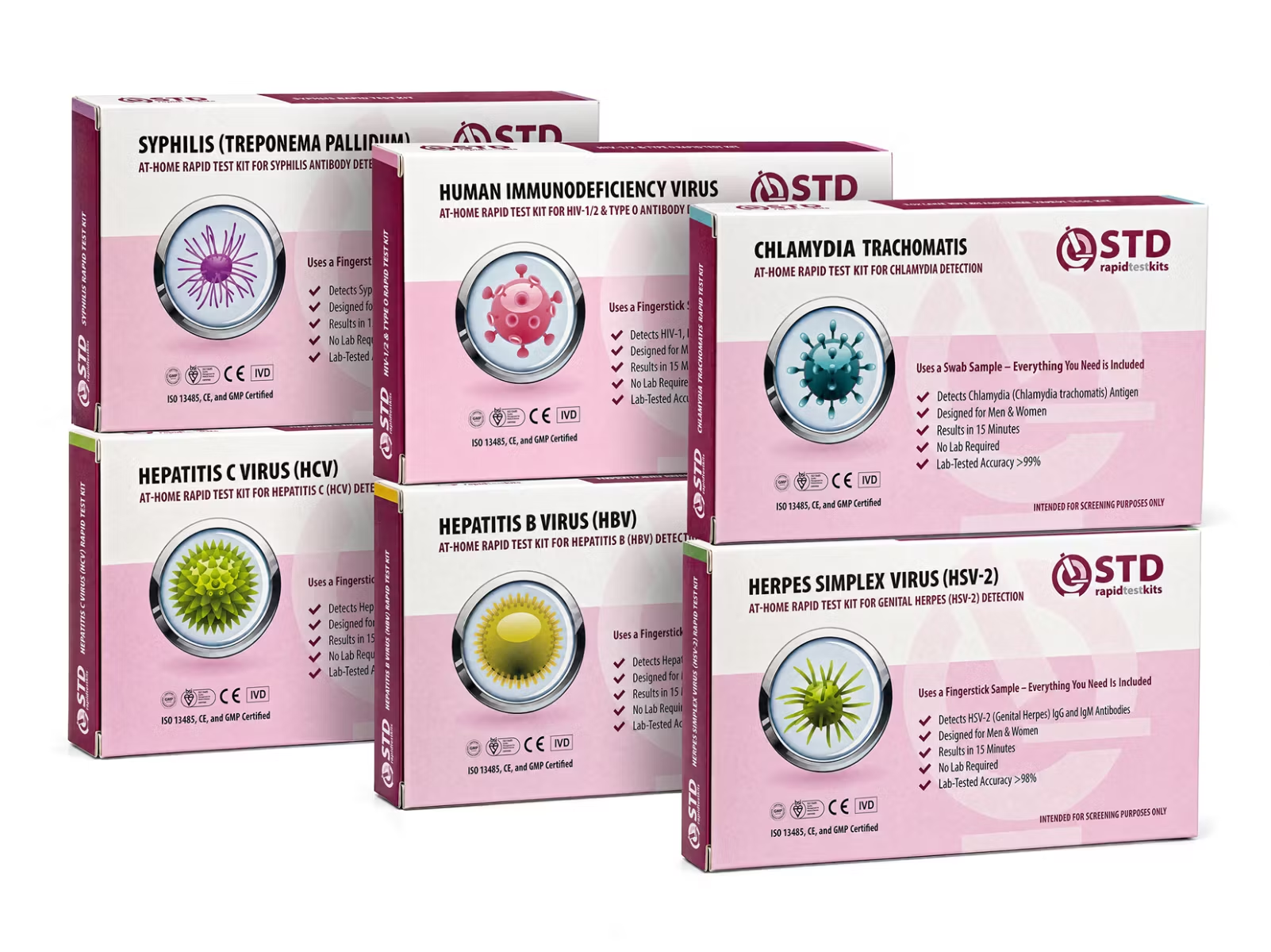
Sore throat after oral contact is the one people don't connect at all. Pharyngeal gonorrhea is real and increasingly common, and it can feel like an ordinary viral sore throat for days before clinicians find it on a swab. The catch: at-home rapid kits don't include a throat swab. If the threesome involved oral contact and a sore throat develops within two weeks, that's a clinic-administered pharyngeal swab, not a home test we sell.
"I Feel Fine" Doesn't Mean You're In the Clear
Most sexually transmitted infections are asymptomatic in the early stages. That's not unusual, it's the default. The CDC has emphasized for years that the majority of new chlamydia and gonorrhea cases are detected through routine screening rather than from someone arriving at a clinic with complaints (CDC STI prevention pages).
This is where people delay testing. Nothing feels urgent enough to act on, and by the time something does feel off, the timeline gets harder to reconstruct. The reality behind the curtain: bacteria or viruses can be present, replicating, and transmissible before any visible signs appear. Feeling normal and being infectious are not mutually exclusive, especially in the first two weeks.
If you're at the point of typing 'no symptoms after threesome STD' into a search bar, you're already in the window where timing matters more than sensation. The right next step isn't another body scan. It's putting a date on the calendar for the first meaningful test and committing to it.
Most chlamydia and gonorrhea diagnoses happen during routine screening, not because someone walked in with complaints. 'Feeling fine' is what untreated infection looks like for the first several weeks in a large share of cases, which is the whole reason calendar-based testing exists.
How soon after a threesome should I test?
For bacterial infections like chlamydia and gonorrhea, day 7 to 14 is the first reliable window. For HIV and syphilis, an antibody-based test becomes meaningful around week 4 to 6. A final confirmation test at week 12 closes out HIV definitively. A test taken on day one returns whatever antibody or antigen level the body has produced so far, which in the first 24 hours is effectively zero for most infections.
Timing Is Everything, Because This Is Where People Mess Up
Testing too early is the most common mistake after a high-risk encounter. The pull is understandable: you want reassurance now, so you test now. The result comes back negative, and you exhale. Biologically, that result might not mean what you think it does. Every infection has a window period, meaning the gap between exposure and when a test can actually detect the infection. Testing before that window closes returns false negatives that feel like good news but aren't.
Different infections close their windows at different paces. Chlamydia and gonorrhea become detectable on swab tests within roughly one to two weeks, consistent with CDC clinical guidance on bacterial STI screening (CDC STI overview). HIV is more nuanced: the CDC reports antibody-only tests can detect exposure anywhere from 23 to 90 days afterward depending on the test, while fourth-generation antigen/antibody tests are typically reliable by six weeks; a confirmation test at week 12 closes the window definitively (CDC HIV testing guidance). Syphilis blood tests also become reliable in the four-to-six week range. Herpes antibody tests take the longest; up to twelve to sixteen weeks may be needed for a conclusive negative.
| Time After Exposure | What to Do | Why It Matters |
|---|---|---|
| Day 0 to 3 | Optional baseline test only | Too early for most infections to register |
| Day 7 to 14 | Test for common bacterial STIs | Most reliable window for chlamydia and gonorrhea |
| Week 4 to 6 | Test for HIV and syphilis | Antibody-based detection becomes reliable |
| Week 12 | Final HIV confirmation test | Closes the HIV window definitively |
Many STDs don't cause obvious symptoms, especially at first. Testing is the only way to know for sure if you have an STD.
If a Test Comes Back Positive, Here's What Actually Happens
This is the part most people fear, and it tends to be more manageable than the anxiety predicts. A positive STI result gives you something to act on. Once you have a name for what is going on, the next steps are usually fast and time-sensitive in a useful way.
Most common bacterial infections (chlamydia, gonorrhea, and trichomoniasis) are curable with antibiotics. A short course resolves the infection, and a follow-up test about three months later confirms clearance and rules out reinfection. There's no permanent damage when caught early, and partner notification can be handled discreetly through state health-department services in most U.S. jurisdictions.
Viral infections like herpes and HIV are different in that they're managed rather than cured, but the management is real, accessible, and built around normal life. Modern HIV treatment achieves undetectable viral load in most people within months, which also means the virus becomes untransmissible to partners through sex (CDC HIV pages). Daily antiviral medication for herpes reduces both outbreak frequency and transmission risk substantially.
(Disclosure: this site sells at-home rapid STI test kits, and the options recommended below are drawn from that catalog. We recommend products based on fit for the reader's concern, not commercial benefit.)

Tested Negative but Still Uneasy? Three Reasons That Happens
This is more common than people admit. The test reads negative, but something still feels off, physically or mentally or both. Three patterns cover almost every case:
Why a negative result doesn't always settle the mind
- You tested inside the window period. The body had not yet produced detectable antibodies, or the bacterial load had not crossed the assay threshold. The fix is a repeat test once the window for the specific infection closes.
- What you are feeling is not an STI. Yeast infections, bacterial vaginosis, urinary tract infections, and post-sex skin irritation mimic STI symptoms closely. Stress can also produce genital itching and pelvic tension that feels physical and resolves without antibiotics.
- Your baseline temporarily shifted. After a sexual encounter with new partners, the local microbiome adjusts to new bacterial flora. That adjustment is typically a five-to-ten-day process, not a permanent state.
When to Watch, When to Get Care Today
Not every symptom carries the same urgency. A few specific signs are not 'wait and see,' they're 'today, not Monday.' Most others can be observed over a couple of days while you sit out the testing window. Pattern-matching is the goal here, not panic-matching.
| Symptom | Action | Why |
|---|---|---|
| Painful sores or blisters | Get tested and seen today | Possible herpes outbreak; early antiviral treatment is most effective |
| Severe pelvic or testicular pain | Seek urgent care | Could indicate epididymitis or pelvic inflammatory disease |
| Fever paired with genital symptoms | Same-day evaluation | Systemic infection possible, not a 'wait it out' scenario |
| Mild irritation or itching alone | Observe 24 to 48 hours | Often non-infectious; resolves without intervention |
| No symptoms at all | Follow the testing timeline | Silent infections are the rule, not the exception |
Talking to Partners Without Making It a Crisis
There is a quiet layer of stress running underneath all of this: what do you owe the people you slept with? What you owe depends entirely on what you know. A positive result creates a public-health obligation. Partner notification stops the cycle of reinfection and gets others tested before complications develop. Most U.S. state health departments offer anonymous partner-notification services if direct conversation feels impossible.
While you are still in the testing phase, communication is optional but often useful. A simple 'I'm getting tested at the two-week mark, just wanted you to know' gives context, reduces guesswork on their side, and sometimes brings useful information back to you. They may already know something about their own status that changes your timeline.
The framing matters. This is not a blame conversation. STIs are biological events that occur on a population scale every minute of every day.
More than 1 million curable sexually transmitted infections (STIs) are acquired every day worldwide, the majority of which are asymptomatic.
A Simple Testing Plan You Can Actually Use
If everything above feels like a lot, here's the compressed version. Right now, before symptoms or anxiety drive the schedule, pick three calendar dates and put each one in your phone:
- Day 10 to 14 after the encounter: first meaningful screen, focused on bacterial infections like chlamydia, gonorrhea, and trichomoniasis.
- Week 4 to 6: blood-based screen for HIV, syphilis, and hepatitis.
- Week 12: final confirmation test. If this one is clean, the timeline closes.
Everything else, every itch you notice between now and day fourteen, every doom-spiral search at 2 a.m., fits inside this structure. Symptom monitoring doesn't have to mean symptom obsession. You have a plan, the plan has dates on it, and the dates do the heavy lifting your worry has been trying to do.
FAQs
- I had a threesome and feel completely fine. Am I overthinking this?
- Most people who test after a consensual encounter get a clean result, so the base rate is on your side. That said, feeling fine right now is the most common early scenario whether or not anything was transmitted, because the first one to two weeks of most STIs are silent. Set a calendar date for day 14; that date does more work than any symptom scan can.
- How quickly would symptoms show up if I did catch something?
- It varies by infection. Gonorrhea symptoms, when they appear, usually emerge within one to fourteen days. Chlamydia symptoms can take longer; the CDC notes they may not appear until several weeks after exposure. Herpes outbreaks tend to appear within two to twelve days. Syphilis chancres can take ten to ninety days. HIV may produce a flu-like illness around two to four weeks or no early symptoms at all. The shared pattern: the absence of symptoms in the first week tells you very little about whether something is there.
- We used condoms the whole time. Doesn't that make this risk-free?
- Condoms substantially reduce transmission for fluid-borne infections, but they don't eliminate skin-to-skin transmission. Herpes, syphilis, and HPV can pass through contact with skin that condoms don't cover. Oral sex also bypasses condom protection unless a barrier was used for that contact specifically. Switching condoms between partners and changing them between oral and penetrative use closes most of the remaining gaps. Condoms are strong protection, not perfect protection.
- I have a little itching. How do I avoid assuming the worst?
- Pause for forty-eight hours and observe. Itching that appears after sex and resolves within a day or two is almost always friction, a new lubricant, or a temporary microbiome shift. If the itching sticks around past two days, intensifies, or starts pairing with a new bump, sore, or discharge change, that's when it crosses into 'worth checking' territory. Until then, you're watching, not panicking.
- Which symptoms are urgent and which can wait a day or two?
- Same-day care: any fever combined with genital symptoms, or visible sores or blisters. Anything else (mild itching, vague discomfort, the occasional twinge) can be observed for 24 to 48 hours while you sit out the testing window. The one exception is no symptoms at all, which still means testing on schedule because silent infection is the rule, not the outlier.
- I tested already and it came back negative. Why am I still uneasy?
- Usually one of three reasons. First, the test ran inside the window period and isn't conclusive yet, which is the most common scenario when people test before day seven. Second, what you're feeling isn't an STI at all but a yeast infection, BV, UTI, or post-sex irritation that mimics one. Third, your baseline body experience temporarily shifted after the encounter and is still recalibrating. A repeat test at the right window resolves the first cause; the other two resolve on their own.
- Do I really need to test my throat too?
- If oral contact was part of the encounter, yes, especially if a sore throat develops within two weeks. Pharyngeal gonorrhea and chlamydia are real, often silent, and frequently missed because at-home rapid kits don't include a throat swab. A clinic-administered pharyngeal swab is the right tool for that question, not a home test. Skipping it after oral exposure is one of the most common ways an infection gets missed in screening.
- How do I stop checking my body every twenty minutes?
- Replace the loop with a plan. The reason the brain keeps scanning is that it's trying to solve uncertainty in real time, which isn't possible biologically. Once a calendar date is set for day fourteen and another for week six, the brain has somewhere to park the worry. That structure gives the body-check loop somewhere to land instead of running on repeat.
You Deserve Clarity, Not Guesswork
The post-threesome headspace is a particular kind of stress. It's not just about symptoms, it's the uncertainty itself that wears on you. Every sensation starts to feel loaded, every 'maybe' turns into a late-night search spiral, and the answer you actually want isn't reassurance, it's resolution.
The goal isn't to decode every itch or overanalyze every feeling. The goal is to follow a clear schedule. Test when timing makes the result meaningful, not when anxiety peaks. Give your body the runway it needs to actually show you what's happening, then act on facts instead of assumptions. If even a small question is still sitting in your head, a discreet at-home screen at day fourteen turns that question into an answer you can move on from.
Day 10 to 14: chlamydia and gonorrhea screen.
Week 4 to 6: HIV, syphilis, and hepatitis blood screen.
Week 12: final HIV confirmation. If this one is clean, the timeline closes.
How We Sourced This Article: Our article was constructed based on current guidance from the most prominent public-health and medical organizations (CDC, WHO, and NHS), then translated into plain-English action items built around the situations people actually search for after a multi-partner encounter. Citations link to root-domain category pages where possible so they remain current as guidance evolves. This is editorial summary, not personalized medical advice.
- U.S. Centers for Disease Control and Prevention. STI prevention and screening hub, including chlamydia and gonorrhea symptom and screening guidance. Used for the asymptomatic-presentation framing and bacterial detection-window timing.
- U.S. Centers for Disease Control and Prevention. HIV testing window-period guidance, including the 23-to-90-day antibody range and week-12 confirmation timing.
- U.S. Centers for Disease Control and Prevention. HIV treatment, viral suppression, and Undetectable=Untransmittable (U=U) framing.
- U.S. Centers for Disease Control and Prevention. About Genital Herpes, including symptom presentation and the common mistake of attributing early lesions to pimples or ingrown hairs.
- World Health Organization. Sexually transmitted infections fact sheet, used for the verbatim 'more than 1 million curable STIs per day' figure and the global-scale framing in the partner-notification section.
- NHS. Sexually transmitted infections overview, used for plain-English STI symptom descriptions and the non-STI-mimic framing in the 'tested negative but still worried' section.
