
Published: November 2025 | Last updated: May 2026 | Editorial review and quality control: Martina N.
Fatigue that drags into the afternoon, a stomach that feels full when you have barely eaten, and a period that quietly skips this month. For most women these signals point at stress, hormones, or a bug going around, and most of the time that is exactly what they are. Sometimes, though, the same quiet pattern is the first hint of a Hepatitis B infection moving through its early phase, weeks before any classic liver symptom appears.
This article walks through how Hepatitis B can show up in a woman's body before the textbook signs arrive, the timeline from exposure to a reliable test result, which test to use and when, and what to do if a result comes back positive. The goal is to give you enough information to take a confident next step, whether that step is testing today or tracking how you feel for another week.
Key Takeaways
- Early Hepatitis B in women often presents as fatigue, bloating, or menstrual irregularity, and many adults with acute infection have no obvious symptoms at all.
- A blood test taken about six to twelve weeks after a possible exposure offers the most reliable window for confirming or ruling out an active Hepatitis B infection.
Why Early Hepatitis B Hides Behind Everyday Symptoms
Hepatitis B is a viral infection of the liver that spreads through contact with infected blood, semen, or other body fluids. Once the virus enters the bloodstream, it works quietly. According to the U.S. Centers for Disease Control and Prevention, many adults who acquire an acute Hepatitis B infection never develop the textbook signs of yellow skin or right upper abdominal pain. When symptoms do appear, they tend to arrive several weeks after exposure, and they often look ordinary enough to be brushed off.
For women, that ordinariness is part of the problem. The early or prodromal phase of an HBV infection can produce a low-grade flu-like feeling without a fever. Sleep does not fully restore your energy. Food sits heavier than usual. The waistband of your jeans feels tight in a way that is not quite the bloating you get after a big meal. Some women notice a dull ache toward the upper right side of the abdomen where the liver sits, while others feel only a vague heaviness or pressure.
The menstrual cycle can also drift. The liver helps metabolize estrogen and other hormones, and when liver tissue is mildly inflamed, hormone clearance can slow down. That can show up as a delayed period, a lighter flow than usual, more breast tenderness, or a cycle that simply feels off. None of these signs are diagnostic on their own. They are the kind of low-volume signal most of us learn to ignore.
The table below summarizes the early signs that women most often report in retrospect, after a Hepatitis B diagnosis prompts them to look back at the weeks leading up to it. Each one has a long list of more common causes. The reason to know these signs is simple: when the usual explanations are not adding up, Hepatitis B belongs on the short list of things to check.
| Early Symptom | How It Shows Up in Women | Why It Gets Overlooked |
|---|---|---|
| Persistent fatigue | Low energy, brain fog, slow recovery after sleep | Blamed on stress, hormones, or work load |
| Bloating or abdominal pressure | Upper-right fullness or low-grade pelvic pressure | Confused with cycle bloating or GI issues |
| Missed or irregular period | Delayed or absent menstruation, lighter flow | Attributed to stress, travel, or hormones |
| Mild nausea | Especially after fatty meals or in the morning | Read as hormonal or digestive |
| Subtle yellow tint | Faint yellowing under the eyes or in the nail beds | Rarely noticed until it deepens |
The Timeline From Exposure to a Reliable Result
Hepatitis B operates on its own schedule, and the schedule matters because testing too early can produce a falsely reassuring result. The incubation period is the gap between exposure and the first symptoms. During most of that time the virus is multiplying silently, and the immune system has not yet produced enough of a response for the earliest tests to detect.
The two markers a blood test looks for behave differently across that window. Hepatitis B surface antigen, abbreviated HBsAg, is a piece of the virus itself. It is usually the first marker to become detectable, often within four to ten weeks after exposure. The other commonly used marker, IgM anti-HBc, is an antibody the immune system produces in response to an acute infection. It tends to rise slightly later and is more specific to recent infection rather than long-standing immunity.
The practical implication is that a single negative test taken three or four weeks after a possible exposure is not the final answer. The CDC notes that when symptoms occur, they often begin around 90 days after exposure, with acute infection defined as occurring within the first six months. A test around six weeks after exposure gives most people a reasonably reliable read on whether HBsAg is present. A repeat test at twelve weeks closes most of the remaining window for adults with normal immune function.
The table below maps the rough timeline most adults follow.
| Stage | Timeline After Exposure | What Is Happening |
|---|---|---|
| Incubation period | About 1 to 6 months (often around 90 days) | Virus replicates silently, no symptoms |
| Window period | About 21 to 60 days | Virus is present, but tests may still read negative |
| Early symptoms | Usually 6 to 12 weeks post-exposure | Fatigue, bloating, nausea, hormone disruption |
| Peak detectability | Around 12 weeks | Hepatitis B surface antigen reliably detectable |

Why Hepatitis B Can Show Up Differently in Women
Hepatitis B does not biologically prefer one sex over another. The virus infects liver cells the same way regardless of who is hosting it. What differs is the layer of confounders that sits on top of the infection in a woman's body, and the way primary care often interprets her symptoms.
Hormones are one piece of this. Estrogen and progesterone fluctuate across the menstrual cycle and across life stages, and both can shift how women feel from one week to the next. Mild bloating in the second half of the cycle, breast tenderness, low energy in the days before bleeding, and irritability are normal cyclical changes that overlap with what a quiet HBV infection can also produce. When the two signals run in parallel, the cyclical explanation usually wins by default. That is reasonable most of the time and occasionally misleading.
Diagnostic patterns matter too. Liver disease is sometimes assumed to be a problem of older adults or of people with obvious risk factors. Younger women presenting with fatigue or vague abdominal fullness are more often funneled toward thyroid panels, iron studies, gynecological evaluations, or mental health screens before liver enzymes are checked. None of those evaluations is wrong, and if all of them come back unremarkable while symptoms persist, a Hepatitis B test is a reasonable next step rather than a last resort.
Several early experiences show up more often in women than in men in patient surveys and clinic interviews. They are not in the formal diagnostic criteria for Hepatitis B, and none should be treated as a stand-alone reason to assume infection. Listed together, they can form a pattern worth investigating:
- Menstrual cycle disruption that does not fit a clear PCOS or endometriosis pattern
- Fluctuating energy levels that iron and thyroid panels do not explain
- Digestive discomfort without typical IBS triggers
- Mild temperature sensitivity, particularly heat intolerance
- Dull soreness near the upper right back or right shoulder blade
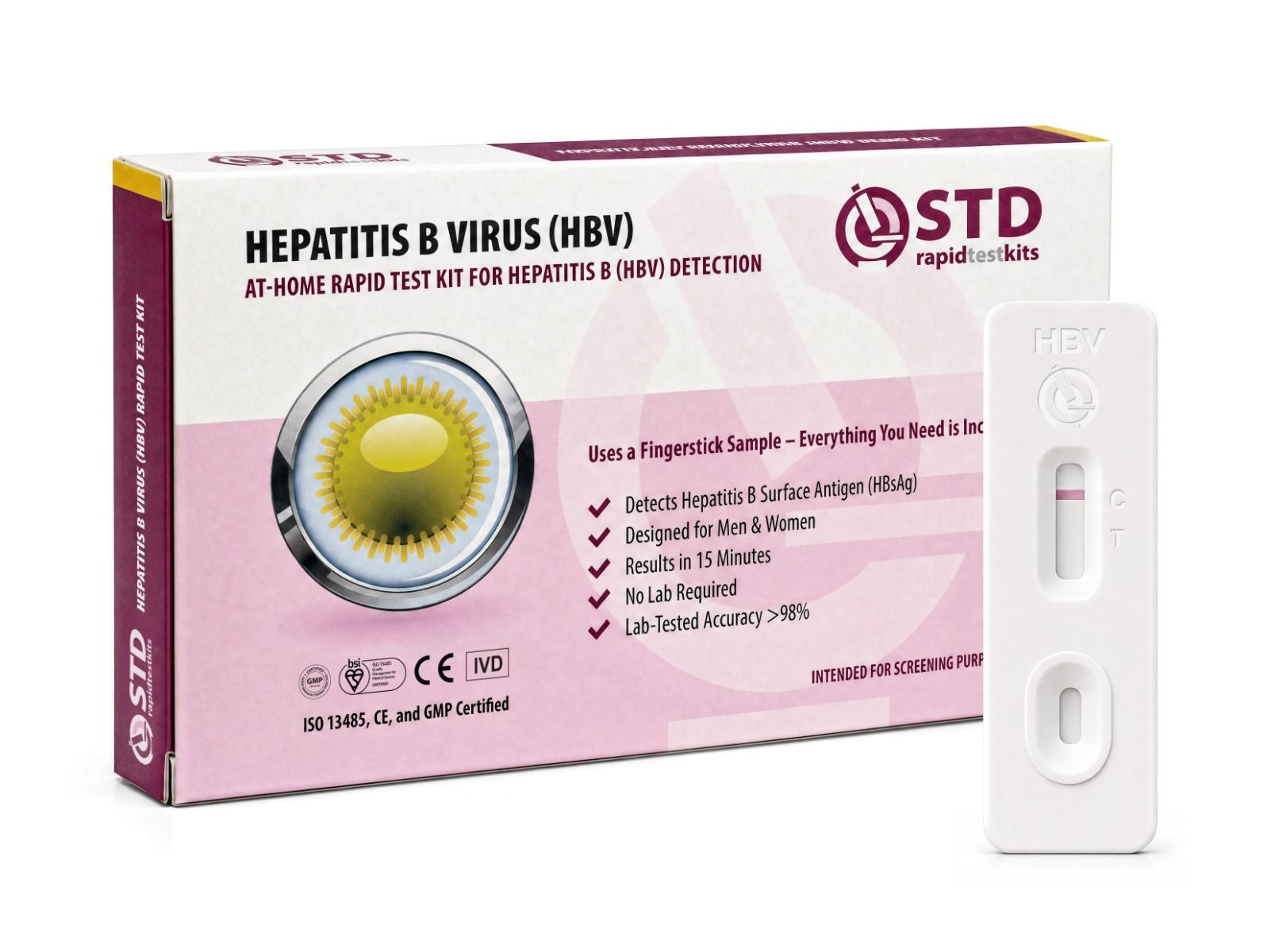
This site sells at-home Hepatitis B rapid tests; the kit referenced below is one of our products, and we mention it because it fits the screening question women in this situation are usually trying to answer.
Which Test to Use, and When to Use It
Several Hepatitis B tests exist on the clinical menu, and they answer different questions. A home rapid test is well suited to one specific purpose: screening for current infection using the HBsAg marker. Laboratory panels go further, looking at antibodies, viral load, and liver enzymes to build a fuller picture once a positive screen comes back.
The most common screening marker is HBsAg, the Hepatitis B surface antigen. A positive HBsAg result on a screening test, including an at-home lateral-flow rapid test, means the virus is present in the blood. It does not, on its own, distinguish between an acute infection that will clear and a chronic infection that is sticking around. That distinction is made later, with follow-up testing roughly six months down the line.
IgM anti-HBc, the core-antibody test, is a lab assay that helps confirm whether an infection is recent. It pairs naturally with HBsAg when someone has symptoms or a known exposure. A third test, HBV DNA by PCR, measures viral genetic material directly and can flag an infection earlier than antibody-based tests. PCR is a laboratory technology rather than a home option.
At-home rapid tests detect HBsAg in a small fingerstick blood sample. They are lateral-flow immunoassays, the same general technology that powers home pregnancy tests and home strep tests. They are useful for private, fast screening at home. Laboratory Hepatitis B testing uses different chemistry and is generally more sensitive at very low viral levels. The two are complementary rather than equivalent: a positive at-home result should be followed up with lab testing for confirmation and staging.
The table below sorts the main tests by what they detect and when each one is most useful. For most women trying to answer the question "do I have Hepatitis B right now?" at home, an HBsAg rapid test taken roughly six to twelve weeks after a possible exposure is the most practical option. If your timeline is shorter than that, testing now is still reasonable, with the plan to repeat the test at the six-week mark if the first result is negative and symptoms continue.
| Test Type | What It Detects | Best Time to Use |
|---|---|---|
| HBsAg (surface antigen) | Current infection | 6 to 12 weeks after exposure |
| IgM anti-HBc (core antibody) | Recent infection | 4 to 10 weeks post-exposure |
| HBV DNA by PCR | Direct viral genetic material | As early as 2 to 3 weeks (lab only) |
| At-home rapid test | HBsAg via fingerstick blood | 6 weeks or later for best accuracy |
If Your Test Comes Back Positive
A positive Hepatitis B result is unsettling, and it is workable. Most adult Hepatitis B infections resolve on their own. According to the World Health Organization, the large majority of healthy adults who acquire an acute Hepatitis B infection clear the virus within six months without long-term consequences. A smaller share progresses to chronic Hepatitis B, defined as HBsAg remaining positive for longer than six months. Chronic infection is manageable with monitoring and, where appropriate, antiviral medication, though it does change your follow-up plan.
The first step after a positive at-home rapid result is to confirm with a clinical laboratory. A confirmatory panel typically includes HBsAg repeated by a different method, anti-HBs, total anti-HBc, IgM anti-HBc, and liver enzymes such as ALT and AST. Together those tell a clinician whether the infection is acute or chronic and how active the virus is at the moment.
Treatment depends on the picture. Acute infections in healthy adults usually do not require antiviral therapy, only supportive care: rest, hydration, avoiding alcohol, and reviewing any medications that place extra load on the liver. Chronic infections may or may not need antiviral medication depending on viral load, liver enzyme levels, and other markers. A hepatology or infectious diseases specialist is the usual referral.
Then comes partner notification. It is harder than the medical part for most people. Partners who may have been exposed can be tested and, if uninfected, vaccinated as a preventative measure. There is no expectation that you handle this conversation perfectly. A short message that names what you tested for, says you are sharing the information so they can decide whether to test, and is not assigning blame, is enough.

When and Why Retesting Matters
Retesting does not mean your first result was wrong. Hepatitis B testing is built around a window period, and a second test is how that design is meant to play out for many people.
Two scenarios call for a repeat test even if the first one was negative. The first is timing: if you tested before the six-week mark and a possible exposure is still inside the standard window, plan a second test once enough time has passed. The second is symptoms: if fatigue, bloating, or menstrual changes persist or worsen over several weeks, repeating the test is worthwhile even when the calendar suggests you are past the typical window.
If your first test was positive and confirmed by a lab, the follow-up pattern is different. You will likely repeat HBsAg, anti-HBs, and anti-HBc testing at the six-month mark to determine whether the infection has resolved or progressed to chronic. Liver enzymes may be checked more frequently in the interim. If antiviral therapy has begun, your clinician will set the cadence of monitoring based on viral load and ALT levels.
The behavioral pattern that matters most for both groups, those waiting to retest and those tracking a known infection, is showing up for the follow-up. Calendar reminders help. Pairing your retest with another appointment helps. The goal is to avoid the gap where you tested once, got a result you were not sure how to interpret, and never closed the loop.
Most people do not experience any symptoms when newly infected. Some people have acute illness with symptoms that last several weeks.
Prevention: Vaccines, Conversations, and Routine Testing
Hepatitis B is one of the few sexually transmissible infections with a highly effective vaccine. Anyone not already infected and not immune from a prior infection can be vaccinated. The CDC currently recommends Hepatitis B vaccination for all adults aged 19 through 59 who have not been previously vaccinated, and for adults aged 60 and older with risk factors. Many clinicians will vaccinate any adult who wants the protection, regardless of stated risk.
The traditional vaccine series is three doses given over six months. A newer two-dose option is also available for adults, administered one month apart, per the CDC vaccination schedule. Both schedules provide strong protection. After completion, a blood test for anti-HBs can confirm that your immune response is at a protective level.
Vaccination is one of several prevention tools, and it works best paired with the others. Condoms reduce transmission risk during sex by limiting contact with body fluids. Avoiding shared needles for tattoos, piercings, or drug use closes another major exposure route. So does avoiding sharing personal items like razors and toothbrushes with someone who might be infected.
The least-discussed prevention tool is the conversation itself. A short status check before any sexual encounter with a new partner does not need to feel clinical. A line that mentions your own recent testing and asks about theirs covers most of what needs to be said, and the response usually tells you as much as the answer itself.
Routine testing rounds out the picture. If you have multiple partners, have recently started a new relationship, or know that exposure has happened before, periodic screening for Hepatitis B alongside other STIs gives you a stable baseline rather than relying only on event-driven tests.
Talking to a Partner or Past Partner
Telling a current or past partner about a possible Hepatitis B exposure is one of the harder parts of the diagnosis. It is also one of the most useful things you can do for someone you care about. The conversation does not need to be perfect, and it does not need to assign blame.
A factual approach generally lands better than an emotional one. Something close to: "I recently tested positive for Hepatitis B. I am not sure when I picked it up, but I wanted you to know so you can decide whether to get tested or vaccinated." That gives the other person what they need to act on without forcing them into a defensive posture.
If you are the partner on the receiving end of that information, the calm framing still works in reverse. Asking for testing is reasonable. Being told that someone you know has Hepatitis B is not, on its own, an emergency. It is information that lets you make a clear decision about your own care.
Vaccination matters here too. If a partner is not infected and not previously vaccinated, beginning the vaccine series soon closes off the exposure risk for future contact.
- Say what you tested for and when, so they can place their own exposure window. "I tested positive for Hepatitis B last week" is enough.
- Offer information, not blame. The point is to give them what they need to test or vaccinate, not to relitigate the relationship.
- Expect a range of responses. Some partners react with thanks, others with anxiety, a few with anger. None of those reactions changes the fact that you did the right thing.
The Bottom Line for Anyone Reading This
Hepatitis B in women rarely announces itself loudly in the first weeks. It shows up as something that could easily pass for PMS, stress, or a stomach acting up. The signals are real, and they are not the kind that suggest the worst outcome unless other patterns line up alongside them.
If you have had a possible exposure within the last six months and you are noticing more than one of the early signs, a Hepatitis B test is a reasonable, low-friction next step. A negative result at the six-week mark gives you a reliable answer; a positive result means a lab confirmation panel and a clinician visit, both of which are straightforward to arrange.
Concrete next steps
- If a possible exposure was 6 weeks ago or longer, take an HBsAg rapid test now and repeat at 12 weeks if symptoms continue.
- If a rapid test comes back positive, schedule a lab confirmation panel (HBsAg, anti-HBs, total anti-HBc, IgM anti-HBc, ALT, AST) before treatment decisions.
- If you test negative and are not previously vaccinated, ask a clinician about starting the Hepatitis B vaccine series.
Frequently Asked Questions
- Can persistent fatigue alone be a sign of Hepatitis B?
- Fatigue by itself has dozens of common causes, most of them unrelated to Hepatitis B. The picture becomes more meaningful when fatigue lasts several weeks, does not respond to rest, and shows up alongside other low-level signs like bloating, mild nausea, or a missed period. If you can also place a possible exposure event within the last few months, testing is a reasonable next step.
- Can Hepatitis B affect menstrual cycles?
- Yes, indirectly. The liver helps clear estrogen and other hormones from the body, and when liver tissue is inflamed, hormone clearance can slow down. That can show up as a delayed cycle, lighter flow, or a period that simply feels off. It is not common as a first symptom on its own, but it does come up in patient histories looking back at the weeks before diagnosis.
- I had a possible exposure two weeks ago. Should I test now or wait?
- You can test now, with one important caveat: a negative result this early does not rule out infection because the virus may still be below detectable levels. Plan a follow-up test at around six weeks for a more reliable read, and again at twelve weeks if symptoms continue or if you want to close the window fully.
- Does Hepatitis B always produce noticeable symptoms?
- No. Many adults with acute Hepatitis B have no obvious symptoms at all, and many learn about an infection only through routine screening, blood donation, prenatal panels, or testing prompted by a partner's diagnosis. Symptom presence or absence is not a reliable guide on its own.
- I tested negative on a rapid test but still feel off. Could the result be wrong?
- Possibly, if you tested early. The most common reason for a negative result followed by a later positive is testing inside the window period before the virus has reached detectable levels. If your possible exposure was less than six weeks ago and symptoms continue, repeat the test once you are past the six-week mark.
- Can someone transmit Hepatitis B without showing symptoms?
- Yes. Hepatitis B can be transmitted by people who feel completely well, both during the early phase of an acute infection and during chronic infection. That is one of the reasons sexual-history conversations and routine STI screening matter, since waiting for a partner to look sick is not a reliable strategy.
- What is the difference between acute and chronic Hepatitis B?
- Acute Hepatitis B is a recent infection, typically within the past six months, that the immune system may still clear on its own. Chronic Hepatitis B is defined by Hepatitis B surface antigen remaining positive for longer than six months. Chronic infection is manageable with monitoring and, where appropriate, antiviral medication, but it does require longer-term follow-up.
- Is Hepatitis B included in standard at-home STI test kits?
- Often not, depending on the kit. Many general at-home STI panels focus on bacterial infections like chlamydia and gonorrhea and on HIV, and skip Hepatitis B unless it is added explicitly. If Hepatitis B is the specific question you are trying to answer, a dedicated Hepatitis B rapid test or a multi-infection kit that lists it by name is the safer choice.
How we sourced this article: This guide is built from current public-health guidance from the U.S. Centers for Disease Control and Prevention, the World Health Organization, and the NHS, alongside published clinical references on Hepatitis B symptom presentation, testing markers, and treatment. We focused on the information women most often look for when early symptoms do not fit obvious causes. This article is informational and is not a substitute for evaluation by a licensed clinician.
- U.S. Centers for Disease Control and Prevention. Hepatitis B basics: signs, transmission routes, and 90-day typical onset window for the general public.
- World Health Organization. Hepatitis B fact sheet: global prevalence, acute infection clearance rates in healthy adults, and chronic-infection definitions.
- U.S. Centers for Disease Control and Prevention. Clinical overview of Hepatitis B for healthcare providers: presentation, serologic markers, acute vs chronic distinction.
- U.S. Centers for Disease Control and Prevention. Hepatitis B vaccination recommendations for adults, including two-dose and three-dose schedules.
- NHS. Hepatitis B overview: transmission, symptoms, prevention, and treatment from the U.K. National Health Service.
- U.S. Centers for Disease Control and Prevention. Hepatitis B testing: who should get screened, how often, and what the results mean at a general level.
