
Published: November 2025 | Last updated: May 2026 | Editorial review and quality control: Martina N.
Around 46 countries, territories, and areas still restrict entry, residency, or long-stay visas for people living with HIV in 2026. UNAIDS tracks the up-to-date list on its interactive HIV travel-restrictions map, and the figure has trended downward only slowly over the last decade. If you live with HIV and you are planning to study, work, or settle abroad, the country you choose matters as much as the visa class you apply for.
This guide walks through the current restriction landscape, what the policies actually accomplish, and how testing privately at home gives you more control over the timeline.
Key Takeaways
- Around 46 countries, territories, and areas still impose entry, visa, or residency restrictions on people with HIV, with most rules triggering at the work-visa or residency stage rather than at a tourist border.
- An at-home fingerstick HIV blood test lets you confirm your status before any visa medical exam, so you can adjust destination plans or begin treatment privately before a foreign agency tests you.
This Isn't History, It's Still Happening
It is easy to assume HIV travel bans disappeared with the panic of the 1980s. They did not. According to the UNAIDS travel-restrictions policy hub, around 46 countries, territories, and areas still impose HIV-specific entry, residency, or long-stay restrictions. The count has fallen slowly from roughly 48 in 2019, reflecting a few reforms rather than a wave of policy change.
Some block long-term visas or residency permits. Others refuse entry entirely. A handful will allow you to enter on a tourist visa and then deport you if a positive HIV test is recorded later. The policies have not changed substantially despite three decades of treatment progress, advocacy, and global health diplomacy.
The countries enforcing the strictest rules tend to cluster in the Middle East and North Africa, with additional restrictions in parts of the Asia-Pacific and Eastern European regions, per UNAIDS regional breakdown. The list shifts year to year, so always check the database for your specific destination before any long-stay visa application.

Where HIV Travel Bans Still Apply Today
The restrictions fall into three broad tiers. The strictest countries deny entry outright if your HIV status is known or detected on a medical exam. A middle tier allows tourist entry but blocks any long-stay visa (work, student, residency) for people living with HIV. The lightest tier requires testing only at certain visa thresholds, typically the 90-day or six-month mark.
Below is a snapshot of selected countries with both their tourist-entry posture and their long-stay treatment, drawn from the UNAIDS database. This is not the complete list, and policies do change, so verify with the UNAIDS map and your destination's embassy before you travel.
| Country | Tourist Entry | Long-Stay or Work Visa | Deportation Risk if Positive |
|---|---|---|---|
| Brunei | Restricted | Denied | Yes |
| United Arab Emirates | Permitted short-stay | Denied for residency | Yes for long-stay |
| Russia | Allowed | Blocked for long-stay | Yes for long-stay |
| Kuwait | Restricted | Blanket ban regardless of viral load | Yes |
| Singapore | Tourist allowed | Long-stay restrictions | Yes for long-stay |
| Malaysia | Tourist allowed | Denied for work or residency | Yes for long-stay |
| Australia | Permitted under 90 days | Health screening required for longer visas | Rare |
What These Laws Actually Achieve (And Don't)
There is no published evidence that HIV-specific travel bans reduce transmission. UNAIDS and the World Health Organization have both stated formally that these policies are discriminatory and serve no public-health purpose.
The transmission reality is well-documented. HIV does not pass through casual contact, shared air on a plane, hotel surfaces, or restaurant utensils. It transmits through unprotected sexual contact, shared injection equipment, perinatal exposure, and blood-to-blood contact, per the CDC's HIV transmission guidance. None of these routes intersect with a tourist visa application or a visa medical exam.
What the bans do accomplish is harder to defend. They push people living with HIV to hide their status during visa screening, skip medication while traveling to avoid detection, and forfeit job or education opportunities they would otherwise qualify for. Advocacy groups have documented cases of travelers who stopped antiretroviral therapy mid-trip, developed opportunistic infections, and ended up in foreign hospitals. The very policy claiming to protect public health caused a worse health outcome for the person it tried to exclude.
HIV-related restrictions on entry, stay and residence based on HIV status alone are discriminatory; they do not protect public health, and they violate the human rights of people living with HIV.
U=U and the Science These Laws Ignore
U=U stands for Undetectable equals Untransmittable. It is the medical consensus that a person with HIV who takes antiretroviral therapy (ART) consistently and reaches an undetectable viral load cannot sexually transmit the virus to a partner. The CDC endorses this position, as does the World Health Organization and most major medical bodies.
U=U has reshaped HIV care globally. People on stable treatment live near-normal life expectancies and pose zero sexual transmission risk to partners. Many are, by routine medical monitoring, in better-tracked health than the general population.
None of this is reflected in HIV travel policy. Most restrictive countries make no distinction between a person with detectable HIV, a person with an undetectable viral load on ART, or a person living with HIV for thirty years without complications. The immigration test result is binary: positive or negative. The science distinguishes treatment status, viral load, and individual risk profile.
This matters for travelers because the test a country administers does not measure viral load or treatment adherence. A standard visa medical screen for HIV is a binary antibody test.
U=U is one of the most important findings in modern HIV medicine. It changes daily life, intimate relationships, and clinical outlook. It does not, on its own, change immigration policy in countries that still write blanket HIV-status rules. Plan around the policy you actually face, not the policy you think the science should compel.
Pre-Travel HIV Testing at Home
Knowing your status before you start a visa application changes what is possible. If your at-home test is negative, you can move ahead without surprise. If it is positive, you have the time and privacy to confirm with a laboratory test, start treatment, choose a destination without an HIV-based barrier, or plan how to handle a required visa medical exam.
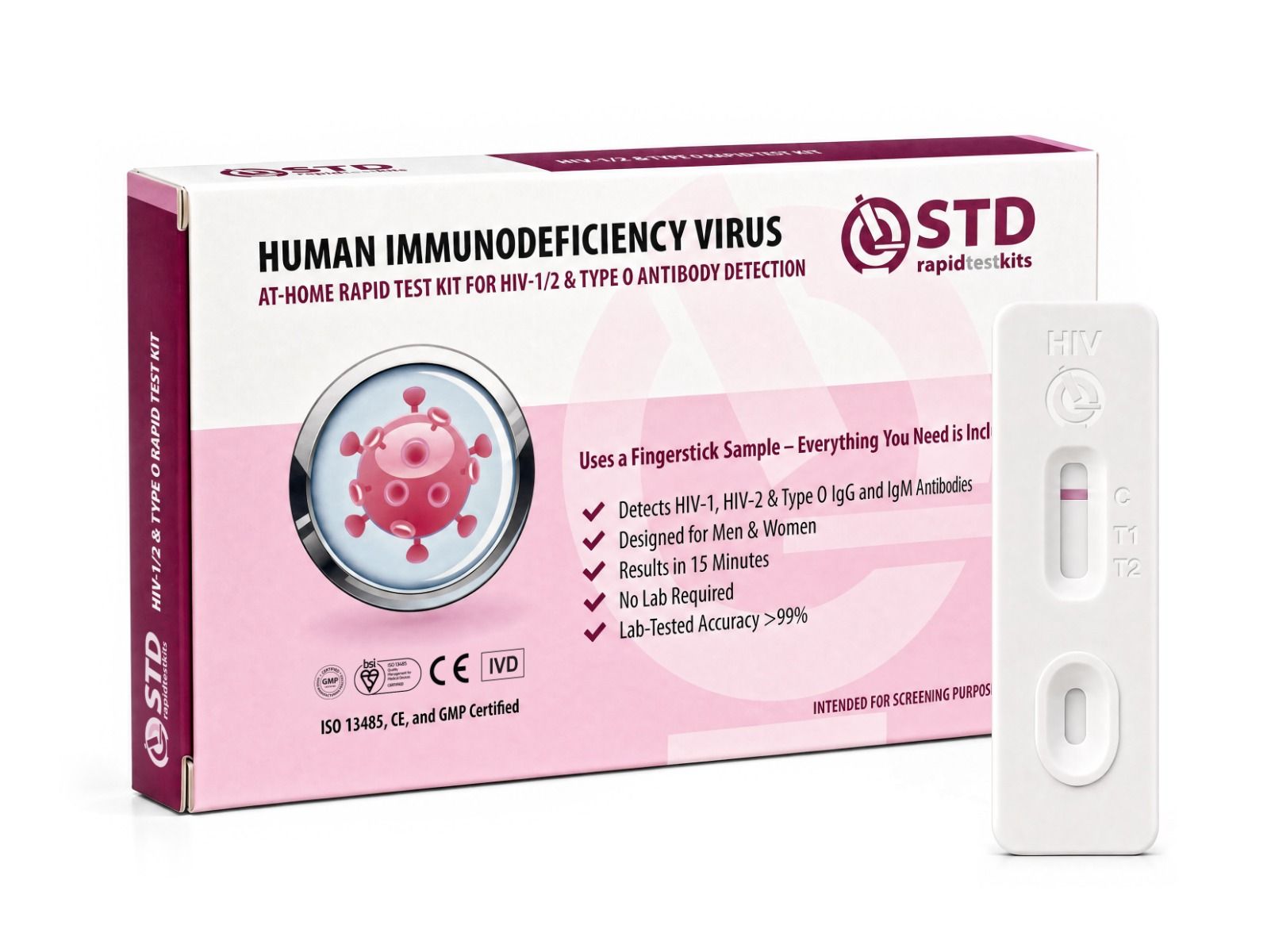
At-home rapid HIV tests use a fingerstick blood sample, not a swab. The lateral-flow strip detects HIV antibodies, and in fourth-generation kits the p24 antigen as well. The window period (the time between exposure and when a test can reliably detect infection) varies by test type, ranging from about 18 days for laboratory antigen/antibody tests up to 90 days for some antibody-only rapid tests, per CDC testing guidance. A reactive at-home result should always be confirmed by a laboratory NAAT or antigen/antibody assay before any clinical decision.
The privacy is the practical feature for travelers. A clinic-based HIV test in some countries enters a medical record that visa screening may later access. A self-test result stays in your possession. If your result is positive, you control when and where you confirm it, when you begin treatment, and whether or how you disclose to anyone else.
This article is published by stdrapidtestkits.com, which sells at-home HIV rapid tests and other STI kits. We recommend a kit when it actually fits the reader's concern.
Planning Travel When You Are HIV-Positive
If you live with HIV and you intend to travel internationally, a practical plan turns a potential disaster into a manageable process. The destination determines what is possible. Tourist trips to most of the world remain straightforward. Work, study, or residency in restrictive countries may not be feasible at any cost, regardless of how the visa interview goes.
A practical checklist before any long-stay application:
- Look up your destination on the UNAIDS HIV travel-restrictions map. The country categorization is the single most important fact to verify.
- Speak to a travel-aware physician early. Many countries that block long-stay visas do allow short tourist visits with personal medication, provided you carry the prescription documentation properly.
- Carry your ART in original prescription containers, with a written prescription and a clinician's letter explaining the medication.
- Plan medication timing around time-zone shifts. Skipping doses risks viral rebound; ask your provider for a structured plan if the trip crosses several zones.
- Never provide false information on a visa form. Lying on an immigration document can result in permanent inadmissibility, separate from any HIV-related rule.
- Confirm visa-medical requirements directly with your destination's embassy. Policies on the public database lag changes in practice, in both directions.
When Policies Get Personal: Composite Stories
The cases below are composites drawn from patient advocacy reports and published case studies. Names and identifying details have been changed to protect privacy, and the outcomes reflect real documented patterns.
Amir, 29. Offered an IT consulting role in Dubai. Completed the standard visa medical, including the mandatory HIV screening. When the result came back positive, the offer was rescinded the same day. There was no appeal and no discussion of treatment status or viral load. The placement agency flagged his passport in its internal database, complicating future Gulf-region applications years later.
Lucas, 34. Stable on ART for six years, undetectable for five. Accepted a two-month consulting trip to Singapore. Worried that his medication might be discovered during a customs check, he left his pills at home and planned to ride it out. By week three his viral load had rebounded and he developed an opportunistic infection that required hospitalization in a foreign healthcare system at his own cost. The trip ended early, and his treatment plan had to be rebuilt from scratch.
Nina, 24. Accepted into a study-abroad program in Australia. As a precaution before her visa medical, she ordered an at-home HIV test. The result was reactive. She confirmed at a laboratory, started treatment immediately, and used the timeline she had gained to switch her program to a country without long-stay restrictions for HIV-positive students. Her education continued without interruption.
Bottom Line: Know First, Travel Smart
HIV travel restrictions are real, they are still enforced in around 46 countries, territories, and areas, and modern treatment evidence has not yet pushed most of those jurisdictions to update their policies. The bans will likely change over the next decade, but slowly, and the next ten years of your travel plans run faster than that.
What you can control is your timeline. Confirm your status privately, before a visa application puts you on someone else's clock. If you are negative, you have the certainty to apply without surprise. If you are positive, you have the lead time to confirm with a laboratory test, begin treatment, and choose a destination that fits your life rather than one that will reject you halfway through the visa medical.
The UNAIDS HIV travel-restrictions map is updated regularly. Check it for any destination involving more than a short tourist visit. Pair the policy check with a current at-home test result, and you have the information to plan without surprise.
Next Steps
- Look up your destination on the UNAIDS HIV travel-restrictions map before booking long-stay travel.
- Take an at-home fingerstick HIV test well before any visa medical exam so a positive result does not surprise you on a foreign timeline.
- Consult a travel-aware physician about ART documentation, medication packaging, and time-zone dosing for any approved destination.
Frequently Asked Questions
- Can I still travel internationally if I have HIV?
- Yes, most countries allow tourists with HIV to enter without any HIV-specific screening. Around 46 countries, territories, and areas impose restrictions, mostly at the work-visa, student-visa, or residency stage. Check the UNAIDS HIV travel-restrictions map for the up-to-date status of your destination before booking anything beyond a short visit.
- Will I be tested at the border on a tourist visa?
- Usually not. Routine HIV testing at customs is rare in most countries. The policies that do exist typically trigger only at a long-stay visa medical exam, which happens after you apply for a work permit, student visa, or residency. Tourist arrivals on short stays generally proceed without an HIV question.
- What happens if I test positive during a visa medical exam?
- It depends on the country. The most restrictive jurisdictions deny the visa immediately, with no appeal. Some flag your information in a regional database, complicating future applications. A handful of countries deport people already in-country who test positive during a renewal medical. Each country handles it differently, so research yours specifically.
- Are HIV travel bans illegal under international law?
- UNAIDS has called for the abolition of HIV-specific travel restrictions since 2008, describing them as discriminatory and a violation of human rights. International health law does not prohibit them outright, however, so countries that maintain them face moral and reputational pressure but not legal sanction.
- How accurate are at-home HIV rapid tests?
- When used after the appropriate window period (about 23 to 90 days post-exposure for antibody-only rapid tests, shorter for fourth-generation antigen/antibody tests) and according to the kit instructions, at-home rapid HIV tests show high agreement with laboratory antibody tests. A reactive at-home result should always be confirmed by a laboratory NAAT or antigen/antibody assay before any clinical decision.
- Does an undetectable viral load exempt me from these restrictions?
- Generally no. Most countries with HIV travel bans treat any HIV-positive status the same way, without distinguishing between detectable and undetectable viral load. The U=U science (Undetectable equals Untransmittable) is medical consensus, but most restrictive immigration systems have not updated their policy to reflect it.
- Is it ever okay to lie about HIV status on a visa form?
- No. Falsifying information on an immigration application can lead to permanent inadmissibility, criminal charges in some jurisdictions, and forfeiture of future visa eligibility, separate from any HIV-related rule. If a visa requires disclosure, your safe options are to disclose or choose a different destination.
- Where do I find the most current country-by-country information?
- The UNAIDS interactive map at travelrestrictions.unaids.org tracks each country's status with regular updates. Your destination's embassy or consulate can confirm current visa-medical requirements. Verify both sources before any long-stay application, since policy and practice can drift apart.
Our article was constructed based on current advice from the most prominent public health and medical organizations, then translated into plain language for travelers and people living with HIV. We drew on the UNAIDS interactive HIV travel-restrictions map and the agency's policy materials, CDC and WHO guidance on HIV transmission and testing, and NHS information on HIV care. Below we have highlighted the most relevant and reader-friendly sources. Our goal is to give you the clearest picture possible so you can take action, protect your health, and stay informed wherever you are headed.
- UNAIDS. Interactive HIV travel-restrictions map. The actively-maintained country-by-country tracker of HIV-related entry, residency, and visa restrictions, replacing the legacy hivtravel.org database.
- UNAIDS. Travel-restrictions keyword hub, including the agency's policy statements that around 46 countries, territories, and areas continue to impose HIV-related restrictions and calling for their elimination.
- U.S. Centers for Disease Control and Prevention. HIV section, covering transmission routes, testing windows for different assay types, and U=U treatment-as-prevention guidance.
- World Health Organization. HIV/AIDS fact sheet with global epidemiology, prevention, and treatment guidance, including the WHO endorsement of U=U.
- NHS. HIV and AIDS overview, including diagnostic methods, antiretroviral therapy, and the practical implications of an undetectable viral load.
