Clinic vs At-Home STD Test: Which Should You Order First?
Some situations call for a clinic the same day. Others fit a discreet at-home rapid test. The right first step depends on timing, symptoms, and privacy, not on which option sounds more medical. Here is how to decide which path fits your situation, and what to do after either kind of result.




- At-home rapid tests work best as a first-line screening tool when you are past the window period for the infection you are worried about and when you do not have severe symptoms.
- A clinic visit is the right first move when symptoms are escalating, when confirmatory testing is needed for HIV or syphilis, or when an exposure happened too recently for any test to detect yet.
Published: November 2025 | Last updated: April 2026 | Editorial review and quality control: Martina N.
You had a possible exposure, or you are due for a routine check, and now you are weighing two options: book a clinic appointment or order a kit and test at home tonight. Both can be the right answer. Which one fits depends on three things: how recently the exposure happened, whether you have symptoms that need a clinician's eyes on you today, and how much privacy matters for the situation you are in.
This guide walks through what each path actually does, when each one is the smarter first move, and what to do after either type of result.
Clinic vs at-home STD test: which should I order first?
If you have no severe symptoms and you are at least 1 to 2 weeks past the exposure you are worried about, an at-home rapid test is a reasonable first step. If you have severe symptoms (high fever, intense abdominal or pelvic pain, rapidly spreading genital sores, severe testicular pain, or symptoms after sexual assault), skip the shipping window and see a clinic the same day. For most other situations, the smartest sequence is screen at home first, then take any positive result to a clinician for confirmation and treatment.
Key Takeaways
- At-home rapid tests work best as a first-line screening tool when you are past the window period for the infection you are worried about and when you do not have severe symptoms.
- A clinic visit is the right first move when symptoms are escalating, when confirmatory testing is needed for HIV or syphilis, or when an exposure happened too recently for any test to detect yet.
Two people, the same question, two different first steps
Imagine two readers landing on this page at the same moment. One has a sharp pelvic pain that started overnight, with a low fever and discharge they have never seen before. The other had a new partner about ten days ago, feels physically fine, and wants to know whether they are clear before seeing that person again. Both questions are reasonable. The first reader needs a clinician today. The second can get most of the answer they want from a kit on the way to their door.
Choosing between a clinic and a home test is less about which method is more legitimate and more about which one solves the problem you have right now. Both detect real infections in real bodies, and what differs is timing, privacy, and what each path can do after a positive result.
What actually changes between the two paths
Clinic and at-home testing both work from one of three sample types: a small blood sample (fingerstick or blood draw), a swab (self-collected or collected by a clinician), or sometimes a urine sample. The technology in the lab matters too. For chlamydia and gonorrhea, the CDC's STI treatment guidelines describe nucleic acid amplification testing (NAAT or PCR) as the recommended method, because it is highly sensitive and can detect very small amounts of bacterial genetic material. Clinic blood draws for HIV and syphilis usually go to a certified lab as well.
Our at-home kits use lateral-flow immunoassay chemistry. You collect the sample yourself, drop it onto a cassette, and read a colored line in about 15 minutes. Lateral-flow is not the same technology as a lab NAAT; it is a screening tool that works well when you are past the window period for what you are testing for. The practical differences between the two paths show up in three places: how soon you get an answer, who else sees the result, and what happens if the test comes back positive.
| Factor | At-home rapid test | Clinic test |
|---|---|---|
| Sample collection | Self-collected at home (swab or fingerstick) | Clinician-collected, or self-collected on site |
| Test technology | Lateral-flow immunoassay (rapid screening) | Lab NAAT or PCR; fourth-generation antigen-antibody for HIV |
| Time to result | About 15 minutes | Same day to several days, depending on the infection |
| Privacy | Discreet packaging, no waiting room, no insurance statement | In-person visit; insurance explanations may be mailed home |
| Best fit | Past the window period, no severe symptoms, screening or peace of mind | Severe symptoms, recent exposure inside the window, confirmatory testing |
The timing trap: when you test matters more than where
Every infection has a window period. The window is the gap between exposure and the moment a test can reliably pick up the infection. Test before the window closes and a negative result is unreliable. The infection might still be there; your body just has not produced enough viral material, antibodies, or bacterial load for a test to see it yet.
Window periods come from the biology of each infection, not from the brand of the test. They apply to clinic tests and home tests alike. The numbers below align with CDC STI screening guidance and CDC HIV testing pages; individual kit inserts list the specific assay timing for that product.
| Infection | Earliest reliable detection | Conservative retest point |
|---|---|---|
| Chlamydia (NAAT or rapid) | About 1 to 2 weeks after exposure | 2 weeks after exposure |
| Gonorrhea (NAAT or rapid) | About 1 to 2 weeks after exposure | 2 weeks after exposure |
| HIV (4th-gen antigen-antibody) | Around 18 to 45 days | 45 days after exposure |
| HIV (rapid antibody) | Around 23 to 90 days | 90 days after exposure |
| Syphilis (treponemal antibody) | Around 3 weeks | 6 weeks for higher confidence |
| Hepatitis C (antibody) | Around 8 to 11 weeks | 12 weeks for higher confidence |
| Herpes (HSV-1 or HSV-2, blood antibody) | Around 12 to 16 weeks after exposure | 16 weeks for higher confidence |
Privacy: a real reason for some readers, not a luxury
For some readers, privacy is a preference. For others, it is closer to protection. Small towns talk. Shared insurance plans generate explanation-of-benefits statements that get mailed to the policyholder's address. Cultural and family stigma still exists, especially for younger adults, LGBTQ+ readers, and people living with extended family. The waiting room itself can be a barrier; running into a neighbor while holding a sign-in clipboard is a real reason people put testing off for months.
At-home testing strips that layer out. The kit arrives in unmarked packaging, the result stays between you and your phone, and there is no insurance line item to explain at the kitchen table. Clinics still offer something at-home cannot replicate: a clinician who can examine you, take a culture if a swab is medically indicated, and write a prescription on the spot.
Insurance plans send an explanation-of-benefits document to the policyholder after each billed visit. It typically lists the date of service, the name of the provider, the diagnostic or procedure codes, and the amount charged. For someone covered under a parent's or partner's plan, that paper trail is the most common reason a clinic visit feels less private than the test itself implies. Public health department clinics often do not bill insurance, and home test kits paid out of pocket generate no insurance record at all.
What about cost?
At-home rapid tests have one number on them. You pay it once, the kit ships, and there are no surprise lab facility fees afterwards. Clinic costs vary far more widely. Public health department clinics often offer free or low-cost STI screening to anyone who walks in, especially for HIV and the bacterial infections most likely to spread without symptoms. Urgent care or commercial primary-care visits can produce a meaningfully larger bill once the visit fee, lab processing, and possible specimen collection charges are itemized.
If you have insurance, screening is often covered without a copay under preventive-care rules, but the explanation-of-benefits document still gets mailed to whoever is the primary policyholder. That is a quiet reason some readers on a parent's plan or a partner's plan choose to pay out of pocket for a home kit. The trade-off worth naming: a $50 to $200 home kit covers screening, while a clinic visit covers screening plus an exam plus immediate treatment if something needs treating today.
Accuracy: how the two paths compare
Accuracy depends on three things: the technology of the test, the timing of the test, and the type of infection. Lab-based NAAT for chlamydia and gonorrhea is the most analytically sensitive method available; the CDC's treatment guidelines describe it as the recommended approach. Lateral-flow rapid tests run a different chemistry. They are designed to flag clear positives and clear negatives reliably when used after the proper window period, and community health programs around the world rely on them for exactly that purpose.
Where rapid tests are weakest is at the very edge of the window period and at very low infection levels. Where they are strongest is speed (a result in 15 minutes) and accessibility (no appointment, no commute). Home rapid tests and lab tests are complementary tools, not interchangeable ones. A clear positive on a home rapid test for HIV or syphilis still warrants confirmatory laboratory testing. A clear negative outside the window period is meaningful information you can act on.
When at-home should be your first move
An at-home rapid test is a sensible first step when three conditions line up: it has been at least one to two weeks since the exposure you are worried about (or longer for HIV and syphilis, per the table above), you do not have severe symptoms that need a same-day clinical eye on them, and privacy or speed is meaningful for the situation you are in.
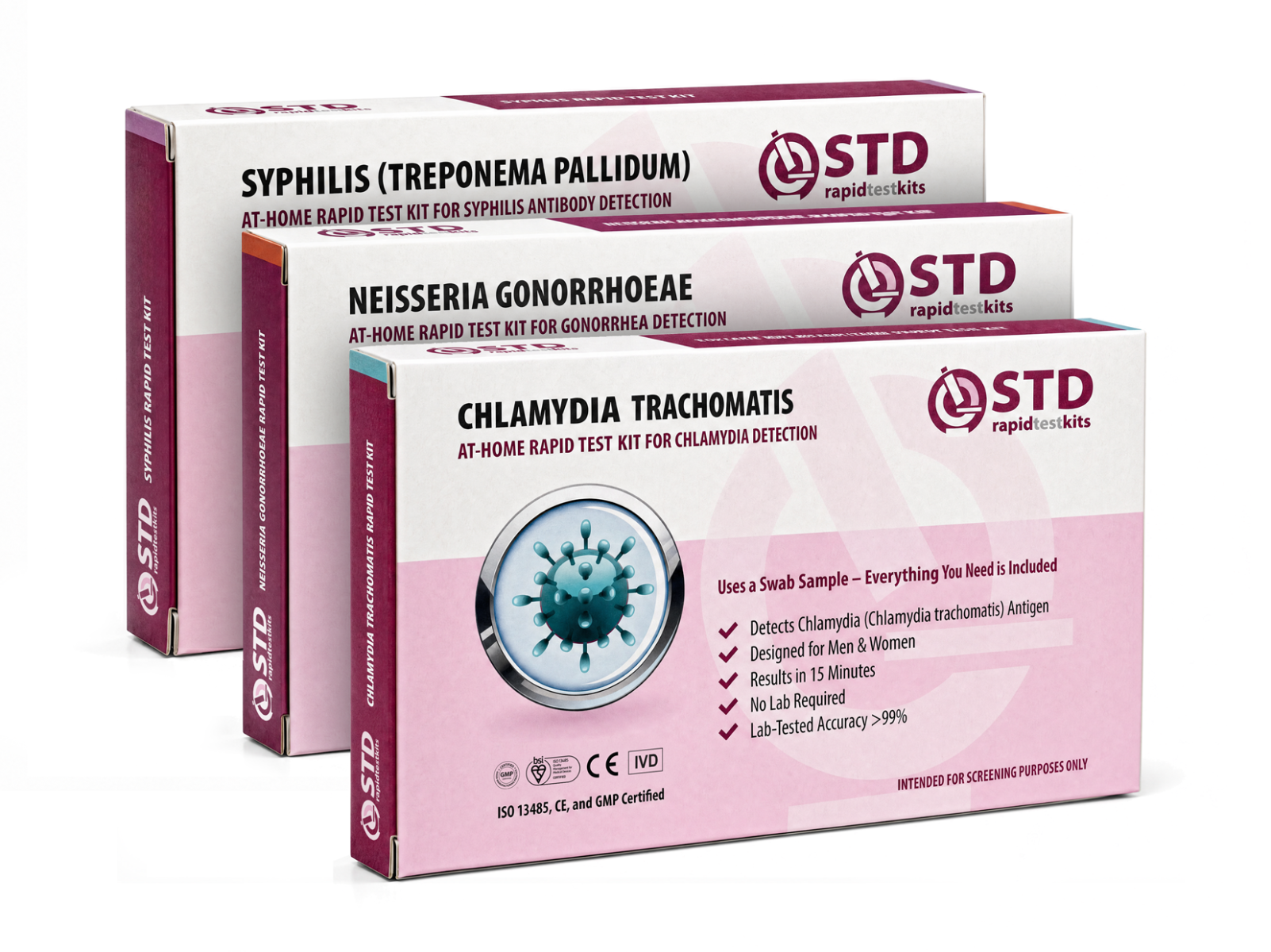
If your last possible exposure included unprotected vaginal or anal sex with someone whose status you do not know, a combo kit is usually a smarter buy than a single-infection test. Combo kits screen for the most common bacterial infections and the standard blood-borne infections in one shipment, which means you are not left wondering about the one thing your single-infection kit did not cover. (Note: stdrapidtestkits.com sells the rapid at-home kits referenced in this article; we recommend products based on fit for the reader's situation, not commercial benefit.)
When a clinic should be your first call
Skip the shipping window and call a clinic the same day if you have any of these: a high fever or chills, intense pelvic or abdominal pain, rapidly spreading genital sores, severe testicular pain, painful urination plus a thick discharge, or symptoms after a sexual assault. These are signals that something needs a clinician's eyes today, possibly with imaging, a culture, or empiric antibiotics started before any test result is back. The window-period question stops mattering when the question becomes how soon someone can examine you in person.
HIV deserves a separate flag. If a recent unprotected exposure carried a meaningful HIV risk (a partner known to be HIV positive and not virally suppressed, a needle-stick incident, or a sexual assault), post-exposure prophylaxis (PEP) is a 28-day antiretroviral regimen that has to be started within 72 hours of exposure to be effective. That window closes fast, and PEP is only available through a clinic, urgent care, or emergency department. Do not wait for a home test result; call the clinic now and ask about PEP.
The same urgency applies if you are pregnant or trying to conceive, if you have a known immunocompromising condition, or if a partner has just been diagnosed with something that has a same-day public-health treatment protocol (gonorrhea, syphilis, and chlamydia all qualify). Sexual-health clinics, urgent care centers, and community health centers all offer walk-in or same-day STI services in most US cities. For people in remote areas where no walk-in clinic exists within reasonable driving distance, a home rapid kit can bridge the gap until a telehealth follow-up is possible.
What to do with a positive at-home result
A positive lateral-flow result on a home test means you have found something worth confirming and treating. The next step depends on the infection. For chlamydia and gonorrhea, the standard care is a single-dose or short-course antibiotic regimen prescribed after a clinical conversation; you can bring the home result to a clinic, a telehealth visit, or a public-health department for treatment. For HIV and syphilis, the CDC explicitly recommends confirmatory laboratory testing before any long-term treatment decisions are made. Rapid antibody tests are excellent screening tools, and a clear positive earns a confirmation, not an immediate prescription.
If the test is negative but you are inside the window period, treat the result as preliminary and plan a retest at the conservative window mark (2 to 12 weeks for most infections, and up to 90 days for a rapid HIV antibody test, per the reference table above). If you have ongoing symptoms despite a negative test, see a clinician; not every cause of pelvic pain or genital irritation is an STI, and some are urgent on their own.
A positive HIV or syphilis result on any rapid screening test (home or clinic-administered) is followed by a confirmatory lab test before treatment starts. This is not a comment on home tests specifically; it is how the CDC's testing algorithm works for these infections regardless of where the screening happens.
How often should you test if you are sexually active?
The CDC's screening recommendations are the easiest baseline to follow. Sexually active women under 25 should screen for chlamydia and gonorrhea at least once a year. Men who have sex with men should screen for HIV, syphilis, chlamydia, and gonorrhea at least annually, and every 3 to 6 months if there are multiple or anonymous partners. Anyone with a new partner since their last test, anyone whose partner has tested positive, and anyone who notices symptoms should test sooner than the calendar suggests.
Routine screening is the part most people skip. Symptoms come and go (or never appear at all for chlamydia and gonorrhea). A test on the calendar twice a year covers more of the actual risk than waiting for the body to send a signal it might never send.
The World Health Organization's <a href="https://www.who.int/news-room/fact-sheets/detail/sexually-transmitted-infections-(stis)" target="_blank" rel="noopener">sexually transmitted infections fact sheet</a> notes that the majority of STIs are asymptomatic, which is why regular screening matters even for people who feel completely well.
Three questions to ask yourself before deciding
The most important question is whether you have severe or escalating symptoms today. If yes, the answer is a clinic, the same day, and the question of which test technology is academic when something needs an in-person examination.
If symptoms are not the deciding factor, timing is. Past the window period for the infection you are most worried about, an at-home rapid test is a reasonable first move. Inside the window, a home test now will give you information that is too early to trust; either wait until the window closes, or see a clinic and explain the timeline so they can pick the right assay for the timing.
That leaves one practical question: what matters most to you right now, speed, privacy, or in-person evaluation? The answer to that usually points clearly at one of the two paths.
FAQs
- Are at-home STD tests reliable enough to count on?
- Yes, when you use them after the proper window period. Lateral-flow rapid tests are the same chemistry community health programs around the world rely on for screening. They are most reliable for clear positives and clear negatives once enough antibodies, antigens, or bacterial material has built up to be detected. Test too early and any test (home or lab) can miss what is there. Past the window, a home rapid result is a meaningful piece of information; a clear positive is still confirmed in a lab for HIV and syphilis.
- If a home test comes back positive, do I have to handle the next step alone?
- No. A positive screening result is a starting point, not an endpoint. Bacterial infections like chlamydia and gonorrhea are usually treated with a short course of antibiotics, which you can get prescribed through a primary-care office, a sexual-health clinic, a public-health department, or a telehealth visit. For HIV and syphilis, the standard care path is a confirmatory lab test, then linkage to treatment. None of those steps depend on you handling them in isolation.
- Is a clinic test more accurate just because it is in a medical building?
- Test accuracy comes from the technology and the timing, not the setting where the test is run. Clinic labs typically use NAAT or fourth-generation antigen-antibody tests, which are the most analytically sensitive methods available. Lateral-flow home tests run a different chemistry that performs well after the window period closes, and less well at the very edge of detection. The real clinic advantage is the clinician: someone who can examine you, take a culture if needed, and treat you the same day.
- I tested negative at home but I am still anxious. Should I test again?
- Possibly, but check the timing first. If you tested before the window closed, schedule a retest at the conservative window mark (about 2 weeks for chlamydia and gonorrhea, 45 days for fourth-generation HIV, 90 days for a rapid HIV antibody test, and 6 weeks for syphilis). If you tested at the right time and you still have symptoms, see a clinician; not every symptom is an STI. If the timing was right, the result was negative, and you have no symptoms, repeated testing is more anxiety management than science.
- What if I have no symptoms? Is testing necessary?
- Yes. Most chlamydia and gonorrhea infections are silent. The WHO and CDC both report that the majority of STIs are asymptomatic, which is exactly why routine screening exists. The presence or absence of symptoms is not a reliable signal in either direction; the test is.
- Should I order a single-infection kit or a combo?
- A combo is usually the smarter starting point unless you have a specific reason to test for one infection only (a partner's confirmed diagnosis, for example). Most exposures are not neatly labeled, and people rarely know exactly what (if anything) was transmitted. A combo kit screens for the most common bacterial and blood-borne infections in one shipment, which avoids the awkward outcome of covering everything except the one thing it turned out to be.
- Will my insurance company find out if I test at a clinic?
- If you bill testing through your insurance, an explanation-of-benefits document is generated and sent to the policyholder. For adults on their own plan that is fine; for someone on a parent's or partner's plan it can be a real privacy issue. Public health department clinics often offer free or low-cost STI screening that does not bill insurance. Home test kits are paid for directly and do not generate an insurance record at all.
- How fast do I really need to act after a possible exposure?
- Faster than denial, slower than panic. If you have severe symptoms, see a clinic today. If you are asymptomatic, the right move depends on timing. Post-exposure prophylaxis (PEP) for HIV is a prescription medication that needs to be started within 72 hours of a high-risk exposure, so if HIV is the specific concern from a recent unprotected exposure, contacting a clinic or urgent-care quickly matters. For most other situations, ordering a kit and testing at the conservative window mark is reasonable.
- U.S. Centers for Disease Control and Prevention. STI Treatment Guidelines, including recommended testing methods (NAAT) for chlamydia and gonorrhea.
- U.S. Centers for Disease Control and Prevention. Sexually transmitted infection screening recommendations by age group, sex, and risk profile.
- U.S. Centers for Disease Control and Prevention. HIV testing pages, including window-period guidance for fourth-generation antigen-antibody tests and rapid antibody tests.
- World Health Organization. Sexually transmitted infections fact sheet, including the statement that the majority of STIs are asymptomatic.
- National Health Service (UK). Sexually transmitted infections overview, including STI clinic services and home testing context.
- Mayo Clinic. STD testing overview, including sample types, test methods, and what to expect.