
Published: November 2025 | Last updated: May 2026 | Editorial review and quality control: Martina N.
Chlamydia is often called a silent infection, and that silence runs deeper in trans and nonbinary bodies. Hormone therapy can mute or alter early symptoms, surgical anatomy can change where the bacterium settles, and a healthcare system that treats gender-affirming care and STI screening as separate visits can leave the gap between them unwatched. The result is that a curable bacterial infection sometimes goes untreated long enough to scar reproductive tissue, trigger pelvic inflammatory disease, or show up years later as joint pain or fertility problems.
This guide walks through what current CDC and WHO guidance says about chlamydia, how presentation can shift in bodies on testosterone or estrogen, and how to test in a way that matches your actual anatomy and sexual practices. The information here is summarized from current public-health guidance, not personal clinical advice. The goal is straightforward: give you something useful you can act on, and remove the parts of the testing process that have historically pushed trans readers away.
Key Takeaways
- Most people with chlamydia have no symptoms; in trans bodies, the mild signs that do appear often get blamed on hormones, dilation, or healing rather than infection.
- Two practices close most of the diagnostic gap: site-specific testing (throat, rectal, frontal or vaginal swabs based on actual exposure) and a follow-up retest about three months after treatment.
When Symptoms Stay Silent
Chlamydia trachomatis is a bacterium that infects mucous membranes: the tissue lining the cervix, urethra, rectum, throat, and (rarely) the conjunctiva of the eye. According to the CDC's chlamydia overview, most people who have chlamydia don't notice it. When symptoms do show up, they're easy to write off: a small amount of unusual discharge, a slight burn during urination, a vague ache in the lower abdomen, a sore throat that doesn't quite explain itself.
For transmasculine people on testosterone, vaginal and frontal tissues tend to thin over time, which can increase the risk of microabrasions during sex. Microabrasions create entry points for bacteria, and they also produce sensations (dryness, friction, occasional spotting) that overlap with the early signs of chlamydia. That overlap is why the question "is this hormone-related or infection-related?" is genuinely hard to answer without a test.
For transfeminine people, especially those who have had vaginoplasty, post-surgical discomfort, granulation tissue, or routine dilation can mask or mimic infectious signs. Estrogen also affects mucosal immunity, although the research base specific to neovaginal STI risk remains limited. Lab-confirmed infection in neovaginal tissue is documented in case reports; the prevalence and presentation are still being studied.
Spotting, mild burning, vague pelvic ache, post-coital irritation: each of these can come from hormone changes, post-surgical healing, or a chlamydia infection. The overlap is the reason routine testing matters more than waiting for a symptom you can name.
What Untreated Chlamydia Actually Does
Left alone, chlamydia rarely stays put. The bacterium can ascend from the cervix or urethra into upper reproductive tissue, triggering pelvic inflammatory disease (PID) in people with a uterus or fallopian tubes. The CDC's chlamydia treatment guidance notes that untreated chlamydia can ascend into the fallopian tubes, causing PID, scarring, and chronic pelvic pain. This applies to transmasculine people who still have those organs, even after years on testosterone.
Other long-term complications are less common but real: reactive arthritis (joint inflammation triggered by the body's immune response to chlamydia), proctitis (inflammation of the rectum after receptive anal exposure), and epididymitis (in people with testes). Many of these complications can be mistaken for something else: joint pain may be blamed on testosterone-related tendon changes, rectal discomfort may be filed under hemorrhoids or irritable bowel. A quiet infection is dangerous in exactly this way. By the time it produces obvious harm, that harm has often been building silently for months.
| Complication | Why it matters in trans bodies |
|---|---|
| Pelvic inflammatory disease (PID) | Develops when chlamydia ascends into upper reproductive tissue. Affects anyone with a uterus or fallopian tubes, including transmasculine people on or off testosterone. |
| Tubal scarring and infertility | Scar tissue in the fallopian tubes can block eggs and cause chronic pelvic pain. Matters for transmasculine people who may want to conceive after pausing testosterone. |
| Proctitis | Rectal inflammation after receptive anal exposure. Symptoms (discharge, pain, urgency) can be mistaken for hemorrhoids or post-surgical changes. |
| Reactive arthritis | Joint inflammation triggered by the body's immune response weeks after the original infection. Easy to misattribute to testosterone-related musculoskeletal changes. |
| Epididymitis | Inflammation of the epididymis in people with testes. Causes scrotal pain and swelling, and if untreated can affect fertility. |
Why Gender-Affirming Care Doesn't Always Catch It
The integration between hormone-prescribing clinics and sexual-health clinics is uneven. A hormone-therapy visit usually focuses on lab work, dosing, and surgical timelines. STI screening doesn't always come up unless the patient raises it, and many trans patients don't, either because previous medical encounters made disclosure feel unsafe, or because nothing in the visit signaled that it was an open question.
The CDC's 2021 STI Treatment Guidelines for transgender and gender-diverse persons address this explicitly. The guidance recommends that providers take a sexual history that asks what kinds of sex a patient is having and at which body sites, then screen based on that history rather than on assumed anatomy. In practice, that means a transmasculine patient who has receptive vaginal sex should be screened with a vaginal or front-hole swab, regardless of how their chart documents gender. A transfeminine patient who has receptive anal sex should be offered a rectal swab. The guideline exists; the implementation gap is real.
If your provider has not asked, you can ask directly. The script below does the work without requiring you to explain anything you would rather not.
"I'd like to be screened for chlamydia at the sites where I've had exposure: throat, frontal, and rectal as relevant."
Anatomy Doesn't Change the Infection
One question that comes up often is whether chlamydia still applies if your anatomy doesn't match the standard medical textbook. The short answer is that it does, because chlamydia infects mucous membranes, and the cells it targets exist in the urethra, rectum, throat, cervix, and neovaginal tissues. The bacterium does not check identity or surgical history before it establishes itself, and the diagnostic tests don't either. A vaginal or front-hole swab is processed the same way by the lab regardless of how the patient describes that anatomy.
For trans women after vaginoplasty, infection in neovaginal tissue is documented in case reports, though the long-term incidence and complications are less well-studied than in cisgender anatomy. The practical implication: if you have neovaginal tissue and you've had penetrative or receptive sex, that site is testable and worth testing.
For nonbinary people or anyone with mixed or surgically altered anatomy, testing should follow exposure rather than assumption: throat swab after receptive oral sex, rectal swab after receptive anal sex, frontal or vaginal swab if the relevant tissue exists and was involved in the encounter. The collection method itself is the same across sites; what changes is which samples you ask the provider or kit to process.
Testing Options That Actually Fit Your Body
Two test technologies dominate chlamydia diagnostics: nucleic acid amplification testing (NAAT) in labs, and rapid lateral-flow tests at home or in clinics. NAAT is the laboratory gold standard for chlamydia per the CDC, with very high sensitivity on urine, swab, throat, and rectal samples. Rapid lateral-flow tests are less analytically sensitive than NAAT but are faster, more private, and useful for routine screening when lab access is hard.
For trans readers, the home-test format solves a specific problem. It removes the requirement to walk into a clinic and have your body discussed by strangers. You collect the sample yourself, from the site that matches your actual exposure. A frontal or vaginal self-swab uses the same sampling technique whether you call it a vaginal swab or a frontal swab; the lab or test cassette reads it the same way.
Timing matters either way. Most chlamydia tests reach reliable sensitivity 7 to 14 days after exposure, because the bacterium needs time to multiply to detectable levels. If you test at day 5 and the result is negative, that doesn't necessarily mean you're in the clear; retesting after day 14 catches the cases where infection was still ramping up. That timeline reflects how infections build to detectable levels, and it's worth planning around.
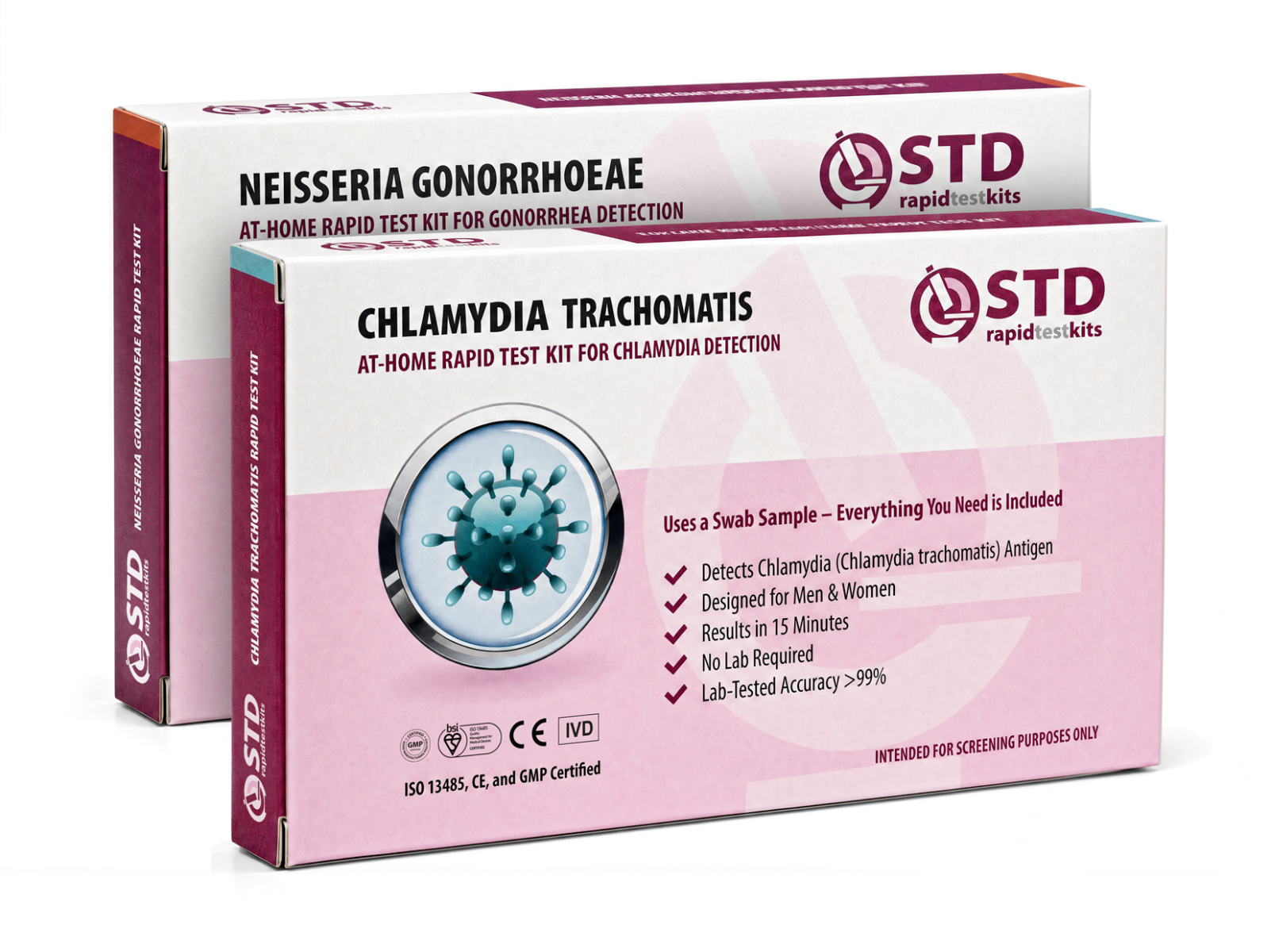
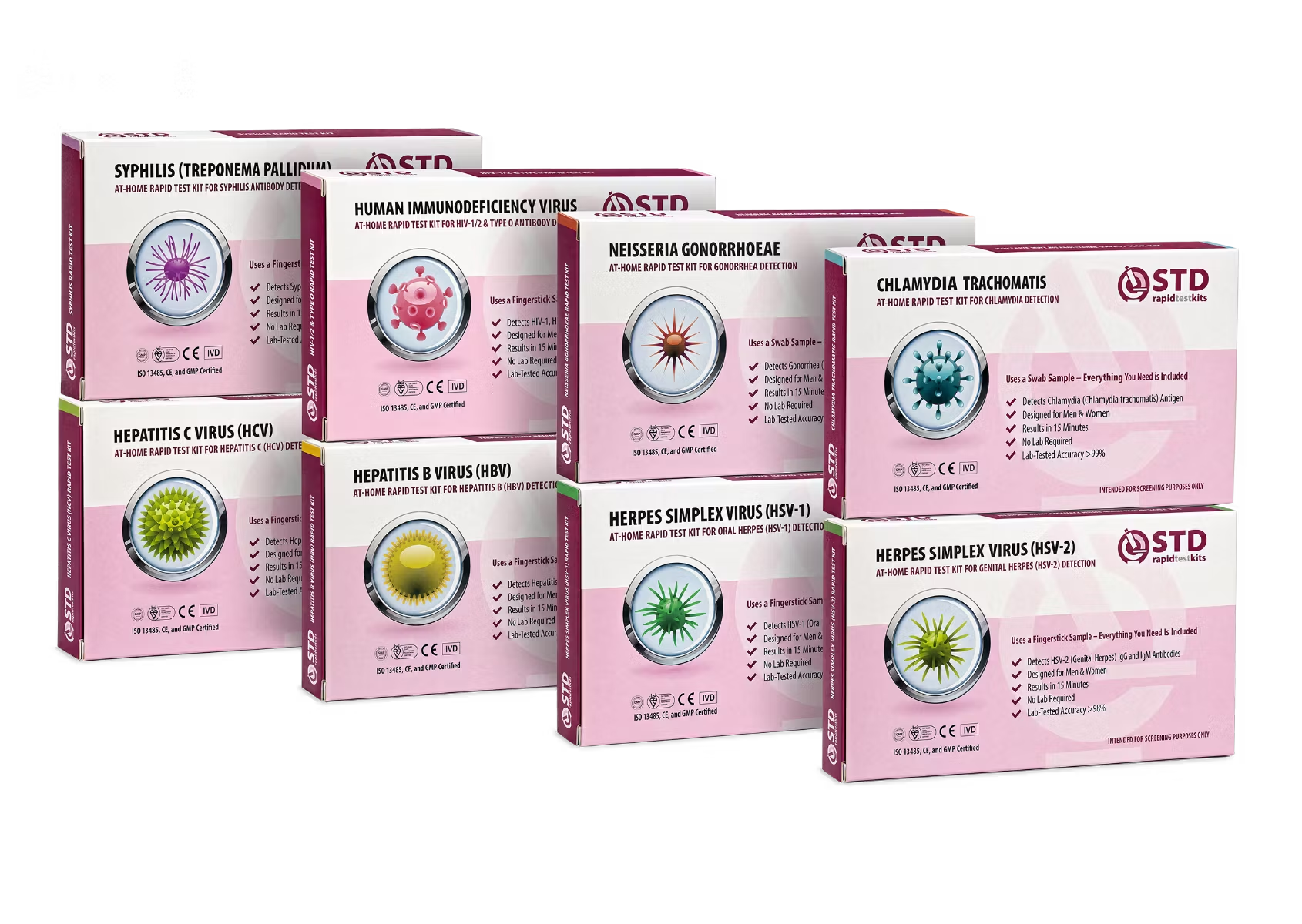
This site sells rapid at-home lateral-flow test kits; the option below ships with no clinic visit required, and we recommend products based on fit-for-purpose for the reader's concern rather than commercial benefit.
| Test type | How it works | Window period |
|---|---|---|
| NAAT (lab or mail-in) | Detects chlamydia DNA in a urine, swab, throat, or rectal sample. The CDC's gold standard for analytical sensitivity. Self-collected swabs are accepted at most labs. | Reliable 7 to 14 days after exposure |
| Rapid lateral-flow swab (at home) | Detects chlamydia antigens directly from a self-collected swab. Result in about 15 minutes at home. Less analytically sensitive than NAAT but useful for routine screening and quick answers. | Reliable about 14+ days after exposure |
| Clinic-based STI panel | Provider-collected samples plus blood draw for related infections (HIV, syphilis, hepatitis). Useful when multiple infections need screening simultaneously. | Varies by infection; typically 7 to 21 days |
Retesting and What It Catches
The CDC's chlamydia treatment guidance recommends a follow-up test about three months after completing treatment. Antibiotics clear the original infection in the great majority of cases. The reason for the retest is the rate of reinfection: high enough that a routine recheck catches more new cases than waiting for symptoms to return would.
For trans readers, the three-month retest carries extra weight. If you are months out from a course of doxycycline or azithromycin and you are still noticing pelvic discomfort, urinary irritation, or unusual discharge, it is worth distinguishing between residual effects of the original inflammation, possible reinfection, and entirely separate causes such as vaginal atrophy on testosterone, post-surgical changes, or bladder irritation. A simple retest answers the chlamydia question and lets you focus on whatever else is going on.
When Symptoms Aren't What You Think
One of the trickier dynamics in trans sexual health is symptom misattribution: urinary burning gets filed under T-related dryness, pelvic pressure gets filed under post-op healing, a sore throat gets filed under cold-and-flu. Sometimes those explanations are right. Sometimes they aren't, and the cost of getting the misattribution wrong is letting an infection scar tissue while you wait for the symptoms to clear on their own.
If a clinician dismisses a possible STI as "probably just healing" without offering a test, you can ask directly: "Can we rule out chlamydia and gonorrhea at this site with a swab?" That phrasing frames it as a diagnostic question rather than a behavioral one, and gives the provider something specific to act on.
- Urinary symptoms that don't respond to standard UTI antibiotics.
- Pelvic pain that lingers beyond the expected post-surgical recovery window.
- Persistent unexplained throat irritation after receptive oral sex.
- Rectal pain after receptive anal sex that doesn't resolve.
None of these automatically means chlamydia, but each is a reasonable trigger to ask for a site-specific swab.
Telling Partners Without a Script That Doesn't Fit
If a test comes back positive, the next step is usually contacting recent sexual partners so they can also test and treat. For trans people, that conversation can be loaded in ways the standard public-health script doesn't address. A partner may not know your full anatomy, your hormone status, or which body sites were actually involved. You may have spent your medical life being misgendered by clinicians and now you are being asked to explain a clinical situation to someone outside that context.
The minimum useful message is short: "I tested positive for chlamydia. We hooked up recently and I wanted to let you know so you can test too. It is curable with antibiotics." You don't need to disclose more anatomy than you are comfortable with, and you don't need to describe what kind of sex you had. Public-health departments in most U.S. states also offer anonymous partner-notification services where you can submit a partner's contact and they receive a heads-up without your name attached.
A bad reaction to a respectful disclosure reflects the partner, not you. Telling them is the responsible step; the social fallout is not yours to absorb.

Why Some Trans People Delay Testing
The CDC's STI treatment guidance for trans and gender-diverse populations acknowledges that healthcare discrimination is a documented barrier to routine STI screening. Survey data line up with what trans patients have been saying directly for years: lower screening rates, later diagnoses, and a strong preference for affirming clinics or at-home options when those are available.
What changes the pattern is access that doesn't require running the gauntlet. At-home test kits are one piece, because they let you collect samples in your own space and on your own timeline. Affirming clinics that ask about sexual practice and body sites without making assumptions are another piece. Friends or partners who can hand you a kit when you would never order one for yourself are a third. None of those solves the larger problem of how care is structured, but each one makes today's question easier to answer.
Most people who have chlamydia have no abnormal physical signs or symptoms.
You Have More Control Here Than the System Suggests
If there is a single takeaway: chlamydia is a small bacterial infection with big complications when it sits unaddressed. The presentation can be quiet, especially in trans bodies, and the clinic system that should be catching it doesn't always ask the right questions. The diagnostic tools themselves are cooperative: a self-collected swab, a NAAT or rapid lateral-flow test, a follow-up retest three months later. Those tools are accessible to you regardless of how your chart reads or how your last appointment went.
The three habits below close most of the gap between a quiet infection and a caught one.
Three habits to build
- Test at the body sites that match your actual exposure (throat, rectal, frontal or vaginal swab as relevant), rather than at the sites your chart assumes.
- Retest about three months after any positive treatment, even if your symptoms resolved.
- Ask for site-specific screening at routine visits, even when no one offers it.
FAQs
- Can trans men get chlamydia even on testosterone?
- Yes. Testosterone doesn't change whether mucous membranes can host the bacterium. If you have had genital, oral, or anal contact, the relevant sites are testable and should be tested after an exposure. Testosterone may actually increase susceptibility at frontal or vaginal sites because the tissue thins, which can make microabrasions and bacterial entry slightly more likely.
- After vaginoplasty or phalloplasty, am I still at risk?
- Surgical anatomy doesn't grant immunity. Chlamydia infects mucous membranes wherever they are, including neovaginal tissue, the urethra, and the rectum. The literature specific to neovaginal STIs is still building, but documented case reports confirm that infection can occur and is detectable with standard swab-based testing.
- What if I have no symptoms at all?
- That is the most common situation. The CDC describes chlamydia as a largely silent infection, meaning routine periodic screening is more reliable than waiting for symptoms to appear. For trans readers, mild signs that do appear often get attributed to hormones or healing, so routine testing removes the guesswork.
- How long after exposure should I wait to test?
- Plan to test at day 14 or later for the most reliable result. The bacterium needs roughly two weeks to multiply to detectable levels, so a negative at day 5 isn't conclusive. If you test early and the result matters, retest after day 14.
- Can untreated chlamydia affect future fertility?
- It can, particularly when it ascends into the fallopian tubes and causes pelvic inflammatory disease. Scar tissue in the tubes can block eggs from reaching the uterus. This matters for transmasculine people who may pause testosterone to conceive later in life, and it is part of why the CDC recommends prompt treatment plus a three-month retest.
- Is throat chlamydia a real thing?
- Yes. Chlamydia can infect the pharynx after receptive oral sex. Throat infections are often asymptomatic; when symptoms do appear they tend to be mild and non-specific (mild sore throat, scratchy feeling). A throat swab is the right test and should be ordered when oral exposure has occurred. Our at-home kits don't include a clinically validated throat swab, so for a confirmed throat-specific result a clinic visit is the right call.
- Do hormones affect chlamydia test results?
- Hormones don't interfere with chlamydia detection. Testosterone and estrogen don't change the chemistry that NAAT testing uses to identify chlamydia DNA, and they don't affect antigen detection in rapid lateral-flow tests either. Hormones can change how symptoms feel, but the test result itself is unaffected.
- How do I tell a partner if I test positive?
- Short and direct works: "I tested positive for chlamydia. We had sex recently. You should test, and it's curable with antibiotics." You don't need to explain anything about your anatomy or your gender. Most U.S. state health departments also offer anonymous partner-notification services if direct contact feels too much.
How we sourced this article. We built this guide on current public-health guidance from the U.S. Centers for Disease Control and Prevention and the World Health Organization, then translated it into plain language to match the questions trans and nonbinary readers actually bring. The CDC's 2021 STI Treatment Guidelines and its chapter on care for transgender and gender-diverse persons were the primary references. The article was written by a medical-content writer and reviewed by a licensed medical doctor for clinical accuracy.
- U.S. Centers for Disease Control and Prevention. Chlamydia overview, prevalence, screening recommendations, and the asymptomatic nature of most infections.
- U.S. Centers for Disease Control and Prevention. 2021 STI Treatment Guidelines, Special Populations: Transgender and Gender Diverse Persons. Site-specific screening based on current anatomy and sexual behavior.
- U.S. Centers for Disease Control and Prevention. 2021 STI Treatment Guidelines, Chlamydial Infections. Treatment regimens, complications including pelvic inflammatory disease and tubal scarring, and the recommendation to retest about three months after treatment.
- World Health Organization. Chlamydia fact sheet. Global prevalence, transmission routes, complications, and screening recommendations.
- U.S. Centers for Disease Control and Prevention. 2021 STI Treatment Guidelines, Screening Recommendations. Annual chlamydia screening for sexually active women under 25 and behavior-based screening for others.
