
Published: June 2025 | Last updated: May 2026 | Editorial review and quality control: Martina N.
Oral sex feels lower-stakes than penetrative sex, and in many ways it is. Most STIs do transmit more readily through vaginal or anal contact, and a long line of public-health messaging has reinforced the idea that “just oral” sits comfortably in the safer-side column. That framing is part right and part dangerous. Lower risk is not zero risk, and one infection in particular has a habit of slipping through the gaps in how most people get tested: chlamydia in the throat.
The bacteria behind chlamydia, Chlamydia trachomatis, can colonize the pharynx after oral sex on a partner with a genital infection. The resulting throat infection is usually quiet, and the urine-based STI screen most clinics default to does not detect it. That is why the U.S. Centers for Disease Control and Prevention recommends extragenital screening for sexually active gay, bisexual, and other men who have sex with men: rectal NAAT for both chlamydia and gonorrhea, and pharyngeal NAAT for gonorrhea. Pharyngeal chlamydia infection is real and documented in women and heterosexual men as well, even though most clinical screening data comes from MSM cohorts where extragenital testing is more routinely offered.
Key Takeaways
- Yes, oral sex can transmit chlamydia in either direction. Pharyngeal (throat) infection is real, usually has no symptoms, and routinely goes undiagnosed.
- A urine-only STI test cannot find a throat infection. Detecting pharyngeal chlamydia requires a dedicated swab of the throat processed in a clinical lab.
Yes, oral chlamydia is real, and it’s often invisible
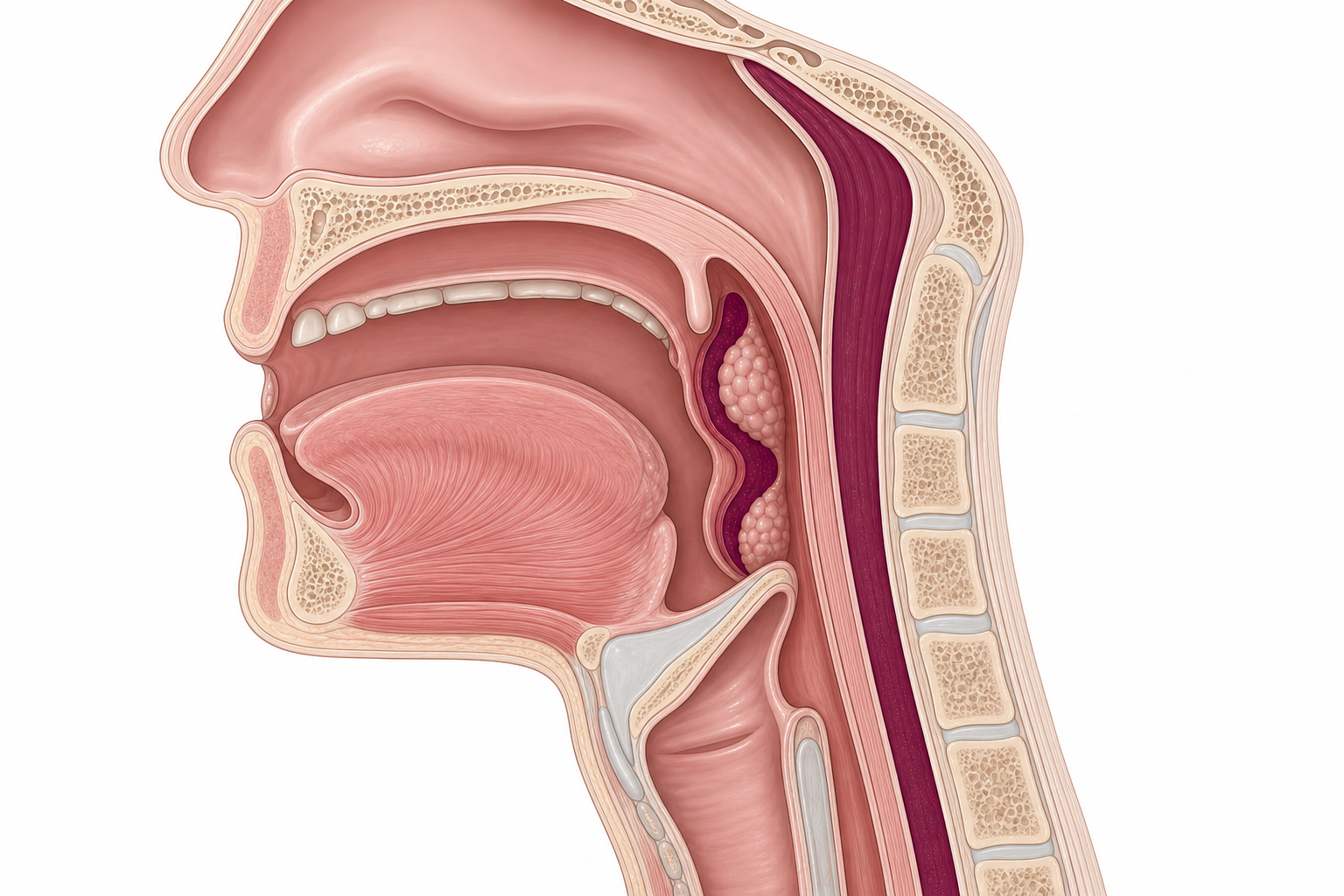
The mechanism is simple. Chlamydia trachomatis lives in the urethra, cervix, rectum, conjunctiva, and pharynx. When a partner with an active genital infection ejaculates or releases pre-ejaculate during oral sex, the bacteria can establish in the receiving partner’s throat. The reverse can also happen: a person with pharyngeal infection performing oral sex on a partner can pass bacteria to the partner’s urethra. The transmission efficiency for oral routes is generally lower than vaginal or anal, though pharyngeal infections still turn up at meaningful frequencies in MSM screening cohorts.
Pharyngeal prevalence varies by population and how often people are screened. In CDC overview material on STI risk and oral sex, pharyngeal chlamydia and gonorrhea are described as documented in MSM cohorts where regular extragenital screening is offered. Studies in MSM clinic populations have reported pharyngeal chlamydia prevalence in the low single digits up to about one in ten, depending on the cohort and the testing frequency. The number is high enough that researchers and clinicians treat it as a meaningful gap when only urine-based panels are run.
Most pharyngeal infections produce no clear signs at all. The throat tissue does not react the way the urethra does. There is usually no discharge, no obvious redness, and no burning during sex. Transmission keeps going because infected people feel ordinary, test negative on whatever urine panel they happened to take, and never know to seek treatment.
Can you really get chlamydia from a blowjob?
Yes. Both performing and receiving oral sex can transmit Chlamydia trachomatis, and the resulting pharyngeal (throat) infection is usually asymptomatic. The standard urine STI test will not find it. Detecting pharyngeal chlamydia requires a throat swab processed in a clinical lab. The most reliable test window is around 14 days after exposure.
Why throat chlamydia stays hidden
One reason is biological. The pharynx tolerates the infection differently from the urethra; symptoms, when they show up at all, look like a common viral sore throat or a vague “off” feeling. Clinicians who are not specifically thinking about an STI rarely connect a mild lingering sore throat to recent oral sex.
The other reason is structural. The way most people get tested for chlamydia uses a urine sample, which detects bacteria shed from the urethra. That is the right test for genital chlamydia, but it physically cannot detect a throat infection. The same logic applies to vaginal or penile swabs and to rectal swabs: each method only picks up infection at the site that was sampled. Without a deliberate pharyngeal swab, the throat is never tested.
| Sample type | What it screens for | What it misses |
|---|---|---|
| Urine NAAT (lab) | Genital chlamydia in the urethra | Throat and rectal infections |
| Vaginal or penile swab NAAT (lab) | Genital chlamydia at the swabbed site | Throat and rectal infections |
| Rectal swab NAAT (lab) | Anorectal chlamydia | Genital and throat infections |
| Pharyngeal swab NAAT (lab) | Throat (pharyngeal) chlamydia | Genital and rectal infections |
| Rapid home swab cassette | Genital chlamydia at the swabbed site | Throat and rectal infections |
What oral chlamydia might feel like, if anything
For most people the honest answer is nothing. The infection sits in the throat without producing recognizable symptoms. When signs do appear, they tend to be mild and easily mistaken for everyday viral or seasonal complaints. The CDC’s overview of chlamydia notes that chlamydia often has no symptoms, a pattern that holds across anatomic sites including the pharynx.
Without that exposure history on the chart, the clinician often prescribes a strep-focused antibiotic, the chlamydia persists untreated, and the infection keeps circulating. The fix is straightforward but only happens when the right exposure history is on the chart, which depends on the patient feeling safe enough to share it.
Common patterns when symptoms appear: a dry, slightly itchy throat that does not respond to the usual hydration or lozenges; a low-grade soreness lasting more than a week without becoming a full cold; mild swelling of cervical lymph nodes (the small glands along the neck); and faint redness or discomfort at the back of the throat when swallowing.
Notably absent: high fever, a thick cough, or the characteristic exudate of strep throat.
What our home tests cover, and where a clinic visit is the right call
This article is published by stdrapidtestkits.com, which sells at-home rapid STI testing kits. We want to be clear about what our products do and do not cover, because the topic of this piece runs into a real gap in our catalog.
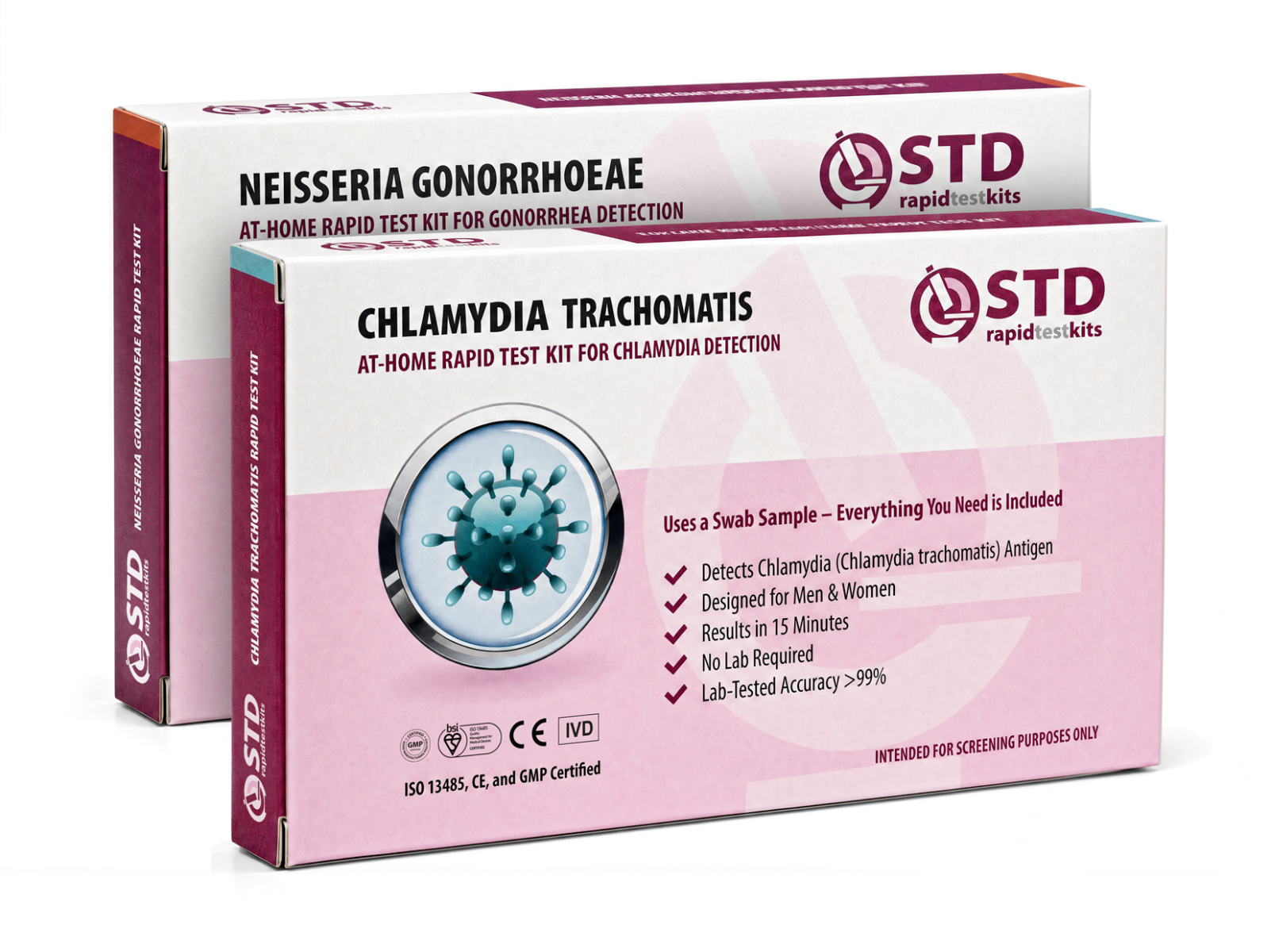
Our chlamydia rapid test, like our gonorrhea, trichomoniasis, and HPV swabs, is designed for self-collected genital samples (vaginal or penile swab). It is a lateral-flow rapid cassette that gives a result in about fifteen minutes, validated for genital sample sites. We do not sell a throat swab kit, and a home rapid cassette is not the right tool for confirming a pharyngeal infection. Pharyngeal chlamydia is detected with a clinical-lab pharyngeal NAAT, which currently requires a clinic visit or a mail-in lab service that explicitly offers a throat-swab option.
If your specific concern is throat exposure and only throat exposure, the most accurate next step is a clinic that offers extragenital NAAT screening: a sexual-health clinic, an LGBTQ+ health center, or any provider that follows CDC MSM screening guidelines. Some Planned Parenthood and city public-health clinics offer these swabs at low or no cost.
Selling you a genital swab as a substitute for the throat test you actually need would not serve you. Our genital swab cannot detect a pharyngeal infection. If your only worry is throat infection, a clinic-administered pharyngeal NAAT is the right test. If your worry also includes genital exposure (most oral encounters involve mutual exposure), our home swab is one part of a sensible picture.
If your concern also includes genital exposure
Most oral encounters are mutual, so the concern that brought you to this article likely covers both sites. If your partner went down on you while you went down on them, both your throat and your genital tract were potentially exposed. The right move is testing each route separately: a pharyngeal swab through a clinic for the throat, and a genital sample at home or in clinic for the urethra (or for women, vaginally).
For the genital side specifically, an at-home rapid swab is reasonable. The chlamydia and gonorrhea two-in-one test below uses a self-collected genital swab and a lateral-flow cassette to return a result at home. It does not replace a pharyngeal swab, and it does not replace a follow-up confirmatory NAAT after a positive result. It does give you a fast, private screening read on the genital site without scheduling a clinic visit.
Window periods: timing your test for an accurate result
Testing too early is one of the most common mistakes people make after a worrying exposure. The window period is the gap between exposure and the moment a test can reliably detect the infection. For chlamydia NAATs, that window is generally 1 to 2 weeks. Testing the day after a hookup feels proactive, but the bacteria may not yet be present in detectable amounts at the sample site, and a negative result that early can be misleading.
The standard guidance is to wait at least seven days for any test to be meaningful, and to treat fourteen days as the more reliable mark. If you test in the first window and the result is negative but you remain worried (or your partner discloses a positive), retest two weeks out. Symptoms that emerge during the wait are themselves a reason to test sooner, but a negative early test should always be paired with a later confirmatory test.
| Days since exposure | Test reliability | Recommended action |
|---|---|---|
| 1 to 5 days | Low | Wait if you can. A positive may show up, but a negative is unreliable. |
| 7 to 13 days | Moderate to high | Test if symptoms appear or if you need a check-in; plan a retest at day 14 or later. |
| 14 days or more | Highest | Standard window for chlamydia NAAT and rapid swab tests. Retest at 3 months if exposure is ongoing. |
If you test positive: what comes next
The first thing to know is that chlamydia, including pharyngeal chlamydia, is fully treatable. The CDC’s current treatment guidelines recommend doxycycline 100 mg by mouth twice daily for seven days as the preferred regimen. Azithromycin remains an alternative in specific situations, particularly during pregnancy, but doxycycline has become the standard first choice based on better cure rates at extragenital sites including the throat and rectum.
After a confirmed positive, three practical steps protect you and your partners. Avoid sex until you and any current partners have completed the full antibiotic course; this stops back-and-forth reinfection. Notify recent partners so they can test and treat. Most local public-health programs offer anonymous notification tools (the CDC and state STI programs maintain lists), which makes the conversation considerably less awkward when you need it. Then retest at three months to confirm the infection has cleared and to catch reinfection, which is genuinely common.
Feeling unsettled after a positive result is normal. Pharyngeal chlamydia is unusually good at slipping past standard testing, which is why a positive result often surprises people who believed they were being careful. It is medical information; act on it, treat it, and move forward.
Stop wondering, get a clear picture
The best response to a worrying oral exposure is not paralysis or a single test. It is a layered picture: the genital site checked at home or in clinic, the throat swabbed at a clinic that offers extragenital screening, and a follow-up at the right window. None of those steps individually is the whole answer; together they are.
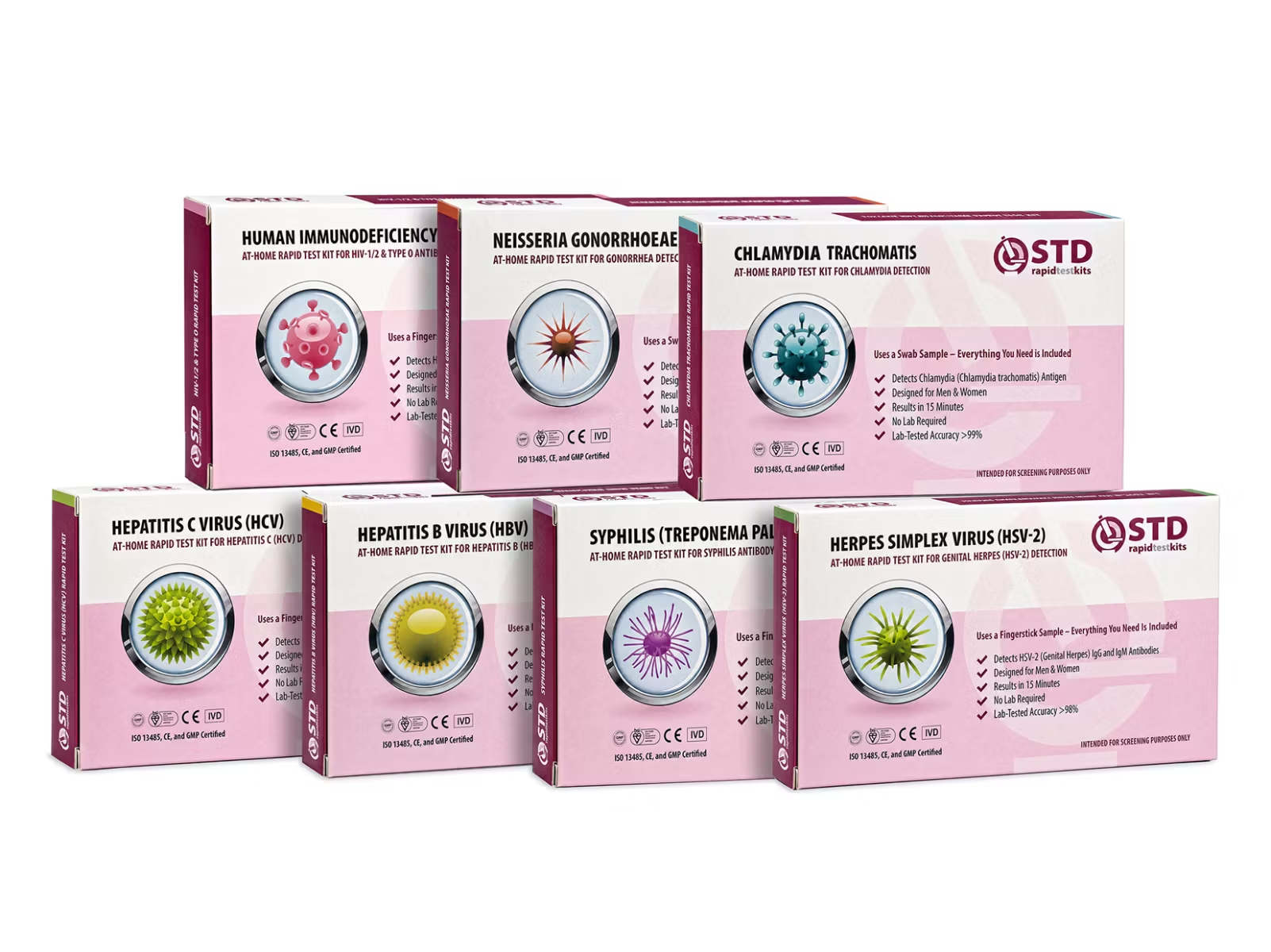
If your concern has expanded beyond chlamydia (which is reasonable; oral exposure carries gonorrhea risk too, and a single new partner often prompts a broader curiosity about HIV and syphilis), a multi-infection home panel is a sensible base layer for the genital and bloodwork sites. The 7-in-1 panel below covers the most common rapid-detectable STIs at home; pair it with a pharyngeal NAAT through a clinic for the throat-side picture.
Frequently asked questions
- Can chlamydia really pass through oral sex without ejaculation?
- Yes. Bacteria can be present in pre-ejaculate and in cervical or urethral secretions, so transmission does not depend on someone finishing. The biological route is contact between infected genital tissue or fluids and the partner’s mouth or urethra.
- Does a normal STI test catch throat chlamydia?
- No, unless it explicitly includes a pharyngeal swab. Urine tests detect chlamydia in the urethra; genital swabs detect it where they were swabbed. A throat infection is only found by a separate pharyngeal swab processed at a clinical lab.
- How soon after oral sex should I test?
- 14 days is the reliable threshold. Test earlier only if you have symptoms or a partner has confirmed positive, and retest at day 14 or later regardless of an early negative result.
- What if I test positive?
- Talk with a clinician about treatment, which is typically doxycycline 100 mg twice daily for seven days per CDC guidelines. Avoid sex until you and any current partners have completed treatment, notify recent partners (anonymous notification tools exist), and retest at three months.
- Do I need to tell my partners?
- Yes. Partner notification protects them and prevents you from being reinfected after treatment. The conversation can be brief: a heads-up that they may want to test. Anonymous notification services run by state and city public-health programs let you send the message without putting your name on it.
- Is giving oral sex riskier than receiving for chlamydia?
- Both directions can transmit, but the directionality of risk depends on which partner has the existing infection. Receiving oral sex from a partner with pharyngeal chlamydia can pass bacteria to your urethra; performing oral sex on a partner with genital chlamydia can pass bacteria to your throat. Treating both routes as plausible is the safest assumption.
- Can chlamydia clear on its own without treatment?
- It sometimes does, but waiting for that is a bad bet. Untreated infection can spread to new partners, can cause complications (especially in women, where it can lead to pelvic inflammatory disease), and can persist for many months. Antibiotics are the reliable answer.
- If I’m a man who has sex with men, how often should I be screening at all sites?
- The CDC MSM guidelines recommend annual minimum screening for HIV, chlamydia (urogenital and rectal), gonorrhea (urogenital, rectal, and pharyngeal), and syphilis. Pharyngeal swabs are indicated for gonorrhea where oral exposure is relevant; rectal swabs cover both chlamydia and gonorrhea. Higher-frequency screening (every 3 to 6 months) applies for those with multiple or anonymous partners.
- U.S. Centers for Disease Control and Prevention. About chlamydia, including transmission routes and asymptomatic infection.
- U.S. Centers for Disease Control and Prevention. STI risk and oral sex overview.
- U.S. Centers for Disease Control and Prevention. STI Treatment Guidelines: men who have sex with men screening recommendations.
- U.S. Centers for Disease Control and Prevention. STI Treatment Guidelines: chlamydial infections, treatment regimens, and follow-up.
- World Health Organization. Chlamydia fact sheet, including global prevalence and clinical course.
