Published: September 2025 | Last updated: May 2026 | Editorial review and quality control: Martina N.
Yes. A negative result is reliable only when you tested after the window period closed, collected the sample correctly, and used a panel that covered the infection. Test too early, swab the wrong site, or skip an infection the panel never included, and a real infection can still read clean.
A negative STD test is useful information, though it is rarely complete information on its own. A clean line on a rapid cassette or a clear lab report tells you what one test, using one method, found in your sample at one particular moment. There is real space between “nothing was detected” and “no infection exists,” and that space matters when symptoms persist or when an exposure happened more recently than the test was designed to catch.
This guide explains that space. You will learn what a negative result actually rules out, why timing decides what a test can find, which infections most panels skip unless you ask, what commonly goes wrong with rapid tests at home, what to do when a partner's result does not match yours, and how to advocate for yourself when symptoms continue after a clear result.
Key Takeaways
- A negative test reports only what was measurable in your sample on the day of testing. Window periods, panel coverage, sample technique, and the body site you swabbed all change what a test can find.
- If you tested within two weeks of exposure, used a panel that did not cover herpes or trichomoniasis, or had symptoms in a body site the swab did not reach, a single negative result is rarely the full picture.
What a Negative STD Test Tells You
A negative STD test means the laboratory or rapid cassette did not find the specific marker it was looking for in your sample. Different tests look for different things. Nucleic acid amplification tests (NAATs) look for fragments of bacterial or viral genetic material. Antigen tests look for proteins on the surface of the virus itself. Antibody tests look for the proteins your immune system makes in response to an infection.
Each method has a limit of detection, the minimum amount of target material required before a positive result will register. Below that threshold, the test reads negative even when an infection is present. Sample quality matters too. A swab that did not collect enough cells, a urine sample collected immediately after voiding, or a fingerstick blood drop that clotted before it reached the strip can all reduce the amount of detectable material reaching the assay.
A negative result is best understood as a snapshot of what the test could see at that moment. The reading is honest within the test's boundaries, though anything outside those boundaries was simply never measured.
Your test reports what was measurable at the moment your sample was taken. An infection that has not yet produced enough viral RNA, bacterial DNA, or antibodies to cross the assay's detection threshold will read as negative even if you carry it.
Why a Negative Test Can Still Be Wrong
Three things produce a false negative result: timing, technique, and biology. Timing is by far the most common. Every infection has a window period, the gap between exposure and the moment your body produces enough of a marker for a test to detect it. Test inside that window and a real infection can read clean.
Technique matters next. A swab that did not reach far enough into the vaginal canal or urethra, a urine sample taken right after drinking a lot of water, or a result read fifteen minutes past the maximum reading time printed on the kit insert can all produce the wrong answer. None of this means rapid tests are unreliable. It means a rapid test is only as accurate as the moment and the method you used it in.
Biology is the rarer cause. People taking antibiotics for an unrelated infection may have temporarily suppressed bacterial loads. People with weakened immune systems may not yet produce enough antibodies for antibody-based tests to register positive. Some infections also sit in body sites a typical genital sample will not reach, including pharyngeal gonorrhea (throat) and rectal chlamydia, which need swabs taken from those specific sites.
For most readers, none of this means a negative result is meaningless. It means the result is a snapshot at one moment, with one method, on one body site. If the snapshot was timed right, the technique was correct, and the method matched the infection, the negative carries real weight. If any of those was off, retest at the right time with the right tool.
- Timing. Tested before the infection's window period closed. By far the most common cause.
- Technique. Sample collected too shallow, too dilute, or read outside the timed window printed on the kit insert.
- Biology. Antibiotics, immune suppression, or an infection sitting in a body site (throat, rectum) that the sample does not reach.
Why Timing Decides What a Test Can Find
The single biggest reason for a false negative is testing too early. After exposure, an infection needs time to multiply. For antibody tests, it also needs time for your immune system to mount a measurable response. That delay between exposure and reliable detection is called the window period. According to the CDC's HIV testing guidance, the window period varies by both infection and test technology.
HIV is a useful illustration. A nucleic acid test can detect HIV roughly 10 to 33 days after exposure. The fourth-generation antigen and antibody combination test, when run on a lab venipuncture sample, typically detects HIV between 18 and 45 days. The same fourth-generation chemistry on a fingerstick rapid format takes longer, often up to 90 days, because capillary blood produces a smaller sample with a lower concentration of detectable marker. An older antibody-only test can take 23 to 90 days regardless of format.
Chlamydia and gonorrhea NAATs, which detect bacterial DNA, become reliable about one to two weeks after exposure. Syphilis antibody tests usually need three to six weeks. Hepatitis B surface antigen testing also needs three to six weeks. Herpes IgG blood tests can take 12 to 16 weeks, and some people seroconvert later than that. The reliable test date column in the table below is the practical takeaway: test on or after that date and the negative result you get back is the one you can act on.
| Infection | Detection Window | Reliable Test Date | Typical Test Type |
|---|---|---|---|
| Chlamydia | 5–14 days | 14+ days post-exposure | NAAT (urine or swab) |
| Gonorrhea | 2–7 days | 7+ days post-exposure | NAAT (urine or swab) |
| Syphilis | 3–6 weeks | 6+ weeks post-exposure | Antibody (blood) |
| HIV (lab Ag/Ab combo) | 18–45 days | 45+ days post-exposure | 4th-gen Ag/Ab (lab venipuncture) |
| HIV (rapid Ag/Ab fingerstick) | 18–90 days | 90+ days post-exposure | 4th-gen Ag/Ab (fingerstick) |
| HIV (antibody only) | 23–90 days | 90+ days post-exposure | Antibody (rapid or lab) |
| Hepatitis B | 3–6 weeks | 6+ weeks post-exposure | Surface antigen (HBsAg) |
| Hepatitis C | 8–11 weeks (up to 6 months) | 12 weeks+ post-exposure | Antibody (blood) |
| Herpes (HSV-2, IgG) | 4–16 weeks | 12–16 weeks post-exposure | IgG antibody (blood) |
| Trichomoniasis | 5–28 days | 2–4 weeks post-exposure | NAAT (vaginal swab) |
What Your STD Panel Probably Did Not Include
“Full STI panel” sounds comprehensive. In practice, most standard panels cover chlamydia, gonorrhea, syphilis, and HIV, with hepatitis B and C sometimes added. Herpes, trichomoniasis, HPV, and mycoplasma genitalium are routinely excluded unless you specifically ask for them or have visible symptoms that prompt a clinician to add them. Many of these infections cause no symptoms at all, a point the World Health Organization stresses in its STI guidance, so what your panel includes matters more than how you feel.
The reasoning is partly clinical and partly logistical. The CDC's 2021 STI Treatment Guidelines note that herpes IgG blood tests can return false-positive results in low-prevalence populations, which is one reason routine herpes screening is generally restricted to people with symptoms or a known exposure rather than ordered by default. Trichomoniasis is harder to detect with older microscopy methods, and modern NAAT-based trich testing is not always part of the default order set in primary care. HPV screening for people with a cervix is done through cervical cancer screening rather than a separate STI panel, and at-home HPV rapid tests on the market (including ours) are validated for vaginal self-swab only; a male-compatible HPV home test does not yet exist, so men with HPV concerns need a clinic visit. Our trichomoniasis rapid test is likewise validated for vaginal self-swab only; male readers concerned about trichomoniasis should see a clinic for a NAAT.
Sample site is the other coverage gap, and it matters more than most readers realize. Standard genital panels do not cover throat or rectal infections, which require swabs taken directly from those sites by a clinician. (For readers in the UK, the NHS guidance on STI testing covers when a clinic-collected swab is more appropriate than a home test.) We do not sell pharyngeal or rectal swab tests. If your concern is a throat infection from oral sex, or a rectal infection from receptive anal sex, the right next step is a clinic visit for a site-specific swab.
If you tested at a sexual health clinic, ask for the printed list of what was on the panel. If you used an at-home kit, read the product page or the kit insert before assuming the panel covered what you were worried about.

When a Broad Home Panel Fills the Gaps
If the section above made you realize your last panel skipped an infection you were actually worried about, a broader retest is the straightforward fix. A multi-infection home kit screens for the common bacterial and bloodborne STIs in a single sitting, which helps when you are not sure exactly what your earlier panel covered, or when one exposure could have involved more than one infection. Run it once the relevant window periods have closed, then confirm any reactive result with a lab test before drawing conclusions.
This article is published by stdrapidtestkits.com, which sells at-home STI testing kits. We point readers to a kit only when it fits the situation (sample type, window period, and infections of concern), not for commercial benefit.
Rapid Tests, Lab Tests, and Why Sensitivity Varies
Not every STD test uses the same chemistry, and the chemistry decides the sensitivity. Some STI tests examine a swab taken from a sore or the genital area, while others rely on a blood sample, as the NIH MedlinePlus overview of sexually transmitted infections describes. Within those broad categories, three technologies dominate consumer-facing STI testing.
Rapid lateral-flow tests, including the at-home kits sold on this site, use immobilized antibodies on a paper strip to detect the target. They are designed for speed, privacy, and ease of use, with results typically in 15 to 20 minutes. Sensitivity for well-validated rapid lateral-flow tests sits in the mid-to-high 90s on clinically apparent infections, though it drops in early or low-burden cases. These kits are most useful as screening tools after the relevant window period has closed, not as diagnostic confirmations for low-burden or asymptomatic infections.
Laboratory NAAT and PCR testing amplifies tiny amounts of bacterial or viral genetic material into detectable quantities. NAATs are the current laboratory standard for chlamydia, gonorrhea, and trichomoniasis, with reported sensitivities above 95 percent for symptomatic infection. They are slower (results in one to three days) and require a sample sent to a lab, but they catch low-burden infections that lateral-flow tests can miss. Lab NAAT and at-home rapid testing are complementary technologies, not equivalent ones; a positive home result is best confirmed at a lab before any final diagnosis.
In-clinic testing combines multiple methods and can include cultures and direct microscopic examination. Culture takes longer (up to a week), can identify antibiotic resistance, and is most useful for severe or recurrent presentations. A practical sequence for most readers worried about a recent exposure: a rapid test at home once the window has closed, a lab-based NAAT to confirm anything reactive, and a clinician visit if symptoms persist.
| Test Type | Time to Result | Strength | Best Used For |
|---|---|---|---|
| Rapid lateral-flow (at-home) | 15–20 minutes | Speed and privacy; mid-to-high 90s sensitivity post-window | Screening after the window period has closed |
| Laboratory NAAT / PCR | 1–3 days after sample arrives | Highest analytical sensitivity for bacterial DNA and viral RNA | Confirming early infection or low-burden cases |
| Clinic culture or microscopy | Same day to 7 days | Identifies antibiotic resistance; catches what NAATs miss | Severe or recurrent symptoms |
| Antibody serology (blood) | Minutes to 3 days | Detects past or established infection via immune response | Syphilis, HIV antibody, HSV-2 IgG (after seroconversion) |
Faint Lines, Invalid Results, and Reading-Time Errors
Faint lines are one of the most common reasons people second-guess a rapid result. The general rule from most rapid-test makers: a faint test line that appears within the printed reading window (typically 10 to 20 minutes after applying the sample) is treated as positive, no matter how light it looks. Antibody and antigen amounts can be low in early infection, and the line darkens as more marker is detected.
Trouble starts when the line appears after the reading window has closed. Past that point, evaporation and drying can leave marks that look like positive lines but mean nothing diagnostically. Read the result inside the time window your instructions specify, then stop looking. If you missed the window, discard the result and run a fresh test, ideally with a buddy who can set a timer for you.
An invalid result, defined by no control line at all, must always be redone. A control line is the test telling you the sample reached the strip and the chemistry worked. No control line means there is no result to interpret, positive or negative. Most rapid-test brands publish a customer support number on the kit insert; if a faint line, a missing control line, or a late reading has you spiraling, that line is worth calling first.
- Faint line inside the printed reading window. Treat as positive. Confirm with a lab test or repeat at home.
- Line that appears after the reading window has closed. Discard the result. Evaporation can create false marks; run a fresh test if you still need an answer.
- No control line at all. Invalid result. The test did not work and must be redone with a new kit, regardless of what the test line shows.
When a Retest Makes Sense
Retesting is a standard part of STI care whenever timing, technique, or coverage leaves real uncertainty. Ordering a second test does not imply the first was done wrong. A retest at the right interval, with the right method, usually closes the gap between symptoms and results. Here are the situations where a follow-up is most clearly worth booking:
- You tested within seven days of a possible exposure. Most window periods are longer than that, so a confirmatory test two to three weeks later is appropriate, longer still for HIV antibody, syphilis, hepatitis B, and herpes.
- Symptoms appeared after the first test, especially genital sores, painful urination, abnormal discharge, or unexplained pelvic pain. Request a herpes PCR if a sore is currently active, and a NAAT for trichomoniasis if discharge is the main complaint.
- Your panel did not include herpes, trichomoniasis, hepatitis C, or mycoplasma genitalium, and your exposure profile makes one of them plausible.
- Your partner has been diagnosed with an STI you were tested for. Partner notification is a valid reason for a fresh test, regardless of the prior result.
- You took antibiotics in the past month for any reason. Recent antibiotic exposure can suppress bacterial loads enough to mask a chlamydia or gonorrhea infection on a single test; wait about a week after finishing the course before retesting.
- You have ongoing unprotected sex with new partners. A routine screen every three to six months catches infections before symptoms appear or transmission spreads, independent of any single negative result.
- You were not confident the sample was collected correctly. Sample technique is the most fixable cause of a wrong-feeling negative, and a fresh kit with careful attention to instructions resolves most of these cases.
Choosing a Kit to Retest With
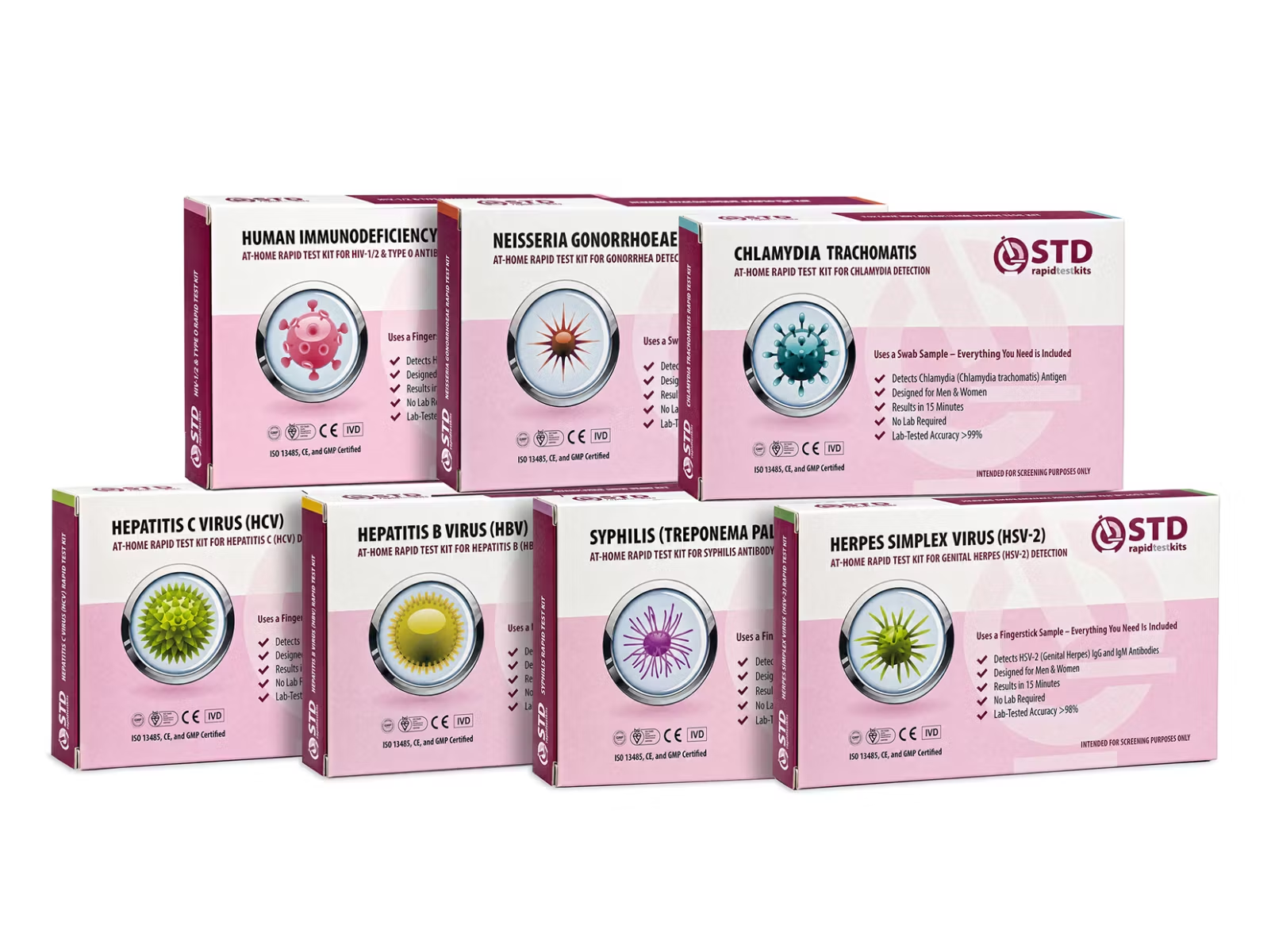
If herpes is part of what is worrying you, note that it sits outside the core panel covered above. A complete home kit adds an HSV-2 antibody test to the six core infections, which matters because herpes is one of the infections most often left off a standard order. Keep in mind that the HSV-2 component is a fingerstick blood antibody test: it looks for seroconversion in the weeks after exposure, not an active sore. When a current lesion is present, a clinic swab of that lesion is the better tool, and the blood antibody test is what confirms exposure later once enough time has passed.
Symptoms After a Negative Test: What Else Could Be Going On
A negative STI panel does not mean the symptoms are imaginary. Several non-STI conditions produce symptoms that overlap closely with the most common sexually transmitted infections, and they are easy to miss when the working assumption is “this must be an STI.”
Bacterial vaginosis (BV) and yeast overgrowth both cause discharge changes and irritation that can be mistaken for trichomoniasis or gonorrhea. BV in particular is often diagnosed only when a clinician looks for it specifically, and standard STI panels do not include it. Urinary tract infections cause burning and urgency that overlap with chlamydia and gonorrhea. Contact dermatitis from new lubricants, latex condoms, soaps, or laundry detergent can mimic herpes prodrome in its first 24 to 48 hours.
Hormonal shifts also matter. Cycle-related changes in cervical mucus, perimenopausal vaginal dryness, and pelvic pain related to ovulation or endometriosis can all read as “something is wrong” without being an infection. Pregnancy alters discharge and immune response, sometimes producing symptoms that resemble an STI without being one. In male anatomy, ingrown hair follicles, friction irritation, and routine balanitis can mimic the early appearance of a sore or rash.
If your STI tests are clear and the symptoms persist, the practical next steps are a wet prep or vaginal pH test for BV, a urine culture for UTI, a careful skin examination for contact dermatitis, and a hormonal workup when the pattern tracks with your cycle.
- Bacterial vaginosis (BV). Discharge changes and irritation; not on standard STI panels.
- Yeast overgrowth. Itching, thick white discharge.
- Urinary tract infection (UTI). Burning, urgency, cloudy urine.
- Contact dermatitis. Reaction to lubricants, latex, soaps, or laundry detergent.
- Hormonal shifts. Cycle changes, perimenopausal dryness, ovulation pain, pregnancy.
- Male-anatomy irritations. Ingrown follicles, friction, routine balanitis.
Partner Tested Positive, You Tested Negative
This pairing is one of the most panic-inducing situations a couple can face, and the first instinct is often to read it as proof of cheating. Most of the time, that reading is wrong. Discordant results between two partners usually come down to timing, sample technique, or test type, not to who slept with whom.
Per CDC partner-services guidance, an exposed partner who tests negative inside the window period may still be infected and should be retested at the right follow-up time. Some clinicians will also offer presumptive treatment, treating before retest results come back, when one partner is confirmed positive for a treatable bacterial STI like chlamydia or gonorrhea. Presumptive treatment of the second partner stops the back-and-forth reinfection that happens when only one person in a couple finishes a course of antibiotics.
If your partner just tested positive, the conversation goes better when you know three specific things before you start counting forward to your own retest date.
- Which infection did they test positive for? Window periods and retest intervals are infection-specific.
- When was their last possible exposure (with you or anyone else)? This sets the timeline you are working backward from.
- What kind of test did they use? A clinic NAAT, a home rapid test, and an antibody-only test have meaningfully different sensitivities.
With those three answers, count forward from your own last shared exposure to the right retest date for that specific infection (the window-period table earlier in this article is the starting point) and test on that date. If symptoms appear in the meantime, test sooner.
Self-Advocacy When the Result Does Not Match Your Symptoms
One of the more frustrating patterns in sexual health is the gap between symptoms and the language used to describe them. “Probably nothing,” “your tests are clear,” and “this is normal for you” can land as reassurance or as dismissal depending on whether the symptoms go away. If yours have not, the next steps are practical.
Ask for the specific list of infections that were on the panel. Most clinic systems will print or email this on request. Compare the list to your symptoms. If herpes was not tested and you have had genital tingling or sores, request a herpes IgG blood test, or a PCR swab if a lesion is currently active. If trichomoniasis was not tested with a NAAT, ask for one specifically. If you have had throat or rectal exposure, ask whether the swab covered those sites; standard genital swabs do not.
Bring a written symptom record. A few sentences with dates, what the symptom felt like, what it looked like, and what made it better or worse, are easier for a clinician to act on than a verbal recap. A written record also makes it harder for a rushed appointment to default to “probably nothing” when the documentation suggests otherwise. If a clinician is unwilling to order additional testing and your symptoms persist, a second opinion at a sexual health clinic or a different primary care provider is a reasonable next step.
According to the <a href="https://www.cdc.gov/hiv/testing/" target="_blank" rel="noopener noreferrer">CDC's HIV testing guidance</a>, no HIV test can detect infection immediately after exposure. The gap between getting HIV and the point a test can reliably detect it is called the window period, and it varies by test type.
Privacy, Discretion, and the Choice to Test at Home
Cost and convenience are part of why at-home testing exists. So is privacy. For people in small towns, in conservative family settings, in college dorms with shared mailboxes, or in any environment where being seen entering a sexual health clinic carries real social cost, an unmarked package and a result read at home is the difference between testing and not testing.
That choice does not require justification. Discreet shipping, kits that look like any other consumer health product, and results read at home rather than in a waiting room are reasonable accommodations for a category of healthcare that still carries stigma in many communities.
At-home rapid tests do not replace a clinician in every situation. They are most useful when used at the right point in the window period, when the panel matches your exposure profile, and when you understand the difference between a screening result and a diagnostic confirmation. A reactive (positive) at-home result should always be followed by confirmatory laboratory testing before any final diagnosis.

Your Next Steps If You Are Still Not Sure
If you tested negative but the situation does not feel closed, work through this short list before assuming the result is the end of the conversation.
First, count the days from your most recent possible exposure to the day of the test. Compare it to the relevant window period for each infection. If you tested inside the window for any one of them, plan a retest at the appropriate later interval (two to three weeks for chlamydia and gonorrhea, six weeks for hepatitis B and syphilis, six weeks for a lab HIV Ag/Ab draw, twelve weeks for a fingerstick HIV rapid, twelve to sixteen weeks for herpes IgG).
Second, identify what was on the panel. If herpes, trichomoniasis, mycoplasma genitalium, or hepatitis C were not included and they fit your exposure profile, request the missing tests by name.
Third, consider non-STI causes if your symptoms persist after a properly timed and properly scoped retest. BV, yeast, UTI, contact dermatitis, and hormonal changes are common, treatable, and worth ruling out.
Fourth, document what you are feeling. A short written symptom log, kept over a week or two, is one of the strongest tools you can bring to a follow-up appointment. Dates, descriptions, and triggers matter.
Fifth, retest at home or in clinic, whichever you can actually follow through with. A home kit you actually run is more useful than a clinic appointment that stays unbooked.
Retest, or See a Clinician?
Did you test within the window period for the infection you are most worried about?
Yes: Retest on or after the reliable test date for that infection (the window-period table above lists each one), or sooner if symptoms appear.
Have your symptoms continued after a correctly timed retest on the right panel?
Yes: Book a clinic visit for a site-specific exam and more sensitive lab testing such as a NAAT, PCR, or culture, plus a check for non-STI causes.
No: A properly timed negative on the right panel carries real weight. If you have ongoing new partners, a routine screen every three to six months is reasonable.
Guidance only. A healthcare provider can advise based on your specific situation.
FAQs
- Can I still have an STI if my test was negative?
- Yes. The most common reasons are testing inside the window period before the infection is detectable, using a panel that did not cover the infection you actually have, a sample technique issue that lowered the test's sensitivity, or an infection in a body site (throat, rectum) that the test did not sample.
- How long should I wait before retesting?
- For chlamydia and gonorrhea, two to three weeks after the original test is usually enough. For a lab HIV Ag/Ab combo draw, retest at six weeks; for a fingerstick rapid HIV Ag/Ab test, retest at twelve weeks if exposure risk was high. For syphilis and hepatitis B, retest at six weeks. For hepatitis C antibody, retest at twelve weeks (and up to six months for late seroconverters). For herpes IgG, retest at twelve to sixteen weeks if the first test was within four weeks of exposure.
- Is a faint second line on a rapid test positive?
- Yes. Any line that appears within the reading window printed on your kit insert counts as a positive result, no matter how faint. A mark that shows up after that window has closed is an evaporation artifact, not a result; discard it and retest. Confirm any reactive home result with a lab test before acting on it.
- My partner tested positive but I tested negative. Does that mean they cheated?
- Almost certainly not. Couples often get discordant results when one partner tested too early or used a less sensitive method. Retest at the correct follow-up interval for the specific infection your partner has. If it is a treatable bacterial STI like chlamydia or gonorrhea, ask your clinician about presumptive antibiotic treatment for both of you before retest results come back, so you are not reinfecting each other during the wait.
- Why do I have STD-like symptoms if my test was negative?
- Several non-STI conditions cause overlapping symptoms. Bacterial vaginosis, yeast infections, urinary tract infections, contact dermatitis from soaps or lubricants, ingrown hair follicles, and hormonal shifts can all produce burning, itching, discharge changes, or pelvic discomfort. Ask your clinician about a wet prep, a urine culture, or a careful skin exam if STI testing keeps coming back clear.
- Could herpes still show up later if I tested negative now?
- Yes. IgG antibody blood tests can take twelve to sixteen weeks to become reliably positive after exposure. If you tested within the first month, a negative result does not rule out a recent herpes infection. If a lesion appears, a PCR swab of the active lesion is more sensitive than IgG blood testing at that stage.
- Do standard STD panels include herpes and trichomoniasis?
- Not usually. Most default panels cover chlamydia, gonorrhea, syphilis, and HIV, with hepatitis sometimes added. Herpes and trichomoniasis are typically run only on request or in response to specific symptoms. If you want either tested, ask for them by name when you book.
- Should I tell my partner if my test was negative?
- If you had a possible exposure or if you have symptoms, tell them. A negative test inside the window does not rule out infection, and your partner deserves to make their own testing decisions. Frame it as an update, not a conclusion: “My test came back negative, but I tested early. I will retest in a few weeks, and you may want to as well.” That keeps both of you safer without assigning blame.
How we sourced this article: Our editorial team summarized current advice from the U.S. Centers for Disease Control and Prevention, the World Health Organization, the U.K. National Health Service, and NIH MedlinePlus, and translated it into plain English for the situations readers face after a negative test. Each numeric claim is anchored to a specific organization's public guidance. We do not invent statistics or fabricate clinician quotes. This article is medical information for general audiences and is not a substitute for individualized clinical advice.
- U.S. Centers for Disease Control and Prevention. STI program overview, including who should be screened, partner-services guidance, and retesting recommendations.
- U.S. Centers for Disease Control and Prevention. HIV testing window periods and guidance on test types (NAAT, antigen/antibody combo, antibody-only, fingerstick rapid vs lab venipuncture).
- U.S. Centers for Disease Control and Prevention. Sexually Transmitted Infections Treatment Guidelines, 2021. Reference for retesting intervals after a negative result during the window period and for the limits of routine herpes serologic screening in low-prevalence populations.
- World Health Organization. Fact sheet on sexually transmitted infections, including diagnosis, global epidemiology, the frequency of asymptomatic infection, and the role of screening in transmission control.
- U.K. National Health Service. Overview of sexually transmitted infections and when to seek testing, including sample-site dependence and when a clinic-collected swab is more appropriate than a home test.
- U.S. National Library of Medicine, MedlinePlus. Sexually transmitted diseases overview, including swab-based and blood-based testing methods and what to expect from a panel.
