
Published: August 2025 | Last updated: April 2026 | Editorial review and quality control: Martina N.
Most people who land on a page like this are not in real danger. They had a moment of worry after solo sex, or a question about whether something they did with a partner counts as risky, and they want a clear answer. The short version is reassuring: solo masturbation, by yourself, with clean hands and your own body, is essentially zero-risk for sexually transmitted infections. You cannot infect yourself with something your body is not already carrying.
The longer version covers the situations where the answer changes. Mutual masturbation with a partner who has an infection. Sex toys that travel between people without being cleaned. The rare case where someone with a fresh cold sore on their lip touches that lesion and then their genitals. Each of those carries a different level of risk, and each has a clear way to handle it.
Can you actually get an STD from masturbating?
Solo masturbation cannot give you a new sexually transmitted infection. The only ways masturbation enters the picture for STI risk are mutual masturbation with an infected partner (genital fluids or active skin lesions on their hands or genitals), sharing a sex toy that was not cleaned between users, or transferring an active oral herpes lesion from your mouth to your genitals on your own fingers. The vast majority of routine self-touching is safe.
Key Takeaways
- Solo masturbation, alone with your own body, is one of the lowest-risk activities for STI transmission. You cannot give yourself an infection you don't already have.
- The real risks come from mutual masturbation with an infected partner, shared sex toys without cleaning between users, and self-spreading oral herpes to your genitals via your hands.
How STIs actually spread
To understand why solo masturbation is so low-risk, it helps to know exactly how sexually transmitted infections move from one person to another. There are essentially three transmission routes for the infections covered by routine testing.
The first is exchange of body fluids during sex. Semen, pre-ejaculate, vaginal fluid, and rectal fluid can carry chlamydia, gonorrhea, trichomoniasis, HIV, hepatitis B, and hepatitis C. The infection rides those fluids into mucous membranes in the genitals, throat, or rectum. According to the U.S. Centers for Disease Control and Prevention, these infections "pass from one person to another through vaginal, oral, and anal sex" and require contact between an infected fluid and a vulnerable mucous membrane (CDC, About Sexually Transmitted Infections).
The second is direct skin-to-skin contact in the genital area. Herpes simplex virus, human papillomavirus (HPV), and the bacteria that cause syphilis (during the chancre stage) all spread through contact with infected skin or mucous membranes, even when no fluid is exchanged. The CDC notes that HPV "is spread through intimate skin-to-skin contact" and you can pick it up "even if they don't have signs or symptoms" (CDC, About HPV).
The third is through blood. Sharing needles is the classic example. Blood-borne transmission also matters in rare cases where a sex toy crosses between users with broken skin or fresh tears, though this is far less common than the first two routes.
Solo masturbation involves none of those routes. There is no second person, no exchange of fluid with anyone else, no skin contact with anyone else's genitals.
Sexually transmitted infections need a source. They have to come from someone or something that already has them. If you are alone, your hands have not touched an infected person or surface, and you are using your own body, you cannot give yourself an STI you do not already have.
Solo masturbation: the real risk profile
Picture an average evening of self-touching at home. You have been at work all day, your hands have not been near anyone else's genitals, and the only body involved is yours. The list of possible infections you could acquire from this activity is empty. There is no chlamydia in your kitchen. There is no HIV on your bedsheets. The bacteria and viruses that cause STIs do not survive long outside a human host, and they cannot generate themselves out of thin air.
The CDC's HIV transmission page makes this point in stronger terms for HIV specifically, noting that the virus "does not survive long outside the human body" and you cannot acquire it through "touching" or surface contact (CDC, How HIV Spreads). The same physical reality applies to chlamydia and gonorrhea, which require living mucosal cells to replicate, and to syphilis, which is killed within minutes outside a human host.
What about the very small handful of organisms that can persist briefly on surfaces? Trichomoniasis can theoretically survive on a damp washcloth or sex toy for a short window. Pubic lice can live off a human body for a day or two. Both still require some path from another person to you. They cannot spawn out of nothing.
Beyond the question of infections, solo masturbation has a substantial set of documented health benefits. Stress reduction, sleep improvement, pelvic floor activity, and a healthier relationship with your own body are all reasonable reasons to keep doing what you are doing. The activity itself is not the problem. The misconceptions around it sometimes are.
Beyond being low-risk for infection, solo masturbation is associated with stress reduction, better sleep, pelvic-floor activity, and a healthier relationship with your own body. It is a normal part of sexual health rather than a behaviour to manage anxiously.
When solo masturbation can transmit infection
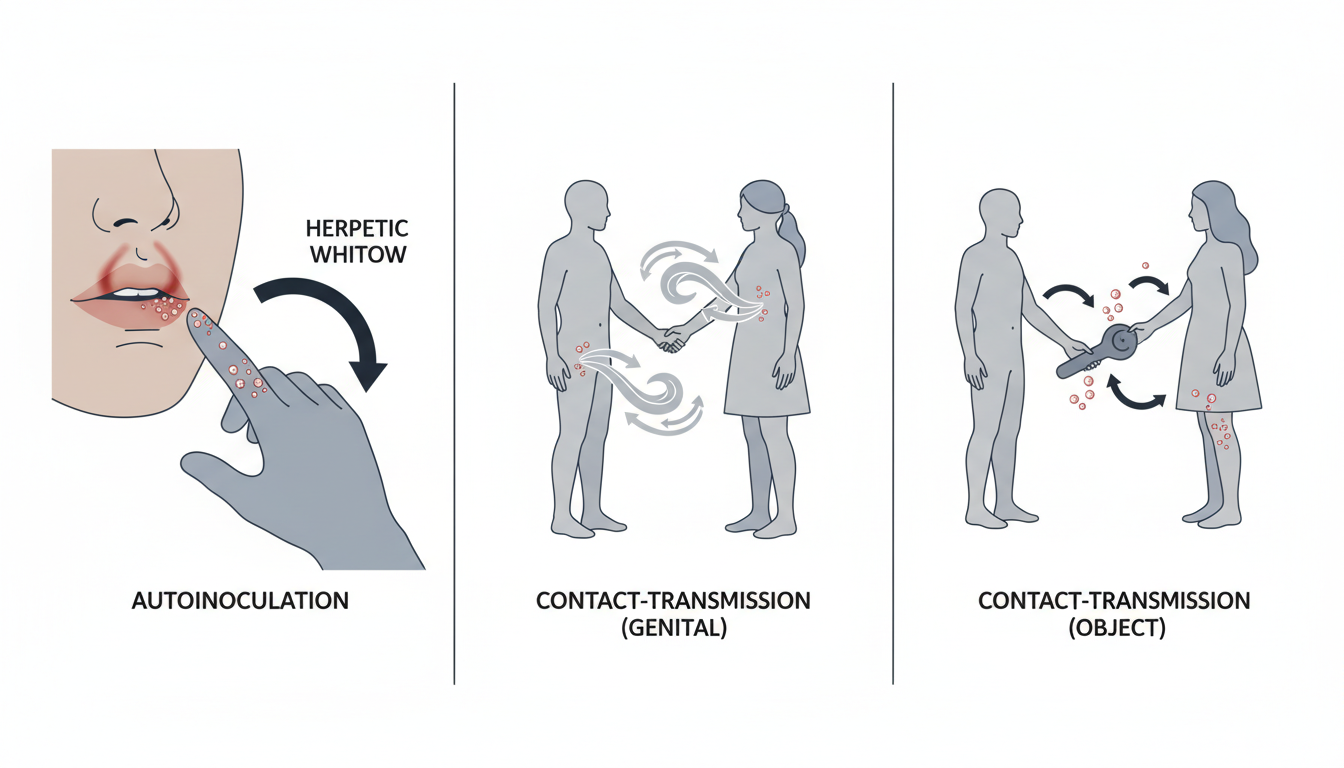
There is one scenario where touching yourself can move an infection from one part of your body to another. This is called autoinoculation. It is uncommon, but it is real, and it almost always involves herpes.
Imagine someone has an active cold sore on their lip caused by oral herpes (HSV-1). They touch the cold sore with their fingers, do not wash their hands, and then touch their own genitals during masturbation. The virus can transfer to the new location and seed a genital herpes infection, this time caused by HSV-1 rather than the more typical HSV-2. The CDC's herpes page confirms that "the skin can release the virus (shed) from areas that do not have a visible herpes sore," which means even a healing or barely-visible lesion can be infectious (CDC, About Genital Herpes).
The same mechanism, in theory, could move HPV from one part of the body to another, although the practical risk is lower because HPV is so common and so often already present. Autoinoculation matters most when:
- There is an active oral herpes outbreak, with a visible cold sore or a tingling prodrome (the early warning sensation that often precedes an outbreak).
- The fingers come into direct contact with the lesion or its fluid.
- The same hand then touches the genital area without being washed.
The fix is straightforward. Wash your hands with soap and water between touching your face and touching your genitals during an active cold sore. If the sore is open and weeping, skip the genital touching for that session entirely. Once the lesion has fully crusted and resolved, the autoinoculation risk drops back to near zero.
One more rare situation worth flagging: if you have an open cut, abrasion, or eczema flare on your hands or fingers, and your own genital area also has an active infection (a known case of HPV warts, an active herpes outbreak, or a syphilitic chancre), repeated rubbing of the lesion can occasionally seed the infection in those broken skin sites. This is unusual but documented in clinical case reports.
Mutual masturbation: hands, fluids, and skin
Mutual masturbation, where two people use their hands on each other's genitals, is meaningfully different from solo masturbation. Now there is a second person, and any infection that person carries is now in play. Whether the activity is risky depends on what the partner has, what is on their hands, and which surfaces are touching what.
The risk profile breaks down into two categories.
Body-fluid infections
If a partner has an active infection caused by chlamydia, gonorrhea, trichomoniasis, or HIV, their genital fluids carry the pathogen. When their fluid ends up on your hand and you then touch your own genital mucosa or rub your own urethra during the same session, transmission becomes plausible. The risk is much lower than direct genital-to-genital sex (the contact is briefer, the fluid quantity smaller, the skin barrier on hands is thicker than mucous membrane), but it is not zero, especially for chlamydia and gonorrhea where infectious doses are small.
Skin-contact infections
Herpes (HSV-1 and HSV-2), HPV, and primary-stage syphilis spread through skin-to-skin contact. If a partner has an active herpes lesion on their genitals, an HPV wart, or a syphilis chancre, your hand touching that lesion and then your genitals creates a transmission route that does not require any fluid exchange at all. The CDC explicitly warns that herpes can be acquired "from a sex partner who does not have a visible sore or is unaware of their infection," because viral shedding occurs without symptoms (CDC, About Genital Herpes).
This is why mutual masturbation is sometimes recommended as a lower-risk alternative to penetrative sex but is not zero-risk. It cuts out the fluid-into-mucosa route that drives most chlamydia and gonorrhea transmission, but it does not eliminate the skin-contact route for herpes and HPV.
The practical answer for couples: know your own status and your partner's status, wash hands before and after, and avoid mutual masturbation during a known active outbreak of herpes or while either partner has visible warts or a chancre.
Herpetic whitlow is a known clinical entity: an HSV infection on the fingers, usually contracted by touching an active oral or genital lesion. From the fingers, the virus can move to other body sites the same way. Hand washing breaks the chain. If you or a partner has an active outbreak anywhere, treat the hands as a potential vector and wash with soap and water before touching mucous membranes.
Sex toys: the underrated transmission concern
Sex toys are the place where most people genuinely underestimate STI risk. Any infection that can be transmitted sexually can ride along on a toy. Bacteria like chlamydia and gonorrhea can survive on a damp surface for hours. Viruses with envelopes (herpes, HIV) survive a shorter time but long enough to matter for back-to-back use. Non-enveloped viruses like HPV are more durable still. Trichomoniasis can persist on damp objects for half a day or more.
The transmission scenario is straightforward. Person A uses a toy. Person A has an undiagnosed (or known) infection. The toy is set down without cleaning. Person B picks up the same toy minutes, hours, or days later. Now the pathogen has a path from A to B even though A and B never touched each other directly.
The risk depends heavily on three factors:
- Time between uses. The longer the toy sits, the lower the viable pathogen load. Most STI organisms are dead or no longer infectious after 24 hours on a clean dry surface, although HPV and trichomoniasis are notable exceptions.
- Material. Non-porous materials (medical-grade silicone, glass, stainless steel, hard ABS plastic) can be fully disinfected. Porous materials (TPE, jelly rubber, some elastomers) absorb fluid into microscopic pores and cannot be reliably sterilized, even with thorough surface cleaning.
- Cleaning between uses. A proper soap-and-water clean immediately after use, followed by complete drying, removes the vast majority of risk for non-porous toys.
The single most important habit is not sharing toys without cleaning between users. The second most important is using a fresh condom on a toy if it is being passed between bodies in the same session.
| Toy material | Can be fully sanitized | Recommended cleaning | Safe to share |
|---|---|---|---|
| Medical-grade silicone (non-vibrating) | Yes | Soap and hot water; can also boil for 3 minutes or top-rack dishwasher (no soap) | Yes, with cleaning between users |
| Medical-grade silicone (vibrating) | Yes (surface only) | Soap and warm water on the body; do not submerge motor | Yes, with cleaning between users |
| Glass (borosilicate) and stainless steel | Yes | Soap and warm water; can also boil briefly | Yes, with cleaning between users |
| Hard ABS plastic | Yes (surface only) | Soap and warm water; isopropyl wipe | Yes, with cleaning between users |
| TPE, TPR, jelly rubber, PVC (porous) | No | Soap and water clean removes surface contamination only | Not recommended; if shared, use a condom each time |
Skin breaks, lubricant irritation, and infection vulnerability
One indirect way that masturbation can raise infection risk is by creating microtrauma in genital skin. Aggressive technique, dry friction without lubricant, harsh soaps, certain spermicidal lubricants, and abrasive toy materials can all leave small abrasions or inflamed skin. None of those breaks magically generate infections. They do, however, give a future infection an easier path in.
This is the same reason vigorous sex without lubrication slightly increases the per-act risk of HIV and other infections in any partnered context. The skin barrier is the body's first defense. Compromised skin lets pathogens reach immune cells and mucosal tissue more easily. If a microabrasion is in place when an infectious exposure happens (a few hours later, a few days later) the exposure is more likely to take.
Practical prevention here is uncomplicated. Use a body-safe water-based or silicone-based lubricant if friction is an issue. Avoid harsh soaps and antiseptics on the genital area; the skin there is sensitive and the bacterial flora is generally protective rather than harmful. Trim fingernails. Avoid sharing or reusing applicator-based products like lube tubes if you share them with a partner during the same session.
Body-safe lubricant guidance
- Use water-based or silicone-based lubricants formulated for genital use.
- Avoid soaps, body oils, lotions, and antiseptics on genital skin.
- Skip oil-based lubricants if you also use latex condoms; oils degrade latex.
- Replace or do not share applicator-style lube tubes between partners during the same session.
How to make masturbation safer (a short, practical list)
The behaviors that turn an already low-risk activity into a near-zero-risk activity are simple and require no special equipment.
- Wash your hands before and after. Soap and water for 20 seconds is enough. This handles autoinoculation risk completely and protects against any incidental contamination from surfaces.
- Do not touch your genitals during an active oral cold sore without washing your hands first. If the sore is open and weeping, do not touch the genital area at all that day.
- Do not share sex toys with a partner without cleaning between users. If you do share, use a fresh condom on the toy.
- Choose non-porous toy materials (silicone, glass, stainless steel) if you have a partner you may share with. Porous toys are fine for solo use but should not move between bodies.
- Use a body-safe lubricant if friction is an issue. Avoid soaps, oils, and lotions not formulated for genital use, especially with latex condoms.
- Take a break if there are open sores, cuts, or rashes on the genital area. Wait until skin is intact again.
- Trim fingernails to prevent accidental abrasion.
None of this is complicated. The summary is essentially: clean hands, clean toys, intact skin, common sense.
The safer-masturbation checklist
- Wash hands before and after, especially during any active oral or genital outbreak.
- Use non-porous toys (silicone, glass, stainless) if you share with a partner.
- Clean toys with soap and water immediately after use; dry fully before storing.
- Skip sessions when you have open sores, cuts, or active outbreaks anywhere relevant.
- Use body-safe lubricant if friction is causing irritation.
When to test (and what to test for)
If you are reading this because you are worried after a specific incident, the question is less about masturbation as a category and more about the specific exposure. Three questions sort the answer for most people.
Was there contact with another person's genitals or fluids? Mutual masturbation with a new or recently new partner is a real exposure. So is sharing a toy without cleaning. If yes, testing is reasonable. If no, you almost certainly do not need a test based on solo masturbation alone.
The infections worth screening for after a mutual masturbation or shared-toy exposure are the same ones screened for after any partnered sex: chlamydia, gonorrhea, HIV, syphilis, hepatitis B and C, and (if symptoms appear) herpes. The WHO notes that more than 30 different organisms transmit through sexual contact, but routine screening focuses on the ones that are common, treatable, and where early diagnosis changes outcomes (WHO, STI Fact Sheet).
Is there a current symptom? Discharge, burning on urination, a new sore or rash, pelvic or testicular pain, or unexplained itching are reasons to test promptly regardless of what triggered the concern. Most STIs are asymptomatic in the early phase, but a symptom is always a reason to act.
How long since the exposure? Each infection has a window period during which a test cannot reliably detect it. Chlamydia and gonorrhea become detectable on swab tests around 7-14 days. HIV antibody tests become reliable from about 23-90 days post-exposure; fourth-generation antigen/antibody combination tests can turn positive earlier, from around 18-45 days, depending on the specific assay. Syphilis serology becomes reliable around 3-6 weeks. Testing too early gives false reassurance; testing at the right time gives useful answers.
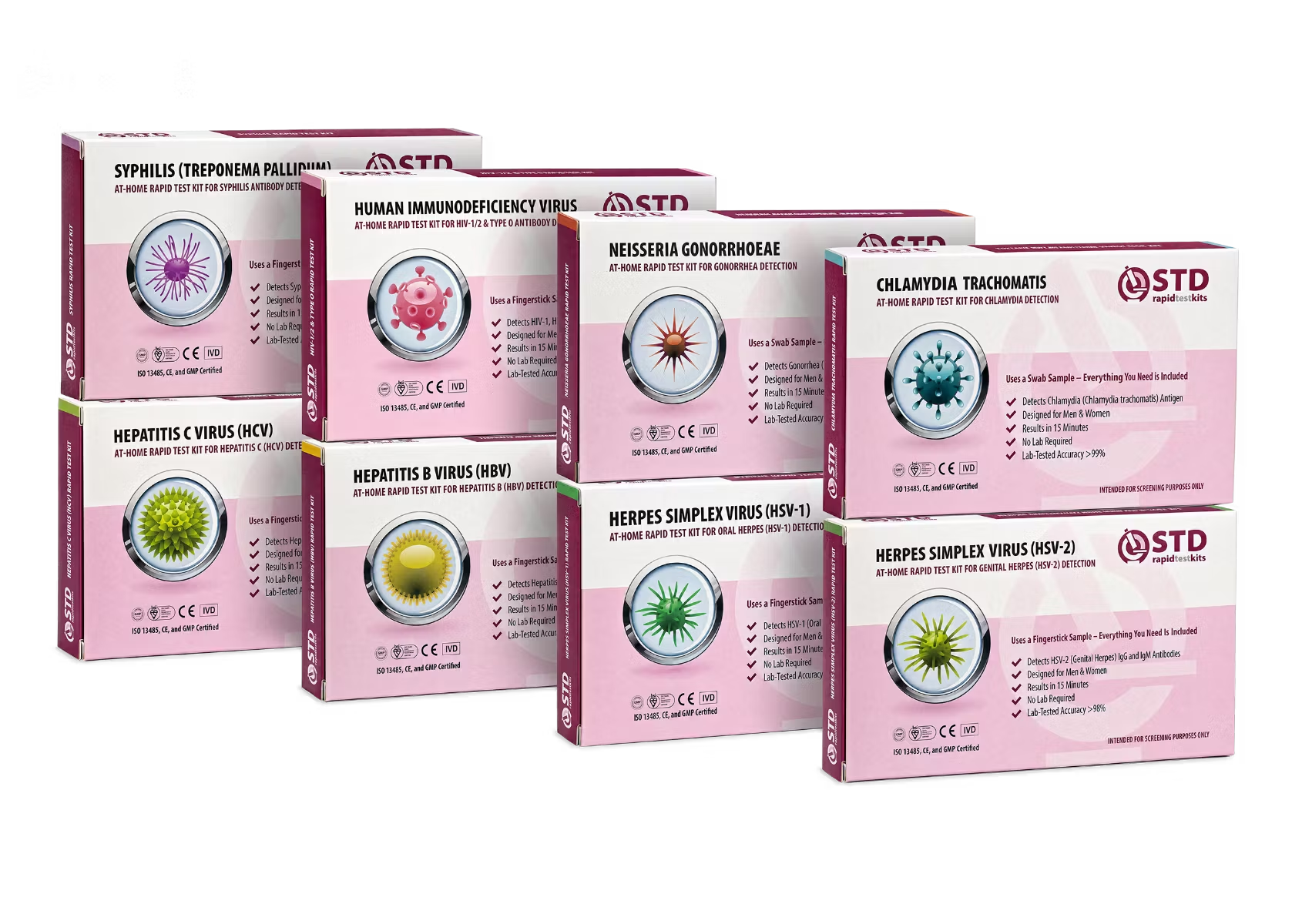
This site sells rapid at-home lateral-flow STI test kits. The products mentioned below are kits we stock; we recommend each based on fit-for-purpose for the reader's concern, not commercial benefit.
Masturbating during STI treatment
If you have been diagnosed with an STI and are working through a treatment course, the question of whether you can still masturbate has a more practical, less worried answer: yes, almost always.
Bacterial STIs (chlamydia, gonorrhea, syphilis, trichomoniasis) are not transmitted from one part of your own body to another by masturbation. The infection is in your genital tract, your own immune system and antibiotics are clearing it, and self-touching does not move it anywhere new. The standard guidance is to avoid sex with partners until treatment is complete and any required wait period has passed (typically 7 days after a single-dose antibiotic, or after completing a full course). Solo masturbation does not need that pause.
Herpes during an active outbreak is the partial exception. The lesions are infectious to others, and the oral-to-genital autoinoculation risk applies. Wash hands carefully, avoid touching the lesion and then other body sites, and let the lesion heal completely before any partnered activity.
Topical treatments (creams for warts, antiviral creams for herpes) come with their own instructions. Most ask you to apply the medication and avoid the area for a window after application. Read the leaflet rather than the internet.
If a treatment makes the genital skin tender or sensitive, pause solo activity until the skin has recovered. Forcing through soreness does not speed healing and can prolong the irritation.
Solo masturbation does not interfere with antibiotic or antiviral treatment for any common STI. The pause that matters is the one before resuming partnered sex: usually 7 days after a single-dose antibiotic, or after completing a full course. During an active herpes outbreak, wash hands carefully so the lesion does not move to other body sites.
Symptoms that mean stop, and test
Most STIs cause no symptoms at all in the first weeks or months after exposure. The CDC notes that many STIs are asymptomatic and that "testing is the only way to know" for sure (CDC, About Sexually Transmitted Infections). When symptoms do appear, they tend to fall into a recognizable list.
- Unusual discharge from the penis or vagina, especially if it is yellow, green, gray, or strongly odorous.
- Burning or pain on urination (dysuria) without an obvious cause like dehydration or a recent UTI.
- New sores, ulcers, or blisters on or near the genitals or buttocks. A single painless ulcer suggests primary syphilis. Clusters of small painful blisters suggest herpes. Painless flesh-colored bumps suggest HPV warts.
- Itching, rash, or visible lice in the pubic area suggests scabies or pubic lice.
- Pelvic or lower abdominal pain in women, especially with intermenstrual or post-coital bleeding, can suggest ascending chlamydia or gonorrhea infection (pelvic inflammatory disease).
- Testicular pain or swelling in men can suggest epididymitis (inflammation of the tube behind the testicle), often caused by chlamydia or gonorrhea.
- Flu-like illness with rash 2-4 weeks after a high-risk exposure can be acute HIV seroconversion.
If any of these appear, do not wait for them to pass on their own. The bacterial infections in the list are quickly curable with antibiotics; the viral ones are manageable with appropriate treatment. Delay primarily increases the chance of complications (infertility, chronic pelvic pain, transmission to others) without changing how easy the infection is to treat in itself.
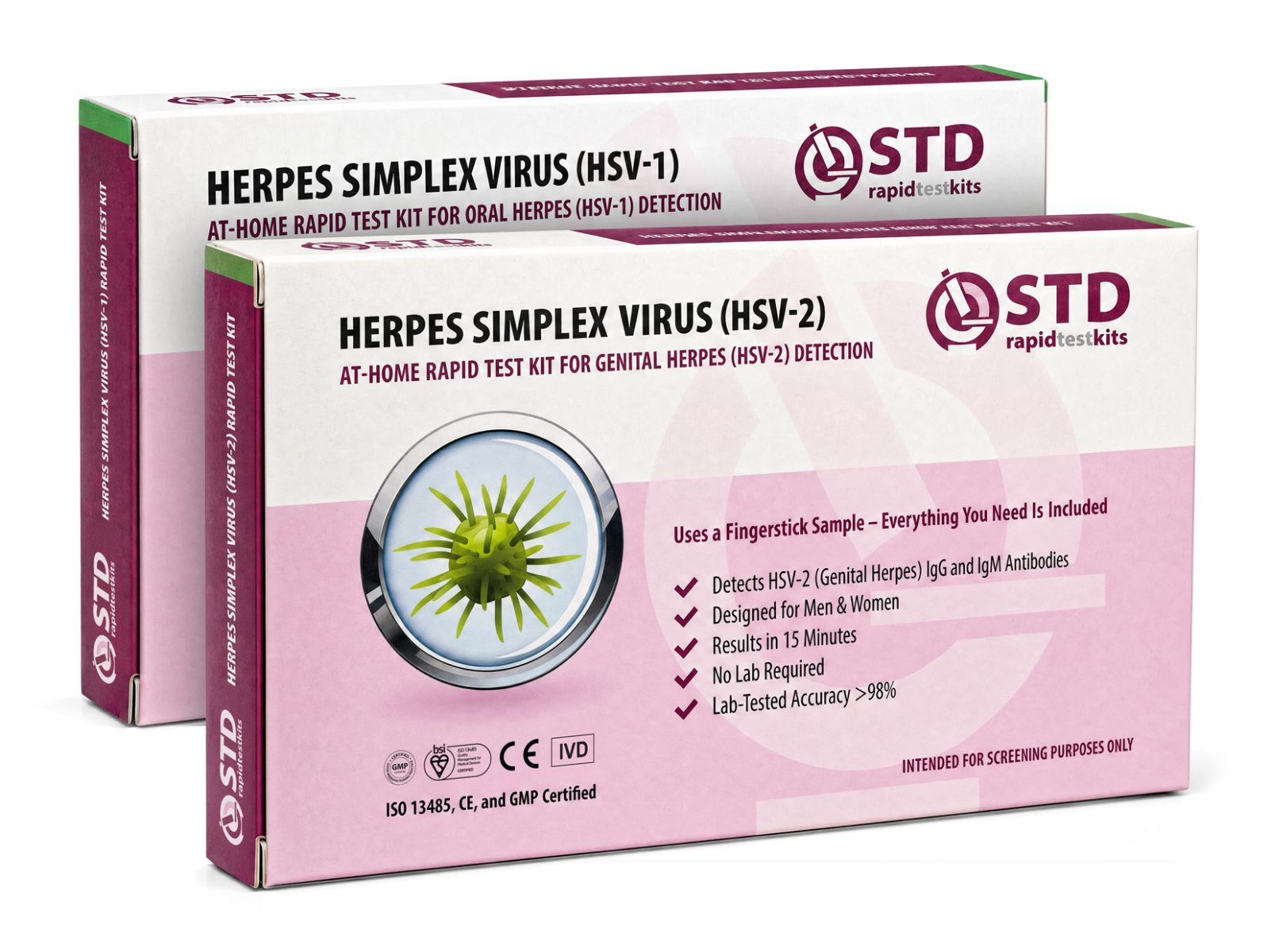
You also can get genital herpes from a sex partner who does not have a visible sore or is unaware of their infection. The skin can release the virus (shed) from areas that do not have a visible herpes sore.
Common myths about masturbation and STIs
The internet is full of confident misinformation on this topic. A few of the more common claims, with what the evidence actually says.
Myth: Masturbation can cause STIs even if you are alone.
It cannot. Sexually transmitted infections require a source. Your own body alone is not a source for an infection you do not already have.
Myth: Masturbating too often weakens your immune system and leaves you vulnerable to STIs.
There is no evidence that masturbation, at any frequency, suppresses the immune system. Hormonal and immune effects of orgasm are short-lived and not clinically meaningful for infection susceptibility.
Myth: You can get an STI from a public toilet seat or a hotel bedsheet.
The organisms that cause common STIs do not survive long on cool, dry surfaces. The CDC's herpes page is direct on this: "You will not get herpes from toilet seats, bedding, or swimming pools" (CDC, About Genital Herpes). The same logic applies to chlamydia, gonorrhea, syphilis, and HIV.
Myth: Mutual masturbation is completely safe sex.
It is lower-risk than penetrative sex, but it is not zero-risk. Skin-to-skin transmission of herpes and HPV is the main reason. Hand-to-genital fluid transfer for chlamydia and gonorrhea is a smaller but real route.
Myth: A shared sex toy that looks clean is clean.
Visual inspection is not enough. Pathogens are microscopic. A toy that has been used by another person and not properly cleaned is a transmission risk regardless of how it looks. The NHS advises that people having casual sex with new partners without a condom are at risk of STIs and should consider a clinic visit for testing (NHS, Sexually Transmitted Infections).
Toilet seats and bedsheets are not infection routes. A shared damp sex toy passed between users without cleaning is. If you take one rule from this article away, make it this: clean toys with soap and water immediately after use, dry them fully, and use a fresh condom on any toy that moves between bodies during the same session.
Frequently asked questions
- Can I get an STD from masturbating with my own clean hands?
- No. Sexually transmitted infections require a source, and your own body alone is not a source for infections you do not already have. Solo masturbation with clean hands is essentially zero-risk for new STI acquisition.
- What about masturbating after touching a doorknob or other public surface?
- The pathogens that cause common STIs do not survive on dry surfaces long enough to transmit through casual contact. Routine hand washing handles any incidental contamination. You do not need special precautions beyond the hand-washing you would do anyway.
- I have a cold sore on my lip and accidentally touched my genitals. Should I be worried?
- There is a real but low risk of self-transferring HSV-1 to the genital area, especially if the sore was open or weeping when you touched it. Wash the area with soap and water now if you have not. Watch for tingling, redness, or small blisters in the genital area over the next 2-12 days (per CDC, About Genital Herpes). Most exposures do not result in transmission, but if symptoms appear, see a clinician for a swab test of the lesion.
- Is mutual masturbation safer than oral or penetrative sex?
- Yes, it is a meaningful risk reduction for chlamydia, gonorrhea, and HIV. It is not a complete reduction. Herpes and HPV transmit through skin-to-skin contact, so an active lesion or warts on either partner's genitals can still spread. Hand washing and avoiding mutual masturbation during active outbreaks closes most of the residual gap.
- How do I clean a sex toy properly?
- Soap and warm water immediately after use, working into all crevices and around the base. Rinse thoroughly. Air dry on a clean surface. Non-vibrating silicone, glass, and stainless steel toys can also be boiled for 3 minutes or run through the top rack of a dishwasher with no soap. Vibrating toys should not be submerged. Porous materials (jelly, TPE) cannot be fully sanitized and should not be shared.
- Can a sex toy I used months ago still carry an infection?
- For most pathogens, no. Bacteria like chlamydia and gonorrhea die within hours on dry surfaces. Enveloped viruses like HIV and herpes survive only briefly outside a host. HPV is more durable and trichomoniasis can persist on a damp surface for up to a day, but a fully cleaned and dried toy stored for weeks is not a meaningful infection risk.
- Should I get tested if I only masturbate alone and never with a partner?
- Routine STI screening is recommended for sexually active adults based on partnered activity, not solo. If solo masturbation is your only sexual activity and your last partnered exposure was years ago with a clean test result since, there is no specific reason to test. The CDC recommends screening based on risk factors like new partners, multiple partners, or known exposures.
- I have an STI and am in treatment. Can I keep masturbating?
- Yes, in almost all cases. Solo masturbation does not interfere with antibiotic or antiviral treatment for bacterial or viral STIs. The exception is during an active herpes outbreak, where you should wash hands carefully to avoid spreading the lesion to other body sites. Avoid partnered activity until treatment is complete and any required wait period (usually 7 days for single-dose antibiotics) has passed.
- U.S. Centers for Disease Control and Prevention. About Sexually Transmitted Infections (STIs): definitions, transmission routes, prevalence, and the role of asymptomatic carriage.
- U.S. Centers for Disease Control and Prevention. STI Prevention: prevention strategies including condoms, vaccination, partner reduction, and testing.
- U.S. Centers for Disease Control and Prevention. About Genital Herpes: skin-to-skin transmission, asymptomatic viral shedding, and what does and does not transmit herpes.
- U.S. Centers for Disease Control and Prevention. About HPV: intimate skin-to-skin transmission and prevalence even without visible signs.
- U.S. Centers for Disease Control and Prevention. How HIV Spreads: confirmed transmission routes, no-risk activities, and survival outside the body.
- World Health Organization. Sexually Transmitted Infections (STIs) Fact Sheet: global prevalence figures, transmission routes, and screening guidance.
- U.K. National Health Service. Sexually Transmitted Infections (STIs): symptom overview, when to test, and recommendations for new partners.
