How to Overcome the Stigma of STD Testing and Take Charge of Your Health
STI testing carries weight it does not deserve. Most people put it off because of shame, not because of cost or access. Here is what changes when you treat it as preventive care: less anxiety, earlier answers, and a smaller chance of passing something on. We walk through the science, the practical steps, and why home test kits are shifting the conversation.




- Routine STI screening is preventive care, not a verdict on your behavior. The CDC recommends at least annual testing for sexually active adults, with more frequent screening for some risk categories.
- Most common STIs are treatable or manageable when caught early. Delaying because of embarrassment is what causes lasting harm, not the test itself.
Published: October 2025 | Last updated: May 2026 | Editorial review and quality control: Martina N.
Most people put off STI testing for one reason, and it is not cost or access. It is the small, quiet dread of being seen. The waiting-room glance. The pharmacy receipt. The internal jury that decides whether asking for a test means something about who you are. None of that has anything to do with the test itself, which takes a few minutes and answers a question that probably will not be the one you feared. The gap between how testing feels and what it actually does is where a lot of avoidable problems start.
This article is about closing that gap. We will walk through where the stigma comes from, what regular screening buys you in terms of health and peace of mind, and how at-home test kits have changed the math for people who would never set foot in a clinic. None of this requires being brave. It mostly requires reframing what testing means.
Key Takeaways
- Routine STI screening is preventive care, not a verdict on your behavior. The CDC recommends at least annual testing for sexually active adults, with more frequent screening for some risk categories.
- Most common STIs are treatable or manageable when caught early. Delaying because of embarrassment is what causes lasting harm, not the test itself.
Why testing feels harder than it should
Testing for an STI is medically one of the simpler things you can do for your health. The actual procedure takes minutes. The results, for most infections, come back quickly. The treatments, when needed, are usually short courses of antibiotics or well-managed antiviral therapy. By any clinical measure this is a low-friction, high-information intervention. The reason it feels hard is almost entirely separate from the medicine.
Three forces push against testing. The first is moral framing inherited from a century of public-health messaging that treated STIs as evidence of bad character rather than as common infections people get from being human and sexual. The second is privacy anxiety, the worry that asking for a test will be visible to a partner, parent, insurer, or employer in some way you cannot fully predict. The third is plain unfamiliarity. Most people are never told, in any practical way, when to test, what to test for, or how often. The system relies on you to ask, and asking feels like admitting something.
None of these is a reason to skip testing. They are reasons it feels harder than it should.
Moral framing. A century of public-health messaging treated STIs as evidence of bad character.
Privacy anxiety. The worry that asking for a test will be visible to a partner, parent, insurer, or employer.
Plain unfamiliarity. Most people are never told when to test, what to test for, or how often.
Where the stigma comes from, and why it is finally shrinking
Public-health attitudes toward STIs were shaped in the early 20th century by campaigns that fused infection with immorality. Posters from the period warned soldiers that contracting an STI was a personal failing and a betrayal of country. That framing leaked into clinics, into school sex-education curricula, and into the way doctors talked to patients well into the 1980s. It left a long shadow.
The picture has been shifting on two fronts. HIV testing normalized over decades, moving from a fear-laden event in the 1980s to a routine part of primary care today, on the strength of sustained advocacy and clearer messaging from the CDC and WHO. At-home testing has accelerated the broader change by removing the most stigmatized step, the in-person clinic visit, from the experience entirely. When you can test in your own bathroom and get results without a clinician present, the social cost drops to almost zero.
That does not mean the stigma is gone. Surveys still find that fear of judgment is one of the most common reasons people give for not testing. It does mean the tools and the cultural footing for changing the conversation are better than they were a generation ago.
HIV testing normalization. From the fear-laden 1980s to routine primary care today, on the back of decades of advocacy and clearer public-health messaging.
At-home testing. Removes the most stigmatized step in the process, the in-person clinic visit, from the equation entirely.
What the evidence shows about regular testing
The basic case for routine STI screening is unglamorous and well supported. Per the CDC's STI prevalence research, roughly one in five people in the United States had an STI on a given day in the most recent surveillance cycle (see CDC STI statistics hub for the underlying reports). Most of those infections were asymptomatic at the time of detection. That single number is the strongest argument for testing on a schedule rather than after symptoms appear. By the time symptoms show, the infection has typically had time to spread or to cause downstream damage like pelvic inflammatory disease or untreated syphilis progression.
Early detection changes outcomes for nearly every common STI. Chlamydia and gonorrhea, the two most-reported bacterial STIs in the US, are curable with antibiotics when caught early; untreated, they are leading preventable causes of infertility. Syphilis is curable in its primary and secondary stages with a single penicillin injection; untreated, it can cause neurological damage years later. HIV is no longer life-limiting on antiretroviral therapy started promptly, and people on suppressive treatment with an undetectable viral load do not transmit the virus to partners. Hepatitis B and C have effective treatments and, in the case of hepatitis C, a high cure rate.
This article is published by stdrapidtestkits.com, which sells at-home STI testing kits. We recommend products based on fit for the reader's concern, not commercial benefit. Where home testing is the wrong tool for the question, we say so plainly.
Practical ways to lower the activation energy
If your problem with testing is friction rather than philosophy, several small changes make a real difference.
Pick a recurring trigger. Many people fold testing into another routine event: an annual physical, a birthday, the start of a new relationship, the first month of a new year. Tying it to something you already do removes the question of when, which is where most people get stuck.
Test before symptoms, not after. The waiting-for-symptoms approach selects for the worst experiences with testing, because by then you are already worried. Routine testing at a calm moment trains a different association: you test because you are sexually active, not because something is wrong.
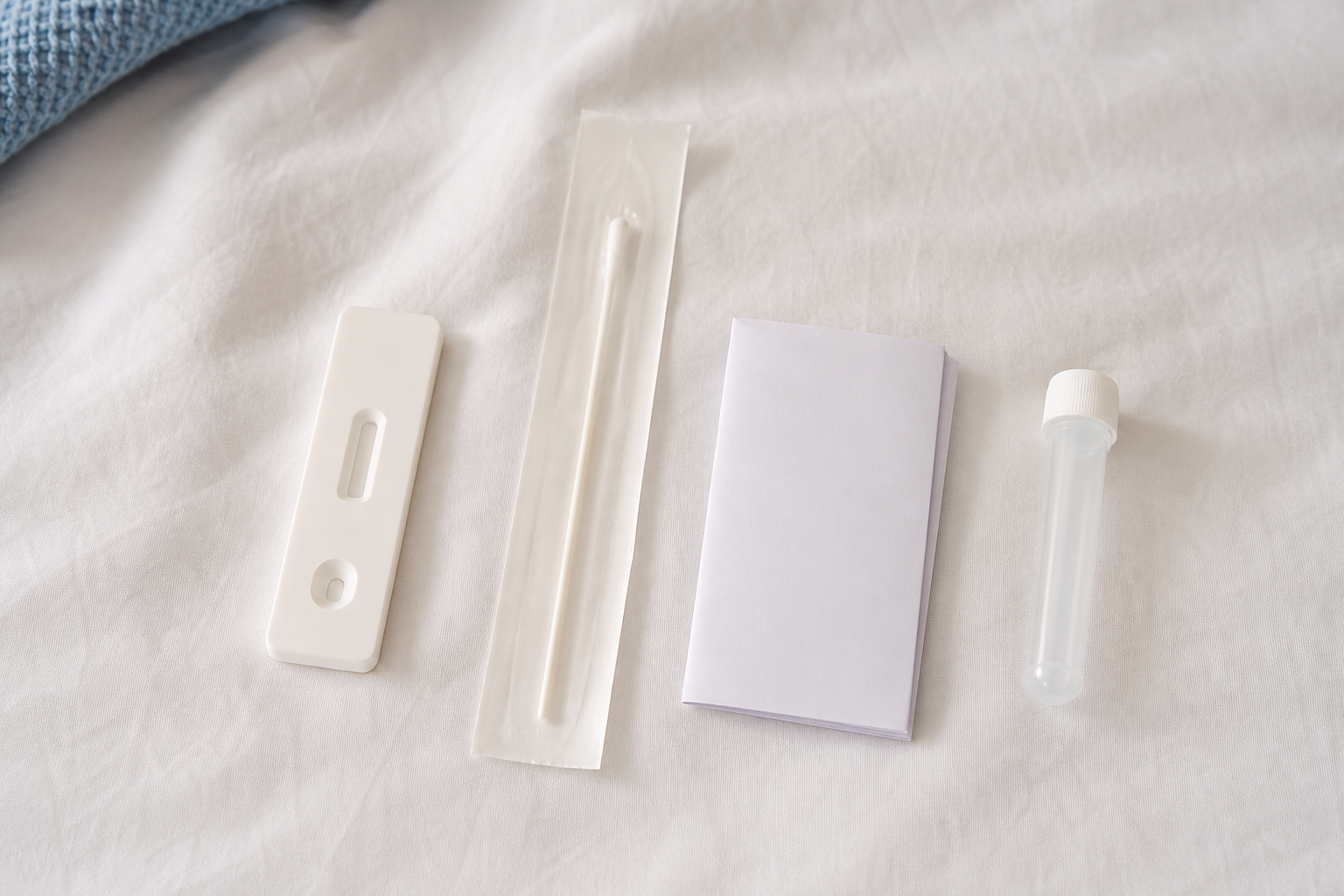
Use the privacy you have access to. At-home test kits collect a sample in your bathroom and either ship to a lab or give a result on a strip in about 15 minutes, depending on the test type. No clinic visit, no shared waiting room, no front-desk conversation. For people in small towns, conservative families, or workplaces where confidentiality matters, this is the difference between testing and not testing.
Have one informed conversation, not a series of awkward partial ones. When the topic comes up with a partner, friend, or doctor, frame it as preventive care rather than confession.
At-home testing: what it covers and what it does not
At-home STI testing is genuinely useful, and it is also not a complete replacement for clinic-based care. Knowing the boundary is important.
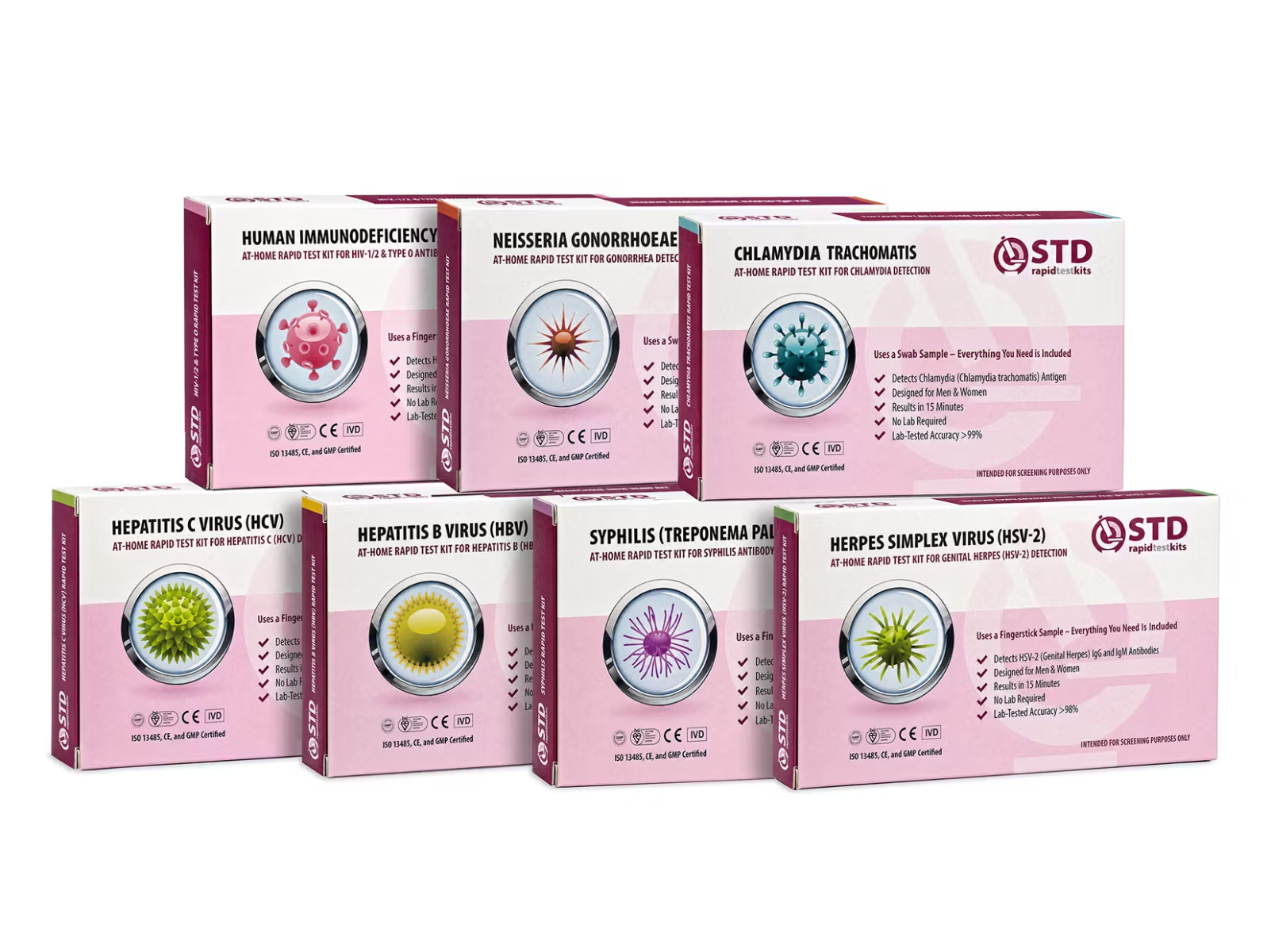
What at-home rapid tests do well. They screen for the most common STIs (chlamydia, gonorrhea, HIV, syphilis, hepatitis B, hepatitis C, herpes, and HPV or trichomoniasis for some kits) using lateral-flow strip chemistry. The sample is either a self-collected swab (vaginal or penile, depending on infection) or a fingerstick blood drop. A positive result is meaningful and should be confirmed and treated. A negative result, taken at the right point after a potential exposure, is reassuring. The privacy and convenience are real benefits that change actual behavior. People who would not visit a clinic do test at home, and that translates into earlier detection and earlier treatment.
What at-home rapid tests do not replace. Pharyngeal (throat) swabs for oral STIs, rectal swabs for receptive anal exposure, full lab NAAT (nucleic-acid amplification) panels that catch infections at the edge of detection, and any clinical examination of unusual lesions all need a clinician. If you have symptoms, particularly visible sores, persistent discharge, pain, or systemic signs like unexplained fever, a clinic visit is the right call. At-home tests are excellent screening tools. Clinic care is the right tool for diagnosis when something specific needs evaluation.
One additional note on scope: our at-home HPV and trichomoniasis kits are validated for vaginal self-swab only. Male readers needing HPV or trichomoniasis testing should see a clinic, because no FDA-cleared at-home version exists for male anatomy.
How often should I get tested for STIs?
For most sexually active adults, the CDC recommends at least once a year. People with multiple partners, new partners, or partners whose status is unknown benefit from screening every 3 to 6 months. Men who have sex with men, pregnant people, and people who use injection drugs have category-specific recommendations that are often more frequent. The right cadence is the one that catches infections before they become problems, not the one that waits for symptoms.
Talking with a partner before testing
The hardest conversation tends to be the first one. After that, it gets easier because the framing shifts from accusation to maintenance.
A few principles help. Lead with yourself. Saying “I am due for a routine screen and I want to get it done” lands differently from “should we get tested.” It puts the action on your side and removes the implication that you are flagging suspicion about them. If the relationship is new, it is reasonable to ask both partners to test before sex becomes condomless. If the relationship is established, periodic testing is the kind of low-key adult maintenance that builds rather than erodes trust.
Be specific about what you are testing for. “I am doing a full panel that covers chlamydia, gonorrhea, syphilis, HIV, and hepatitis” is more useful than “I am getting tested,” and it makes clear that this is routine rather than triggered by a specific worry. If the test is at-home, you can offer to test together, which removes the imbalance of one person being the patient and the other being audited.
Expect that the response will tell you something. A partner who finds the conversation reasonable and engages with it is showing you who they are. A partner who reacts with offense or stonewalling is also showing you who they are. The conversation is information either way.
Lead with yourself. “I am due for a routine screen” lands differently from “should we get tested.”
Be specific about the panel. Name what you are screening for: chlamydia, gonorrhea, syphilis, HIV, and hepatitis.
Read the response. Whether a partner engages or reacts with offense, the conversation gives you information either way.
When at-home is not enough and a clinic visit is the right call
At-home testing covers a wide range of common scenarios. There are also specific situations where it is the wrong tool, and being honest about that matters more than steering everyone toward a single solution.
You need a clinic when you have visible symptoms that need examination. A lesion, an unusual discharge, persistent pelvic or testicular pain, or a sudden onset of systemic symptoms after a known exposure all warrant a clinician looking at the actual tissue or doing targeted lab work. At-home antibody tests cannot evaluate a visible lesion.
You need a clinic for exposure sites at-home kits do not cover. Pharyngeal and rectal swabs are not part of any over-the-counter at-home kit currently on the US market. If your exposure was oral or receptive anal, a clinic visit with proper site-specific swabs is the only way to test accurately. This is not a small subset of cases. CDC surveillance consistently shows that extragenital infections, particularly pharyngeal and rectal chlamydia and gonorrhea, account for a meaningful fraction of cases that genital-only testing misses.
You need a clinic when you need treatment. A positive result on an at-home kit is a screening signal. Treatment requires a prescription, and many infections require partner notification and follow-up testing to confirm the infection has cleared. Telehealth follow-up after a positive at-home result is increasingly available and is often the simplest bridge to treatment.
Sexually transmitted infections are some of the most common health conditions in the United States, with millions of new infections each year, many among young people.
A reasonable testing rhythm for sexually active adults
For people without specific risk factors and one steady partner whose status is known, annual screening for the major bacterial and viral STIs is the standard recommendation.
For people with new or multiple partners, or whose own status has changed, every three to six months is a more appropriate cadence. After a high-risk exposure (condomless sex with a partner of unknown status, a broken barrier, or a known exposure event), test at the right window for each infection. Chlamydia and gonorrhea show up on tests roughly two weeks after exposure. For HIV, CDC HIV testing guidance distinguishes two test classes: lab-based antigen-antibody tests using a vein draw can detect HIV within 18 to 45 days after exposure, while rapid finger-stick antigen-antibody tests (the kind most at-home kits use) may need 18 to 90 days. If you are using an at-home kit, the longer window applies. Syphilis can take three to six weeks for antibodies to appear. Per CDC herpes testing guidance, current HSV antibody tests may take up to 16 weeks or more after exposure before they reliably detect infection.
The point of these windows is to test at a moment when a negative result is actually informative. Testing the day after a possible exposure mostly answers a question about a previous one. If you are unsure, a clinic can advise on the specific timing based on what you were exposed to.
One last thing about how to think about all of this
Testing is not a referendum on your character. It is a low-cost piece of preventive care that buys you information, and information is what lets you make any decision well. The stigma that built up around testing in the last century was a public-health failure as much as a cultural one, and the tools that exist now (at-home kits, telehealth follow-up, normalized HIV screening) are slowly fixing what that century broke.
The reader-respecting version of this advice is short. Find a cadence. Stick to it. Use the privacy you have access to. Use a clinic when you need diagnosis rather than screening. Tell the people you sleep with what you are doing and ask the same of them.
- Pick a recurring trigger (annual physical, birthday, new year) so testing happens on a schedule, not after a scare.
- Use an at-home kit when privacy is the bottleneck.
- Book a clinic visit if you have visible symptoms or need site-specific swabs (oral or rectal).
- Test together with a new partner before going condomless.
Frequently Asked Questions
- How often should I test for STIs if I am in a monogamous relationship?
- Annual testing is still the standard recommendation, partly because routine screening is cheap insurance and partly because asymptomatic infections from earlier in life can persist. After an initial screen for both partners, annual rechecks are a reasonable baseline unless circumstances change.
- Are at-home STI tests as accurate as clinic tests?
- For the infections at-home kits screen, the answer is yes for screening purposes. Lateral-flow rapid tests are designed to deliver clinically useful sensitivity and specificity within their window periods. Lab NAAT testing is more sensitive at the very edges of detection, which is why a positive at-home result should be confirmed by a clinic, and why a recent exposure should be retested at the right window if the first test was negative.
- Will my insurance know if I take an at-home test?
- At-home test kits purchased directly are out-of-pocket and do not generate an insurance claim. This is one reason they are popular with people who are on a parent's plan or who do not want test history in their insurance record. Clinic testing typically does involve an insurance claim unless you pay cash.
- Should I tell a new partner I am testing before we have sex?
- Generally yes. Both partners testing before unprotected sex is the cleanest baseline and avoids the awkward retroactive conversation. Frame it as a mutual step, not a request for one person to clear themselves.
- What if my at-home test comes back positive?
- Treat it as a strong signal rather than a final diagnosis. Contact a clinician (in-person or via telehealth) to confirm with a lab test and to start treatment. Most bacterial STIs are curable with short antibiotic courses. Notify recent partners so they can also test.
- Can I test before symptoms appear and still get useful results?
- Yes, and that is the point. Most STIs are asymptomatic in the early phase, which is why routine screening is more informative than waiting for symptoms. The exception is the window period right after exposure, where the body has not yet generated detectable antibodies or antigens. For those situations, retest at the right window.
- Which STIs do at-home rapid kits not cover well?
- Pharyngeal (throat) and rectal infections are not testable with current consumer at-home kits. If your possible exposure was oral or receptive anal, a clinic with site-specific swabs is the right path. Our at-home HPV and trichomoniasis kits are validated for female anatomy only; male readers needing those tests should see a clinic.
- Is annual testing enough if I always use condoms?
- Condoms reduce but do not eliminate transmission risk for every STI. Some infections (HSV, HPV, syphilis) can transmit through skin-to-skin contact in areas a condom does not cover. Annual testing is still a reasonable baseline even with consistent condom use, particularly if you have multiple partners.
- U.S. Centers for Disease Control and Prevention. Sexually Transmitted Infections (STIs) topic hub, covering screening recommendations, prevention, and treatment guidelines.
- U.S. Centers for Disease Control and Prevention. STI Surveillance hub linking to the underlying prevalence reports that produce the one-in-five US population estimate.
- World Health Organization. Sexually transmitted infections fact sheet covering global incidence, prevention, and treatment guidance.
- U.K. National Health Service. Sexually transmitted infections overview, including symptom-based guidance on when to seek clinic testing.
- U.S. Centers for Disease Control and Prevention. HIV Testing overview, including distinct window periods for lab-based and rapid at-home antigen-antibody tests.
- U.S. Centers for Disease Control and Prevention. Sexually Transmitted Infections Treatment Guidelines, including screening intervals for different risk categories and partner-notification guidance.
- U.S. Centers for Disease Control and Prevention. Screening for Genital Herpes, including the HSV antibody testing window period of up to 16 weeks or more after exposure.