
Published: November 2025 | Last updated: May 2026 | Editorial review and quality control: Martina N.
The idea of taking an STD test can feel heavier than the test itself. People can stand in a pharmacy aisle for twenty minutes deciding whether to buy the kit, then stare at the sealed box on the bathroom counter for three more days before opening it. Anxiety has a way of stretching a fifteen-minute decision into a week of sleepless nights.
This pattern is common in sexual-health settings: people fear the result more than they fear the underlying infection. The fear is loud, specific, and often out of proportion to what the test actually reveals. It is also entirely understandable, and there are concrete ways to work through it. This guide walks through why testing anxiety hits so hard, what each test format involves, what a positive result really looks like, and how to make the wait survivable on your own terms.
Key Takeaways
- STD testing anxiety is extremely common, even in people who handle other kinds of medical stress without flinching.
- Most STIs are curable, and the ones that aren’t are managed with daily treatment, so the worst-case scenarios anxiety paints rarely match what the next steps actually look like.
Why Testing Anxiety Hits So Hard
This kind of anxiety isn’t a personal weakness. It’s a predictable response to a situation your nervous system reads as threatening on several axes at once: bodily vulnerability, social stigma, identity, and uncertainty about a future you can’t yet see.
Biologically, when you anticipate a feared outcome, the amygdala (the brain’s threat-detection center) activates the same circuits that would fire if you were about to step in front of a car. Cortisol rises. The prefrontal cortex (the part responsible for calm reasoning) gets quieter. So “just take the test, you’ll feel better” advice rarely lands in the moment, because the part of the brain doing the worrying is not the part listening to the advice.
Layer on cultural baggage. Sex education in many countries has historically tied sexual health to shame, especially for women, queer people, and anyone raised in environments where “clean” and “dirty” became moral labels rather than hygiene descriptors. So a positive test result doesn’t feel like a medical condition with treatment options. It feels like a verdict on who you are.
The U.S. CDC publishes annual STI surveillance reports that consistently show millions of new infections across the conditions it tracks. That framing matters more than any single number: STIs are routine medical conditions to test and treat, very common across the general population, and the test result is data about an infection rather than a label about a person.
Avoidance is the single most common response to testing anxiety, and it’s also the response that makes the fear worse. The longer you wait, the more weight the unknown carries. The relief most people describe after finally testing usually arrives faster than the dread did.
Breaking the Wait Down by Test Type
Anxiety thrives on vagueness, so naming the timeline helps. Different test formats deliver results on very different schedules, and your emotional preparation should match the format you’re using.
Rapid at-home tests, the kind sold as lateral-flow cassettes, give you a result in roughly 10 to 20 minutes. That short window can be both a relief and a problem. Some people prefer it because the wait is over quickly. Others find that twenty minutes alone with their thoughts feels longer than two business days waiting for a lab. Knowing your own pattern helps.
Mail-in lab tests, where you collect a sample at home and ship it off, typically return results within 2 to 5 business days. The advantage is privacy and lab-grade accuracy. The disadvantage is the dread can stretch across a long weekend. Most people do better when they set a single time of day to check for results rather than refreshing their email every twenty minutes.
Clinic and telehealth visits vary widely. Some same-day rapid panels exist. Others mean a week of waiting for full screening results. Bringing a friend, writing down your questions ahead of time, or using a telehealth provider for the conversation can take some of the edge off.
| Test format | Typical result time | Common emotional pattern | What helps during the wait |
|---|---|---|---|
| At-home rapid test | 10 to 20 minutes | Sharp spike then quick resolution | Grounding plan ready: music, breathing, someone to text |
| Mail-in lab test | 2 to 5 business days | Slow-build dread, compulsive email checking | Pick one time of day to check; avoid constant refreshing |
| Clinic or telehealth visit | Same day to about a week | Anxiety tied to talking to a provider | Write questions in advance, bring a friend, consider telehealth |
How long does STD testing anxiety usually last?
Anxiety usually peaks in the hours right before and right after the test. For most people it fades within a day or two once results arrive. If a result is positive, the emotional adjustment typically eases within a week or two as a treatment plan takes shape. Avoidance, by contrast, can stretch the anxiety into months. Testing is almost always the faster path back to feeling steady.
What a Positive Result Really Means
Here is the thought that runs the loudest in the background: what if I have something? It hits hardest when your hand hovers over the “check results” button, or when the lab email finally arrives. The mental picture of a positive result feels catastrophic. The reality, almost always, is less dramatic than the picture.
A positive result doesn’t mean you are dirty, broken, or unlovable. It means a common infection has entered your body, something that happens to millions of people every year. CDC surveillance reports millions of new STI cases annually in the United States, and many of those people don’t realize they have one until a routine test catches it.
For genital herpes specifically, the CDC notes that most people with the virus do not know they have it, because symptoms are mild, absent, or mistaken for something else. The biology of the virus explains the gap, not any failure of self-awareness. Once diagnosed, daily suppressive antiviral therapy reduces outbreak frequency and lowers transmission risk meaningfully.
Whatever the specific infection, the “next step” is usually small. A short course of antibiotics. A daily pill. A conversation with a partner. The catastrophic outcomes that anxiety paints, the isolation, the end of your sex life, the permanent damage, are largely stigma and outdated television plot lines rather than current medical reality.
| Infection | Curable? | Typical treatment | What life looks like after |
|---|---|---|---|
| Chlamydia | Yes | Single course of antibiotics, usually 7 days | Retest in 3 months to confirm clearance; normal sex life resumes after treatment |
| Gonorrhea | Yes | Injection plus oral antibiotic in many cases | Same retest pattern; full resolution is typical |
| Trichomoniasis | Yes | Single-dose oral antibiotic | Symptoms clear within days; retest recommended |
| Syphilis (early) | Yes | Penicillin injection | Cleared with prompt treatment; bloodwork confirms |
| Genital herpes (HSV) | No, but managed | Antiviral medication, as-needed or daily suppressive | Outbreaks become less frequent over time; long symptom-free stretches are common |
| HIV | No, but undetectable equals untransmittable | Daily antiretroviral therapy | Normal life expectancy; HIV-negative partners stay negative on consistent treatment |
When Avoidance Wins, and How to Break It
Avoidance is the most common response to testing fear, and it’s the one that hurts the most over time. The logic feels protective in the moment: if I don’t test, the result can’t be real. But infections don’t read the script that anxiety writes. They keep doing their work whether or not you look.
Untreated chlamydia and gonorrhea can quietly cause pelvic inflammatory disease and, in some cases, fertility problems. Untreated syphilis progresses through stages that get harder to treat. Untreated HIV reduces life expectancy substantially compared to consistent antiretroviral therapy. None of those outcomes are caused by the test, and each of them is something the test gives you a chance to prevent through early treatment.
For many people, what makes testing easier is choosing the format that removes the highest-friction part of the process. Going to a clinic in person works for some. For others, just imagining a receptionist asking what they’re there for is enough to cancel the appointment. At-home rapid tests sidestep that entire conversation. You order the kit, it arrives in unmarked packaging, and you test in your own bathroom on your own schedule.
Talking Back to Fear While You Wait
Once you’ve ordered the test or taken the sample, the gap between action and result is where most of the emotional work happens. The phone pings. The email refreshes. The mind drifts to worst-case scenarios at two in the morning.
A few things genuinely help. First, name the spiral when it starts. Saying “this is anxiety, not new information” out loud short-circuits the part of the brain that tries to reason with the spiral as if it were evidence. Second, plan what you’ll do when the result arrives, regardless of which way it goes. Knowing in advance who you’ll call, what your next medical step is, and what kind of evening you’ll give yourself reduces the disorientation in the moment.
Grounding statements work differently from generic positive thinking. They give the threat-detection part of your brain a concrete, believable alternative frame, moving it from crisis mode toward problem-solving mode. “This result gives me information, not a verdict on me.” “Whatever it says, I know what to do next.” “I am not alone in this.”

Preparing to Test, on Your Own Terms
Anxiety responds to preparation. The same test feels different when you’ve laid the ground for it versus when you’re scrambling. Pick a time when you won’t be interrupted for at least half an hour. Choose a place that feels safe rather than purely convenient. Read the kit instructions twice before unboxing. Lay out everything you’ll need so you’re not fumbling with a swab while panicking.
Some people light a candle or play a specific playlist. Some prefer the structure of taking the test during a video call with a trusted friend. Some sit in silence and find that calmer than music. There is no wrong format. The point is to walk in feeling like you set the terms, not the test.
Writing down the next step for either outcome ahead of time is useful, not as pessimism but as a concrete way to tell your nervous system that the result is information rather than the end of the story. If positive: who you’ll contact for follow-up care, what the partner conversation looks like, and what treatment involves. If negative: how you’ll mark the relief, whether you need a retest date based on the window period, and whether the result changes anything about your testing routine going forward.
Read the instructions once through. Lay out everything you need on a clean surface. Choose a time when you won’t be interrupted. Decide in advance who you’ll contact when results arrive, regardless of which way they go.
Window Periods and When to Retest
One of the most useful pieces of information for someone dealing with testing anxiety is the concept of the window period. Each infection has a stretch of time after exposure during which a test may not yet detect it. Testing inside that window can produce a false-negative result, which feeds anxiety rather than resolving it.
Rough windows, drawn from CDC infection-specific guidance and kit manufacturers’ product labelling:
Chlamydia and gonorrhea show up reliably on lab NAAT testing about 1 to 2 weeks after exposure. Rapid at-home lateral-flow swab tests work in a similar window, though analytical sensitivity is lower than lab NAAT and the at-home kit is best treated as a screen rather than a confirmatory test.
HIV detection depends on the test generation. According to the CDC’s HIV testing page, fourth-generation antigen and antibody lab tests typically detect HIV by 18 to 45 days after exposure, while antibody-only tests, including most rapid tests and self-tests, can take 23 to 90 days.
Syphilis blood tests usually detect antibodies 3 to 6 weeks after exposure, sometimes longer in slower seroconverters. Hepatitis B and C antibody tests fall in a similar range.
Herpes antibody tests (the kind used in rapid blood panels) generally need 6 to 12 weeks to detect seroconversion, occasionally as long as 16 weeks in slow responders. If a test comes back negative but the exposure was recent, retesting at the window’s outer edge is the standard recommendation. If symptoms persist despite a negative result, follow up with a clinician for differential testing rather than assuming the test was wrong.
Most STIs are treatable, and many can be cured.
Privacy, Packaging, and Discreet Shipping
One of the most common blockers for people anxious about testing isn’t the test itself. It’s the worry that someone will see the package, ask about it, or somehow find out before they’re ready to share.
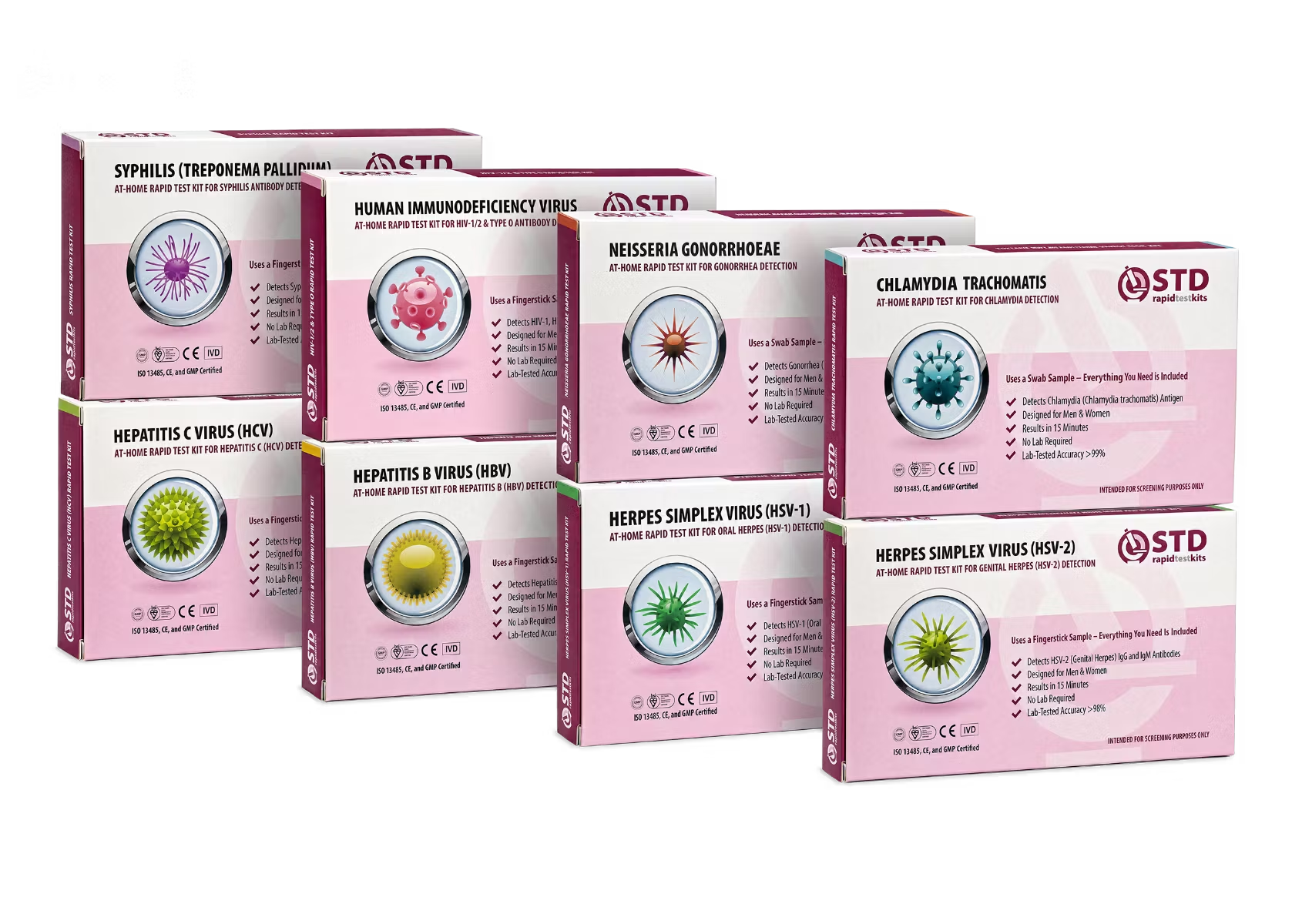
At-home tests from STD Rapid Test Kits ship in plain, unmarked packaging. There’s no logo, no STI-related branding, and no signature required. The packaging looks identical to any small online purchase. For people who live with roommates, family, or a partner they’re not ready to talk to yet, this matters. The fear of being seen testing can itself be the reason testing gets pushed off for months.
Results from at-home rapid tests are read by you, in your own bathroom, on your own timeline. There’s no portal notification sent to anyone else. You decide who hears the result and when. That control over disclosure is genuinely calming for many people. It also means that if the result is negative, there’s no awkward conversation to navigate afterward, and if it’s positive, you have time to absorb the information before you decide how to handle the next steps.
FAQs
- Is it normal to feel this anxious before an STD test?
- Yes, and it doesn’t say anything bad about you. Testing-related anxiety is reported by a large portion of people who seek STI screening. The combination of bodily vulnerability, social stigma, and uncertain outcome reliably activates the brain’s threat system. It’s a predictable response, not a personal weakness.
- Can stress or anxiety affect the test result itself?
- No. Stress can affect your sleep, digestion, and skin, but it doesn’t change whether or not you have an infection, and it doesn’t change what the test detects. The biology runs its own course regardless of how you feel about it.
- What if I test positive and I genuinely can’t cope?
- Reach out the same day you receive the result, even if it’s just a text to one trusted person. Most STIs have a clear, routine treatment plan, and clinicians who handle STI care don’t approach patients with judgment. If the emotional weight is heavy enough to interfere with daily life, a single appointment with a therapist or your primary care provider can help you build a short-term plan.
- Do I have to tell my partner if my test is positive?
- If they were exposed, yes, ethically and in many places legally for certain infections. The framing that helps most people is treating it like a heads-up rather than a confession. Anonymous partner-notification services exist in many regions and can deliver the message on your behalf if a direct conversation feels impossible.
- How accurate are at-home rapid STD tests?
- When used within the correct window period, modern at-home rapid lateral-flow tests typically report sensitivity and specificity in the mid-to-high 90s, depending on the infection and the kit. They are not identical to lab NAAT testing, which has higher analytical sensitivity. For screening purposes they’re useful; any positive result is worth confirming with a lab test.
- Does the test hurt?
- Not really. A fingerstick blood draw is a brief sting. A self-collected vaginal or penile swab is awkward more than painful. None of the at-home tests sold for self-use involve anything beyond what you can do calmly in a bathroom.
- How soon after treatment can I retest?
- For curable bacterial STIs like chlamydia, gonorrhea, and trichomoniasis, the standard recommendation is to retest about 3 months after completing treatment, both to confirm clearance and to catch any new infections that have happened since.
- Can I have sex while waiting for my results?
- It depends on what you think the risk is. If you suspect a recent exposure, the responsible move is to either pause or use condoms consistently until you have the result. The few days of delay tend to bother people less than the regret of knowingly passing something on.
- U.S. Centers for Disease Control and Prevention. STI surveillance program and annual surveillance report landing page.
- U.S. Centers for Disease Control and Prevention. Getting tested for STIs: who should test, how often, and what to expect.
- U.S. Centers for Disease Control and Prevention. HIV testing types, window periods, and result interpretation.
- U.S. Centers for Disease Control and Prevention. Genital herpes: prevalence of undiagnosed infection and management with antiviral therapy.
- Mayo Clinic. Sexually transmitted diseases: symptoms, causes, diagnosis, and treatment.
- NHS. Sexually transmitted infections: overview, testing, and treatment information for general audiences.
- MedlinePlus. Sexually transmitted infection (STI) tests: what each test covers and how results are interpreted.
