

Published: August 2025 | Last updated: April 2026 | Editorial review and quality control: Martina N.
Knowing you should get tested is not the same as being ready to do it. STI testing touches sex, identity, trust, and a quiet sense of self-judgment, so even people who advocate for public health can freeze at the moment of action. Information alone rarely breaks the block; what is happening underneath is your nervous system trading short-term certainty for short-term comfort.
This guide is not a lecture. It is a calm walkthrough of what is actually happening when you keep putting it off, what current public-health guidance says about timing and accuracy, and how to take one small step that breaks the loop.
Why do people avoid STI tests even when they know they should get one?
Avoidance has its own logic. Your brain trades a brief, certain discomfort (testing) for a longer, vaguer one (uncertainty), because uncertainty feels safer in the moment. Most common STIs are treatable, most at-home rapid tests take 15 to 20 minutes, and a clear result, positive or negative, consistently feels lighter than the dread that comes from not knowing. The path forward is small, private, and lower-stakes than your brain is making it.
Key Takeaways
- Avoidance is your brain choosing short-term emotional safety over long-term certainty. Naming the pattern is most of breaking it.
- Per the CDC, common STIs like chlamydia and gonorrhea are often silent in early infection. Regular testing, not symptom-watching, is what catches them.
Why testing feels harder than the test itself
Picture a familiar evening: phone glowing, a few search tabs open, a vague worry circling. You consider booking a test. You decide you will think about it tomorrow. The relief is immediate and very small. That tiny dip in anxiety is what the brain is optimizing for, even when it costs you days of low-level worry afterward.
The threat-detection system in the brain (centered around the amygdala) flags emotionally risky situations the same way it flags physical ones. The threat in this case is not the infection itself; it is the meaning attached to it. What will the result say about me? What happens to my relationship? What does this mean about my judgment? Uncertainty creates a spike of anxiety, and the fastest way to lower a spike is to step away.
Avoidance works in the very short term. The moment you decide not to test today, anxiety drops a notch. Your brain learns the pattern and reaches for it again next time. The loop becomes: worry, consider testing, avoid, feel briefly better, repeat. The original question, the one that started the loop, never actually gets answered. It just lingers.
This is why willpower-based advice ("just go get tested") so often fails. You are not lacking information; you are managing emotion. Once you can name the loop, the rest of this article becomes a series of small moves you can make when the loop fires up.
Worry shows up. You consider testing. You decide to think about it tomorrow, and anxiety drops a notch. Next week the same thing happens, because the loop pays off in tiny moments of relief. The original question never closes; it just gets quieter and louder in cycles until something forces a decision.
The core barriers, and they are rarely just embarrassment
The narrative that people who delay testing are irresponsible is the wrong frame. Most avoidance is driven by emotional and logistical pressures stacked on top of each other. Recognizing which pressures are doing the most work for you is the first place to push back.
| Barrier | What it sounds like in your head | Why it matters |
|---|---|---|
| Fear of the result | "What if I cannot handle knowing?" | Delays action even when symptoms are present, and stretches uncertainty for weeks. |
| Shame and stigma | "I do not want to be that person." | Creates silence around routine sexual healthcare and makes the test feel like a confession. |
| False reassurance | "It was just one time. They said they were fine." | Reduces urgency, but many STIs are transmissible while symptom-free. |
| Privacy concerns | "What if someone sees the package or my browser history?" | Pushes people away from testing they would otherwise do at home. |
| Cost or access | "I do not have insurance or a clinic nearby." | Causes chronic delays even with high motivation, especially for younger and uninsured readers. |
| Trauma response | "I shut down around medical stuff." | Often unspoken, often powerful, and especially relevant for survivors of sexual trauma. |
For people with sexual-trauma histories, the act of swabbing, being examined, or even reading testing instructions can trigger flashbacks or shutdown. This is not being dramatic. It is the nervous system doing its job. A trauma-informed clinician, a friend on standby during a telehealth call, or a self-administered home kit in a familiar space can all soften the experience. Testing does not have to repeat the harm. Done at your pace, it can be part of reclaiming a sense of safety.
When "I feel fine" is the trap
One of the most damaging assumptions about STIs is that no symptoms means no problem. The CDC notes that most chlamydia infections cause no symptoms, and the same is broadly true for early gonorrhea, early HIV, and early syphilis. The World Health Organization describes silent infection as the rule, not the exception, for several common STIs.
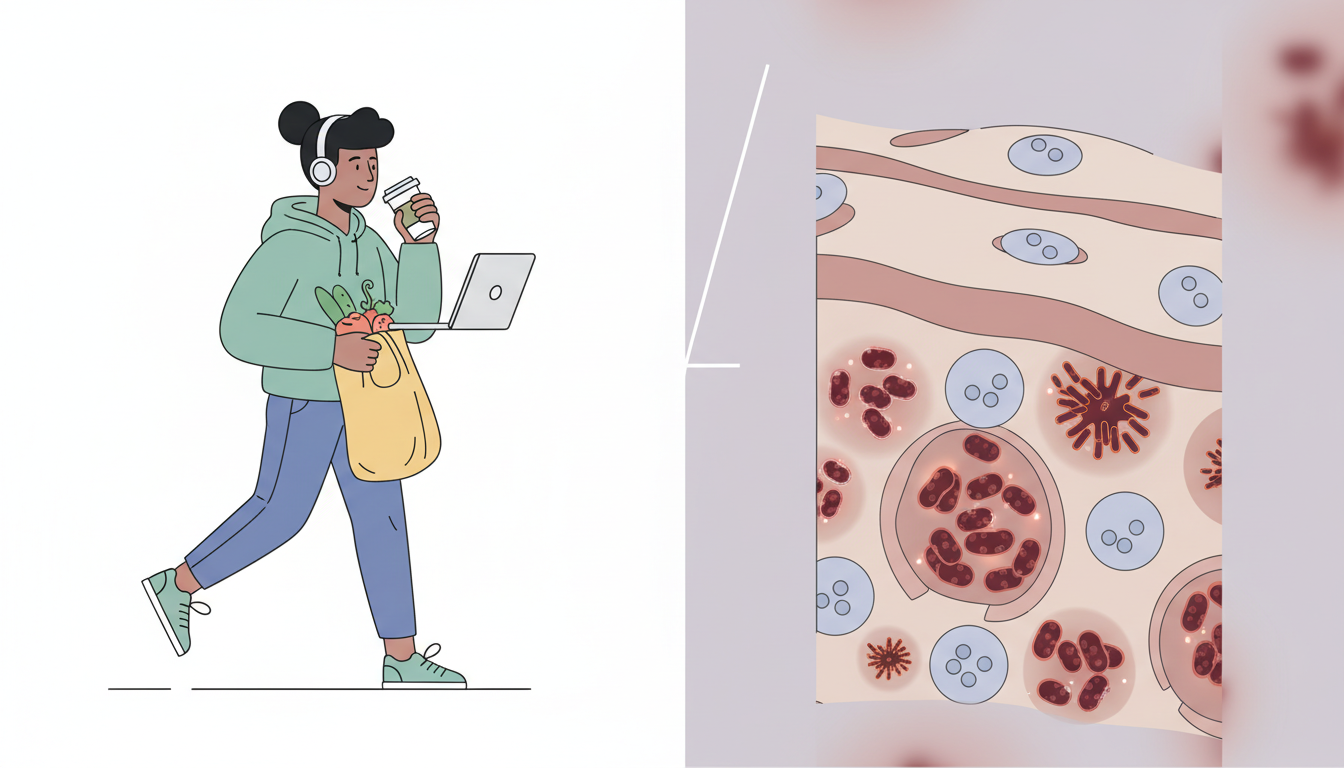
Biology does not pause because you are not looking. Bacterial infections like chlamydia and gonorrhea attach to cells in the genital tract and replicate quietly, often without inflammation strong enough to register as a symptom. Viral infections like HIV interact with the immune system from day one. The absence of symptoms is not the body giving you the all-clear. It is the body operating on a biological timeline that runs independently of how you feel.
This is why people are sometimes surprised by a positive result during routine screening. They felt healthy, they had no obvious red flags, and the infection had been there silently for weeks or months before any test was taken.
Window periods: why timing changes what a test means
Another reason people stall is timing confusion. Test too early and a negative result does not actually rule out infection. Test at the wrong moment and the result is reassurance you cannot trust. Every infection has a window period, the span of time between exposure and when a test can reliably detect it. Knowing the window turns a vague "should I test now or wait?" into a concrete plan.
The table below summarizes typical detection windows for the most common infections. Lab-based nucleic acid amplification tests (NAAT, sometimes called PCR) can sometimes detect bacterial infections at the early end of the window. At-home rapid lateral-flow tests are best read at, or after, the windows shown.
| Infection | Sample type | Reliable from | Notes |
|---|---|---|---|
| Chlamydia | Self-collected swab | About 14 days after exposure | Often asymptomatic. Annual screening recommended for sexually active women under 25 (CDC). |
| Gonorrhea | Self-collected swab | About 14 to 21 days after exposure | Frequently asymptomatic, especially in women. |
| Syphilis | Fingerstick blood (antibody) | 3 to 6 weeks after exposure | Antibody-based tests need time for seroconversion. |
| HIV | Fingerstick blood (antibody) | First indicator at about 6 weeks; confirm at 12 weeks | Lab antigen-antibody combo tests can detect earlier; rapid antibody tests use the longer window. |
| Hepatitis B | Fingerstick blood | About 6 weeks after exposure | Window varies by test; retest if early. |
| Hepatitis C | Fingerstick blood (antibody) | 8 to 11 weeks after exposure | Antibody seroconversion takes longer for HCV. |
| Herpes (HSV-1, HSV-2) | Fingerstick blood (antibody) | 12 weeks or more for full sensitivity | Blood antibody tests detect systemic seroconversion, not active lesions. Active sores are confirmed by clinic swab and PCR. |
If you are uncertain how long it has been since exposure, an early test plus a follow-up at the end of the window is more useful than waiting. An early negative tells you something. An end-of-window negative tells you everything. Per <a href="https://www.cdc.gov/hiv/testing/" target="_blank" rel="noopener">CDC HIV testing guidance</a>, retesting is part of the process, not a sign you did the first test wrong.
Privacy, discretion, and how at-home actually works
For some readers, the testing block is not about results at all. It is about being seen testing. The mental image of a clinic waiting room, a co-worker walking past, an insurance line item, or a partner asking about a package can outweigh the medical question entirely.
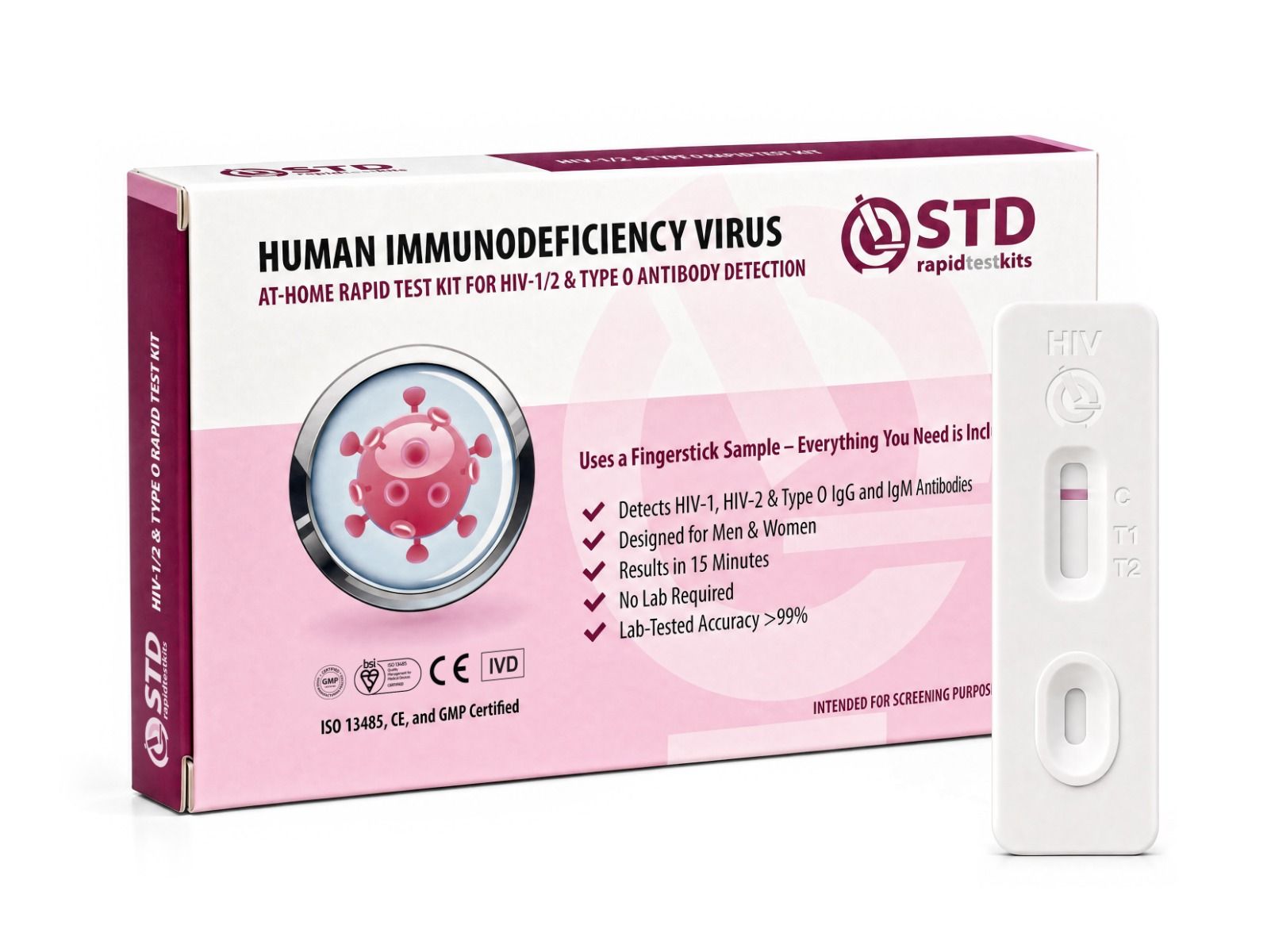
At-home rapid tests change that equation. Kits arrive in plain outer packaging, sample collection is self-administered in your bathroom, and the result reads in under 20 minutes, with no waiting room or small talk in between. Nothing on the outer box names a diagnosis, and payment processors do not flag what was purchased to anyone other than you.
One important nuance: at-home rapid tests are screening tools, not lab confirmation. A positive at-home result is best confirmed with a clinician, who will usually order a NAAT or antibody test and walk you through next steps. A negative test taken inside the correct window period is reliable. The pattern most clinicians recommend is straightforward: screen at home for speed and privacy, confirm at a clinic if anything reads positive.
| Testing path | Privacy level | Result speed | Best fit for |
|---|---|---|---|
| At-home rapid lateral-flow | Very high | 15 to 20 minutes per test | Immediate peace of mind; testing on your own timeline |
| Mail-in lab kit | High | 2 to 5 days after the lab receives the sample | Lab-grade NAAT or antigen-antibody confirmation from home |
| Clinic or sexual-health service | Moderate | Same-day to 1 week | In-person consultation, full STI panel, or follow-up after a positive home result |
What a positive result means in practice
This is the fear underneath the other fears. Not "what if I test" but "what if it comes back positive?" The imagined future is usually a sudden life change. The actual experience for most people is closer to a single appointment, a treatment plan, and a quieter month than expected.
Most common STIs are curable with appropriate treatment: chlamydia, gonorrhea, and syphilis with antibiotics; trichomoniasis (a protozoan, not a bacterium) with an antiparasitic medication, typically metronidazole. Per the NHS, early treatment usually clears the infection and reduces the risk of long-term complications and onward transmission. Viral infections like HIV, HSV, and hepatitis B and C are not always curable, but they are highly manageable with current medication. Per the CDC, people with HIV who take effective treatment can reach an undetectable viral load and have effectively no risk of sexually transmitting the virus to a partner.
Most diagnoses move quickly into a treatment plan and a follow-up appointment. The cinematic life change people picture in advance is rarely how it plays out.
When you are ready but still frozen
There is a particular kind of stuck for people who already know they want to test. The kit is in the cart. The clinic phone number is on a sticky note. Days pass. Weeks pass. The reason is rarely laziness. It is usually a mix of decision fatigue, unresolved shame, and a brain that has learned avoidance pays off in the short term.
Two strategies work better than willpower. The first is shrinking the task. Not "I am going to deal with my sexual health today" but "I am going to add a kit to my cart and that is it for today." Tomorrow's task is "I will check the discreet-packaging note." The day after is "I will place the order." Each step is small enough that the loop has nothing dramatic to react to.
The second is removing friction. Most of the resistance is not the test itself; it is the apparatus around it (appointments, waiting rooms, awkward conversations). At-home testing strips most of that out. What is left is a single specific decision, made in your space, on your schedule.
Anticipation is almost always worse than the experience. People imagine worst-case scenarios and rate the imagined dread far higher than what testing feels like in the bathroom on a Tuesday evening with a 15-minute timer running.
Many STIs do not cause symptoms, so you may have one and not know it. Testing is the only way to know for sure.
Making testing routine, not a crisis decision
One of the reasons testing feels so heavy is because it is usually framed as a reaction to something going wrong. After a hookup, after a symptom, after a scare. When testing only happens during emotional spikes, it gets emotionally charged, and that charge makes it harder to do next time.
Routine testing changes the framing. Per CDC screening recommendations, sexually active women under 25 should have annual chlamydia and gonorrhea screening, and others at increased risk (new partners, condomless sex outside a tested monogamous relationship, men who have sex with men) benefit from regular screening as well. Pulling testing out of the "only when worried" bucket and into the "part of regular health" bucket lowers the emotional weight every time.
The people who experience the least anxiety around STI testing are not the ones who never worry. They are the ones who close the loop quickly: notice the question, get an answer, move on.
If routine feels like a leap, start with a single calendar reminder six months from today: "Time for a check-in." Future you will thank past you for the small, undramatic act of building a rhythm.
FAQs
- Is it normal to keep putting off an STI test?
- It is more common than most people admit. People delay all kinds of health tasks, and STIs add an extra emotional layer (sex, stigma, identity). Avoidance is the brain trading short-term comfort for long-term certainty, which is a common pattern, not a personal flaw. The work is noticing when "I will do it later" becomes weeks of background worry.
- I do not have any symptoms. Do I still need to test?
- Yes, especially for chlamydia, gonorrhea, and HIV, which are often silent in early infection. Per the CDC, the absence of symptoms is not evidence of absence; it is just timing. Routine screening is what catches asymptomatic infections, not symptom-watching.
- How private is at-home testing, really?
- There is no clinic record, no insurance line item, and no waiting-room visibility. The outer packaging carries no diagnostic labels and payment processors do not flag what was bought, so deliveries arrive looking like any other small parcel. After the test runs, you decide whether to share the result with a partner or a clinician; nothing is reported on your behalf.
- What if the result comes back positive?
- A positive at-home result is best confirmed with a clinician, who will usually order a confirmatory lab test and discuss treatment. Most common bacterial STIs are curable with antibiotics, and trichomoniasis is treated with antiparasitic medication. Viral infections like HIV and HSV are highly manageable with current medication. A positive result is a clear next step, not an identity change.
- How long after sex do I need to wait before testing?
- Each infection has its own window period. Chlamydia and gonorrhea are reliable from about 14 days. Syphilis from 3 to 6 weeks. HIV gives a first indicator around 6 weeks (confirm at 12). Herpes blood antibodies need 12 weeks or more for full sensitivity. If unsure, test now and plan a retest at the end of the window.
- Are at-home rapid tests as accurate as a lab?
- At-home rapid tests are lateral-flow immunoassays. They are not the same technology as lab NAAT or PCR. When used inside the correct window period, they are reliable screening tools, and a clear negative inside the window is meaningful. A positive at-home result is best confirmed with a lab test before treatment decisions.
- Will my partner find out if I get tested?
- Only if you tell them. A home test leaves no clinic record on insurance, no waiting-room visibility, and no automatic notification. If you want to bring a partner into the conversation later, framing testing as personal responsibility rather than accusation usually goes better.
- How often should I test if I am sexually active?
- Per CDC screening recommendations, sexually active people benefit from annual screening at minimum, with more frequent testing if you have new or multiple partners, condomless sex outside a tested monogamous relationship, or specific risk factors. A simple rule: any time something changes (new partner, missed protection, a worry that does not resolve), test.
- U.S. Centers for Disease Control and Prevention. Sexually transmitted infections (STIs) topic page. General prevalence, screening recommendations, and asymptomatic-infection guidance.
- U.S. Centers for Disease Control and Prevention. Chlamydia detail page. Asymptomatic-infection rates and annual screening recommendation for sexually active women under 25.
- U.S. Centers for Disease Control and Prevention. HIV testing guidance. Window-period guidance, retesting protocols, and undetectable equals untransmittable framing.
- World Health Organization. Sexually transmitted infections (STIs) fact sheet. Global prevalence, asymptomatic-infection patterns, and consequences of untreated infection.
- UK National Health Service. Sexually transmitted infections (STIs) overview. Screening recommendations, symptoms, and clinical-care pathways.
- U.S. Centers for Disease Control and Prevention. STI screening recommendations summary. Frequency guidance for different populations and risk groups.
