Who Is Eligible for PrEP, and Should You Take It?
Most people asking about PrEP qualify for it. The harder question is whether your own last six months make it worth starting, and which of the four approved options fits your body, your kidneys and the way you could be exposed. Here are the CDC signals, the checks a prescriber runs, and a four-question walk-through to bring to the appointment.



- The essential requirement is a negative HIV test right before you start; pills also need a kidney check.
- A partner with HIV, inconsistent condom use, an STI in the past six months or shared injection equipment are the clearest signs PrEP would help you.
Published: October 2026 | Last updated: October 2026 | Editorial review and quality control: Martina N.
Who can get PrEP?
Anyone without HIV who could be exposed through sex or injection drug use is a candidate, including teens who weigh at least 35 kg. CDC's clearest signals are a partner with HIV, inconsistent condom use, an STI in the past six months, or shared injection equipment. US clinicians are told to prescribe it to anyone who asks.
PrEP, short for pre-exposure prophylaxis, is HIV medicine taken before any exposure so the virus cannot take hold. This guide covers the step before the prescription: whether you qualify, whether your situation calls for it, and what a prescriber checks before you start. If you are still working out which prevention medicine fits a specific moment, our PEP vs PrEP comparison covers that choice.
The payoff for the right person is large. Taken as prescribed, oral and injectable PrEP reduce the risk of getting HIV from sex by about 99%, and oral PrEP reduces the risk from injection drug use by at least 74%, according to CDC clinical guidance.
What every PrEP prescription requires
The medical baseline is short. You must not have HIV, confirmed by a test taken immediately before your first dose. The FDA labels for Truvada, Apretude and Yeztugo cover adolescents who weigh at least 35 kg (77 pounds), and CDC clinical guidance lists F/TAF as approved for that group as well (all four PrEP medicines are listed by NIH's HIVinfo). There is one exception for teens. CDC's guidance does not yet recommend cabotegravir injections for anyone under 18, because the shot has not been studied in that age group, so a prescriber will advise which option fits. Age rules differ elsewhere: in England, the NHS says most HIV-negative people aged 16 and over can take PrEP, and it may sometimes be prescribed for younger people at risk.
The pills add two checks. Tenofovir, the backbone of both PrEP pills, is cleared by the kidneys, so your kidney function (estimated creatinine clearance, or eCrCl) is measured first. CDC guidance notes that F/TDF (Truvada or a generic) is approved for people with an eCrCl above 60 mL/min and F/TAF (Descovy) for an eCrCl of 30 mL/min or higher; kidney tests are not needed for the cabotegravir shot. You will also be tested for hepatitis B, because the Truvada prescribing information warns that people with hepatitis B can have a severe flare after stopping the drug. Hepatitis B does not rule PrEP out; it changes how a clinician plans for stopping. The same label suggests a bone-density assessment for people with a past pathologic fracture (a break from minimal force) or other risk factors for osteoporosis.
Some things are not on the list. There is no CD4 count and no treatment-monitoring viral load; those are tests for people already living with HIV. An HIV-1 RNA test to catch a very early infection is different: CDC pairs it with the antigen/antibody test before you start and at follow-up. And there is nothing about your gender, orientation or number of partners.
Signs your situation calls for PrEP
Qualifying and benefiting are separate questions. The CDC's patient guidance lists scenarios that make someone without HIV a good candidate, most of them measured over the past six months. Read the list against your own recent history rather than against a stereotype of who “needs” PrEP. A partner with HIV whose viral load is unknown or detectable is the clearest signal. If the partner is durably undetectable, PrEP is optional but still available on request.
One situation is not on the list. If your worry is a single exposure in the last few days, PrEP is the wrong tool; ask a clinic or emergency department about PEP straight away, and see our guide to the 72-hour PEP window. People who need PEP repeatedly are often good PrEP candidates afterward.
CDC signals that PrEP would help you
Any one of these is enough to raise PrEP with a clinician. None of them is required to ask for it.
- Anal or vaginal sex in the past 6 months with a partner who has HIV, especially one whose viral load is unknown or detectable
- Anal or vaginal sex in the past 6 months without consistently using a condom
- A sexually transmitted infection diagnosed in the past 6 months
- Injecting drugs with an injection partner who has HIV
- Sharing needles, syringes or other injection equipment such as cookers
- Continued risk after a course of PEP, or having used PEP more than once
You do not have to prove risk to ask
Plenty of people never tick a box above because they are unsure of a partner's status, or would rather not describe their sex life to a stranger. US guidance plans for that. CDC tells clinicians to inform all sexually active adult and adolescent patients about PrEP and to prescribe it to anyone who asks, including people who report no risk factors (CDC clinical guidance). Its patient page says the same thing from the other side: you may choose to take PrEP even if none of the listed behaviors apply to you.
Prescribe PrEP to anyone who asks for it, including sexually active people who do not report HIV risk factors.
Matching a PrEP option to your body and your risk
Eligibility also depends on which medicine you are considering. Four are FDA-approved for PrEP: two daily pills and two long-acting shots (NIH HIVinfo). The biggest restriction is on Descovy. CDC recommends F/TAF for preventing sexual transmission excluding people likely to get HIV through receptive vaginal sex, because it has not yet been studied in people assigned female at birth exposed that way. For those readers, the options are F/TDF or a shot.
Route of exposure matters too. CDC's effectiveness estimate for injection drug use comes from oral PrEP, and both shots are labeled for sexually acquired HIV. The shots suit people who struggle with a daily pill: the Apretude label starts with two injections one month apart and then one every 2 months, with an oral lead-in that is optional, while the Yeztugo label pairs start-up injections with tablets on days 1 and 2, then injections every 6 months. The World Health Organization added twice-yearly lenacapavir to its PrEP recommendations in July 2025. Our Yeztugo explainer covers that shot in more depth.
| PrEP option | How it is taken | Approved or recommended for | Worth knowing | HIV testing |
|---|---|---|---|---|
| F/TDF pill (Truvada or generic) | One pill daily | Sexual exposure; CDC guidance also uses oral PrEP for people who inject drugs | Needs eCrCl above 60 mL/min; bone density may be checked if you have osteoporosis risk factors | Before starting, then at least every 3 months |
| F/TAF pill (Descovy) | One pill daily | Sexual exposure, excluding people at risk through receptive vaginal sex | Works with eCrCl of 30 mL/min or higher; cholesterol and triglycerides checked first | Before starting, then at least every 3 months |
| Cabotegravir shot (Apretude) | Injection in the buttock: two doses a month apart, then every 2 months | Sexual exposure; the FDA label covers adults and teens of at least 35 kg, but CDC guidance does not yet recommend it under 18 | No kidney check needed; injection-site soreness is common | Before starting and before every injection |
| Lenacapavir shot (Yeztugo) | Start-up injections plus tablets on days 1 and 2, then injections under the skin every 6 months | Sexual exposure, adults and teens of at least 35 kg | Can stay in the body 12 months or longer after the last dose | Before starting and before every injection |
Why the HIV test has to come first
PrEP labels carry a boxed warning about this. PrEP drugs are not a complete HIV treatment, and if someone starts them while already infected, the virus can become resistant. The Truvada label reports drug-resistant HIV in people who started PrEP during an undetected early infection, and says not to start it when signs of acute HIV are present until a negative status is confirmed. The Yeztugo label requires a test before the first dose and every injection using one cleared to diagnose acute or primary HIV infection. CDC's follow-up protocol repeats an HIV antigen/antibody test and an HIV-1 RNA test at least every 3 months on pills, and at month 1 and then at least every 2 months on the cabotegravir shot. CDC prefers laboratory antigen/antibody and RNA testing; a rapid FDA-approved fingerstick antigen/antibody test may be used while lab results are pending. CDC also says oral swab-based HIV self-tests are usually not recommended as the PrEP test because they may miss a recent infection, and no home screen replaces the prescriber's test.
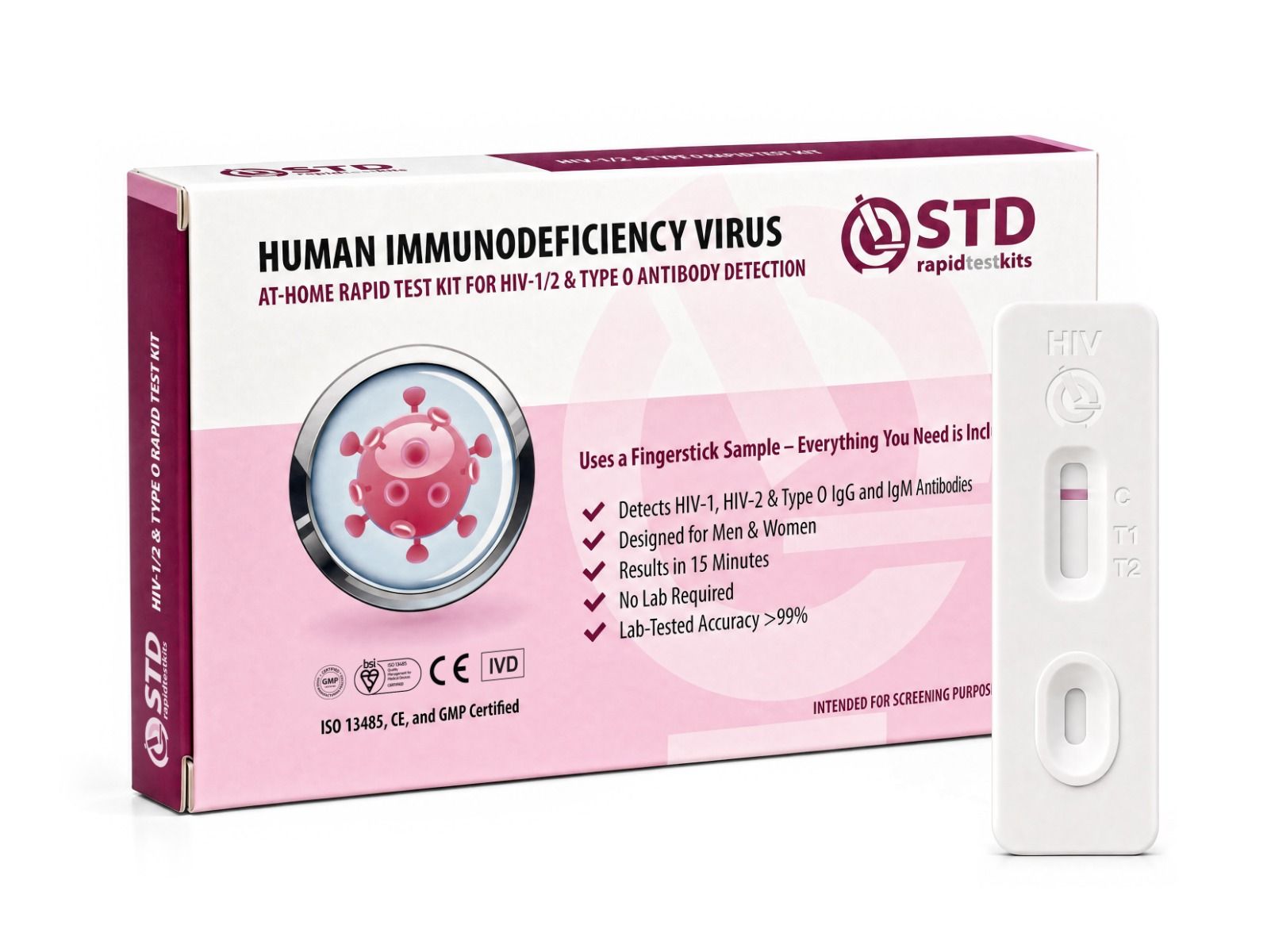
A home test has a narrower use before the appointment. If you have not tested in a long time, a reactive fingerstick screen points toward confirmatory testing and care. A nonreactive result does not clear you to start PrEP. The prescriber will run an antigen/antibody test and an HIV-1 RNA test, and an antibody screen can miss exposures from the last 3 to 4 weeks. Our HIV kit is an antibody screen intended for fingerstick blood according to the manufacturer's instructions. The manufacturer's product information for it, as recorded in our catalog, gives detection from 3 to 4 weeks after exposure with a retest at 90 days. A reactive result always needs confirmation by a clinician, and in people with little HIV exposure a larger share of reactive screens turn out to be false. Mention any recent exposure or flu-like illness to the prescriber, whatever the home result.
stdrapidtestkits.com sells at-home STI testing kits. We recommend products based on fit for the reader's concern, not commercial benefit.
Walking through the decision
The four questions below condense CDC's criteria into the order a clinician would think about them. Treat the result as a starting point for the appointment, not a substitute for it.
Should I ask about PrEP?
Did you have a possible HIV exposure in the last few days (condomless sex with a partner of unknown or positive status, or shared needles)?
Yes: Ask a clinic or emergency department about PEP now. PrEP can follow once the PEP course ends if your risk continues.
In the past 6 months, have you had anal or vaginal sex with a partner who has HIV, sex without consistent condom use, or an STI diagnosis?
Yes: PrEP fits your situation. If your only risk is a partner who is durably undetectable, PrEP is optional but still available on request. Expect an HIV test first, plus kidney and hepatitis B tests if you choose pills.
Do you inject drugs and share equipment, or have an injection partner with HIV?
Yes: CDC says people who inject drugs should be offered PrEP. Ask about daily oral PrEP, the option studied for this route.
Have you used PEP more than once, or do you simply want extra protection?
Yes: Raise it at your visit. No listed risk factor is needed.
No: PrEP may add little right now. Revisit the question if partners, condom use or an STI diagnosis change.
Guidance only, based on CDC criteria. A clinician makes the final call with your test results.
Questions to bring to the appointment
Arriving with a short list makes a brief visit far more useful, especially if you are choosing between pills and shots.
- Which option fits the way I could be exposed: sex, injection drug use, or both?
- Do my kidney results, bone health or other medicines rule out any option? Lenacapavir, for example, can affect some other medicines for months after the last injection, according to its label.
- How often will I need an HIV test, and can follow-up happen by telehealth or at a pharmacy where I live?
- If I stop, what protects me afterward? Lenacapavir can stay in the blood for 12 months or longer, and the Yeztugo label advises considering and starting another form of PrEP within 28 weeks of the last injection if your risk continues.
- What will my plan cover, and is there an assistance program if it does not?
FAQs
- How soon after starting does PrEP protect me?
- For pills, CDC says maximum protection arrives after about 7 days of daily use for receptive anal sex and after up to about 21 days for receptive vaginal sex and injection drug use. CDC's clinical guidance notes there are no data yet for the insertive partner. How quickly a shot protects depends on which shot you get, so ask your prescriber and use condoms in the meantime.
- Will I have to pay for PrEP?
- Usually not, if you are insured. CDC says that under the Affordable Care Act, PrEP must be free under almost all health insurance plans, including the medicine, clinic visits and the lab tests needed to keep the prescription. Without insurance or Medicaid, manufacturer programs such as Gilead's and ViiVConnect, and some state programs, can provide free or lower-cost PrEP.
- Are PrEP side effects a reason not to start?
- CDC calls PrEP safe to take. It lists diarrhea, nausea, headache, fatigue, stomach pain and injection-site pain as possible side effects and says they usually go away over time. Tell your prescriber if they persist; switching between pills and shots is an option.
This article summarizes current guidance from the U.S. Centers for Disease Control and Prevention (CDC), the NHS, NIH HIVinfo and the U.S. National Institutes of Health (NIH) and the other sources listed below. Each specific figure or recommendation links to the page that states it, and every page used is listed under Sources with what it supports. It is general health information written by our editorial staff, not a diagnosis or a treatment plan; how we choose topics and use sources is described in our editorial policy.
- U.S. Centers for Disease Control and Prevention. Clinical Guidance for PrEP: inform all sexually active patients, prescribe to anyone who asks, about 99% (sex) and at least 74% (injection drug use) risk reduction, 35 kg adolescent threshold, cabotegravir injections not recommended under 18, kidney thresholds for F/TDF and F/TAF, F/TAF receptive-vaginal-sex exclusion, follow-up HIV testing intervals and test types, no insertive-partner data on time to protection.
- U.S. Centers for Disease Control and Prevention. Preventing HIV with PrEP (updated September 2026): scenarios that make someone a good PrEP candidate, choosing PrEP without listed risk factors, time to maximum protection for pills, common side effects, insurance coverage and assistance programs.
- NHS. Who can and cannot take PrEP: most HIV-negative people aged 16 and over can take PrEP; it may sometimes be prescribed for younger people at risk.
- National Institutes of Health, HIVinfo. Pre-Exposure Prophylaxis (PrEP) fact sheet: the four FDA-approved PrEP medicines and their schedules.
- U.S. National Library of Medicine, DailyMed. Truvada prescribing information: HIV-negative status required before and during PrEP, drug-resistance and hepatitis B boxed warnings, hepatitis B testing, kidney threshold, bone mineral density assessment, adolescents of at least 35 kg.
- U.S. National Library of Medicine, DailyMed. Yeztugo (lenacapavir) prescribing information: initiation and every-6-month dosing, HIV testing before each injection, residual drug levels for 12 months or longer, starting other PrEP within 28 weeks of the last injection, drug interactions after the last dose.
- U.S. National Library of Medicine, DailyMed. Apretude (cabotegravir) prescribing information: optional oral lead-in, two injections one month apart then every 2 months, HIV testing before each injection, adults and adolescents of at least 35 kg.
- World Health Organization. News release, 14 July 2025: WHO recommends twice-yearly injectable lenacapavir as an additional PrEP option.