

Published: August 2025 | Last updated: April 2026 | Editorial review and quality control: Martina N.
Most sexually transmitted infections show no symptoms in their early stages. A person can carry chlamydia, gonorrhea, HIV, syphilis, hepatitis B or C, or HPV for months or years without knowing. During that quiet stretch the infection can damage organs, raise cancer risk, scar reproductive tissue, or pass to a partner who has no way to know either. The U.S. Centers for Disease Control and Prevention reports that about 1 in 5 people in the United States have an STI, affecting millions of Americans (CDC 2025 national STI data release).
This guide walks through what actually happens to the body when these infections go untreated, what public-health records and history tell us about the worst outcomes, what window periods to plan around when you decide to test, and how home rapid testing fits into routine screening. The goal is calm and useful information for the reader who wants to make a sensible plan, not a list of worst-case scenarios.
What are the actual consequences of leaving an STI untreated?
Untreated bacterial STIs (chlamydia, gonorrhea, syphilis) progress within weeks to months, causing pelvic inflammatory disease, scarring, infertility, ectopic-pregnancy risk in women, epididymitis in men, and in the case of syphilis, eventual neurological and cardiovascular damage. Untreated viral STIs (HIV, hepatitis B and C, HPV) cause cumulative organ damage and cancer risk over years to decades. All of them transmit silently to partners during the asymptomatic stretch. Bacterial STIs are fully curable with antibiotics if caught early; viral STIs are managed long-term with antiviral therapy. Testing decides which path you are on.
Key takeaways
- About 1 in 5 people in the U.S. have an STI, and most do not know because early symptoms are mild or absent (CDC).
- Untreated chlamydia and gonorrhea can ascend to cause pelvic inflammatory disease, with downstream scarring, infertility, and ectopic-pregnancy risk.
What untreated STIs actually do to the body
Sexually transmitted infections fall into two broad groups, and the consequences of leaving them untreated look different in each.
Bacterial STIs include chlamydia, gonorrhea, and syphilis. These are caused by living bacteria that multiply in tissue and trigger an inflammatory immune response. Without antibiotics, the bacteria persist and the inflammation continues. In chlamydia and gonorrhea, that prolonged inflammation in the reproductive tract scars the fallopian tubes in women, the epididymis in men, and the lining of either organ in ways that can prevent normal function later. In syphilis, the bacteria spread through the bloodstream and over years invade the cardiovascular system and central nervous system. The good news is that all three are fully curable with the right antibiotic regimen, and the CDC publishes detailed evidence-based treatment recommendations for clinicians (CDC STI Treatment Guidelines).
Viral STIs include HIV, hepatitis B and C, and HPV. Viruses cannot be cured the way bacteria can, but every one of these has effective long-term management. HIV is suppressed indefinitely with daily antiretroviral therapy, and a person with an undetectable viral load cannot transmit the virus sexually. Hepatitis B is managed with antivirals; hepatitis C is now curable in most cases with 8 to 12 weeks of direct-acting antivirals. HPV usually clears on its own within 1 to 2 years, but high-risk strains that persist drive nearly all cervical cancer and a meaningful share of oropharyngeal and anal cancers.
The reason untreated cases are so consequential is the gap between infection and symptom. People feel fine for weeks, months, or years and have no reason to suspect their body is carrying something. By the time symptoms surface, treatment is often still possible but the damage already done may not reverse.
HIV: from acute infection to AIDS without treatment
HIV without treatment progresses through three clinical phases. Acute HIV infection begins 2 to 4 weeks after exposure and lasts a few weeks; most people develop flu-like symptoms during this stretch including fever, sore throat, swollen lymph nodes, and rash, while others have no noticeable symptoms (CDC HIV overview). Viral load is extremely high during this phase, which makes onward transmission risk highest precisely when the infected person is least likely to suspect anything is wrong.
Clinical latency follows and can last a decade or longer. The virus continues replicating and slowly depleting CD4 T-cells, the immune-system cells it targets, but the person feels well. This is the stretch in which most undiagnosed HIV transmission happens, since there is no symptom prompting a test. The CDC recommends at least one routine HIV test for everyone aged 13 to 64 as part of standard medical care, with more frequent testing for people with ongoing exposure risk.
AIDS is the late stage, defined by a CD4 count below 200 cells per cubic millimeter or by the appearance of opportunistic infections that a healthy immune system would normally suppress: pneumocystis pneumonia, Kaposi sarcoma, esophageal candidiasis, and others. Without antiretroviral therapy, life expectancy after an AIDS diagnosis historically ran 1 to 3 years.
The contemporary picture is dramatically different. With timely diagnosis and adherence to antiretroviral therapy, life expectancy for someone diagnosed with HIV today approaches that of the general population, and an undetectable viral load eliminates sexual transmission entirely. The pivot point is the diagnosis itself, which is why home rapid antibody testing exists and why fourth-generation lab antigen-antibody tests can pick up infection as early as 18 days after exposure.
Modern antiretroviral therapy is a single daily pill for most people, with strong long-acting injectable options also available. Side-effect profiles are far milder than the early generations of treatment. The CDC's Undetectable = Untransmittable (U=U) framework reflects two decades of evidence: people with HIV who maintain a viral load below the level of laboratory detection cannot transmit the virus to sexual partners.
Syphilis: a four-stage disease with brain involvement
Syphilis is the clearest example of how an untreated bacterial STI progresses through clinical stages over years. The cause is Treponema pallidum, a spirochete bacterium that the CDC tracks closely, with congenital syphilis (mother-to-infant transmission) continuing to increase year over year according to CDC 2024 surveillance data (CDC 2025 national STI data release).
Primary syphilis appears 3 weeks to 3 months after exposure as a single painless ulcer (chancre) at the infection site, often the genitals, anus, or mouth. Because the chancre does not hurt and heals on its own within 3 to 6 weeks, many people miss it entirely. The infection is fully curable with a single intramuscular benzathine penicillin G injection at this stage.
Secondary syphilis follows 4 to 10 weeks later as a body-wide rash, often involving the palms and soles, with fever, swollen lymph nodes, and fatigue. The rash also resolves on its own and gets mistaken for a viral illness or drug reaction.
Latent syphilis is the asymptomatic phase that follows. The bacteria are still present but cause no outward signs. Latent syphilis can persist for months to decades. Blood tests detect it readily; physical examination cannot.
Tertiary syphilis develops in a minority of untreated cases, typically 10 to 30 years after the original infection. Most people with untreated syphilis will not progress to this stage, but the consequences when they do are severe. Complications include cardiovascular syphilis (aortic aneurysm, valve damage), neurosyphilis (cognitive decline, seizures, paralysis, vision loss), and gummas (soft tissue masses that can erode bone). Antibiotic treatment at this stage halts further progression but cannot reverse the damage already done. The CDC's syphilis overview describes the same four-stage progression in clinician-facing detail (CDC syphilis overview).
| Stage | Typical timing after exposure | What happens | Reversible with treatment? |
|---|---|---|---|
| Primary | 3 weeks to 3 months | Painless chancre at the infection site, easily missed | Yes, single penicillin injection cures it |
| Secondary | 4 to 10 weeks after the chancre heals | Rash on palms and soles, fever, swollen lymph nodes | Yes, antibiotic-curable |
| Latent (early and late) | Months to decades | No symptoms; bacteria still present and detectable on blood test | Yes, but more antibiotic doses required |
| Tertiary | 10 to 30 years untreated | Cardiovascular damage, neurosyphilis, gummas | Existing damage permanent; treatment stops further progression |
Chlamydia and gonorrhea: silent damage to fertility
Chlamydia and gonorrhea are the two most commonly reported bacterial STIs in the United States. They are easy to miss because the asymptomatic rate is high: chlamydia often causes no symptoms in either sex, and many gonorrhea cases are also silent until complications appear (CDC chlamydia overview; CDC gonorrhea overview). Untreated cases progress to lower and upper reproductive tract complications.
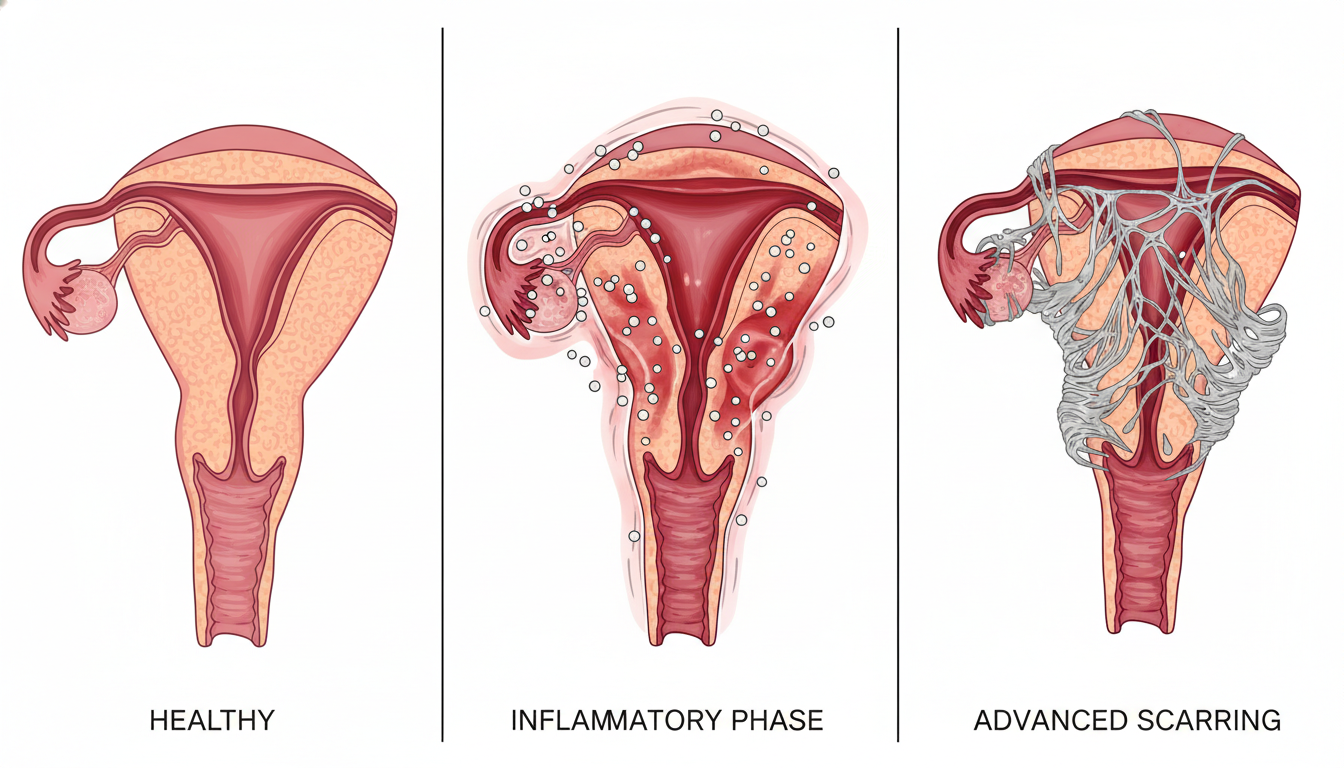
In women, untreated chlamydia or gonorrhea ascends from the cervix into the uterus and fallopian tubes, causing pelvic inflammatory disease (PID) in a meaningful subset of cases. PID is the inflammatory cascade that scars the fallopian tubes. The downstream consequences are well-documented: tubal-factor infertility (the leading cause of female-factor infertility in many populations), ectopic pregnancy (where a fertilized egg implants in the tube and ruptures it, a life-threatening surgical emergency), and chronic pelvic pain. PID is treatable with antibiotics, but the scarring it causes is structural and permanent.
In men, untreated infection causes epididymitis (inflammation of the duct behind the testicle), which produces pain, swelling, and in rare cases scarring sufficient to cause infertility. Untreated gonorrhea also occasionally causes disseminated gonococcal infection, with bloodstream spread to joints and skin.
Both bacteria can also infect the throat (from oral sex) and rectum (from receptive anal sex). Pharyngeal and rectal infections are very often asymptomatic and are missed by genital-only testing. The CDC's gold-standard laboratory test is nucleic acid amplification (NAAT) on the relevant anatomic site sample. At-home rapid lateral-flow swab tests use the same sample type for genital infections; for the throat and rectum, a clinic test is the right tool.
Many women with PID have no recognized symptoms or only mild discomfort that gets attributed to ordinary cycle pain. Because the scarring happens regardless, the CDC recommends annual chlamydia and gonorrhea screening for all sexually active women under 25, and for older women with new or multiple partners. Screening is the only way to catch silent infection before tubal damage occurs.
Hepatitis B and C: liver damage that can take decades
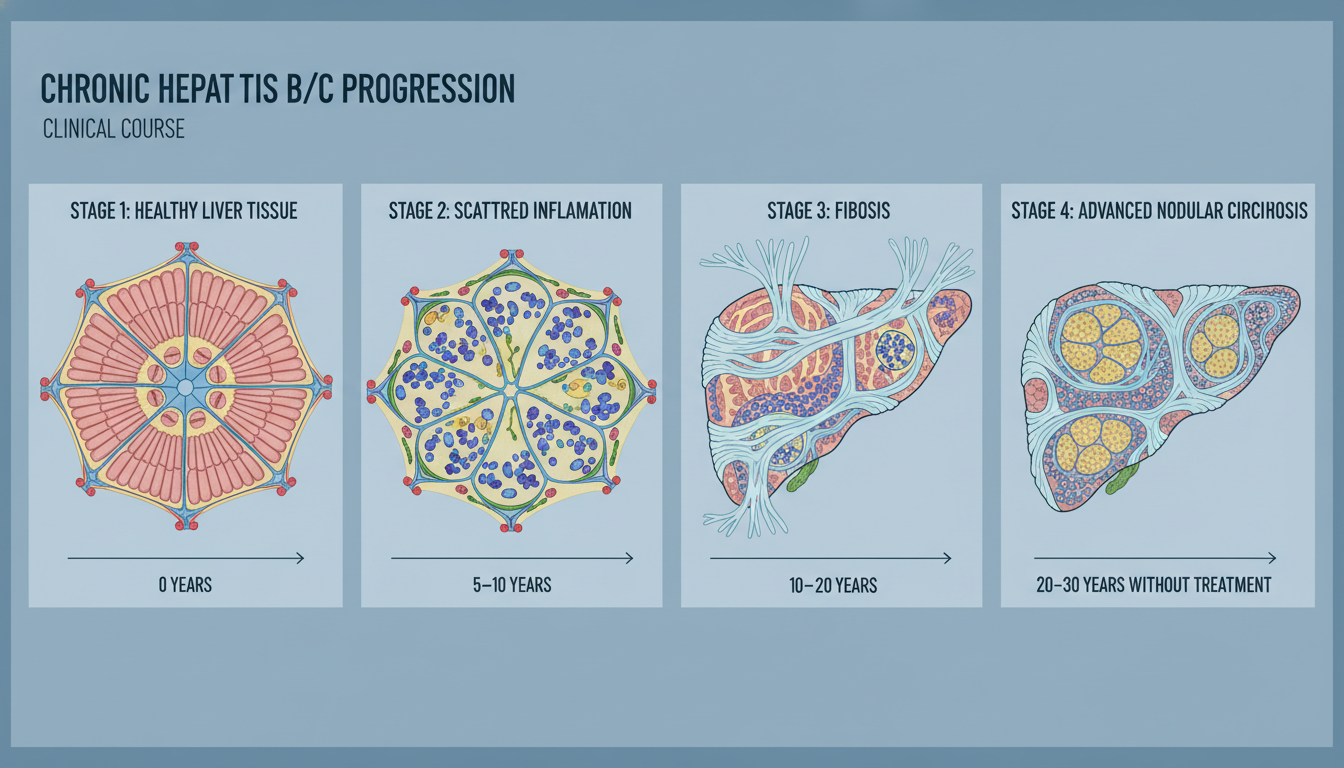
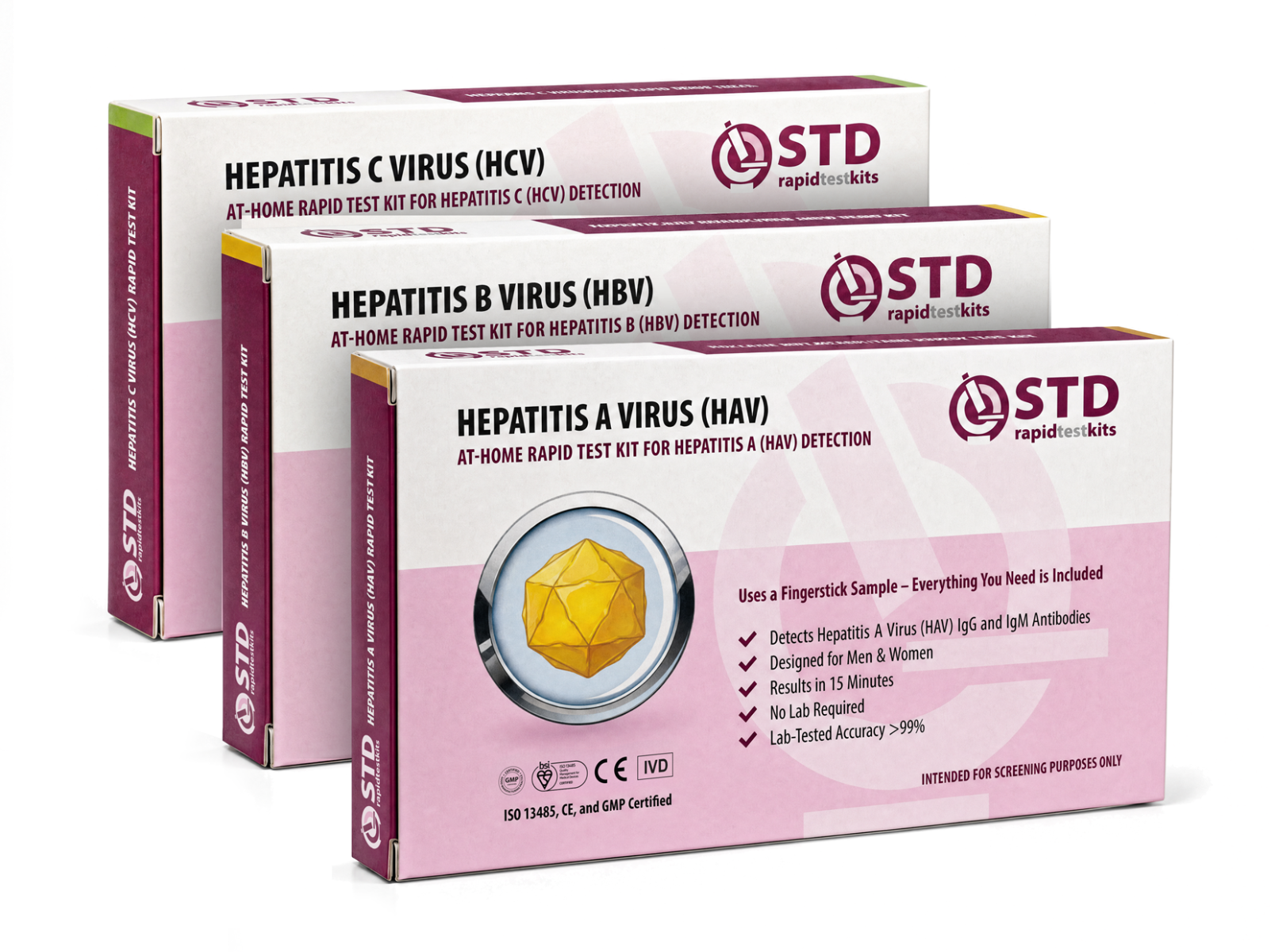
Hepatitis B and C are bloodborne and sexually transmissible viruses that infect liver cells. Both run a long, mostly asymptomatic course in chronic infection, and both are major causes of cirrhosis (irreversible liver scarring) and hepatocellular carcinoma (primary liver cancer) when left untreated.
A fraction of adults with acute hepatitis B develop chronic infection requiring lifelong monitoring or antiviral therapy; the rest clear the virus without treatment (CDC hepatitis B). Hepatitis B is preventable with a routine vaccine series; the CDC now recommends universal adult vaccination for ages 19 to 59, with shared decision-making for older adults.
Hepatitis C is the more concerning of the two for adults exposed today. Most people infected with hepatitis C develop chronic, lifelong infection without treatment, and chronic hepatitis C is the leading cause of liver transplant referral in the United States (CDC hepatitis C). The good news is dramatic: direct-acting antiviral therapy now cures more than 95 percent of hepatitis C cases in 8 to 12 weeks, and the CDC recommends one-time screening for all adults aged 18 and over, plus periodic re-testing for people with ongoing risk factors.
The window between infection and symptomatic liver disease can run 20 to 30 years for hepatitis C.
HPV: from infection to cervical cancer
Human papillomavirus is the most common STI in the United States, and most sexually active people acquire at least one strain at some point. The vast majority of HPV infections clear on their own within 1 to 2 years and never cause symptoms or harm. The problem is the persistent infections with high-risk oncogenic strains, which the CDC reports cause more than 9 in 10 cases of cervical cancer and a meaningful share of vulvar, vaginal, anal, penile, and oropharyngeal cancers (CDC cancers caused by HPV).
Persistent high-risk HPV infection in the cervix progresses slowly through pre-cancerous changes (cervical intraepithelial neoplasia, CIN 1 to 3) over a typical timeline of 10 to 20 years before developing into invasive cervical cancer. This long window is the reason routine cervical screening (Pap smears and HPV co-testing) is so effective: it catches abnormal cells while they are still pre-cancerous and treatable. Screening dramatically reduces cervical cancer mortality, and the CDC reports that HPV vaccination can prevent over 90 percent of cancers caused by HPV when administered before exposure.
The Advisory Committee on Immunization Practices (ACIP) recommends routine HPV vaccination for everyone through age 26, with shared clinical decision-making through age 45 for adults who were not vaccinated earlier. For adults already exposed to HPV, the priority shifts to screening: regular Pap smears and HPV testing as recommended by your clinician.
The HPV vaccine prevents most but not all HPV-related cancers, and it works best when given before any exposure to the virus. People who were vaccinated as adults, or who acquired HPV before vaccination, still benefit from regular cervical screening. Pap smears and HPV co-testing catch pre-cancerous CIN changes during the 10 to 20 years it usually takes for persistent high-risk infection to progress to invasive cancer, which is why routine screening at clinician-recommended intervals remains the front line for cervical-cancer prevention.
What history teaches us about untreated STIs
Three historical cases routinely come up in writing about untreated STIs because they make abstract consequences concrete. They are worth a careful look, since the lesson each one carries is different.
Freddie Mercury, the Queen frontman, was diagnosed with HIV in the late 1980s, several years before effective antiretroviral therapy became available. He died in November 1991 from AIDS-related bronchopneumonia, having confirmed his diagnosis publicly only the day before his death. His era was defined by a treatment vacuum more than a testing one; in the late 1980s, there was little a clinic could offer beyond palliative care for opportunistic infections. Today the same diagnosis is a treatable chronic condition, and the lesson Mercury's story carries forward is the one piece of the equation that has not changed: medication only helps after a diagnosis. Testing is the entry point.
Al Capone, the 1920s organized-crime figure, contracted syphilis as a young man and never received early-stage treatment. Penicillin became standard therapy for syphilis in 1943, but by then his nervous-system damage was already extensive. Historical biographies describe his cognitive decline, seizures, and personality changes during his final years as consistent with neurosyphilis, the late-stage central nervous system involvement of untreated infection. He died in 1947 at age 48. A single intramuscular benzathine penicillin injection now cures primary or secondary syphilis at a per-dose cost of a few dollars.
The 1990s Jamestown, New York case involving Nushawn Williams sits in a different category. Public-health records document that Williams knowingly transmitted HIV to at least 13 partners, prompting state legislation around criminal HIV transmission and a broader reassessment of partner-notification practices. The case is sometimes cited to make a point about individual responsibility, but the real public-health takeaway is structural: routine screening and partner-notification systems catch transmission chains earlier than any single person's choices ever could. Most STI transmission happens between people who do not know they are infected, not between people choosing to deceive.
The Mercury and Capone cases reflect treatment gaps, not just testing gaps. In the 1980s there was no effective antiretroviral therapy for HIV, and in Capone's youth penicillin had not yet been developed for syphilis. Both gaps have closed: HIV is now managed indefinitely with a single daily pill and the U=U framework, and syphilis is curable in primary or secondary stage with a single benzathine penicillin G injection. The Williams case from the late 1990s sits closer to the present, since both diagnostic and therapeutic tools were already available; the gap there was access, awareness, and partner notification, not pharmacology.
When to test: typical window periods
The window period is the gap between exposure and the point at which a test can reliably detect infection. Testing too early gives a falsely reassuring negative result. The right approach is to test at the earliest reliable point, then retest at the definitive point if the first test was negative and you want full confidence.
Window periods differ by infection type and by test technology. Lateral-flow rapid antibody tests (the chemistry used in most home kits) generally have slightly longer windows than fourth-generation laboratory antigen-antibody tests, because home tests detect antibodies only, while lab tests can also detect viral proteins (antigens) that appear earlier. The table below uses typical published windows from CDC fact sheets and product labels for the rapid lateral-flow chemistry used in home kits.
| Infection / test type | Earliest reliable result | Definitive negative |
|---|---|---|
| HIV (lab antigen-antibody) | 18 days | 45 days |
| HIV (rapid antibody home test) | 23 days | 90 days |
| Syphilis (rapid antibody) | 3 to 6 weeks | 90 days |
| Chlamydia (swab) | 1 to 2 weeks | 14 days |
| Gonorrhea (swab) | 1 to 2 weeks | 14 days |
| Hepatitis B surface antigen | 3 to 6 weeks | 60 days |
| Hepatitis C antibody | 3 to 8 weeks | 6 months |
| HSV-2 (blood antibody) | 4 to 6 weeks | 12 weeks (per CDC guidance; check the specific product label) |
How home rapid testing fits into screening
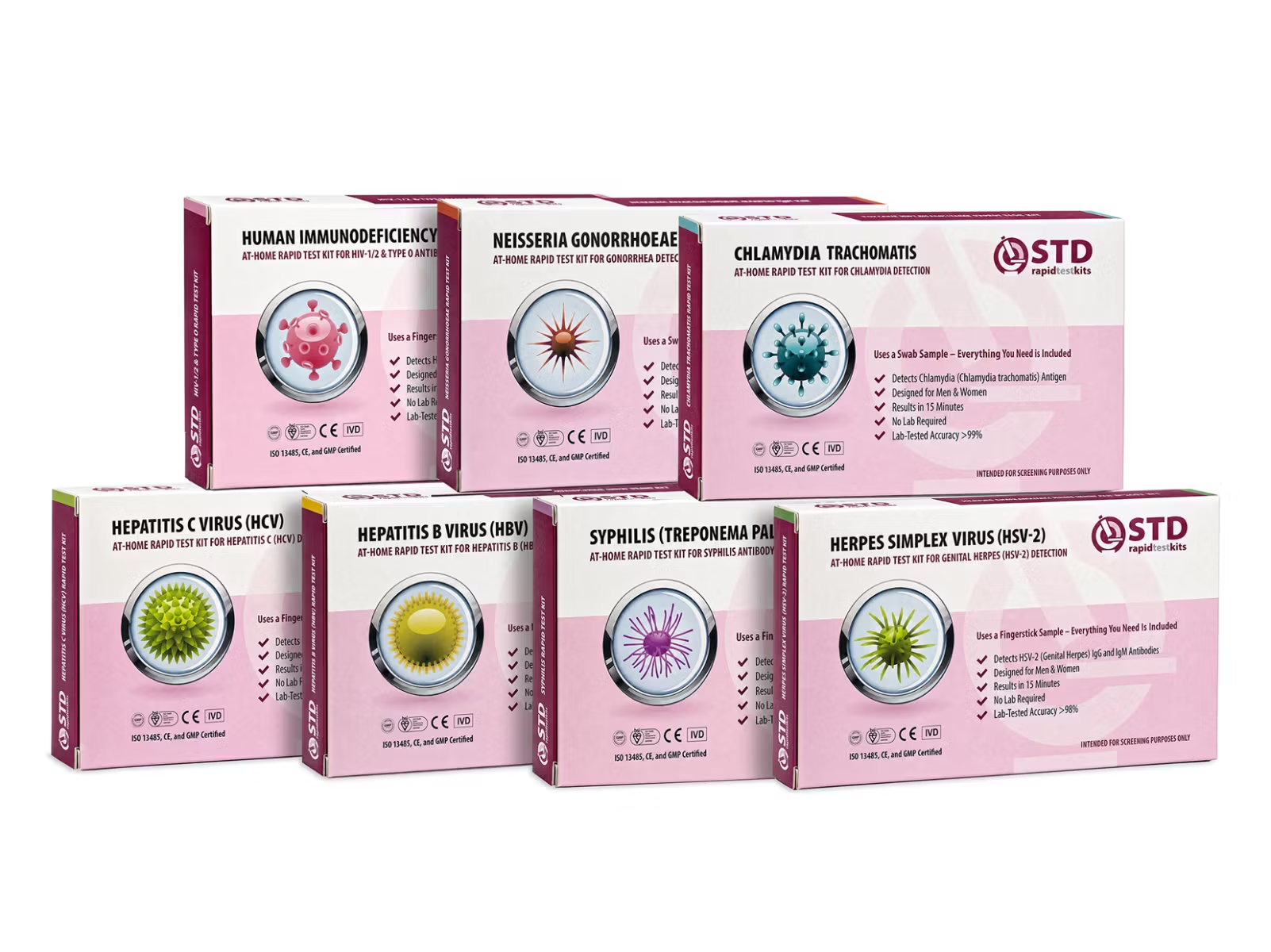
Home rapid tests for sexually transmitted infections use the same lateral-flow chemistry as the rapid tests used in many clinics. They produce a visible band on a test strip within 10 to 20 minutes, similar to a pregnancy test or a rapid COVID test. They are most useful for two scenarios: routine periodic screening when you are well past the window period and want a baseline, and a screening check several weeks after a possible exposure when you would otherwise wait longer to see a clinic.
What home rapid tests do well is provide an accessible, private first-line screen with minutes to result. They are not a substitute for clinic confirmation when something positive comes back. The U.S. testing infrastructure for STIs is built around a screening-then-confirmation model: a sensitive screen (rapid antibody, immunoassay) followed by a confirmatory test that is typically more specific (Western blot historically, or quantitative PCR for viral infections, or treponemal-specific testing for syphilis). A positive home result calls for clinic confirmation before any treatment decision.
Two limitations are worth noting up front. Home rapid tests are lateral-flow immunoassays, not nucleic acid amplification (NAAT) or PCR; their analytical sensitivity for very early or very low-viral-load infections is somewhat lower than lab molecular testing. And no rapid kit currently available covers throat or rectal sites; a person who has had receptive oral or anal exposure with a partner of unknown status should request site-specific NAAT testing at a clinic.
See a clinic for: pharyngeal (throat) and rectal swab testing, NAAT-based gold-standard confirmation, partner notification services, immediate treatment after a confirmed positive, sexual-assault forensic exams, and pregnancy-related STI testing. Home tests are an effective screening complement, not a replacement, for the contexts above.
More than 1 million curable sexually transmitted infections (STIs) are acquired every day worldwide in people 15 to 49 years old, the majority of which are asymptomatic.
FAQs
- Can untreated STIs really cause permanent damage?
- Yes. Untreated chlamydia and gonorrhea cause pelvic inflammatory disease and tubal scarring that is structural and irreversible, even after the bacteria are killed. Untreated syphilis causes cardiovascular and neurological damage in tertiary stage that antibiotics can halt but cannot reverse. Chronic hepatitis B and C cause progressive liver fibrosis that is permanent. Persistent high-risk HPV causes cervical cancer in a meaningful subset of cases. The earlier the diagnosis, the more reversible the outcome.
- How long does it take for an untreated STI to cause complications?
- Timelines vary widely by infection. Chlamydia and gonorrhea can cause PID within weeks to months. Untreated HIV typically reaches a symptomatic late stage within approximately a decade, with considerable individual variation. Untreated syphilis takes 10 to 30 years to reach tertiary stage. Hepatitis C cirrhosis takes 20 to 30 years on average. HPV-driven cervical cancer typically takes 10 to 20 years from persistent infection to invasive disease.
- Are there STIs that go away on their own without treatment?
- Most HPV infections clear spontaneously within 1 to 2 years; the persistent infections that do not clear drive HPV-related cancer risk. A fraction of adults with acute hepatitis B develop chronic infection, while the rest clear the virus naturally. Bacterial STIs (chlamydia, gonorrhea, syphilis, trichomoniasis) and HIV do not resolve without treatment. Even self-clearing infections can transmit to partners during the active phase.
- Can a home test detect STIs accurately enough to act on?
- A negative home test result, taken at the right time after potential exposure, is generally reliable for ruling out infection. A positive home test result is a strong screening signal that should be confirmed at a clinic before treatment, because confirmatory lab tests use more specific chemistry. For routine screening of someone with no recent suspected exposure, home rapid tests are a practical first-line tool.
- What is the window period for HIV testing at home?
- Home rapid antibody tests are reliable from about 23 days after potential exposure, with definitive results at 90 days. If you test negative within the first 90 days but had a known high-risk exposure, retest at the 90-day mark. Lab-based fourth-generation antigen-antibody tests can detect infection earlier (from about 18 days) because they pick up viral protein in addition to antibodies.
- If I test negative, do I still need to test again?
- It depends on your situation. If you tested at the earliest reliable point after a specific exposure, retest at the definitive window for confidence. For routine screening, the CDC suggests at least annual screening for sexually active people under 25, for anyone with a new or multiple partners, for men who have sex with men (every 3 to 6 months for some infections), and for pregnant people early in pregnancy.
- Can I get an STI from oral sex?
- Yes. Oral sex transmits gonorrhea, chlamydia, syphilis, herpes (HSV-1 and HSV-2), HPV, and rarely HIV. Pharyngeal gonorrhea and chlamydia are very often asymptomatic and require a throat swab to detect; home rapid kits do not cover this site, so a clinic visit is the right tool for an oral-exposure check.
- What should I do if my home STI test is positive?
- Schedule a clinic visit promptly for confirmatory testing and, if confirmed, treatment. Do not start antibiotics on the basis of a home test result alone. Notify recent sexual partners so they can also be tested; some health departments offer anonymous partner-notification services. If you are pregnant, contact your obstetric provider the same day, since several STIs have time-sensitive implications for the pregnancy.
- U.S. Centers for Disease Control and Prevention. National STI data release covering 2024 surveillance data, including continuing year-over-year increases in congenital syphilis and the 1-in-5 STI prevalence figure.
- U.S. Centers for Disease Control and Prevention. HIV overview: stages of HIV infection, transmission, and prevention.
- U.S. Centers for Disease Control and Prevention. Syphilis overview covering primary, secondary, latent, and tertiary stages.
- U.S. Centers for Disease Control and Prevention. Chlamydia overview covering symptoms, complications, and screening recommendations.
- U.S. Centers for Disease Control and Prevention. Gonorrhea overview covering symptoms, site-specific testing, and complications.
- U.S. Centers for Disease Control and Prevention. Hepatitis B basics for the public, including vaccine recommendations and chronic infection.
- U.S. Centers for Disease Control and Prevention. Hepatitis C basics covering screening and direct-acting antiviral cure rates above 95 percent.
- U.S. Centers for Disease Control and Prevention. Cancers caused by HPV, with annual U.S. case counts and HPV vaccination prevention rates.
- U.S. Centers for Disease Control and Prevention. STI Treatment Guidelines for clinicians, covering recommended antibiotic regimens.
- World Health Organization. Sexually transmitted infections fact sheet covering global burden, asymptomatic infections, and the case for routine screening.
