
Published: July 2025 | Last updated: May 2026 | Editorial review and quality control: Martina N.
Why does STI stigma still hit LGBTQ+ communities harder in 2026?
The legacy of the HIV/AIDS crisis layered on top of ongoing healthcare bias, intake systems that skip anatomy-based screening, and sex education that excludes queer lives. CDC and WHO data point to structural drivers, not behavior. Three practical exits work today: affirming clinics, queer-led community health centers, and at-home rapid testing.
For many LGBTQ+ readers, deciding to test for an STI is rarely a fifteen-minute errand. It picks up history, family, and identity on the way to the lab. A swab or a fingerstick can carry forty years of fear about being judged, outed, or written off, even when the person ordering the test is a stranger who barely looks up from the screen. That weight is the reason testing rates can lag for queer adults compared with their straight peers in surveys that ask, and it is the reason a routine visit can feel like a courtroom appearance.
This piece walks through where that stigma comes from, why it still bites in 2026, what the CDC and WHO data show about the population gap, and where the practical exits are: affirming clinics, peer-led community health centers, at-home rapid tests, and language that lets a person disclose a result without flinching. The aim is information you can use today, not therapy and not a lecture.
Key Takeaways
- LGBTQ+ patients report higher rates of avoidance, distrust, and discomfort in sexual health care settings, and the legacy of the HIV/AIDS crisis is a major reason why.
- Affirming clinics, queer-run community health centers, and at-home rapid testing are the three practical exits from the stigma loop.
Why LGBTQ+ stigma has deeper roots
Today's stigma starts with a specific historical wound. In June 1981 the U.S. CDC published the first cluster reports of an unknown immune disease in young gay men. The federal response over the next four years was slow, underfunded, and shaped by moral panic rather than medicine. President Reagan did not speak the word AIDS in a public address until late 1985, by which point thousands of Americans had already died. The cultural messaging that filled that silence was brutal: queer bodies were treated as inherently contagious, and a person's diagnosis became a verdict on their identity.
That history shaped everything that followed. It is the air that LGBTQ+ adults over forty learned to breathe, and it is the script their younger siblings, partners, and patients still inherit. Internalized stigma, the version of shame that lives inside a person, is well documented in CDC materials on HIV in the United States as a barrier to testing, treatment, and disclosure. The biomedical picture has changed dramatically since 1996, when protease inhibitors transformed HIV from a death sentence into a manageable chronic condition. The cultural picture has changed more slowly.
What this looks like in practice today:
- Some gay and bisexual men still describe a residual fear that any positive STI result will be read as confirmation of HIV, even when the two are unrelated.
- LGBTQ+ elders carry direct grief from the AIDS years, including the loss of partners, friends, and chosen family during a period when society told them their grief did not count.
- Younger queer people inherit fragments of that fear secondhand: through family stories, through the language clinicians choose, and through the absence of LGBTQ+ inclusive sex education in many U.S. school districts. The Trevor Project's national surveys of LGBTQ youth mental health consistently link affirming home and healthcare environments to lower rates of suicide attempts, a reminder that the cost of stigma is not only delayed testing.
Treatment, prevention, and visibility have all changed since the 1980s. Culture lags biology, though, and a clinic that opened in 2024 still sits inside the cultural memory that opened in 1981.
1981: First MMWR cluster report on what would be named AIDS. 1985: Reagan first addresses AIDS publicly; the HIV antibody test is approved by the FDA. 1987: ACT UP founded; AZT approved. 1996: Protease inhibitors transform HIV prognosis. 2012: FDA approves the first daily PrEP regimen for HIV prevention. 2016: The U=U scientific consensus (undetectable equals untransmittable) becomes public health guidance.
What the CDC numbers show
Stigma is hard to measure directly, but its downstream effects show up clearly in U.S. surveillance data. Gay, bisexual, and other men who have sex with men account for a majority share of primary and secondary syphilis cases reported in recent CDC STI surveillance reports. Transgender women, particularly Black and Latina trans women, carry HIV diagnosis rates several times the general-population baseline, according to CDC HIV surveillance data. Adolescents and young adults aged 15 to 24 account for nearly half of new chlamydia and gonorrhea diagnoses each year, even though they make up only about a quarter of the sexually active population. MSM living with HIV are also at elevated risk for hepatitis C co-infection per CDC, which can complicate treatment and warrants its own screening conversation with a provider.
These figures are often quoted in a way that flattens them into a behavior story: queer people, the framing goes, simply have more partners. The data does not actually say that. What sits behind the numbers is structural: who can access testing, who can afford treatment, who feels safe asking a doctor about their sex life, and how often a given population is offered the right tests. When researchers control for testing access, much of the gap narrows. Populations that test more frequently catch more infections that would otherwise stay hidden, which inflates the same diagnosis rate that gets read as a behavior problem.
The WHO's STI fact sheet notes that more than one million curable STIs are acquired worldwide every day in people aged 15 to 49, the majority asymptomatic. Asymptomatic infection is the engine here. Stigma keeps people from testing during the window when they feel fine, and asymptomatic transmission does the rest.
<a href="https://www.cdc.gov/std/treatment-guidelines/msm.htm" target="_blank" rel="noopener noreferrer">CDC STI treatment guidelines for men who have sex with men</a> note that roughly 70 percent of gonorrhea and chlamydia infections in this population can be missed when only urogenital samples are collected. Most pharyngeal and rectal infections are asymptomatic, so without site-specific swabs they go undiagnosed and continue to transmit. The diagnosis gap, in other words, is partly a sampling gap.
The quieter stigmas: herpes, HPV, and the gossip economy
HIV is not the only STI that carries weight in queer communities. Herpes, HPV, chlamydia, and gonorrhea all travel with their own emotional baggage. (Quick disclosure: stdrapidtestkits.com sells at-home rapid tests for several of these infections, and the inline product links above go to our catalog pages.) In tight queer social networks, where ex-partners often share friend groups and chosen family, a diagnosis can feel less like a private medical fact and more like a piece of information that may move on its own.
Three patterns show up repeatedly:
- Gay and bisexual men describe judgment around anal sex practices, sometimes from clinicians who lack training on extragenital screening sites. CDC screening guidance for sexually active gay and bisexual men recommends testing at the relevant anatomical sites (pharyngeal and rectal, in addition to genital) for chlamydia and gonorrhea. Many primary-care clinics still do not offer extragenital swabs by default, leaving real infections undetected and feeding the stereotype that gay men have higher STI rates simply because they have more sex. Undertesting, not behavior, drives much of this disparity. The full reference set is in the CDC STI treatment guidelines for men who have sex with men.
- Bisexual women and bisexual men describe a different bind: being seen as oversexualized and untrustworthy by partners of any gender, and being told by clinicians that their orientation is irrelevant to STI risk. Bi-erasure in healthcare leads to undertesting (a section below covers this in more detail).
- Trans patients report being skipped for routine STI screening entirely, often because clinicians are unsure which anatomy to swab or which questions to ask. CDC STI screening recommendations follow anatomy rather than gender markers, but many clinic workflows still do not.
A herpes or HPV diagnosis is rarely a medical emergency in itself. Most adults will be exposed to one or more strains of HPV in their lifetime, and most herpes infections are managed quietly with antivirals when symptoms appear.
For sexually active gay and bisexual men, CDC treatment guidance recommends testing at pharyngeal and rectal sites for chlamydia and gonorrhea, in addition to genital screening. Urogenital-only testing misses a substantial share of these infections. Many primary-care clinics do not order the extra swabs unless the patient explicitly asks for them.
The clinic closet: why many queer patients delay care
Researchers and patient advocates sometimes use the phrase "care closet" to describe the part of an appointment where a queer patient decides which parts of themselves to disclose and which to hide. The closet has little to do with pride or politics. It is about whether a given clinician is safe enough today to know that the patient has a same-sex partner, an HIV exposure question, a hormone regimen, or any other detail the patient suspects might change the quality of the care they receive.
This is documented. The Human Rights Campaign Foundation publishes the Healthcare Equality Index, which rates healthcare facilities on LGBTQ+ inclusion criteria. The index exists because LGBTQ+ patients have for decades reported worse experiences with their providers than straight cisgender patients do, including outright refusal of care in some regions. Queer patients learn early to scan a clinic for signals: pronouns on the intake form, rainbow pins on a name tag, gender-neutral bathrooms, and the way the receptionist reacts when a same-gender partner is listed as the emergency contact.
Common fears that walk into the exam room:
- Being misgendered during intake or during the physical exam, including by clinicians who saw the chart and still chose the wrong pronoun.
- Being assumed positive or high-risk based purely on orientation, then either over-tested or, more often, refused testing for what the clinician deems "the wrong" infection.
- Being denied testing with phrases like "you do not need that" when the patient has explicitly asked for screening.
- Having a partner outed by careless conversation in a hallway, especially in small towns where the clinic, the pharmacy, and the patient's workplace share employees.
These fears reflect accurate forecasts grounded in lived data. Asking queer patients to be braver misses the point.

Trans and nonbinary patients run into specific care gaps
Trans, nonbinary, and intersex patients often describe a distinct set of problems on top of the general LGBTQ+ stigma picture. STI screening is anatomy-driven (a swab tests a specific tissue, regardless of the patient's gender), but most clinic intake systems and EHR templates are not built that way. A trans woman on hormone therapy may have a chart that flags her as female and a screening template that therefore skips testing for the anatomy she still has. A trans man may be offered a Pap and ignore it for a decade because the language around it ("women's health") makes him feel invisible in his own appointment.
What this looks like in practice:
- EHR systems that surface only the screening menu mapped to the legal gender marker, instead of anatomy-based prompts that include cervix screening for anyone with a cervix and testicular self-exam guidance for anyone with testes.
- Clinicians who do not know whether to use a vaginal or a frontal swab, who default to skipping screening rather than asking a clarifying question.
- Pharmacies that flag a hormone refill in a way that outs the patient at the counter.
Workable standards already exist. The American College of Obstetricians and Gynecologists, the Endocrine Society, and the World Professional Association for Transgender Health all publish guidance that supports anatomy-based screening. When a clinic uses that guidance well, the trans or nonbinary patient gets routine STI testing in the same fifteen minutes that a cisgender patient does.
If you are trans or nonbinary and looking for an affirming provider, the Healthcare Equality Index directory linked above is one starting point. Many U.S. cities also have at least one LGBTQ+ community health center: Howard Brown in Chicago, Fenway Health in Boston, Callen-Lorde in New York, and Lyon-Martin in San Francisco, among others.
Stigma, discrimination, and other social and structural inequalities continue to prevent people from accessing HIV prevention, testing, and treatment services.
Bisexual erasure and the shame of being invisible
Bisexual, pansexual, and other multi-gender-attracted adults are the largest subgroup of the LGBTQ+ population in U.S. surveys, and they consistently report some of the worst health outcomes in the community. Bi adults do not fit either box, and that invisibility has clinical consequences. They often experience a particular kind of clinical erasure: when they disclose a same-gender partner, providers assume they are gay or lesbian; when they disclose a different-gender partner, providers assume they are straight. Either assumption ends up cutting off a relevant testing conversation.
When clinicians lack the language to ask about orientation and partner history clearly, the failure modes split in opposite directions:
- Risk underestimation. A bi woman whose current partner is male may not be offered HIV screening that she would benefit from based on her broader sexual history. A bi man whose current partner is female may not be offered the pharyngeal or rectal swabs that the CDC recommends for men who have ever had sex with men.
- Risk overestimation and moralizing. The mirror version, in which a clinician treats a bi patient as inherently "riskier" than a monosexual peer with identical history. Both patterns can drive a patient out the door without screening.
Beyond the clinical encounter, many bi adults describe the shame of being treated as either greedy or secretive by partners of any gender. That shame compounds the medical stigma, and it discourages exactly the disclosure that makes routine screening efficient. Affirming care for bi patients starts with a sentence as simple as "who have you had sex with in the last twelve months" instead of "are you gay or straight."
U.S. survey data consistently shows bisexual adults reporting worse mental and physical health outcomes than either monosexual gay/lesbian or straight peers, including lower rates of routine STI screening. What drives the gap is how clinical encounters handle disclosure: workflows that fail to translate a partner-history answer into appropriate screening leave bi patients underserved on both sides of the orientation map.
Five myths that quietly keep stigma alive
Stigma is rarely transmitted as a single big falsehood. It moves in small assumptions, repeated until they sound like common sense. Five show up most often in queer settings.
Myth 1: Only gay men get HIV. HIV transmits through specific routes: condomless anal or vaginal sex, sharing needles, and vertical transmission during birth or breastfeeding. Sexual orientation is not the variable. Rectal tissue is more biologically vulnerable than vaginal tissue, and the U.S. epidemic spread first through male-male sexual networks before testing was widely available. Today the CDC documents significant new HIV diagnoses among heterosexual women of color and people who inject drugs. Anyone with the relevant exposure can contract HIV.
Myth 2: You can tell if someone has an STI by looking. Most STIs are asymptomatic. Chlamydia, gonorrhea, and HPV frequently produce no visible signs at all. Early syphilis chancres can appear in places people do not check. Testing is the only way to know, both for the reader and for any partner.
Myth 3: PrEP makes other STI testing unnecessary. PrEP, taken daily before exposure, is highly effective at preventing HIV when used as prescribed (see the NIH HIVinfo PrEP fact sheet). It does nothing for syphilis, gonorrhea, chlamydia, hepatitis, or any other infection. Clinical guidelines recommend more frequent STI testing for people on PrEP, not less, because that population is typically in higher-exposure scenarios. A good PrEP protocol bundles syphilis, gonorrhea, and chlamydia screening into every quarterly visit.
Myth 4: At-home tests are unreliable. Reputable lateral-flow rapid tests, used inside their stated window periods, perform within published sensitivity and specificity ranges. They are not as analytically sensitive as a laboratory NAAT for bacterial infections, and a positive should be confirmed clinically. They are a reasonable first screen, not a final answer.
Myth 5: Talking openly about STIs encourages risky behavior. The evidence runs the other way. Reviews of comprehensive, LGBTQ+-inclusive sex education curricula in U.S. and European school districts consistently report lower STI rates and later onset of first sexual activity among participating teens, with no signal of increased risk behavior.
Of the five myths, the PrEP one lands the most readers in trouble. PrEP protects against HIV transmission only. Syphilis, gonorrhea, chlamydia, and hepatitis still need their own screening on a regular cadence. CDC PrEP protocols build that screening into routine follow-up visits; if your prescriber is not running it, ask.
How to find LGBTQ+ affirming sexual health care
Most LGBTQ+ patients eventually develop a personal shortlist of clinics, urgent care centers, and online providers that have proven safe over time. If you are starting that shortlist now, the following sources are reliable entry points.
Directories that filter for LGBTQ+ inclusion:
- The Human Rights Campaign Foundation's Healthcare Equality Index, which rates hospitals and clinics on inclusion criteria including non-discrimination policies, staff training, and patient services.
- GLMA (Health Professionals Advancing LGBTQ+ Equality), which maintains a provider directory of clinicians who have voluntarily registered as LGBTQ+ affirming.
- Planned Parenthood locations, most of which provide STI testing on a sliding scale and use intake forms designed to capture orientation, anatomy, and partner gender separately.
- Title X-funded clinics, which provide confidential sexual health care on a sliding-scale fee structure and are particularly useful for younger readers on a parent's insurance.
Community-led centers are usually the strongest option when one is available in your area. Examples include Fenway Health (Boston), Howard Brown Health (Chicago), Callen-Lorde (New York), Lyon-Martin (San Francisco), Whitman-Walker (Washington D.C.), Mazzoni Center (Philadelphia), and Equitas Health (Ohio). These organizations were built by and for LGBTQ+ communities, often during the AIDS crisis, and their intake workflows reflect that history.
Vetting questions for a new provider:
- Do you offer extragenital STI screening (pharyngeal and rectal swabs) when clinically indicated?
- How does your intake form handle gender, anatomy, and partner information?
- Do you offer PrEP and PEP, and are you comfortable prescribing them?
- For trans and nonbinary patients: do you use anatomy-based screening prompts, and how is hormone management handled?
A good clinic will answer these without hesitation. A clinic that becomes defensive when asked is telling you something useful. If asking the questions in person is not safe, the same vetting can happen over a brief phone call to the intake line, or via the patient-portal messaging that many practices now offer.
Call the front desk and ask two questions: "do you do pharyngeal and rectal swabs for chlamydia and gonorrhea when patients ask," and "what does your intake form ask about gender and partner gender." The answers (and the tone of voice) will tell you within ninety seconds whether the clinic is worth a full appointment.
When to test, and how often
The CDC STI Treatment Guidelines separate testing frequency by exposure profile, not by orientation label. For sexually active gay, bisexual, and other men who have sex with men, the recommendation is at least annual testing for HIV, syphilis, chlamydia, and gonorrhea, and every three to six months for those with multiple or new partners. The same cadence applies for transgender women and non-binary readers whose sexual exposures are similar. For sexually active LGBTQ youth more broadly, at least annual screening is the floor. The UK's NHS sexually transmitted infections page offers a parallel framing of screening eligibility for readers outside the U.S. system.
Window periods matter as much as frequency. A test performed too early after a possible exposure can miss an infection that has not yet generated detectable antibodies. Bacterial swab tests for chlamydia and gonorrhea can detect infection within one to two weeks of exposure. If a recent exposure is the concern, the right move is either to repeat the test once you are inside the window, or to visit a clinic for an earlier-detection assay such as the fourth-generation HIV antigen-antibody test, which can detect infection roughly 18 to 45 days after exposure.
Vaccination is the quiet companion to all of this. HPV vaccination is recommended through age 26 routinely, and through age 45 with shared clinical decision-making, per the CDC's HPV vaccination information (the CDC HPV section carries the full ACIP guidance). Hepatitis B vaccination is recommended for all unvaccinated adults. Both are usually covered by insurance, and many public clinics offer them at no cost.
Approximate window periods for at-home rapid antibody tests
- HIV: 23 to 90 days from exposure for antibody-only rapid tests. Clinic-based fourth-generation antigen-antibody assays detect earlier, roughly 18 to 45 days.
- Syphilis: 21 to 90 days from exposure for antibody seroconversion.
- Hepatitis B: approximately 30 to 60 days for antibody detection on rapid kits.
- Hepatitis C: approximately 8 to 11 weeks (about 56 to 77 days) for antibody seroconversion. The 30-day lower bound from older guidance is optimistic for HepC specifically.
- Herpes: about 12 weeks for most people; a minority of patients take up to six months to seroconvert.
- Chlamydia and gonorrhea: one to two weeks from exposure for swab-based bacterial detection.
At-home testing lowers the stigma tax
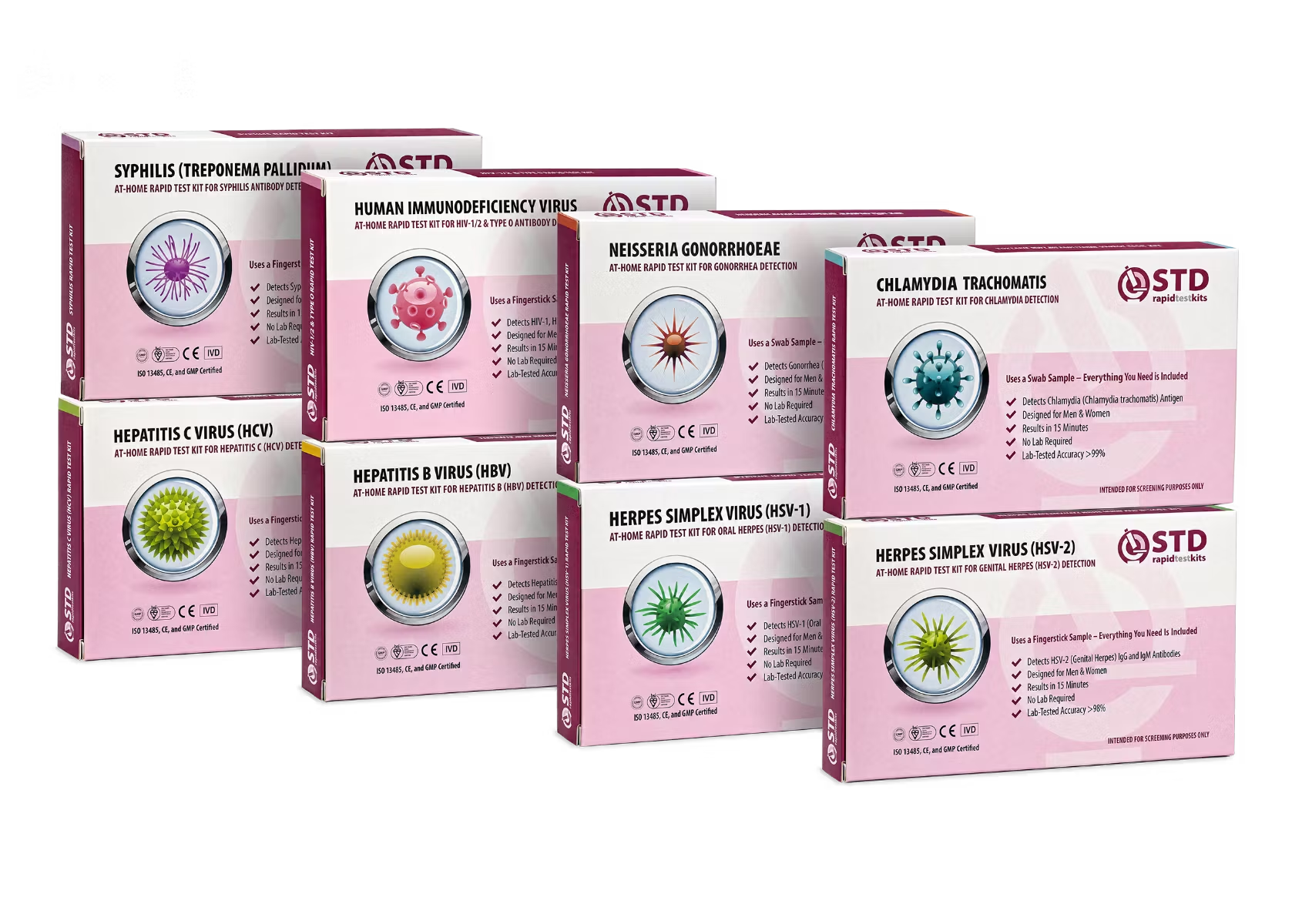
For readers who do not have an affirming clinic nearby, or who simply do not want the social cost of an in-person visit this week, at-home rapid testing is a useful tool. The kits are lateral-flow rapid tests, the same chemistry that pregnancy tests use, with a window for the antibody or antigen the device is looking for. A swab kit asks for a self-collected vaginal or penile swab; a blood kit asks for a fingerstick. Results show in about fifteen minutes.
What at-home rapid testing is good at:
- Bypassing the clinic encounter entirely when stigma, time, distance, or insurance is a barrier. For a teenager still on a parent's insurance or a college student between coverage cycles, that bypass can be the difference between a first test and no test.
- Letting a person test on their own schedule, including the morning after a worrying exposure or while waiting for a follow-up clinic appointment.
- Giving a clear screening result that a person can choose to confirm at a clinic if it comes back positive.
What at-home rapid testing cannot do:
- Replace clinical care when there is a visible lesion, persistent pain, or any sign of a serious infection. A clinic can swab, culture, and prescribe in a way that a home kit cannot.
- Substitute for a laboratory NAAT or PCR. Lateral-flow rapid tests are screening tools, and labs use NAAT or PCR for higher analytical sensitivity. A positive home result is worth confirming with a lab test when possible, and a negative result still needs to respect the window period of the infection being tested.
- Cover every concern in a single panel. The trichomoniasis and HPV swab kits sold on this site are validated for vaginal self-collection only; readers with penile anatomy who want screening for those infections will need a clinic visit.
At-home testing does not erase stigma. It does shrink the part of stigma that lives in the waiting-room chair, the intake form, and the receptionist's tone.
Rewriting the story: from shame to self-trust
Stigma operates at the population level even when it feels intensely personal. The literature is clear that internalized stigma reduces testing rates, delays treatment, and worsens mental health outcomes across the LGBTQ+ population. The literature is also clear that the most reliable counter to that pattern is community: affirming providers, peer-led organizations, partners who normalize disclosure, and resources that meet people where they already are.
None of this requires perfection from the individual reader. The interventions that move the data are structural (better intake forms, anatomy-based screening, expanded PrEP access, free or low-cost rapid testing) and relational (a friend who will go with you to a clinic, a partner who shares their last result without ceremony, a chosen-family group chat that treats a positive result as logistics rather than tragedy).
If you have been delaying a test because of the weight in this article, the practical step today is small. Pick one of the three exits: book an appointment at an affirming clinic, message a community health center on its patient portal, or order a kit that lets you screen at home this week.
The interventions with the strongest evidence base are structural rather than personal: anatomy-based screening prompts at intake, expanded PrEP and PEP access, free or low-cost rapid testing, and clinic workflows that translate a partner-history answer into appropriate test panels. Reader courage is one input among many, and not the limiting one.
Three concrete moves you can make this week
Did you have a high-risk exposure (condomless sex with a partner of unknown HIV status, or a shared needle) in the last 72 hours?
Yes: Call a sexual health clinic, urgent care, or ER about PEP (post-exposure prophylaxis) today. It has to start within 72 hours of exposure to be effective against HIV. After PEP, set follow-up testing at the relevant windows for HIV, syphilis, chlamydia, and gonorrhea.
Do you have an LGBTQ+ affirming clinic or community health center you can reach this week?
Yes: Book screening for HIV, syphilis, chlamydia, and gonorrhea. Ask explicitly for pharyngeal and rectal swabs if those sites match your exposure history. Confirm that the clinic uses anatomy-based prompts if you are trans or nonbinary.
No: Use the HRC Healthcare Equality Index or the GLMA provider directory to find one, or order an at-home rapid panel that covers your main concerns. If a home result comes back positive, follow up at a clinic or community health center to confirm the result and start treatment.
Pick the one that fits your situation. None of them require a perfect support network.
Frequently asked questions
- Why does STI stigma hit LGBTQ+ communities harder?
- Because of the unique historical weight of the HIV/AIDS crisis and decades of healthcare bias on top of the general stigma everyone faces. LGBTQ+ patients also report higher rates of clinician bias, misgendering, and assumed risk, which makes routine care feel high-stakes in a way it should not be.
- Do gay men have higher STI rates, or is that a stereotype?
- Higher diagnosis rates in this population mostly reflect who gets offered the right tests, not who has more sex. Pharyngeal and rectal swabs are rarely run at primary-care clinics, PrEP uptake is uneven, and undertested social networks let asymptomatic infections circulate longer. Once exposure type and testing access are held constant, biological risk profiles look similar across orientations.
- Are LGBTQ people biologically more likely to get STDs?
- Biological risk profiles are similar across orientations. Higher diagnosis rates in some LGBTQ populations reflect testing access, healthcare discrimination, the asymptomatic nature of many infections, and historical network effects from epidemics like HIV. When testing access and stigma are controlled for, much of the gap closes.
- Can I get accurate STI screening as a trans or nonbinary person?
- Yes, with the right provider. Screening is determined by anatomy, regardless of someone's gender marker. Affirming clinics and community health centers (Fenway, Howard Brown, Callen-Lorde, Lyon-Martin, and many others) routinely run anatomy-appropriate screening for trans and nonbinary patients. At-home rapid testing is another option when clinic access is limited.
- Does PrEP cover other STIs besides HIV?
- PrEP only protects against HIV. People on PrEP should continue regular screening for syphilis, gonorrhea, chlamydia, and hepatitis as recommended by their prescriber. Most PrEP protocols already include this screening at every quarterly visit, so if yours does not, ask for it.
- Is HIV still considered a gay disease?
- The medical answer is no. HIV affects people of every gender and orientation worldwide, and the U.S. epidemic now shows significant impact in heterosexual women of color and people who inject drugs. Culturally, the association still hangs on, which is one reason HIV stigma remains heavier than the biology now warrants.
- What should I do if I test positive at home?
- Get the result confirmed clinically. Most STIs are highly treatable, especially when caught early. A positive at-home test is the start of treatment, not a diagnosis you have to navigate alone. A primary care clinician, an LGBTQ+ affirming community health center, or a sexual health clinic can confirm the result and start treatment.
- What if a family member sees the test arrive?
- Reputable suppliers ship in plain unbranded packaging, and the mailing label typically does not name the contents. If a household member regularly opens mail addressed to others, picking up a test at a community health center, having it sent to a friend's address, or arranging in-store pickup are reasonable alternatives.
- U.S. Centers for Disease Control and Prevention. STD prevention, screening recommendations, and STI surveillance overview for the United States.
- U.S. Centers for Disease Control and Prevention. HIV basics, prevention (PrEP and PEP), and current surveillance data on disparities affecting gay, bisexual, and transgender populations.
- U.S. Centers for Disease Control and Prevention. STI Treatment Guidelines, including screening frequency for sexually active gay, bisexual, and other men who have sex with men, extragenital pharyngeal and rectal NAAT recommendations, and hepatitis C co-infection guidance.
- U.S. Centers for Disease Control and Prevention. Human papillomavirus information and ACIP vaccination guidance through age 26 routinely and through age 45 with shared clinical decision-making.
- UK National Health Service. Sexually transmitted infections overview, including screening eligibility and symptom guidance for general audiences.
- U.S. National Institutes of Health, HIVinfo. Pre-exposure prophylaxis (PrEP) fact sheet, including effectiveness against HIV transmission and clarification that PrEP does not protect against other STIs.
- World Health Organization. Sexually transmitted infections fact sheet, including the figure of more than one million curable STIs acquired daily in people aged 15 to 49 and the role of stigma in poor STI outcomes.
- Human Rights Campaign Foundation. Healthcare Equality Index, the U.S. benchmarking tool for LGBTQ+ inclusion in healthcare facilities.
