
Published: December 2025 | Last updated: May 2026 | Editorial review and quality control: Martina N.
A sore throat that drags past the second week, doesn't respond to amoxicillin, and has no obvious cause is what brings most readers here. The good news first: most lingering throat pain is viral or post-nasal in origin and resolves on its own within a couple of weeks. A small but meaningful share of stubborn cases are caused by sexually transmitted infections, most under-recognized of which is oral syphilis. It can show up as a single painless ulcer on a tonsil or as nonspecific irritation that mimics ordinary pharyngitis, which is exactly why it gets missed.
This article walks through the clinical pattern, the testing pathway, what a standard throat swab won't catch (and why), how to interpret the syphilis window period, what treatment looks like, and how to think about pharyngeal gonorrhea, chlamydia, and acute HIV when syphilis comes back negative.
Key Takeaways
- Most prolonged sore throats are viral and resolve without treatment, but a throat ulcer or red patch lasting longer than two weeks deserves an STI workup, not just another round of antibiotics.
- Syphilis in the throat is diagnosed by a blood antibody test, not a throat swab. A standard pharyngeal swab catches gonorrhea or chlamydia but misses syphilis entirely.
Why Oral Syphilis Gets Overlooked
Most people associate syphilis with genital ulcers or rashes, and most clinicians do too. The infection actually starts wherever the bacterium Treponema pallidum enters the body. For people who give or receive oral sex, the entry point is often inside the mouth or throat. The first sign is typically a chancre, a firm, round, painless sore that develops at the contact site. When that chancre forms on a tonsil, the back of the tongue, or the soft palate, it looks unremarkable on a quick exam and feels different from the cluster of canker sores or strep-induced redness that providers see far more often.
The trouble compounds because chancres are usually painless, so people don't ask about them. They heal on their own within three to six weeks without any treatment, which feels like a problem solved. The infection itself moves from the entry site into the bloodstream and progresses to secondary syphilis weeks to months later. By the time a body-wide rash, low-grade fever, or swollen lymph nodes appear, the original throat sore is gone and the connection to the earlier episode is invisible to both patient and provider.
Unless a clinician specifically suspects syphilis and orders a treponemal blood test, the infection won't show up on a strep rapid test, a respiratory viral panel, or a standard throat culture. The default sore-throat workup simply doesn't include it. Per CDC's annual STI surveillance summary, primary and secondary syphilis cases in the United States have risen substantially over the past decade, and oral and pharyngeal presentations contribute to delayed diagnosis.
Persons with primary syphilis have one or more chancres at the site of infection. Chancres can occur in nongenital locations (e.g., the mouth or pharynx). Because chancres can be painless and often go unnoticed, primary syphilis can go undiagnosed.
What Oral Syphilis Can Look and Feel Like
There is no single textbook presentation. Reported clinical features in published case series include a solitary painless ulcer on a tonsil, the lateral tongue, or the soft palate, often firm-edged and 0.5 to 2 cm across, sometimes with a clean gray-yellow base. Some people report a persistent raw or burning sensation in the throat without obvious redness or pus. One-sided tonsillar enlargement that doesn't respond to a course of penicillin or amoxicillin is another pattern. Painless swelling of the lymph nodes under the jaw on the same side as a sore is common.
In the secondary stage, flat gray-white plaques called "mucous patches" can appear on the tongue, gums, or buccal mucosa. These have sharply demarcated red borders and are highly infectious. Some people with early-stage infection have no oral symptoms at all, with only a positive blood test indicating exposure.
The subjective experience patients describe most often is a sore throat that overstayed its welcome. Strep typically resolves within 48 to 72 hours of starting an antibiotic. Mono usually carries marked fatigue, swollen glands throughout the neck, and sometimes a measurable fever. A chancre or mucous patch sits there refusing to follow either pattern, which is the clinical clue that ought to prompt testing.
The gallery below shows the visual spectrum: an oral chancre, secondary mucous patches, strep throat for differential comparison, and a common canker sore (also a frequent differential). Visual ID alone is not reliable for diagnosis. Even experienced clinicians need lab confirmation. Use these images to recognize when something looks worth investigating, not to self-diagnose.
How Oral Syphilis Differs From Strep, Mono, and Viral Pharyngitis
Most clinicians who see sore throats every day match patterns rather than running every possible test. The clues that should shift suspicion toward syphilis are duration, pain pattern, and response to ordinary antibiotics. The table below compares the four most common causes of a sore throat that lasts more than a few days.
| Feature | Oral Syphilis | Strep Throat | Mono | Viral Pharyngitis |
|---|---|---|---|---|
| Onset | Gradual; sore appears 10 to 90 days after exposure | Sudden; 1 to 5 days after exposure | Gradual; 1 to 2 weeks of fatigue first | Gradual; cold-like symptoms |
| Pain level | Often painless or mild | Severe | Moderate to severe | Mild to moderate |
| Visible sign | Single firm ulcer or gray patch | Red tonsils with white pus, often bilateral | Swollen tonsils, possible white coating | Mild redness, no exudate |
| Fever | Usually none in primary stage | High (101F or above) | Often present | Low-grade or none |
| Other body symptoms | None initially | Body aches, headache | Profound fatigue, swollen glands throughout neck | Cough, runny nose |
| Responds to amoxicillin | No | Yes within 48 to 72 hours | No | No |
How Syphilis Is Diagnosed (And Why Throat Swabs Miss It)
The standard diagnostic workflow for syphilis uses a two-step blood test. Per the CDC's STI Treatment Guidelines, the first step is a non-treponemal screening assay (the RPR or VDRL test) that measures non-specific antibodies your immune system produces in response to the inflammation syphilis causes. A reactive screen is followed by a treponemal-specific test (TP-PA, FTA-ABS, or a treponemal EIA) that confirms exposure to Treponema pallidum specifically. Many labs now run the sequence in reverse, starting with the treponemal test and reflexing to RPR, but the principle is the same: two complementary antibody tests are required for a confident diagnosis.
A throat swab, the test most clinicians reach for first when a patient presents with sore throat, will rule in or out gonorrhea and chlamydia (both can colonize the pharynx) but will not detect syphilis. The bacterium does not grow in standard culture, and there is no rapid antigen test for it equivalent to the strep test. If a throat swab came back negative, syphilis is still on the table until a blood test rules it out.
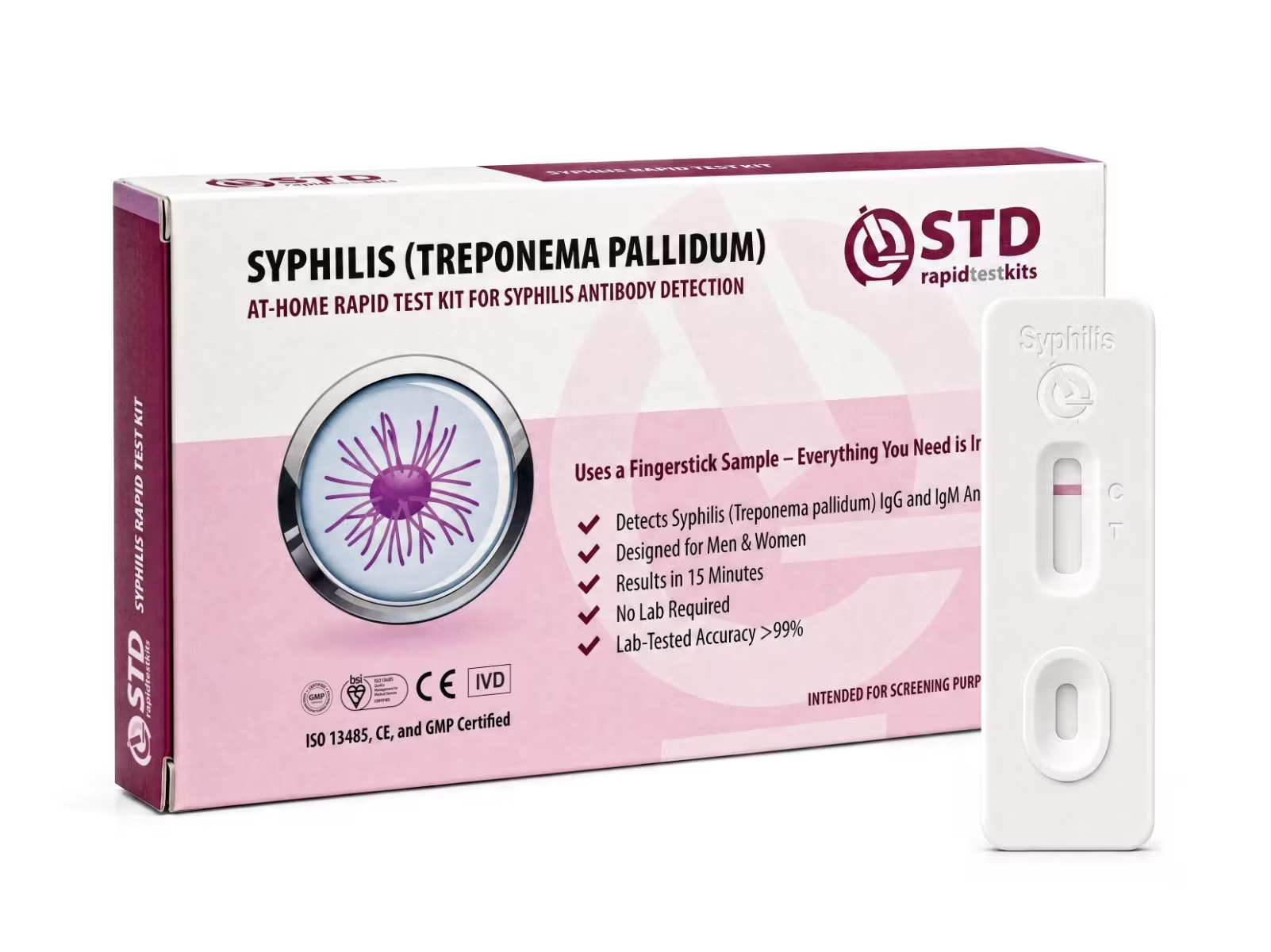
At-home rapid antibody tests for syphilis use a fingerstick blood sample and lateral-flow chemistry. They detect treponemal antibodies and are useful as a screen between three and six weeks after suspected exposure. A reactive at-home result should always be confirmed by a clinic blood draw and quantitative RPR titer, which guides treatment decisions and follow-up monitoring. At-home rapid tests are screening tools, not standalone diagnostic tools.
Quickest path to a diagnosis if your throat has hurt for two weeks or more?
Get a syphilis blood test (RPR plus treponemal confirmation) and ask the clinic to also throat-swab for gonorrhea and chlamydia at the same visit. The blood test is reliable from about 3 weeks post-exposure and definitive by 6 weeks. A pharyngeal swab covers the bacterial STIs that syphilis blood tests miss. Combined, the two-test approach catches the most common oral STIs in one visit.
When to Test: The Window Period for Syphilis Antibodies
Antibodies take time to develop. Testing too early after exposure produces false negatives that feel reassuring and aren't. The CDC's recommended window for reliable serological testing is three to six weeks after the exposure event, with most cases positive by week six. People with active symptoms (a visible sore, one-sided swollen tonsil, or a mucous patch) should test sooner because primary syphilis can be diagnosed by direct examination of fluid from the chancre via dark-field microscopy or PCR if available, and should retest at six weeks if the first blood test is negative.
Disclosure: stdrapidtestkits.com sells the at-home syphilis blood test referenced below. We recommend products based on fit-for-purpose for the reader's concern, not commercial benefit; the rapid lateral-flow kit screens for treponemal antibodies and is most useful three weeks or longer after exposure.
| Time Since Exposure | Test Reliability | Recommended Action |
|---|---|---|
| 0 to 2 weeks | Very low | Too early for serology unless a visible sore is present; test can be done but expect to retest |
| 2 to 3 weeks | Low to moderate | May catch early infection if a chancre is present; retest at 6 weeks if negative |
| 3 to 6 weeks | High | Optimal window for first reliable blood test |
| 6 to 12 weeks | Very high | Definitive screening period; a negative test here is reassuring |
| 12+ weeks | Highest | Use for confirmation after initial test or for late presenters |
Treatment, Follow-Up, and Re-Testing
Syphilis is curable. A single intramuscular injection of long-acting benzathine penicillin G (2.4 million units) clears the bacterium in primary, secondary, and early latent infection in the great majority of cases, per current CDC clinical guidance. Late latent syphilis, infection of unknown duration, or tertiary syphilis requires three weekly doses. Penicillin allergy management is a clinical decision; in pregnant patients, where penicillin remains the only fully effective treatment, desensitization is performed under specialist supervision.
Many people experience a Jarisch-Herxheimer reaction within the first 24 hours after treatment: a flu-like episode of fever, chills, headache, and muscle aches caused by the rapid die-off of bacteria. This is expected and resolves on its own within a day. Acetaminophen helps.
After treatment, the standard recommendation is a follow-up RPR titer at 6 and 12 months to confirm a fourfold drop in antibody level, which indicates successful treatment. The treponemal antibody test can stay positive for life even after cure. Persistent treponemal antibodies reflect immunological memory rather than treatment failure. What matters clinically is the downward trend in the non-treponemal (RPR or VDRL) titer.
Recent partners need to be notified and tested. State and local health departments offer partner-services programs that can do the notification on a patient's behalf, anonymously if desired.
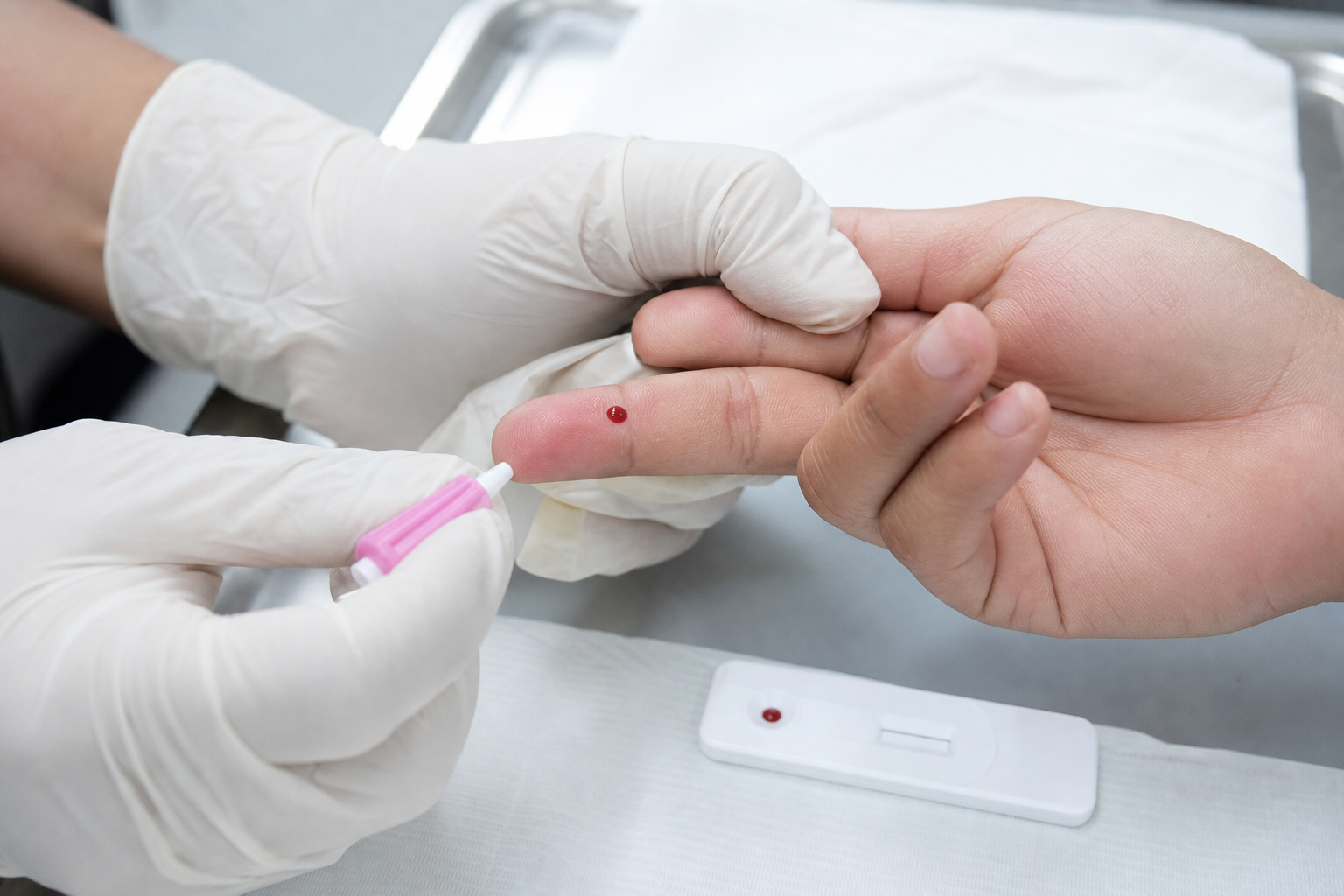
Among adults who acquired syphilis, follow-up serologic testing at 6 and 12 months after recommended therapy is recommended to assess treatment response.
Negative Syphilis Test, Persistent Throat Symptoms: What Else to Consider
A negative syphilis test in someone with persistent throat symptoms isn't the end of the workup. Several other oral and pharyngeal infections deserve consideration before defaulting back to "probably viral."
Pharyngeal gonorrhea is the most common bacterial STI of the throat. It is usually asymptomatic but occasionally causes a sore throat with mild redness. Diagnosis requires a clinic-collected throat swab analyzed by NAAT (nucleic acid amplification testing). stdrapidtestkits.com does not sell a pharyngeal swab kit; our at-home tests cover blood-based and genital sample types only.
Pharyngeal chlamydia is less common than throat gonorrhea but possible after oral sex. Same testing pathway: a clinic-collected throat swab analyzed by NAAT. Pharyngeal gonorrhea has narrowing antibiotic options because of resistance, so treatment is guided by current CDC recommendations.
Acute HIV infection can include a flu-like illness with sore throat, fever, fatigue, swollen glands, and sometimes a body-wide rash, typically 2 to 4 weeks after exposure. A fourth-generation antigen-antibody HIV test is reliable from about 18 to 45 days post-exposure, per CDC's HIV testing guidance. Earlier than that, a HIV RNA (viral load) test from a clinic can detect infection sooner. Combined HIV plus syphilis at-home blood tests cover both at once.
Oral herpes (HSV-1 and occasionally HSV-2) produces grouped painful vesicles that ulcerate. Cold-sore-type lesions cluster on the lips; intra-oral herpes tends to favor the hard palate and attached gingiva rather than the soft tissue inside the mouth.
Non-STI causes worth ruling out before extensive testing include chronic post-nasal drip, allergic pharyngitis, gastroesophageal reflux causing posterior throat irritation, and oral thrush (candidiasis) particularly in people on inhaled corticosteroids or with diabetes. If a sore throat has lasted more than three weeks regardless of testing pattern, an in-person ENT evaluation is warranted to rule out non-infectious causes including, in older adults or smokers, oropharyngeal cancer.
| Infection | Typical Throat Symptom | Diagnostic Test | At-Home Option from stdrapidtestkits.com? |
|---|---|---|---|
| Pharyngeal gonorrhea | Often silent; occasionally mild redness | Throat-swab NAAT at a lab | No (clinic-collected swab required) |
| Pharyngeal chlamydia | Usually asymptomatic | Throat-swab NAAT at a lab | No (clinic-collected swab required) |
| Acute HIV | Flu-like sore throat with fever and swollen glands | 4th-generation antigen-antibody blood test | Yes (fingerstick blood antibody test) |
| Oral herpes (HSV-1 / HSV-2) | Grouped painful vesicles on lip, hard palate, or gingiva | Lesion swab PCR at a lab | Blood antibody only (no at-home lesion swab) |

Telling Recent Partners Without the Drama
Notifying recent partners is a public-health expectation when syphilis or any reportable STI is diagnosed. It feels difficult on the inside and is usually less so on the outside than people expect. Most U.S. state and local health departments offer partner-services programs that will contact partners on a patient's behalf, anonymously if requested, and arrange testing and treatment without naming the index case.
The script doesn't need to be elaborate. A short factual message that names the infection, mentions the testing window, and points toward a place to get tested is enough. The callout below shows one template that works for in-person delivery, text, or anonymous partner-services notification.
"I tested positive for syphilis recently and wanted to let you know in case you want to get checked too. The blood test is most accurate three to six weeks after exposure, but if you have any symptoms now, get checked sooner. Happy to send a clinic link if it helps."
Three sentences. Name the infection, mention the window, point to the next step. That's all a partner needs to act on it.
Prevention That Actually Reduces Risk
There is no syphilis vaccine. The risk-reduction options that work in everyday practice are barrier protection during oral sex (condoms and dental dams reduce, though don't eliminate, the chance of mucosal contact with a sore in an unprotected area), regular screening every three to six months for sexually active people with multiple partners, and prompt evaluation of any persistent oral or genital lesion to shorten the diagnostic delay.
Doxycycline post-exposure prophylaxis (doxy-PEP), a single 200-mg dose taken within 72 hours after condomless sex, is recommended in the 2024 CDC clinical guidelines for men who have sex with men and transgender women with a recent bacterial STI history. In those populations it substantially reduces incidence of syphilis, chlamydia, and gonorrhea. Doxy-PEP is not currently recommended as a routine intervention for cisgender heterosexual people, where the supporting evidence is more limited.
Routine HIV pre-exposure prophylaxis (PrEP) does not protect against syphilis. The two interventions address different infections and should be considered separately.
Risk-Reduction Checklist
- Barrier protection during oral sex (condoms and dental dams) reduces, though doesn't eliminate, contact with a sore in an unprotected area.
- Regular screening every three to six months for people with multiple partners catches infection early, when a single penicillin dose still clears it.
- Doxy-PEP at 200 mg within 72 hours of condomless sex is recommended in the 2024 CDC guideline for MSM and transgender women with a recent bacterial STI history.
When Self-Testing Stops Being Enough
At-home testing is appropriate for screening when symptoms are mild, exposure history is clear, and access to in-person care is limited or stigmatizing. It is not a substitute for professional evaluation in several specific situations, summarized in the callout below.
Treatment with the right antibiotic resolves syphilis in the great majority of cases. Untreated, it progresses through latent and tertiary stages with serious cardiovascular and neurological consequences over years to decades. The decision to test is the difficult part of the process.
- A throat sore or one-sided tonsillar swelling has lasted longer than three weeks regardless of test results.
- A rash is spreading rapidly to the trunk, palms, or soles (a possible secondary syphilis pattern).
- High fever, drooling, difficulty swallowing, or trouble breathing has developed. These signal possible epiglottitis or peritonsillar abscess and are medical emergencies.
- An at-home test result is reactive. Clinic confirmation and treatment should follow within days, not weeks.
Frequently Asked Questions
- Can a sore throat actually be a sign of an STI?
- Sometimes, yes. Most lingering throat pain is viral or related to allergies. A small share is caused by oral STIs, the most under-recognized of which is syphilis. Pharyngeal gonorrhea and chlamydia can also cause throat irritation, though both are often symptom-free. A throat sore that has lasted longer than two weeks with no clear viral cause warrants asking a clinician about STI testing.
- What does oral syphilis look like in the throat?
- In the secondary stage, flat gray-white mucous patches with sharp red borders often appear on the tongue or buccal mucosa before most people connect the symptoms back to the earlier primary stage. The earlier primary sign is a single painless firm ulcer on a tonsil or tongue, under 2 cm, with a clean gray base. A meaningful share of people develop no visible sore at all, only a nonspecific raw throat sensation. Visual diagnosis alone is unreliable; blood testing confirms it.
- Why didn't a throat swab catch syphilis?
- Throat swabs test for bacteria that either grow in culture or bind to antigen probes. Treponema pallidum does neither, so the body's antibody response is the only reliable detection signal. That is why a syphilis diagnosis depends on a blood sample rather than a throat swab, and why a negative throat swab does not rule syphilis out.
- How long after oral sex do I need to wait before a syphilis test is reliable?
- Antibodies typically become detectable 3 to 6 weeks after exposure, with most cases positive by week 6. Testing earlier than 3 weeks can produce a false negative. If you have an active throat sore now, test promptly and retest at the 6-week mark to confirm a negative result.
- Can syphilis be passed through kissing alone?
- It is uncommon but not impossible. Direct contact between mucous membranes and an active syphilis lesion (a chancre or mucous patch on the lip, tongue, or oral cavity) can transmit the bacterium. Most oral syphilis cases come from oral sex with an infected partner rather than from kissing.
- Will a sore throat from an STI go away on its own?
- The visible sore may heal on its own within 3 to 6 weeks. The infection itself does not. Untreated syphilis progresses through latent and tertiary stages with potentially serious cardiovascular and neurological consequences over years to decades. Healing of the chancre is not the same as cure.
- What other STIs can cause a sore throat?
- Pharyngeal gonorrhea (most often asymptomatic, occasionally mild redness), pharyngeal chlamydia (less common, usually silent), oral herpes (HSV-1 and sometimes HSV-2, with grouped painful vesicles), and acute HIV seroconversion (a flu-like illness 2 to 4 weeks post-exposure with fever, fatigue, swollen glands, and sometimes a sore throat).
- Should I take leftover antibiotics if I think it's an STI?
- No. Self-medicating risks partial treatment that masks symptoms without curing the infection, promotes antibiotic resistance, and complicates later diagnosis. Syphilis treatment requires a specific regimen (long-acting penicillin G) at a clinical dose. Pharyngeal gonorrhea has narrowing effective options because of resistance. See a clinician.
How we sourced this article: Our article was constructed based on current advice from the most prominent public health and medical organizations (CDC STI Treatment Guidelines, CDC STI surveillance, WHO syphilis fact sheet, NHS condition pages, and the 2024 CDC doxy-PEP MMWR guideline), and then molded into simple language based on the situations that people actually experience when an unexplained sore throat persists past two weeks. Citations point to root-domain pages from those organizations where possible, so the references stay valid as the underlying evidence base updates.
- U.S. Centers for Disease Control and Prevention. About Syphilis: signs and symptoms by stage and transmission routes.
- U.S. Centers for Disease Control and Prevention. STI Treatment Guidelines, syphilis section: serologic testing algorithm, treatment regimens, and follow-up RPR titer monitoring.
- World Health Organization. Syphilis fact sheet: global epidemiology, transmission, and screening recommendations.
- U.K. National Health Service. Syphilis condition page: patient-facing description of stages, symptoms, and treatment.
- U.S. Centers for Disease Control and Prevention. MMWR Recommendations and Reports, Vol. 73, No. 2 (June 2024). CDC Clinical Guidelines on the Use of Doxycycline Postexposure Prophylaxis for Bacterial Sexually Transmitted Infection Prevention.
- U.S. Centers for Disease Control and Prevention. HIV testing overview: window periods for fourth-generation antigen-antibody and HIV RNA tests.
- U.S. Centers for Disease Control and Prevention. Sexually Transmitted Infections Surveillance, annual summary: national case counts and trends for chlamydia, gonorrhea, and syphilis.
