
Published: September 2025 | Last updated: May 2026 | Editorial review and quality control: Martina N.
Recurring symptoms in the genital area are confusing in a specific way: they show up just long enough to scare you, then fade before you decide to act. A faint burning at the end of urination on Sunday, gone by Wednesday. A small sore that disappeared in three days. An itch that returns every few weeks but never quite the same. Many people land in this loop and decide the silence between flares is reassurance. It usually is not.
Several common sexual-health conditions can produce a stop-start symptom pattern, including herpes, chlamydia, gonorrhea, trichomoniasis, bacterial vaginosis, and HPV. Sometimes the pattern reflects an active viral infection rebounding. Sometimes it reflects a bacterial infection that was never fully treated, or one passed back and forth between partners. Sometimes the symptoms are not from a sexually transmitted infection at all and have a benign explanation. Testing is the only reliable way to tell which version you are dealing with.
This article walks through how each major STI can produce a fade-and-return pattern, how to tell recurrence from reinfection, and how to choose a sensible testing plan, even after the symptom has already faded.
Key Takeaways
- Symptoms that disappear are not the same as an infection that has resolved; herpes, chlamydia, gonorrhea, trichomoniasis, BV, and HPV can all cause stop-and-start patterns.
- Test after a noticed symptom or unprotected exposure, even if you feel fine today, and consider retesting if the first test was inside the infection's window period or if a partner went untreated.
Why STD symptoms can fade and come back
Most sexual-health conditions cause inflammation in tissue that is sensitive, well-supplied with nerves, and constantly changing under the influence of hormones, friction, and bathing habits. That sensitivity cuts both ways. A small viral lesion can feel like searing pain on day two and barely a tingle by day five. A bacterial infection can cause brief burning during urination, then quiet down once the local inflammatory response settles. Quiet phases do not mean the underlying problem has resolved.
The CDC's overview of genital herpes describes a typical pattern: an initial outbreak that may include painful sores, fever, swollen lymph nodes, and burning, followed by repeat outbreaks that are usually shorter and less severe than the first. People often describe the recurrences as a tingle, an itch, or a single small spot that heals before they can take a clear photo of it.
Bacterial infections behave differently but produce a similar reader experience. A chlamydia or gonorrhea infection can cause mild burning during urination, slight discharge, or pelvic discomfort that fades after a few days even though the bacteria continue to multiply. The inflammation calms; the infection does not. According to the CDC's overview of chlamydia, chlamydia often has no symptoms but can still cause serious health problems, which is one reason untreated infections so often progress to pelvic inflammatory disease before being noticed.
There is a third pathway worth naming. The genital area has a baseline of mild irritation that goes up and down with hormones, sex, soaps, fabrics, and shaving. A symptom that comes and goes with no underlying infection is plausible. The honest answer is that you cannot reason your way to which version is yours from sensation alone. Testing converts the question from "what is this?" into "is this on the list, yes or no?"
1. Viral recurrence. Viruses like herpes and HPV stay in the body. Outbreaks surface, the immune system pushes them back, and they surface again later.
2. Bacterial persistence or reinfection. Chlamydia, gonorrhea, and trichomoniasis can quiet down between flares while still multiplying, or can return when an untreated partner reintroduces them.
3. Non-infectious irritation. Hormones, friction, soaps, fabrics, and skin conditions can produce stop-and-start sensations that mimic STI symptoms but never show up on an STI panel.
The infections most often behind a stop-start pattern
Herpes (HSV-1 and HSV-2) is the textbook example. Once the virus enters the body it travels along nerves to the sensory ganglia and stays there for life. Outbreaks are triggered by stress, illness, hormonal changes, friction, and fluctuations in immune function. Between outbreaks the virus can shed asymptomatically, which means transmission is possible even without visible sores. The CDC notes that recurrence is common in the first year after a new HSV-2 infection and tends to decrease in frequency over time.
Chlamydia and gonorrhea cause symptoms in only a minority of cases. When symptoms appear they often involve burning during urination, abnormal discharge, or pelvic discomfort, and they can ease after several days as the local inflammatory response settles even though the bacteria continue to multiply. Untreated, these infections can cause pelvic inflammatory disease, infertility, chronic pelvic pain, and in men, epididymitis (inflammation of the tube behind the testicle that stores and carries sperm).
Trichomoniasis is one of the most common curable sexually transmitted infections worldwide per the CDC, and most infected people have no symptoms. When symptoms appear they may include itching, burning, frothy discharge, and irritation that fluctuates with hygiene products and the menstrual cycle. The pattern is often "bothersome for a few days, then quiet for weeks."
Bacterial vaginosis is classified separately from sexually transmitted infections, though its recurrence is heavily influenced by sexual activity and partner change. According to the NHS overview of BV, recurrence is common and the condition can return within months of treatment, especially in people who continue to have new sexual contacts.
HPV behaves differently. Most infections clear within one to two years on their own. The strains that do not clear can stay quiet for years before producing visible warts or, in the case of high-risk types, abnormal Pap smear changes that signal cervical cell change. The fade-and-return sensation here is usually warts that respond to treatment and reappear weeks or months later because the underlying viral DNA is still present in surrounding skin cells.
Syphilis has perhaps the most misleading symptom course. The primary stage produces a single painless ulcer (the chancre) at the site of infection. The chancre heals on its own within three to six weeks regardless of whether the infection is treated. Many people miss it entirely, especially when the chancre forms on the cervix, in the throat, or in the rectum. Weeks to months later, secondary syphilis can produce a rash (often on the palms and soles), fever, and swollen lymph nodes, before the infection enters a long latent phase that may last years.

When "feeling fine" is not the all-clear it seems
A pattern common in sexual-health searches looks like this: notice a symptom, panic, search a phrase like "STD symptoms went away should I still test," watch the symptom fade, feel relief, and file the episode under "probably nothing." Several months later, a new partner mentions positive results, or a routine visit catches an infection that was never treated.
The trap is that mild symptoms that resolve on their own are still symptoms. Cellular damage from chlamydia can continue silently. Viral shedding from herpes can occur without visible sores. Gonorrhea bacteria can spread from the urethra to the testicles or from the cervix to the fallopian tubes during the quiet phase, which is when much of the long-term reproductive damage actually happens.
Skipping testing once symptoms fade is a rational response to discomfort and uncertainty. The alarm goes silent, and the brain treats silence as resolution. The fix is to detach the testing decision from how things feel today and tie it to the exposure itself.
- You had unprotected sexual contact with a new or untested partner in the last few months.
- You noticed any genital symptom (burning, itching, sore, unusual discharge), even briefly.
- A current or former partner told you they tested positive for an STI.
Recurrence, reinfection, and something else entirely
Three different mechanisms can produce the same reader experience of "it came back." Sorting out which one applies changes what you do next.
Recurrence is what happens with viruses the body cannot fully clear, like herpes and HPV. The virus is still present in the nervous system or skin cells. It surfaces, the immune system pushes it back, and it surfaces again later. Treatment can shorten outbreaks and reduce frequency for herpes, and HPV-related warts can be removed, but the underlying virus stays in the body until the immune system clears it (or, for herpes, indefinitely). Recurrence patterns vary widely between individuals.
Reinfection is what happens with curable bacterial infections like chlamydia, gonorrhea, and trichomoniasis. The first round was treated, the symptoms cleared, and a new sexual contact (or an untreated partner) brought the infection back. The CDC's surveillance of repeat chlamydia infections shows that reinfection within a year of treatment is common, especially when partners are not treated at the same time.
Something else entirely covers a long list of non-infectious causes that mimic STI symptoms: friction or razor irritation, contact dermatitis from soaps, lubricants, or condom materials, hormonal cycle changes, vulvodynia, lichen sclerosus, eczema, urinary tract infections that are not sexually transmitted, yeast overgrowth, and hemorrhoidal flares. None of these show up on STI panels. All of them deserve evaluation if the pattern continues after STIs have been ruled out.
The practical implication: ruling things in (positive test) is fast. Ruling things out (negative test plus persistent symptoms) is slower, because the next step becomes a clinical examination by dermatology, gynecology, urology, or primary care. Either direction, the first move is testing for the most common infections.
This article is published by stdrapidtestkits.com, which sells at-home rapid STI testing kits; product mentions in this article link to our own catalog. We recommend products based on fit-for-purpose for the reader's concern, not commercial benefit.
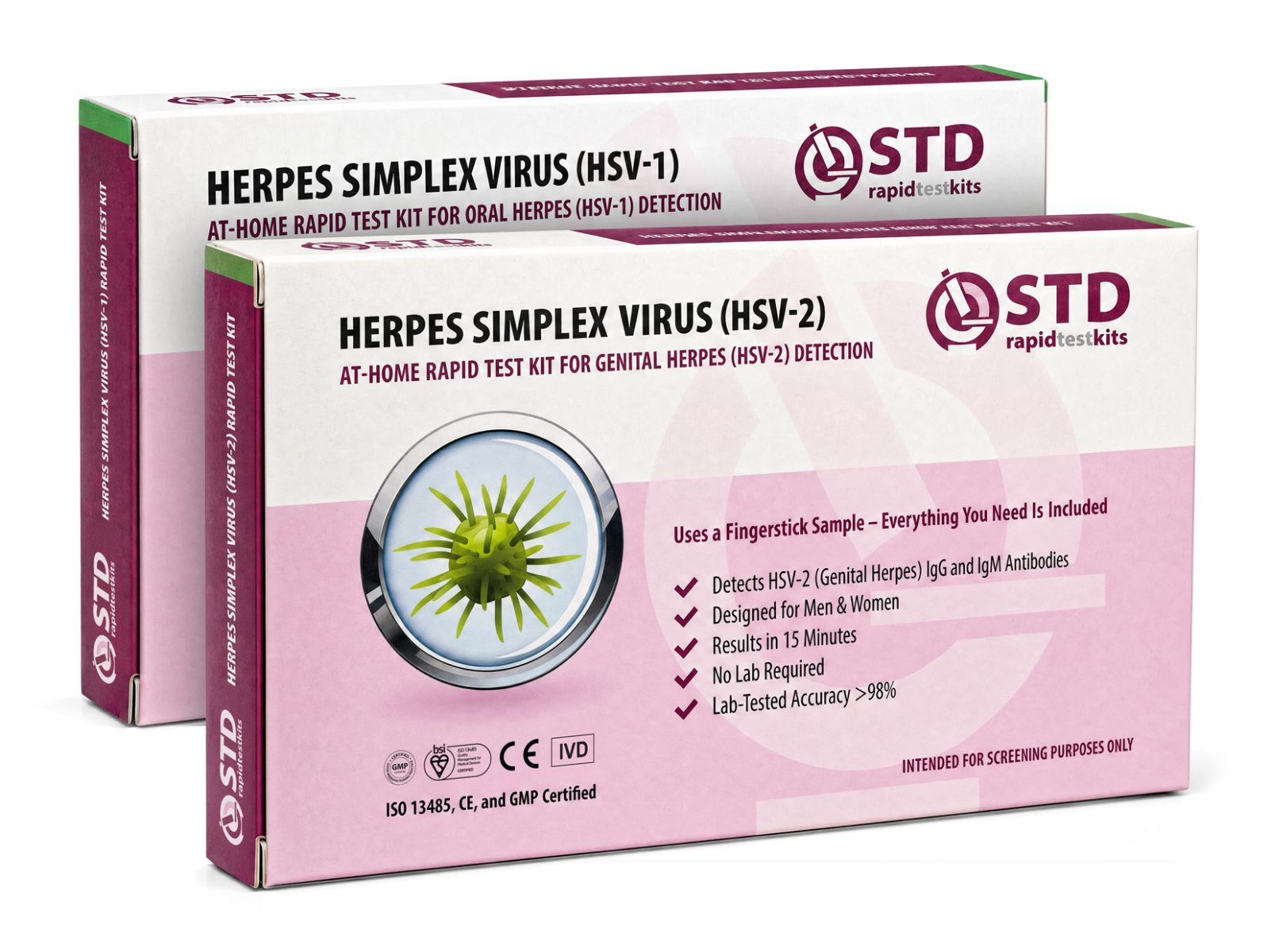
Why a single negative test is not always the end of the story
The window period is the gap between exposure and the time when a test can reliably detect the infection. Test before that window closes and you can get a falsely reassuring negative.
For HIV, fourth-generation antigen-antibody tests detect most infections by 18 to 45 days post-exposure per CDC guidance. For chlamydia and gonorrhea, lab NAAT tests detect the bacteria within roughly 1 to 3 weeks after exposure. For herpes, the CDC notes that current antibody blood tests can take 12 weeks or more (up to 16 weeks for some test types) to become reliably positive after a new infection. For syphilis, the antibody window is roughly 3 to 12 weeks. At-home rapid lateral-flow tests use antibody or antigen chemistry similar to lab antibody tests, with somewhat lower analytical sensitivity than laboratory NAAT, which makes them well-suited as screening tools; a positive home result is worth confirming with a clinician.
Two situations call for a retest:
- The initial test fell inside the window period for the specific infection. Retest after that window has closed.
- Symptoms returned after a clean test, especially after new sexual contact or an untreated partner. Retest at 2 to 3 weeks for bacterial STIs and at 12 weeks or more for herpes and HIV antibody tests.
A single negative result is reassuring information for that day and that test. It does not lock in an indefinite all-clear if exposure has continued or if the test was taken too early.
Persons treated for chlamydia should be retested approximately three months after treatment, as reinfection from an untreated sex partner is common.
How to read your body's signals without spiraling
Anxiety amplifies sensation. Once you have had a scare or a positive result in the past, the genital area becomes a place you scan more often. Tingles you previously ignored register as alarms. Healthy variations in discharge or skin texture become candidates for diagnosis.
This is real, and it does not mean the sensations are imagined. It means the brain has gotten good at flagging the area, and that the data alone cannot distinguish "this is the same baseline I have always had" from "this is new." Testing helps in both directions: a positive result tells you what to treat, and a negative result lets the part of your brain that is monitoring stand down.
Three concrete habits help break the spiral:
- Decide testing intervals in advance, tied to your sexual activity rather than to current sensation. For most sexually active people with new partners, every 3 to 6 months for the basic panel is a reasonable default.
- When a symptom appears, write down what, where, and when. A two-line note is enough. Patterns become visible faster on paper than in memory.
- After a negative result during a scare, set a calendar reminder for the appropriate retest date if the test was taken inside the window period.
That approach decouples the testing decision from how you feel on any given day.
When to test, when to retest, and what to test for
A reasonable default panel for sexually active adults includes chlamydia, gonorrhea, syphilis, and HIV. Add trichomoniasis if symptoms or pelvic discomfort have been present, hepatitis B and C if there has been needle-sharing or sex with someone whose status is unknown, and herpes serology if symptoms have suggested HSV but earlier swab tests came back inconclusive.
Time-of-test guidance based on CDC windows:
- After unprotected contact with a new partner: chlamydia and gonorrhea at about 2 weeks; HIV, hepatitis, and syphilis at 4 to 6 weeks; HSV serology at 12 weeks or more if symptoms have appeared.
- After a partner notification: test as soon as possible if symptoms are present, then retest at the appropriate window if the first test is negative.
- During treatment for a bacterial STI: avoid sex until both partners have completed treatment to prevent ping-pong reinfection between you.
- Three months after completing chlamydia or gonorrhea treatment: test again. The CDC recommends this retest because reinfection from an untreated partner is common.
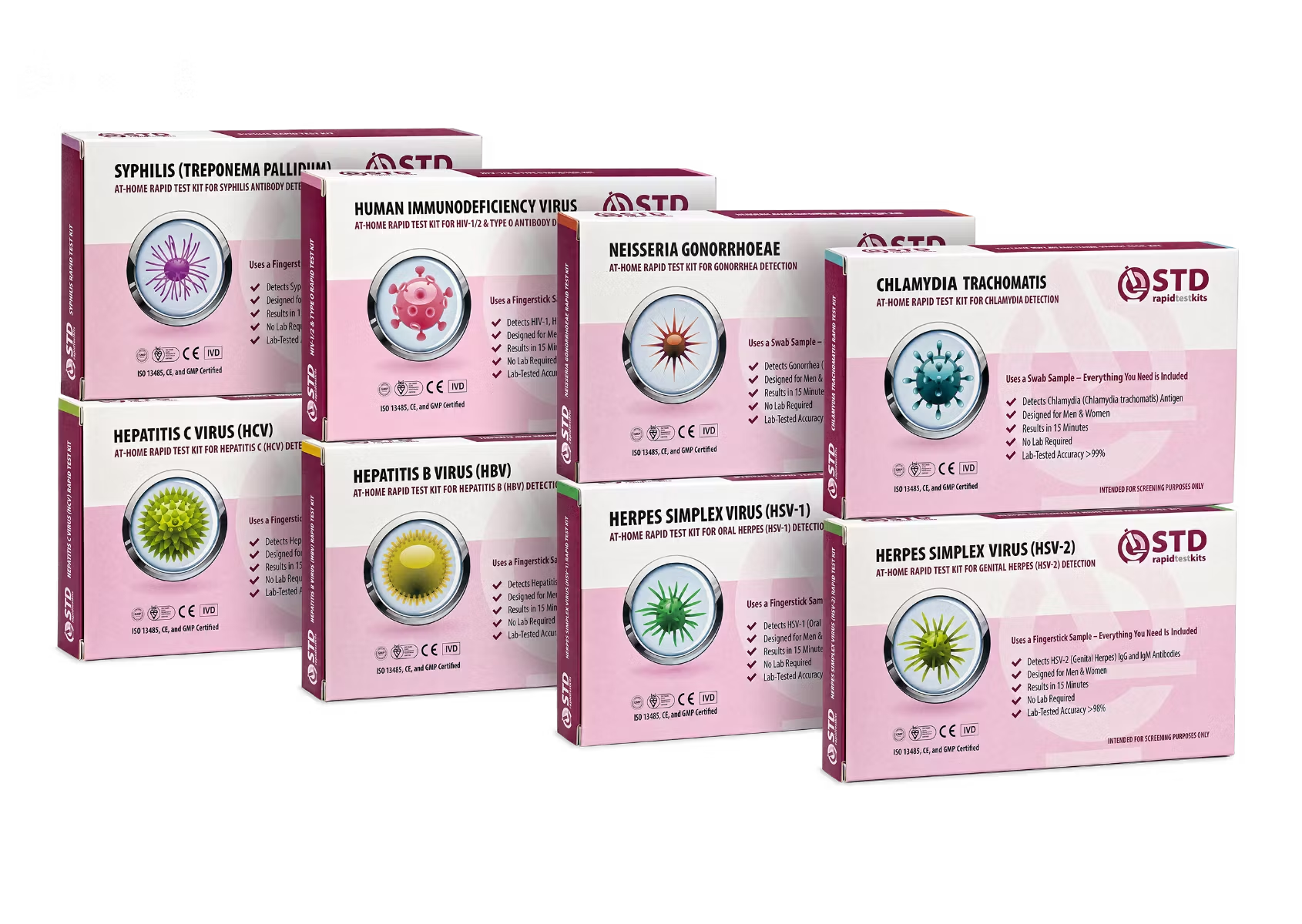
Use an at-home kit when convenience and privacy matter most; follow up with a lab NAAT when the home result is positive, when the exposure was high-risk, or when a clinician needs a confirmatory result for treatment decisions.
What to do this week if symptoms keep cycling
If symptoms have been coming and going, here is a sensible plan for the next seven days:
- Write down what you have been noticing: where, what, when, how long, and what makes it ease.
- Note any recent unprotected sexual contacts and how long ago they were.
- Choose a test that matches your timeline. If the most recent contact was within 2 weeks, the bacterial-STI window is closing but not yet closed; HIV and syphilis windows are wider.
- Test, even if symptoms have faded today.
- If the result is positive, treatment is straightforward for bacterial infections (typically a course of antibiotics for chlamydia and gonorrhea) and manageable for viral infections (daily or as-needed antiviral medication for herpes outbreaks).
- If the result is negative and symptoms continue, book a clinician visit for in-person examination. Some causes need to be looked at, swabbed, or biopsied to identify.
The single biggest mistake people make in this situation is waiting until symptoms feel "bad enough" to test. Symptoms that come and go are signals worth acting on whether they hurt today or not.

FAQs
- If symptoms went away, do I still need to test?
- Yes. Infections like chlamydia, gonorrhea, and herpes can persist and cause internal damage even after surface symptoms ease. The CDC recommends testing after any unprotected exposure or noticed symptom, regardless of whether the symptom is currently present.
- Can herpes really cause one tiny sore and nothing else?
- Yes. Recurrent HSV outbreaks, especially after the first one, often present as a single small lesion or a brief tingling sensation that heals within a few days. Atypical presentations like a paper-cut-shaped fissure or sensitivity during sex are also common. If a small spot keeps reappearing in the same place, an HSV antibody test 12 weeks or more after the suspected first exposure is reasonable.
- How accurate are at-home rapid STI tests?
- At-home rapid lateral-flow tests use the same antibody or antigen chemistry as lab versions but generally have somewhat lower analytical sensitivity than lab NAAT for bacterial STIs. They are useful screening tools, especially when used after the appropriate window period has passed, and a positive result should be confirmed with a clinician.
- If my partner was treated, can I still get reinfected?
- Yes, if you had sex before both partners completed treatment, or if your partner was not actually treated for the same infection you had. The CDC recommends abstaining from sex until both partners have completed therapy and any follow-up retest has been done.
- Can I pass an STI on if I have no symptoms?
- Yes. Asymptomatic transmission is well documented for chlamydia, gonorrhea, HIV, herpes, HPV, and syphilis. HIV in particular is transmissible during the early window period before any test can reliably detect it; fourth-generation antigen-antibody tests close that window faster (about 18 to 45 days) than older antibody-only tests, which can take up to 90 days. Routine screening is the only reliable way to catch silent infections.
- How soon after exposure can I test?
- The earliest useful test is around 1 to 2 weeks for chlamydia or gonorrhea. HIV and syphilis windows close for most people by about 6 weeks, with fourth-generation HIV tests reliable from 18 to 45 days. Herpes antibody tests need the longest wait, at least 12 weeks after a possible first exposure. Testing earlier than these windows risks a falsely reassuring negative.
- What if I test negative but my symptoms keep coming back?
- If basic STI screening is negative and symptoms persist, the next step is in-person clinical evaluation. Possibilities include contact dermatitis, lichen sclerosus, vulvodynia, recurrent UTI, hemorrhoidal flares, hormonal-cycle skin changes, and yeast infections. Some of these need a physical examination or biopsy to identify.
- Is bacterial vaginosis a sexually transmitted infection?
- BV is classified separately from STIs, though its recurrence is strongly influenced by sexual activity. Recurrence within months of treatment is common, and recent research suggests treating both partners may reduce repeat episodes. The NHS lists BV under sexual-health conditions for that reason.
- U.S. Centers for Disease Control and Prevention. About genital herpes: symptoms, recurrence patterns, and transmission.
- U.S. Centers for Disease Control and Prevention. About chlamydia: asymptomatic infection and complications.
- U.S. Centers for Disease Control and Prevention. Genital herpes testing: window periods for HSV antibody blood tests (up to 16 weeks or more).
- U.S. Centers for Disease Control and Prevention. Sexually transmitted infections treatment guidelines, including retest recommendations after chlamydia and gonorrhea treatment.
- NHS. Bacterial vaginosis: overview of symptoms, recurrence patterns, and partner-related risk factors.
- World Health Organization. Sexually transmitted infections fact sheet: global incidence, asymptomatic transmission, and screening priorities.
- U.S. Centers for Disease Control and Prevention. HIV testing: window periods for fourth-generation antigen-antibody tests and rapid antibody tests.
