Published: December 2025 | Last updated: May 2026 | Editorial review and quality control: Martina N.
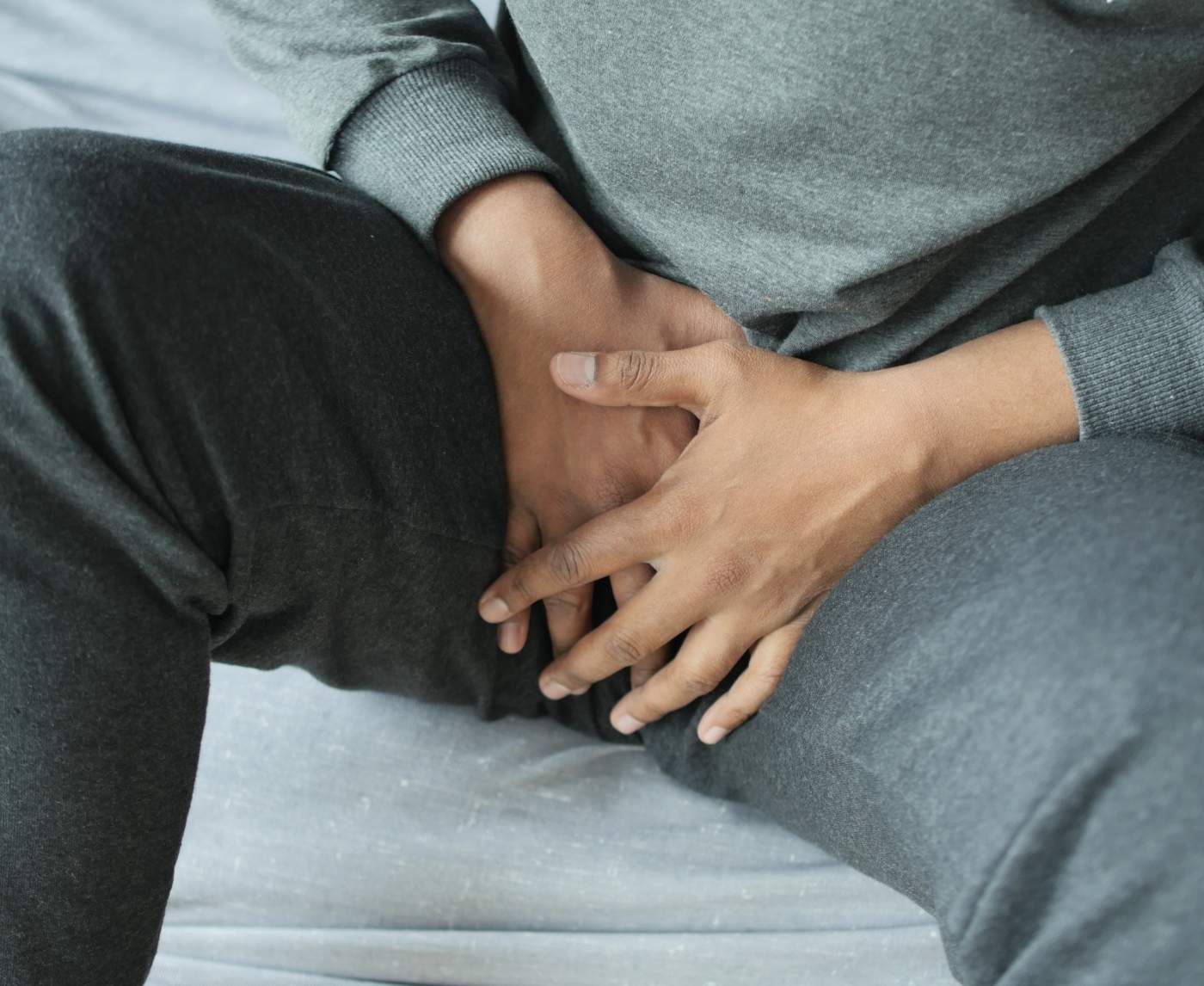
A deep ache in one testicle a day or two after sex is the kind of symptom most men try to wait out. Maybe it pulled when you shifted weight. Maybe you slept on it strangely. Maybe it will fade by tomorrow. Sometimes that is true. Pain in one testicle that follows sex, especially unprotected sex, is also a recognized early sign of a sexually transmitted infection that has worked its way into the epididymis, the coiled tube that sits behind each testicle.
This guide walks through what STI-related testicle pain feels like, how it differs from a strain or a torsion, when each cause becomes urgent, when home testing is reliable, and what to do if your test came back negative but the ache will not settle. It is going to be specific about timing, sample types, and what at-home rapid tests can and cannot tell you.
Key takeaways
- Chlamydia and gonorrhea can quietly travel from the urethra into the epididymis and cause one-sided testicle pain, often as a dull or dragging ache without the discharge or burning many men expect from an STI.
- Sudden severe pain in one testicle, especially with nausea or a visibly high-riding testicle, is a surgical emergency (testicular torsion) and needs the ER within 6 to 12 hours, before any STI workup.
Why one testicle hurts after sex (and why brushing it off costs you)
Two anatomical facts make sex-linked testicle pain easy to miss. First, only one side usually hurts at first, because the bacteria that travel up the urethra during and after intercourse tend to lodge on whichever side they reach earliest, the right or left epididymis. Second, the pain often shows up after a delay, usually one to four days post-exposure, sometimes longer. By that point the encounter has dropped out of your active memory, so your first instinct is to look for a non-sexual explanation: a long bike ride, a heavy lift, an awkward position.
The pattern is consistent enough that the CDC's STI treatment guidelines name acute epididymitis as a known complication of untreated chlamydia and gonorrhea, especially in men under 35. The infection does not arrive with fanfare. There is no bright red rash, no obvious sore, often no pus. Just a deep, low-grade ache on one side, sometimes worse with movement or after ejaculating, sometimes dull and persistent regardless of activity.
That low signal is the trap. Many men spend a week trying ibuprofen and rest before something else (worsening pain, partner notification, a fever) pushes them to test. By that point the inflammation is harder to settle, and the antibiotic course is longer.
STD or strain? How to start telling them apart
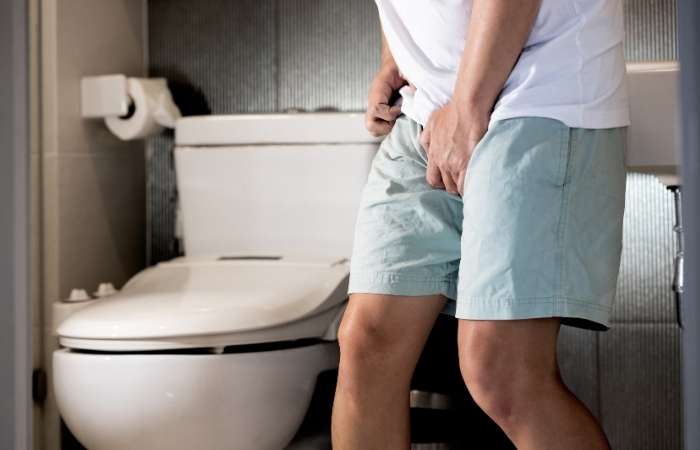
Pain that started right after sex is rarely a single thing. The same one-sided ache can come from sexual transmission, from torsion of the spermatic cord, from a strained groin muscle, from a hernia, or from inflammation of the prostate. Sorting these out depends less on the location of the pain (most causes pick one side) and more on three other features: how fast the pain started, what it actually feels like, and what shows up alongside it. Use the table below as a starting frame rather than as a diagnosis. Anything that fits the emergency rows belongs in an emergency room rather than a testing kit.
| Possible cause | What the pain feels like | Other clues | STI-related? |
|---|---|---|---|
| Chlamydia in the epididymis | Dull, dragging ache; one side; gradual onset 2 to 7 days after sex | Mild burning when peeing or no urinary symptoms at all | Yes |
| Gonorrhea in the epididymis | Steady ache that worsens over 2 to 5 days; one side | Often pus-like discharge from the urethra; sometimes fever | Yes |
| Epididymitis (general) | Tender lump behind the testicle; ache extends into the scrotum | Skin may feel warm; can be STI-related or from urinary tract | Often |
| Testicular torsion | Sudden 10/10 pain on one side, within minutes | High-riding testicle, nausea or vomiting; ER within hours | No |
| Inguinal hernia | Aching with lifting or straining; bulge near the groin | Improves with rest; visible bulge worsens with cough | No |
| Groin strain | Pulled-muscle ache that improves with rest | Tied to a specific exertion; pain in muscle, not testicle itself | No |
What chlamydia or gonorrhea in the testicles actually feels like
Most pop-culture descriptions of an STI focus on the urethral side, like burning when you pee, discharge from the tip, or pain on ejaculation, and those symptoms do happen. Chlamydia in particular frequently causes no urethral burning or discharge in men; the CDC's chlamydia fact sheet notes the infection often goes undetected without testing. When the bacteria climb past the urethra and reach the epididymis, the symptom that does show up is mechanical: a low, deep ache that sits behind the testicle on one side.
Men describe it as a heaviness or dragging sensation, often tighter when seated for long stretches, sometimes flaring during ejaculation before settling back into a dull background ache. Sometimes the testicle itself feels mildly tender to the touch on that side, or the scrotum looks slightly redder. Often nothing is visibly different, which is the thing that throws people off.
Compare that to a sports strain. A pulled adductor or a tweaked obturator hurts when you stretch or move that specific muscle, and rest reliably helps within 24 to 48 hours. STI-driven epididymitis does not respond to rest the same way. Day three feels about the same as day one, sometimes slightly worse. That mismatch between rest and recovery is one of the most reliable distinguishing features.
Two markers that point toward STI-driven epididymitis
- No meaningful improvement after 48 hours of rest, ice, or over-the-counter anti-inflammatories. A muscle strain typically eases inside that window; bacterial epididymitis does not.
- Tender to gentle palpation behind the testicle on one side, sometimes with a small firm thickening where the epididymis runs along the back of the testis.
Epididymitis: where STIs hide in young men
Epididymitis is inflammation of the epididymis, a tightly coiled tube about 6 meters long when uncoiled, packed into the back of each testicle. Sperm matures there before ejaculation. It is also the easiest place in the male reproductive tract for ascending bacterial infection to settle, because the tube is narrow and the local immune response is slower than in the bladder or urethra.
In men under 35, the most common cause of epididymitis is sexual transmission, most often chlamydia, less often gonorrhea, and occasionally other organisms. In men over 35, the same condition more often comes from urinary tract sources (an enlarged prostate that disrupts the flow of urine, a recent catheter, a urinary tract infection). The clinical picture is similar; the cause matters because the antibiotic regimen differs. The CDC's epididymitis guidance recommends testing for both chlamydia and gonorrhea before starting empirical treatment, because covering both is straightforward when you know which one is present.
Untreated epididymitis is rarely a same-day emergency, but it gets worse over weeks. The inflammation can spread to the testicle itself (epididymo-orchitis), and persistent inflammation can leave behind scarring that affects sperm transport. The Cleveland Clinic notes chronic epididymitis as a recognized long-tail outcome when the underlying infection is not cleared. Most clinicians recommend testing and treating early specifically to prevent that long-tail outcome.
Acute epididymitis caused by sexually transmitted Chlamydia trachomatis or Neisseria gonorrhoeae is most often seen among sexually active men less than 35 years of age... empirical therapy is indicated before laboratory test results are available.
When to test (timing matters more than urgency)
The instinct when something hurts is to act on day one. With STIs, that instinct trips you up. Every test for an STI has a window period: the gap between exposure and the point at which a test can reliably detect the infection. Test before that window closes and you can get a false negative, which feels like a clean bill of health but actually just means there is not yet enough antigen, antibody, or DNA in your sample for the test to register a positive.
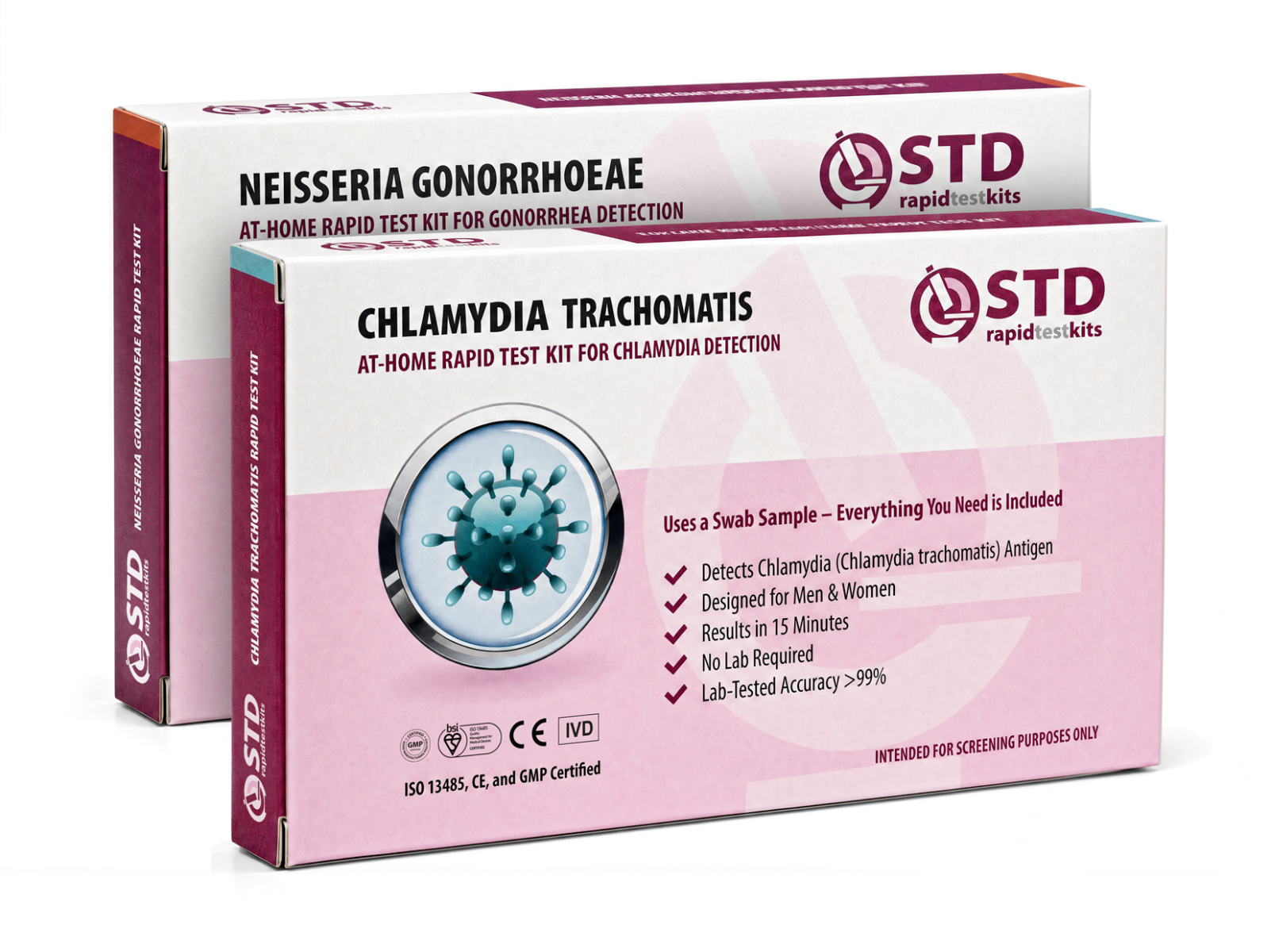
The window varies by infection and by the test technology used. Lab-based nucleic acid amplification tests (NAATs) detect the bacteria's genetic material directly and are sensitive earliest. At-home rapid lateral-flow tests, including the kits we sell, look for bacterial antigens and need slightly more material in the sample to read positive. The figures below use the conservative end of CDC laboratory guidance; if you are using a rapid at-home test, treat the longer end of each window as your minimum wait.
| Infection | Earliest reliable lab test | Best accuracy (wait until) | Sample for our at-home rapid test |
|---|---|---|---|
| Chlamydia | Day 7 (lab NAAT) | Day 14+ (lab NAAT) | Self-collected penile swab, day 14 onwards |
| Gonorrhea | Day 5 (lab NAAT) | Day 14+ (lab NAAT) | Self-collected penile swab, day 14 onwards |
| Syphilis | Day 21 (lab antibody) | 6 to 12 weeks | Fingerstick blood antibody test |
| HIV (4th-generation lab) | Day 18 to 45 | 12 weeks | Fingerstick blood antibody/antigen test |
| Trichomoniasis | Day 7 (lab NAAT) | Day 21+ | Vaginal-swab kit only (validated for female anatomy; male readers see a clinic) |
Your three real testing options
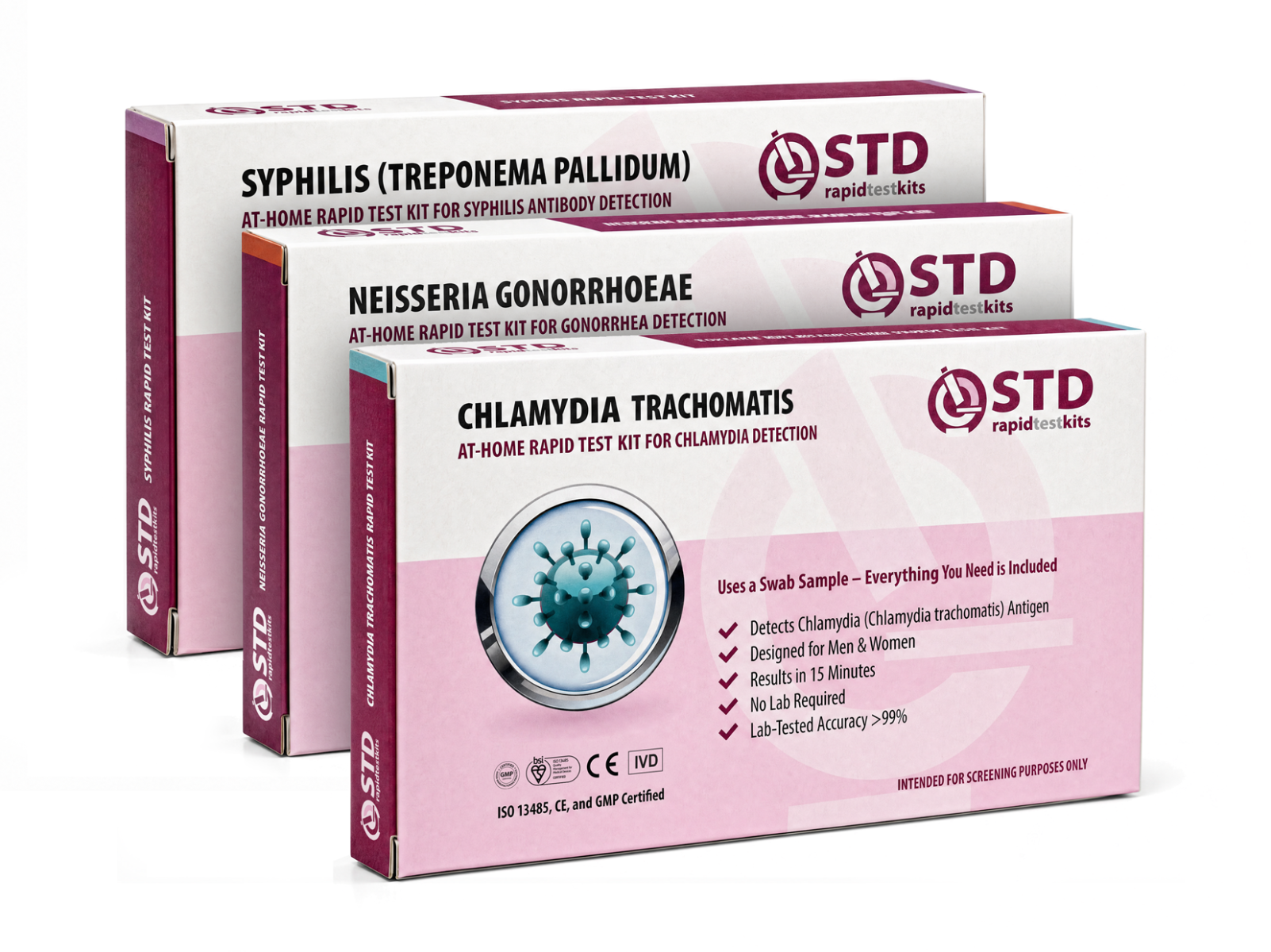
If your testicle hurts and you are within the testing window, you have three practical paths. Each one trades speed for accuracy in a different direction. None of them is wrong; the right choice depends on whether you want a fast yes-or-no, a confirmatory result, or both.
| Method | Speed of result | Privacy | Sample type | Best for |
|---|---|---|---|---|
| At-home rapid lateral-flow kit | 15 to 30 minutes | High (no chain of custody) | Self-collected swab or fingerstick blood | Quick screening, early reassurance, repeat testing |
| Mail-in lab NAAT kit | 2 to 5 days after lab receipt | High (discreet shipment) | Self-collected swab or urine, lab-processed | Confirmatory testing inside the recommended window |
| Clinic visit (urgent care, sexual health, primary care) | Same-day exam, results 1 to 7 days | Lower (chart documented) | Clinician-collected swab or urine, plus exam | Severe pain, persistent symptoms, possible torsion, antibiotic prescription |
Negative result, still in pain? Here is what to check
The frustrating scenario goes like this: pain shows up, you order a test, it comes back negative, and a week later the pain is still there or has worsened. Three things commonly explain this, and they are worth running through in order.
The first is window period. If you tested before day 14 for chlamydia or gonorrhea, that negative might be a true negative for the test you ran but a false negative for the actual infection state. The fix is to retest after day 14, ideally with a swab sample. If the original test used a urine sample, retesting with a penile swab can also catch positives that urine testing misses, since the swab samples directly from the urethral opening where the bacteria live.
The second is sample type or test technology. Antibody-based tests (used for HIV, syphilis, HSV) have longer windows than antigen-based or DNA-based tests. If you tested for the wrong panel for the symptoms you have, the result will be uninformative regardless of timing.
The third is that the cause of the pain may not be an STI at all. Chronic prostatitis, varicocele, hernia, and post-vasectomy pain syndrome can all present with one-sided testicle ache that follows physical activity, including sex. If two well-timed tests come back negative, that is a signal to involve a clinician for a physical exam.
Telling a partner without making it a confrontation
If your test comes back positive, or if you are starting empirical treatment based on symptoms, telling recent sexual partners is part of the treatment cycle. The CDC recommends contacting any partner from the previous 60 days. The reason is not moral, it is practical: untreated chlamydia or gonorrhea in a partner can re-infect you within days of the antibiotic course finishing, putting you back at square one.
The conversation tends to land better when it is framed around shared next steps rather than an accusation about who infected whom. Many bacterial STIs were carried asymptomatically for weeks before the symptomatic person noticed, so the chain of who-gave-it-to-whom is usually unanswerable. Most adults take the information well, especially when it arrives before they develop symptoms themselves.
If direct conversation is not realistic (a one-time encounter, an estranged ex, a hookup whose number you do not have), most state and city health departments run free anonymous partner-notification services that send a text or postcard without naming you. Search "partner notification" plus your state name, or ask the clinician who diagnosed you.
"I tested positive for chlamydia, and the guidance is to let any partner from the last two months know so they can test too." That is a complete sentence. It does not assign blame, it does not require explanation, and it gives the other person what they actually need: the name of the infection and the reason to test.
First, rule out testicular torsion (the actual emergency)
Before any STI workup, one cause of one-sided testicle pain has to be cleared: torsion. Testicular torsion is a twist of the spermatic cord that cuts off blood supply to the testicle, and the testicle can be permanently damaged within 6 to 12 hours. It is most common in adolescents and men under 25 but can occur at any age. The pain is usually 10 out of 10, sudden, often comes with nausea or vomiting, and the affected testicle often sits visibly higher in the scrotum than the other side.
Torsion does not wait for an STI test. If your pain fits this description, the right move is the emergency room within hours. The hospital will use ultrasound to check blood flow and, if needed, surgically untwist the cord. Saving the testicle depends on getting blood flow restored before the tissue dies, which is why the time-to-ER number is measured in hours, not days.
Stop reading and go to the emergency department now if your pain came on suddenly within minutes (not hours), if it is severe (around 10/10), if you have nausea or vomiting alongside the pain, or if one testicle visibly sits higher than the other. Testicular torsion has a 6 to 12 hour window before permanent damage, so home tests can wait; the ER cannot.
Other non-STI causes worth knowing about
Once torsion is ruled out and STIs are being tested for, the remaining causes of one-sided testicle pain are usually non-emergency but still worth identifying if symptoms do not improve. They differ from STI-driven epididymitis in two ways: they often have a clear mechanical trigger (lifting, prolonged sitting, a specific impact), and they tend to improve with rest rather than worsen.
- Inguinal hernia: a portion of intestine pushes through a weak spot in the lower abdominal wall, causing aching that worsens with lifting or coughing and a visible bulge near the groin.
- Varicocele: enlarged veins in the scrotum that produce a dull dragging ache (often described as a bag-of-worms feeling), worse after standing or exercise, better when lying down.
- Chronic prostatitis: inflammation of the prostate that radiates pain into the testicles, perineum, and lower back, often with urinary urgency or frequency.
- Spermatocele or epididymal cyst: a fluid-filled sac on the epididymis that can ache when it grows; usually painless but occasionally tender.
- Direct trauma: a sports impact, prolonged bike-saddle pressure, or a fall can produce lingering soreness for days to weeks; the timeline starts at the impact, not at sex.
Frequently asked questions
- Can an STI really cause pain in just one testicle, with no other symptoms?
- Yes. The absence of urethral symptoms is common enough that a dull ache on one side can be the only sign for several days. Chlamydia in particular frequently causes no burning or discharge in men; the CDC notes the infection often goes undetected without testing, so a one-sided ache after recent sex deserves a workup even when nothing else feels wrong.
- How soon after sex can STI testicle pain appear?
- Usually one to four days, sometimes up to two weeks. The bacteria need time to climb from the urethra to the epididymis and trigger inflammation. If you ejaculated soon after exposure, that can speed it up because ejaculation pulls fluid (and any bacteria with it) toward the epididymis.
- What does STI-related testicle pain feel like compared to a strain?
- The clearest tell is how rest affects it: a pulled groin muscle gets noticeably better within a day or two; epididymitis from a bacterial infection holds steady or worsens over the same window regardless of ice or ibuprofen. Quality is also different. Strain pain is sharp and tied to specific movement, while epididymitis is a deep, dragging ache that sits behind the testicle even when you are still.
- I have no discharge or burning when I pee. Am I in the clear?
- Not necessarily. Many male chlamydia and gonorrhea infections never produce urethral symptoms, even when the infection is active and contagious. Pain is sometimes the only signal. If you have had recent unprotected sex and now have one-sided testicle pain, the absence of discharge does not rule out an STI.
- When should I go to the ER instead of testing at home?
- Sudden severe pain (around 10/10) that came on within minutes, nausea or vomiting alongside the pain, or one testicle visibly sitting higher than the other. Those features point toward testicular torsion, which can permanently damage the testicle within 6 to 12 hours. Home tests can wait until torsion is ruled out by ultrasound at a hospital.
- Can I trust an at-home rapid test for chlamydia or gonorrhea after testicle pain?
- An at-home rapid lateral-flow test is a reasonable first screen, especially if you are at least 14 days past the exposure and you use a self-collected penile swab rather than urine. Lab-processed NAAT is more sensitive than rapid lateral-flow, so a positive at home is high-confidence; a negative at home with persistent symptoms is worth re-confirming via a lab kit or clinic.
- Negative test, still in pain. What now?
- Three things to check: timing (was the test inside the window period?), sample type (a penile swab beats a urine sample for the urethral end of the infection), and panel (a chlamydia and gonorrhea kit will not catch syphilis or HSV). If two well-timed tests are negative and the pain persists, the cause may be non-infectious, and an in-person exam can sort hernia, varicocele, prostatitis, or trauma.
- Should I stop having sex while I figure this out?
- Yes, until you have a result you trust. Bacterial STIs are most contagious during the symptomatic phase, so abstaining (or at minimum using condoms consistently) protects partners while you test and treat. If a kit returns positive and you start antibiotics, the standard guidance is to wait seven days after completing treatment before resuming sex.
When to act, and how to start
One-sided testicle pain after sex is rarely a single thing, and it is rarely nothing. The decision tree, from most to least urgent, is short. If the pain is sudden and severe, with nausea or a high-riding testicle, the answer is the ER today. If the pain is a dull or dragging ache that started a few days after sex and has not improved with rest, the answer is an STI test. If you are still inside day 14 since exposure, wait the rest of that window before you trust a result; a same-day negative does not mean much when the bacteria have not had time to multiply.
The home rapid kits referenced above cover the swab and bloodwork screening that catches the most common bacterial STIs behind male epididymitis. Use them as a first screen. If symptoms persist after a negative test, or if pain is severe at any point, schedule an in-person exam. Bacterial STIs are easy to clear once identified, and a 15-minute home test plus a 14-day wait window is a small price for ruling them out before the inflammation has time to settle in.
Decision tree at a glance
- Sudden severe pain, nausea, or a high-riding testicle: go to the ER today (testicular torsion has a 6 to 12 hour window).
- Dull post-sex ache that does not improve with rest: test 14 or more days after exposure with a self-collected penile swab for chlamydia and gonorrhea.
- Two well-timed negative tests but pain persists: book an in-person exam to rule out hernia, varicocele, prostatitis, or trauma.
This article was constructed based on current advice from the most prominent public health and medical organizations, including the U.S. Centers for Disease Control and Prevention's STI Treatment Guidelines, the NHS, and the Cleveland Clinic. Window periods, complication risks, and the relationship between sexually transmitted infections and acute epididymitis come directly from those sources. Clinical guidance is summarized in plain English; this is a summary, not a substitute for evaluation by a licensed clinician, especially for severe or persistent pain.
- U.S. Centers for Disease Control and Prevention. STI Treatment Guidelines, Epididymitis section. Source for STI-related epididymitis demographics in men under 35, recommended dual testing for chlamydia and gonorrhea, and empirical therapy timing.
- U.S. Centers for Disease Control and Prevention. About Chlamydia. Source for the high asymptomatic-infection rate in men and the role of chlamydia in male reproductive complications.
- U.S. Centers for Disease Control and Prevention. About Gonorrhea. Source for transmission patterns, male symptom variability, and overlap with chlamydia presentation.
- NHS. Epididymitis. Source for symptom timeline, examination guidance, and when to seek same-day medical care for testicular pain.
- Cleveland Clinic. Epididymitis: Causes, Symptoms, Diagnosis and Treatment. Source for chronic-epididymitis long-tail outcome, distinguishing STI-related from non-STI epididymitis, and recommended antibiotic approaches.
