

Published: October 2025 | Last updated: April 2026 | Editorial review and quality control: Martina N.
There are few moments more disorienting than checking yourself the morning after sex and finding redness, a few bumps, or a patch of skin that was not there before. The mind goes straight to the worst case, and herpes is usually at the top of the list. The skin around the genitals is some of the most reactive tissue on the body, though, and it responds to friction, sweat, lube, fragrance, latex, and a long list of ordinary irritants long before any virus has a chance to enter the conversation.
This article walks through what a herpes rash actually looks like, what the common lookalikes are, and how to tell the two apart. It also covers when an at-home test is useful, which kind of test fits which timing window, and what to do during the wait. The goal is calm clarity, not panic.
Is a rash after sex herpes?
Sometimes, but most post-sex rashes are not. Herpes typically appears 2 to 12 days after exposure as a small cluster of bumps or blisters in one spot, often preceded by tingling or burning in that same area. Friction, latex allergy, lube ingredients, yeast overgrowth, and ingrown hairs all produce rashes that can look similar in the first 24 hours. The only way to confirm is testing: a clinic swab during an active lesion, or a blood antibody test taken 16 weeks or more after a possible exposure, since the CDC notes detection can take that long or longer.
Key Takeaways
- Herpes outbreaks usually appear 2 to 12 days after exposure and tend to recur in the same spot, while friction and allergy rashes show up within hours and fade once the trigger is removed.
- A negative blood antibody test taken inside the window period may be too early to detect HSV; the CDC says detection can take up to 16 weeks or more after exposure, so retesting at that point is the most reliable approach.
What a herpes rash actually looks like
Herpes rarely arrives the way the worst search-engine images suggest. The first outbreak, if a person notices it at all, can come with body aches, swollen lymph nodes in the groin, and a low fever. After that, the virus tends to settle into nerve roots and can reactivate periodically, often without a clear cause (CDC, About Genital Herpes).
Visually, herpes typically begins with a prodrome, a clinical term for the early warning signs that arrive a day or two before any rash is visible. The prodrome feels like tingling, itching, or burning in one specific spot. Small red bumps follow. The bumps cluster tightly, then evolve into clear or yellowish blisters, then ulcerate, then crust, and finally heal. Initial outbreaks tend to be more severe than later ones, and symptoms generally clear on their own, with antiviral medication shortening the course when prescribed (CDC, STI Treatment Guidelines: Herpes).
Two patterns are worth holding in mind. First, herpes tends to recur in the same anatomical spot, often with the same prodromal sensation. Second, herpes does not always blister. Some outbreaks present as a single paper-cut-like fissure, a small patch of irritated skin, or a few barely visible bumps that heal in a few days and never get diagnosed. That ambiguity is exactly why people miss it.
| Stage | Day | What you might notice |
|---|---|---|
| Prodrome | Day -2 to 0 | Tingling, itch, or burning sensation in one spot, often where past outbreaks happened |
| Initial bumps | Day 0 to 2 | Small red papules clustered tightly together, sometimes sore |
| Vesicles | Day 2 to 5 | Clear or yellow fluid-filled blisters, may be itchy or painful |
| Ulcer and crust | Day 5 to 9 | Blisters open, weep, then scab over; sensitive to friction |
| Healing | Day 9 to 14 | Crusts fall off, skin regrows, sometimes with mild discoloration that fades |
The lookalikes: what else makes you rash up after sex
Sex is mechanically demanding on skin. Long sessions, dry friction, sweat, and new products all leave traces, and the body reacts. Most of these reactions are not infections. They are the body answering a stimulus.
Friction irritation shows up almost immediately or within a few hours. It looks like flat or slightly raised redness in the contact zones, sometimes with linear marks from sheets or skin folds. It usually fades inside 48 hours if no further friction is applied.
Contact dermatitis is an allergic or irritant reaction to something the skin met. Latex condoms, glycerin in flavored lubes, fragrance in laundry detergent, dye in underwear, spermicides, and even semen sensitivity can all set it off. The rash tends to be itchy, blotchy, and sharply bordered to where the substance touched. It often appears within 1 to 24 hours of exposure.
Yeast overgrowth can cause an external rash even before any classic discharge appears. The skin looks faintly inflamed, sometimes shiny or with a fine scale at the edges. It is more common after antibiotic use, in tight clothing, or in warm humid conditions.
Folliculitis and ingrown hairs show up as small red bumps each centered on a hair follicle, often with a tiny white pustular tip. They follow the shave or wax pattern and tend to be evenly distributed rather than tightly clustered.
The trouble is that the early hours of any of these conditions can resemble herpes. A rash without blisters can still be herpes; blisters that are not painful can still be yeast or contact dermatitis. The pattern over a week is more diagnostic than the snapshot in front of you the morning after.
Herpes versus its lookalikes, side by side
The single most useful framing is timing. Friction and allergy reactions appear within hours and fade fast. Herpes has a longer incubation, a sensory warning, and a recognizable cycle.
| Feature | Herpes | Most other post-sex rashes |
|---|---|---|
| Time from exposure to rash | 2 to 12 days | Within hours, sometimes during sex |
| Sensory warning signs | Tingling, burning, or stinging in one specific spot | Generalized itch or mild irritation, no localized pre-rash sensation |
| What the rash looks like | Tightly grouped vesicles or small ulcers in a single area | Flat redness, hives, evenly spaced papules, or scaling |
| Recurrence pattern | Same spot returning between dormant periods, sometimes without a clear trigger | Variable, follows the trigger or activity |
| Resolution speed | 7 to 14 days for a first outbreak, 3 to 7 days for recurrences | 1 to 3 days once the trigger is removed |
| Body-wide symptoms | Possible fever, fatigue, swollen groin lymph nodes (first outbreak) | Rare unless the rash is severe or infected |
Asymptomatic herpes is more common than you think
Most people who carry HSV do not know they have it. The CDC notes that the majority of genital herpes infections are unrecognized, partly because outbreaks are mild and partly because the early signs get blamed on yeast, razor burn, or stress (CDC, About Genital Herpes). The World Health Organization estimates that around 520 million people aged 15 to 49 have genital HSV-2, and most are unaware (WHO, Herpes Simplex Virus Fact Sheet).
The reason this matters is twofold. First, a person can transmit HSV during periods of asymptomatic viral shedding, which is part of why the virus spreads as broadly as it does. Second, a small mild rash that healed in three days a year ago might have been an outbreak. That does not mean every faded patch was herpes; it means symptom recall alone cannot rule it in or out. Testing is the only thing that can.
Herpes carries a heavy stigma that does not match its actual medical impact for most people. The virus does not damage organs, does not shorten life expectancy, and is suppressible with daily antiviral medication when outbreaks are frequent. The hardest parts are the disclosure conversation and the initial emotional adjustment.
Most people with genital herpes have no symptoms or have very mild symptoms.
Other STIs that can show up as a rash
Herpes gets the most attention, but it is not the only sexually transmitted infection that produces visible skin changes. Knowing the broader list helps you decide whether to ask for a single-condition test or a wider panel.
Secondary syphilis can produce a flat, copper-red, spotty rash that classically appears on the palms of the hands and the soles of the feet, alongside the trunk. It typically arises weeks to months after an untreated primary chancre and is often painless and non-itchy, which is part of why it gets missed (CDC, About Syphilis).
Acute HIV infection can cause a flu-like illness about two to four weeks after exposure, sometimes with a fine pinkish rash on the trunk. The rash is usually short-lived and tends to come with sore throat, fever, and swollen lymph nodes. A single rash episode is not diagnostic; lab testing is.
Molluscum contagiosum is not classified as a classic STI but spreads through close skin contact, including sexual contact. It produces firm, dome-shaped, flesh-colored bumps with a small central dimple. They are painless and typically self-resolve over months.
HPV usually does not cause a rash; it causes genital warts, which are firm raised growths rather than diffuse redness. The HPV rapid swab kit on this site is validated for vaginal self-swab only, so male readers concerned about HPV exposure should see a clinician.
Chlamydia and gonorrhea rarely cause skin rashes. They more often present with discharge, burning during urination, or pelvic pain, although both can be entirely silent.
If your rash is on the palms or soles, on the trunk, or accompanied by fever and swollen lymph nodes, it is worth asking about a broader STI panel rather than only a herpes test. A multi-test home kit covers HIV, syphilis, hepatitis B and C, and HSV antibodies in one window.
When to get tested, and which test to use
Two test types matter for herpes: a clinician-administered swab during an active lesion, and a blood antibody test that looks at the body's longer-term immune response.
The swab is collected from a fresh blister or ulcer in a clinic, sent to a lab, and analyzed by PCR or viral culture. PCR is more sensitive and is the modern preference. The catch is timing: the lesion needs to be open or freshly broken. Once it has crusted over, the test sensitivity drops quickly. If you have a suspicious bump or sore, get the swab within 48 hours of it appearing. The at-home rapid test kits sold on this site are blood antibody tests, not lesion swabs, so an active sore is best evaluated at a clinic.
The blood antibody test looks for IgG antibodies the immune system makes after HSV infection. According to the CDC, detection can take up to 16 weeks or more after exposure, so testing too early gives a false reassurance (CDC, Genital Herpes Testing). Many people retest at the 16-week mark to be sure. The at-home herpes panels on this site are lateral-flow fingerstick antibody tests, complementary to lab IgG testing rather than equivalent to NAAT or PCR. This site sells the at-home rapid test kits referenced below; products are recommended based on fit-for-purpose, not commercial benefit.
| Situation | Best test | Timing |
|---|---|---|
| Active visible blister or sore | Clinic swab (PCR or viral culture) | Within 48 hours of the lesion appearing |
| Rash has healed, recent unprotected exposure | Blood IgG antibody test | 16 weeks or more after exposure for the most reliable result |
| No symptoms, broader screening after a partner change | Multi-STI panel covering HIV, syphilis, hepatitis, HSV antibodies | Most STI markers reliable by 12 weeks; HIV detectable earlier with antigen-antibody testing; HSV antibodies up to 16 weeks or more |
| Recurring rash in the same spot | Clinic swab during the next outbreak; IgG antibody test between flares | Time the swab to the active stage |
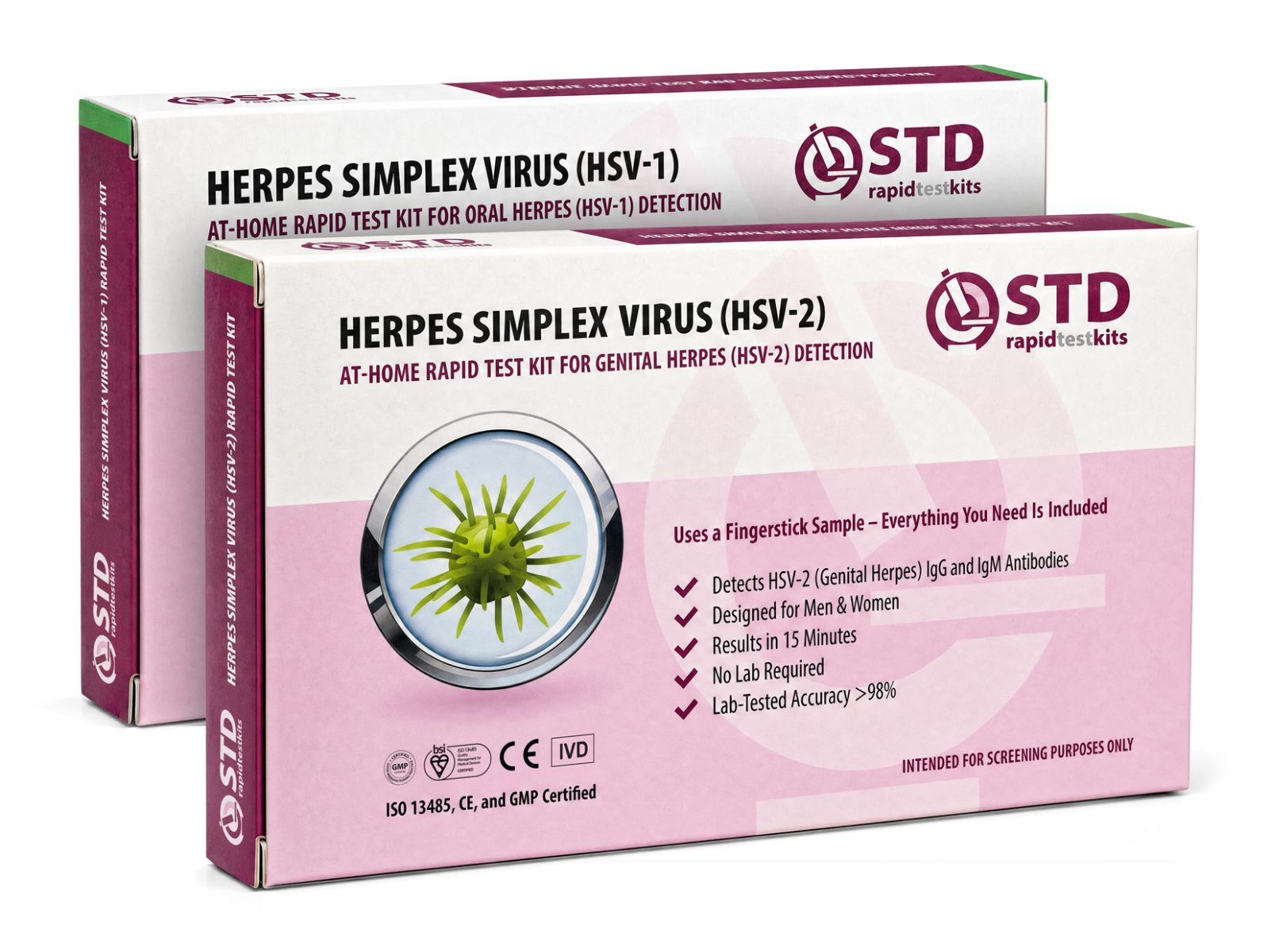
What to do while you wait
The hours and days between a new rash and a clear answer are uniquely uncomfortable. A few things help.
Treat the skin gently. Skip harsh soaps, scented products, and tight synthetic underwear. Warm water and a mild unscented cleanser are enough. A cool compress or a sitz bath calms most irritation. Plain petroleum jelly or zinc oxide cream protects the skin without interfering with healing of either an irritation rash or an early herpes lesion. If pain is significant, an over-the-counter lidocaine cream is reasonable for short use.
Pause sexual activity until you have an answer. This protects partners if it does turn out to be an active herpes lesion, and it lets irritation rashes heal without continued friction.
Document what you see. Photographs from a few angles, dated, plus brief notes about when the rash started, what it felt like, and how it changed across days, give a clinician far more to work with than a single in-the-moment description. If the rash recurs, this baseline is useful for the next provider visit too.
Talk to recent partners honestly. You do not need a diagnosis to start the conversation. A simple message that something on your skin is being checked out, and that you wanted them to know in case they want to test as well, keeps the door open without claiming more certainty than you have.
- Use only warm water and an unscented mild cleanser; skip scrubs, douches, and scented wipes.
- Apply plain petroleum jelly or zinc oxide as a barrier; use lidocaine cream short-term if pain is significant.
- Pause sex until you have a clear answer, even if you suspect the rash is friction or allergy.
- Photograph the area daily and note what changes; bring the timeline to your provider visit.
- Send a brief, neutral heads-up to recent partners so they can test if they want to.
You deserve answers, not assumptions
If you have read this far, you are already doing the harder thing: paying attention. A rash after sex is not proof of carelessness, and a herpes diagnosis is not a verdict. Both are signals to gather data and act on it. Whether what you are looking at turns out to be friction, allergy, yeast, or a viral outbreak, the next step is the same: a test that matches your timing window and your concern.
The discreet at-home options below cover the questions most people in this situation are asking. Pick the one that matches your concern, and stop refreshing search results.
If a blister or sore is visible right now, book a clinic appointment for a PCR swab within 48 hours; the at-home antibody kits on this site cannot test an active lesion. If the rash has healed or the concern is exposure rather than a current sore, a fingerstick blood antibody test taken 16 weeks or more after the suspected exposure is the appropriate at-home option.

Frequently asked questions
- Can a herpes rash show up the same day as sex?
- Almost never. The shortest documented incubation is around two days, and most outbreaks appear two to twelve days after exposure. A rash that arrives within a few hours of sex is far more likely to be friction, contact dermatitis, or a reaction to lube, latex, or laundry detergent.
- What if there are no blisters, just redness and burning?
- Herpes does not always blister. Some outbreaks present as a single small fissure, a faint patch of irritated skin, or a few barely visible bumps. If the redness recurs in the same area or comes with a tingling pre-warning, a clinic swab during the next active phase is the most reliable way to confirm. Outside of an active lesion, the at-home blood antibody test taken 16 weeks or more after exposure is the alternative.
- How do I know it is not just razor burn or ingrown hairs?
- Razor burn produces evenly spaced small red bumps in the shave pattern, often with tiny white pustular tips on individual hair follicles. It typically fades in one to three days without changing shape. Herpes clusters tightly in one spot, evolves through stages over a week, and tends to come back in the same place. If a lesion grows, weeps, ulcerates, or recurs, it warrants testing.
- Does herpes always hurt?
- No. Pain ranges from severe enough to make underwear uncomfortable to a faint itch or nothing at all. The CDC has long noted that the majority of HSV infections are unrecognized precisely because symptoms can be that mild. Pain level alone is not a useful rule-out.
- Can lube, condoms, or laundry detergent cause a rash that looks like an STI?
- Yes, and this is one of the most common explanations for a sudden post-sex rash. Latex, glycerin in flavored lubes, fragrance, dye, and spermicide are all frequent triggers. Switching to fragrance-free, glycerin-free, and non-latex products for a few cycles often resolves the rash on its own. If it persists or returns despite the switch, treat that as a reason to test.
- I tested negative, but I still have symptoms. Why?
- Two reasons usually. The blood antibody test was taken inside the window period, before IgG levels were detectable; the CDC notes detection can take up to 16 weeks or more, so retesting at that point is the standard fix. Or the rash is not herpes at all and another condition is producing the symptoms. A clinician can examine the rash directly and run targeted tests for yeast, dermatitis, or other causes.
- Can someone have herpes for years and not know?
- Yes, and this is the most common course. The WHO estimates hundreds of millions of people worldwide carry genital HSV-2 without realizing it, and CDC data tells the same story for the United States. Outbreaks can be so mild they pass for razor burn, yeast, or nothing at all. This is also why partner transmission can happen without anyone knowingly being symptomatic at the time.
- Should I tell a partner before I have answers?
- A short, honest heads-up is better than silence and easier than most people expect. Something direct works: you noticed something on your skin, you are testing, you wanted them to know in case they want to test as well. You are not making a diagnostic claim, you are sharing information that affects them. Most partners respond reasonably, and the conversation is much harder if it has to happen after a confirmed diagnosis with no warning.
- U.S. Centers for Disease Control and Prevention. About Genital Herpes: symptoms, prodrome description, and asymptomatic transmission framing.
- U.S. Centers for Disease Control and Prevention. Genital Herpes Testing: who should be tested, antibody test window-period guidance (up to 16 weeks or more), and the limits of serology inside the window.
- U.S. Centers for Disease Control and Prevention. Sexually Transmitted Infections Treatment Guidelines: herpes diagnostic specifics, outbreak management, and antiviral treatment course.
- U.S. Centers for Disease Control and Prevention. About Syphilis: secondary-stage rash characteristics including palms and soles distribution.
- World Health Organization. Herpes Simplex Virus Fact Sheet: global HSV-1 and HSV-2 prevalence figures and the proportion of infections that go unrecognized.
