
Published: September 2025 | Last updated: May 2026 | Editorial review and quality control: Martina N.
There's roughly a $270 gap between the cheapest at-home STI test on a marketplace listing and the most expensive one a telehealth service will sell you. Same infection, same anxious moment of waiting for a line to appear. So what makes one test cost $19 and another $289?
Sometimes the cheap one is fine. Sometimes the cheap one quietly returns a negative for an infection you actually have, and you find out weeks later in a clinic when the bacteria that should have been caught is still there. The difference between those two outcomes isn't only price. It's how the test detects an infection, when you used it, and what kind of sample it can analyze.
This guide breaks down what you're really buying when you compare a $30 rapid kit against a $150 mail-in lab kit, where cheap tests tend to fail their users, and how to tell when the bargain option does the job and when it costs more than it saves.
Key Takeaways
- Cheap rapid STI tests can be reliable when used after enough time has passed for the infection to reach detectable levels, typically 7 to 14 days for chlamydia and gonorrhea and longer for HIV and herpes antibody tests. Testing too early is the single most common reason budget kits return false negatives.
- The price of an STI test usually buys three things: more sensitive lab chemistry (NAAT vs lateral-flow), longer detection windows for early infections, and confirmation support if your result is positive or unclear.
Why the Same STD Test Can Cost $29 or $289
The price gap between STI tests isn't only about markup or branding. It reflects how the test detects an infection, who reads the result, and what happens after a positive shows up.
Imagine two people testing for the same thing. One buys a $30 rapid swab kit from a marketplace listing, runs the test in their bathroom, and tosses the cassette in 15 minutes. The other ships a urine sample to a CLIA-certified laboratory through a $149 mail-in service, gets results in a secure portal three days later, and has the option to talk to a clinician about treatment. They're answering the same question, but the analytical sensitivity, the detection window, and the follow-up infrastructure are different products.
The table below breaks down what each price tier typically includes. When you see a number on a listing page, this is roughly what sits behind it.
| Price Range | What's Included | Typical Sensitivity | Turnaround |
|---|---|---|---|
| $20–$50 | Basic lateral-flow rapid test, usually no lab confirmation. Window-period guidance is sometimes generic. | Moderate (varies by infection and timing) | 10–20 minutes |
| $70–$150 | Mail-in collection kit processed by a CLIA-certified laboratory using NAAT. Includes shipping, sample collection, secure results portal. | High (NAAT-grade, 95%+ in window) | 2–5 days |
| $200+ | Multi-infection lab panel, optional telehealth consult, discreet packaging, often partner-notification support. | Very high (NAAT plus reflex confirmation) | 24–72 hours |
Sticker Shock vs Safety: What That Number Actually Buys
When cash is tight, the cheapest test on the page can feel like the obvious answer. But infection detection isn't a single moment. You're buying a result plus everything that backs it up: the chemistry of the strip, the lab that validated it, the instructions that tell you when it works, and the support if something goes sideways.
Take a common scenario. Diego, 26, ordered a $25 rapid kit from a third-party site after a casual partner said they'd tested positive for chlamydia. The listing promised "instant results." He took the test two days after the exposure, saw a negative line, and exhaled. Three weeks later, when symptoms appeared, a clinic NAAT came back positive.
That cheap test didn't malfunction. It just wasn't designed to detect chlamydia 48 hours after exposure. Lateral-flow strips need a higher bacterial or viral load to register a visible line than laboratory NAATs do, which means a $25 strip used during the first week after exposure can return a misleadingly clean result regardless of how good the strip itself is. General screening guidance recommends waiting roughly a week to two weeks after exposure before testing for chlamydia or gonorrhea by NAAT, with longer windows for HIV, syphilis, and HSV antibody seroconversion. A rapid lateral-flow strip used inside that window is being asked to find something that has not yet built up to detectable levels in the sample.
Most people with STIs have no symptoms. Testing is the only way to know your status.
Speed, Accuracy, and Privacy: You Can Only Buy Two
Shopping for an STI test often feels like a forced choice between three things no one should have to compromise on. You want results now. You want them to be right. And you don't want a paper trail with your name on it.
Most affordable testing options only deliver two of those three at a time. The table below maps the trade-offs across the common test types people compare while shopping.
| Test Type | Speed | Privacy | Accuracy |
|---|---|---|---|
| At-home rapid lateral-flow strip (under $50) | Immediate | Very high | Moderate, depends heavily on timing |
| Mail-in lab kit, NAAT ($70–$150) | 2–5 days | Very high | High to very high |
| In-person clinic visit (with ID) | Same day to 3 days | Low to moderate | Very high, with same-day treatment option |
When Cheap Becomes Costly: The Hidden Price of False Negatives
The most dangerous failure mode of a budget STI test goes beyond mechanical failure. It returns a confident-looking negative for an infection you actually have, without ever telling you something went wrong.
Consider this: Lena, 33, ordered a $35 kit from a discount retailer's website. No shipping fee, no follow-up portal, no number to call. She tested six days after the exposure she was worried about, got a negative line, and moved on. A month later, her OB/GYN flagged signs of untreated chlamydia during a routine pelvic exam. The infection had been there during her home test; the bacterial load was simply below the antigen strip's detection threshold at six days.
Timing is where cheap kits most often quietly fail their users. Even a laboratory NAAT cannot detect what isn't there yet, which is why every reliable testing service publishes specific window periods for each infection. The CDC's HIV testing page states detection windows of about 18 to 45 days for an antigen/antibody lab test, 18 to 90 days for a rapid antigen/antibody fingerstick, 23 to 90 days for an antibody-only test, and 10 to 33 days for nucleic acid testing. For chlamydia and gonorrhea, screening guidance generally advises waiting about a week to two weeks after exposure before a NAAT becomes reliable; syphilis serology can take 3 weeks to 3 months; HSV-2 antibody testing usually needs 12 weeks or longer for reliable seroconversion. The CDC's chlamydia treatment guidelines identify NAAT as the recommended laboratory test for detecting C. trachomatis, citing it as the most sensitive method for the relevant specimen types.
Rapid lateral-flow strips raise the bar further. They need more bacteria, more virus, or more antibody molecules to make a visible line than a lab NAAT needs to register a positive signal. The price of that simpler chemistry is reduced analytical sensitivity, especially at the early end of any window period. A $30 strip used on day 5 of a 14-day window is being asked to do something the chemistry simply cannot do.
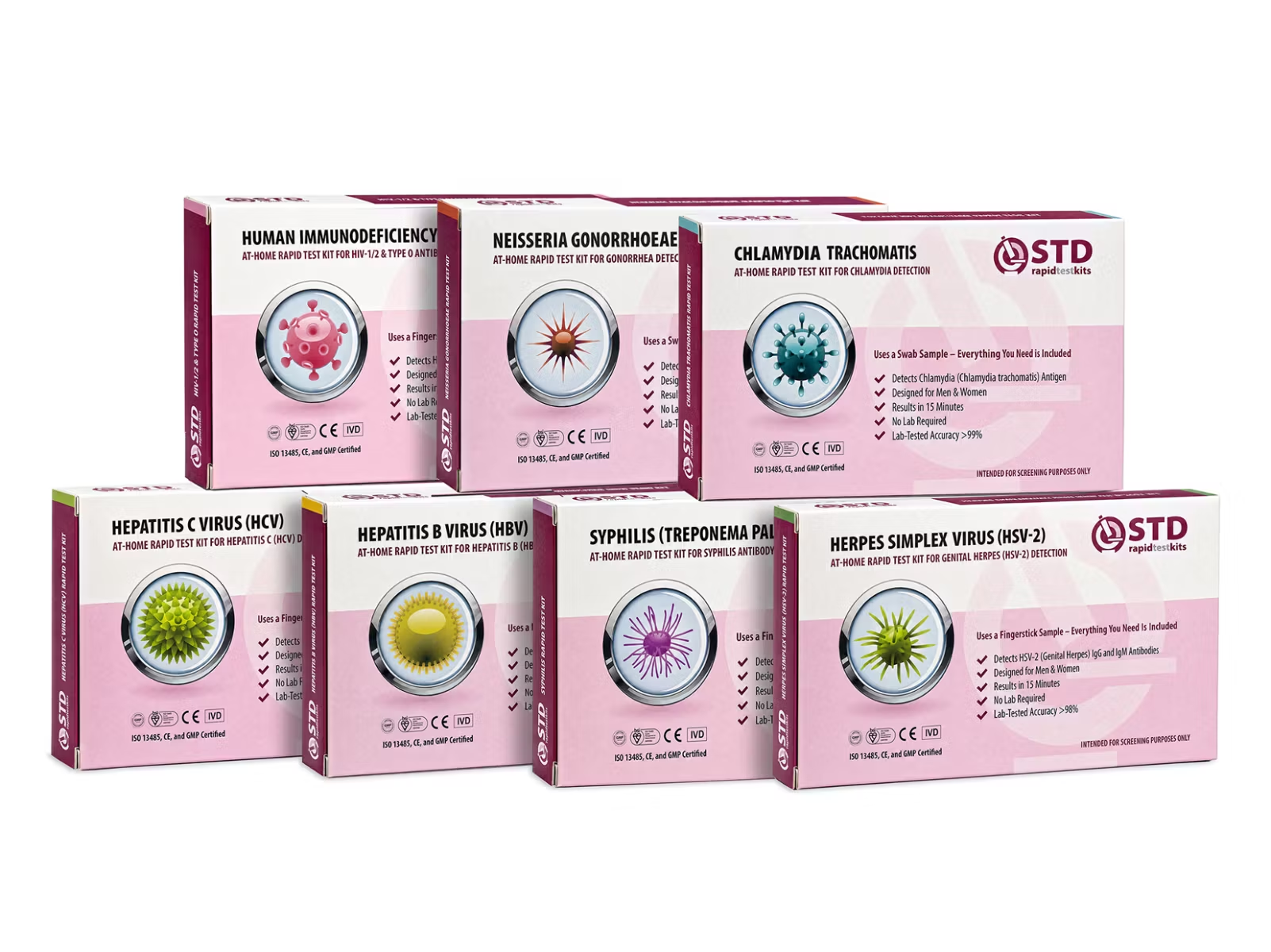
We sell rapid lateral-flow at-home STI tests; the kit recommended below is one of our own products.
The Shipping Trap and Other Hidden Costs of Bargain Kits
One of the sneakier costs of cheap STI testing is shipping, and it usually doesn't show up until checkout. A $24.99 strip kit can look like a steal until you add $15 of priority mail and a 10-day delivery window. Sometimes the apparent savings disappear entirely.
Worse, some marketplace kits ship from overseas with no clear manufacturer, untranslated instructions, and customs delays nobody warned you about. That might be fine for a household thermometer. For an STI test where early treatment prevents transmission and long-term complications like pelvic inflammatory disease or infertility, a two-week shipping delay can be the difference between catching an infection at the curable stage and treating downstream complications.
Jordan, 29, lived in a rural area when wildfire evacuations made a clinic visit feel impossible. He ordered a $40 chlamydia kit online; it took 11 days to arrive. By the time it showed up he had already developed discharge and burning during urination. He ended up driving 90 minutes to a walk-in clinic anyway, wishing he'd paid the extra $30 for an overnight option from a U.S.-based supplier with a known turnaround.
Before you buy, check the ship-from address, the stated delivery window, whether the price includes return postage for a mail-in lab kit, and whether the listing names an actual manufacturer rather than only a marketplace seller.

A Decision Walkthrough: Which Test Fits Your Situation
If you're staring at a $25 strip kit and a $125 lab kit and trying to figure out which is the right call, the answer depends less on price than on four things: how long ago the exposure was, whether you have symptoms, what infections you're screening for, and what you plan to do with the result.
Below are the four situations most readers land on this page from, and what tends to work for each.
You had a one-time encounter and want quick reassurance. A rapid strip can fit here, but only once you're past the window period for whatever you're testing for. If the encounter was within the last 7 days, a rapid kit taken today is likely to miss an early-stage chlamydia or gonorrhea infection. Either wait 10 to 14 days before using the rapid test, or pay slightly more for a mail-in NAAT kit you can collect now and ship the same day.
You have symptoms right now. Symptoms change the equation completely. Discharge, burning, sores, unusual bleeding, or unexplained pelvic pain are reasons to skip the bargain bin and either order a mail-in lab kit with NAAT-grade analysis or, better, see a clinician who can examine you in person, run a culture or PCR, and prescribe treatment same-day if needed. The Mayo Clinic's chlamydia diagnosis guidance notes that laboratory testing remains the standard for symptomatic cases.
You're asymptomatic but had recent unprotected sex. The CDC's STI screening recommendations treat asymptomatic screening as a routine step for sexually active women under 25 and for adults with new or multiple partners. A mail-in kit that uses NAAT and is processed in a CLIA-certified lab is the sweet spot here: lab accuracy, no clinic visit, and a window period that matches what major guidelines recommend.
You're testing for general peace of mind, not because of a specific worry. This is where a budget rapid kit can do honest work. Use it as a screening pass, follow up with a lab test if anything is positive or anything feels off, and don't treat the strip's negative result as a closed case. If money is tight, look into low-cost services through community health centers and Planned Parenthood, or platforms that accept FSA and HSA payments.
Is a $30 STI test ever as accurate as a $150 lab test?
For some infections, in the right window, yes. Lateral-flow rapid tests typically post specificity above 98% across the major STIs, which means a clear positive line is very likely to be a true positive. Their weak point is sensitivity in early-window samples: a $30 rapid kit taken 5 days after exposure can return a false negative that the $150 mail-in NAAT would catch. The price gap mostly buys earlier-window detection and confirmation infrastructure, not better positive accuracy.
So, Are Cheap STD Tests Ever Worth It?
Sometimes, yes. The price tag doesn't make a test unsafe; using a test outside the conditions it was designed for is what makes it unsafe. A $30 rapid kit used 14 days after exposure, on the right sample type, by someone who reads the instructions and plans to confirm any positive at a clinic, is a reasonable tool. The same kit used 48 hours after exposure, with rushed instructions, by someone treating the negative line as a final answer, is likely to return a false negative that delays the treatment they actually need.
What separates the two outcomes isn't the price. It's how the user understands the result. Cheap tests punish impatience and reward people who understand window periods and confirmation steps. More expensive tests are more forgiving of impatience, mostly because they buy you a longer detection window and a follow-up infrastructure that catches user error.
If you're going to test once and treat the result as settled regardless of what it says, spend the extra money on a NAAT-grade mail-in kit or go to a clinic. If you treat a home test as a screening step in a multi-week plan that includes a follow-up clinic visit when warranted, a budget rapid kit does what it was designed to do at the price point you paid.
A $30 rapid kit used after the window period for the infection you're testing for, with a plan to confirm any positive at a clinic, is a reasonable screening tool. The same kit used 48 hours after exposure and treated as a final answer is likely to return a false negative that delays treatment.
What to Look For Before You Click "Buy"
Not every at-home STI test on the market is FDA-cleared, CLIA-validated, or even shipped by a company that will answer an email when something goes wrong. A test can be cheap and responsibly made, or expensive and under-validated; the listing price tells you almost nothing on its own. What does pull weight is the presence of basic regulatory and support markers in the product documentation, and the kind of company behind the kit.
Authorized at-home diagnostic tests carry FDA clearance or marketing authorization, and the manufacturer's documentation typically references the 510(k) number or marketing-authorization letter. Before you check out, look for the following on the product page or in the manufacturer's documentation.
- FDA clearance or marketing authorization for at-home use, with a 510(k) number or DEN/marketing-authorization letter referenced in the instructions for use.
- CLIA-certified lab partner for any mail-in kit; the lab's CLIA number should be findable on the listing or in the company's about page.
- Manufacturer name and U.S. address, not only a marketplace seller name.
- Specific window-period guidance for the infection you're testing for, not generic "test anytime" language.
- Customer support that responds via a phone number or email you can verify before you buy.
- Refund or replacement policy for damaged samples, expired strips, or invalid control lines.
Before You Buy: What Bargain Listings Don't Mention
When you're staring at a "Buy Now" button on a $19 listing at 2am because you're worried about something specific, no listing page in the world is going to say "this might miss your infection." It's going to use the language of ease, speed, and "over 99% accuracy."
That accuracy figure, on its own, doesn't tell you what you need to know. A test can be 99% accurate at identifying established infections and still miss a 7-day-old exposure a significant fraction of the time, because manufacturer accuracy claims usually report performance on samples with detectable amounts of the target, not on early-window samples that don't yet contain detectable amounts.
Noah, 24, learned this the awkward way. He bought a $27 kit from an overseas marketplace seller. The instructions were in broken English. When he ran the test, the result line never appeared; the strip just stayed blank. He shrugged it off and assumed everything was fine. Two months later, his new partner tested positive for chlamydia at a routine appointment. The conversation that followed was the one neither of them had been prepared to have.
A blank strip with no control line is an invalid result rather than a negative, a faint line that appears within the manufacturer's reading window is still a positive on most lateral-flow cassettes, and instructions written in a language you cannot read are part of how you identify those edge cases. These are the failure modes cheap listings don't mention, and they happen often enough that public-health testing guidance specifically warns about confirming any unclear or positive home-test result through laboratory testing.
Before you click buy, ask yourself three things.
- Am I testing inside or outside the window period for this infection? If inside, a negative result is probably premature, not reassuring.
- Do I know exactly how to read the result, including what a faint line means and what to do if the control line never appears?
- What is my plan if the result is positive, unclear, or if symptoms appear later anyway? Do I have a clinic or lab follow-up lined up?
You Deserve Clarity, Not Confusion
If you've read this far, you aren't looking for the cheapest test. You're looking for the one that won't mislead you, and that's a meaningfully harder question. Cheap doesn't always mean dangerous, but it often means compromise: less analytical sensitivity, shorter detection windows, less customer support, slower shipping.
The best STI test for you is the one that fits your timeline, your symptoms or lack of them, and the level of certainty you actually need before you can stop worrying about this exposure. Sometimes that's a $30 strip used in week three. Sometimes it's a $130 NAAT mail-in kit used in week one. Sometimes it's a clinic visit because symptoms are real and a strip will only delay the treatment you already need.
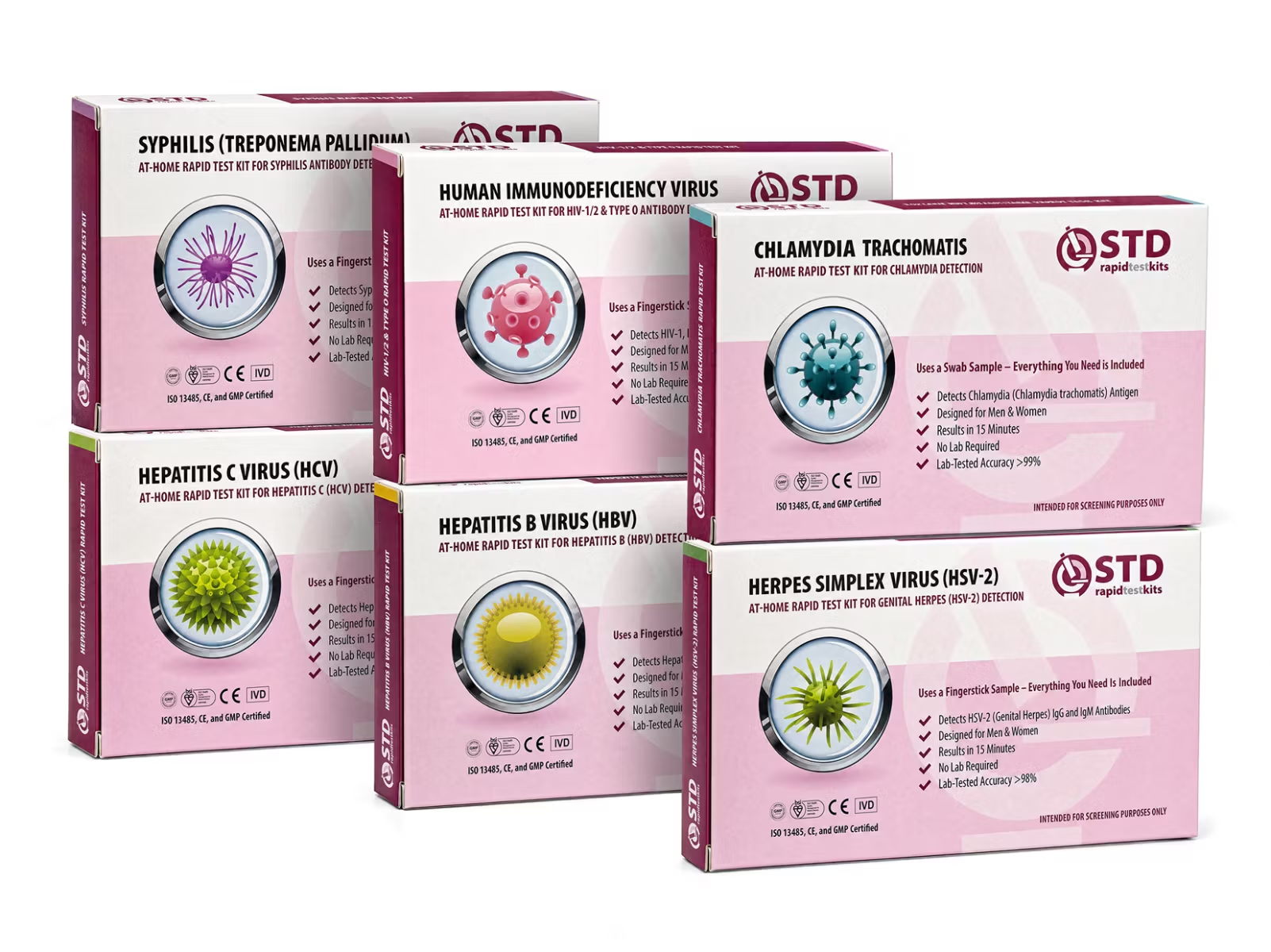
You can browse our full range of at-home STI test kits for the lateral-flow rapid options we sell, including single-infection swab tests for chlamydia and gonorrhea, fingerstick blood tests for HIV, syphilis, and hepatitis, and combination panels. For pharyngeal or rectal swabbing and lab-processed NAAT panels, you'll need a clinic visit. Those are categories of testing we don't sell, and we'd rather tell you that directly than recommend a product that doesn't fit the question you're trying to answer.
- Past the window period and screening for general peace of mind: a rapid lateral-flow kit can be a reasonable starting point.
- Within the first week after exposure, or symptomatic right now: a mail-in NAAT kit or an in-person clinic visit is the better tool.
- Any positive or unclear rapid result: confirm at a lab or clinic before treating the answer as final.
FAQs
- Can I trust a $30 STD test?
- Yes, when two things are true. First, you're testing after the detection window for that infection has been satisfied (typically 7 to 14 days for chlamydia and gonorrhea, longer for HIV and herpes antibody tests). Second, you treat any positive as a reason to confirm at a lab rather than a final diagnosis. Miss either condition and the cheap test becomes unreliable, but that's a timing and process failure rather than a product one.
- Why do some at-home STI tests cost more than $200?
- The higher price usually covers lab-grade NAAT analysis, CLIA-certified processing, secure digital results, optional telehealth follow-up, discreet packaging, and partner-notification support. You're paying for a longer detection window, higher analytical sensitivity, and a follow-up infrastructure that catches user error, not only for the strip in the box.
- I took a cheap test and got a negative result, but I still feel off. Now what?
- Trust the symptoms over the strip. Burning, unusual discharge, sores, spotting between periods, or persistent pelvic discomfort are reasons to see a clinician or order a NAAT-grade mail-in lab kit. False negatives are most likely when you tested too early in the window period or when the strip's sensitivity is lower than the bacterial load in your sample.
- What does a faint line on a rapid STI test mean?
- On most lateral-flow strips a faint line is still a positive line, especially if it appears within the manufacturer's reading window. Don't guess. Photograph the strip under good lighting, call the manufacturer's support line, and confirm the result with a lab NAAT before you change anything about your treatment or partner notification.
- Are super-cheap at-home STD kits on Amazon legitimate?
- Some are, many are not. If the listing ships from an unnamed overseas seller, arrives in packaging you can't read, doesn't list a manufacturer or U.S. address, and has no customer support contact, treat the result with skepticism. Look for FDA clearance, a CLIA-certified lab partner for mail-in kits, and a manufacturer you can actually reach.
- Can I use an STI test that's been sitting in a drawer for a year?
- Check the expiration date on the foil pouch, not only the outer box. Expired tests have degraded reagents and unreliable control lines. If the kit is past its printed expiry, replace it. The cost of a fresh test is much smaller than the cost of trusting a degraded one.
- How soon after a hookup can I test for an STI?
- It depends on the infection and the test technology. For chlamydia and gonorrhea, a NAAT mail-in kit is usually reliable from about 7 to 14 days after exposure. HIV antigen-antibody tests are usually reliable from 18 to 45 days. Syphilis can take 3 weeks to 3 months. HSV-2 antibody tests usually need at least 12 weeks. Testing earlier than these windows is the most common reason cheap rapid kits return a misleading negative.
- What's the most affordable test that still works well?
- For most readers, a mail-in NAAT kit focused on the two or three infections you're most worried about, run by a CLIA-certified lab, is the affordability-to-accuracy sweet spot. Many such kits sit between $70 and $130. Skip mega-panels unless you're screening across many possible exposures or want a complete baseline picture.
- Is it safe to throw away a used STI test at home?
- Yes, for lateral-flow strips. Wrap the cassette in tissue or a small bag and put it in the household trash. For mail-in lab kits that ship back biohazard-labeled samples, follow the provider's return instructions exactly. Don't flush any part of the kit, and don't pour buffer solution down a sink.
- U.S. Centers for Disease Control and Prevention. About sexually transmitted infections, including symptom patterns and the role of asymptomatic transmission.
- U.S. Centers for Disease Control and Prevention. Getting tested for STIs, including who should be screened and recommended sample types.
- U.S. Centers for Disease Control and Prevention. Sexually Transmitted Infections Treatment Guidelines (2021), including screening and management recommendations.
- U.S. Centers for Disease Control and Prevention. STI Screening Recommendations, with screening tables organized by infection and population.
- U.S. Centers for Disease Control and Prevention. Chlamydial Infections (STI Treatment Guidelines), including NAAT as the recommended laboratory test for C. trachomatis detection.
- U.S. Centers for Disease Control and Prevention. Getting Tested for HIV, including specific window periods for antigen/antibody, antibody, and nucleic acid tests.
- MedlinePlus (U.S. National Library of Medicine). Chlamydia Test overview, including sample types and how the test is used.
