
Published: August 2025 | Last updated: May 2026 | Editorial review and quality control: Martina N.
For many pregnant patients, prenatal screening feels comprehensive. There is a blood draw, a urine sample, an early STI panel, and the comforting sense that everything is being checked. Then a newborn develops a chlamydia-related eye infection or pneumonia in the weeks after delivery, and the obvious question follows: how did this happen when the test came back negative?
The short answer is that prenatal chlamydia screening is usually done once, early, before any later exposure could have occurred and before a recent infection has had time to replicate enough to detect. This piece walks through why that gap exists, when retesting is recommended, what at-home rapid tests can and cannot do during pregnancy, and how to ask for a second test without making it awkward.
Key takeaways
- A negative chlamydia test early in pregnancy reflects that single moment in time, not the rest of the pregnancy. New exposures or recent infections can still be missed.
- CDC guidance recommends repeat chlamydia testing in the third trimester for anyone under 25, with new or multiple partners, or with a partner of unknown status.
Why some pregnant patients fall through the cracks
The assumption that prenatal screening catches everything is both comforting and misleading. Most obstetric clinicians screen for chlamydia and gonorrhea once, in the first trimester, as part of the initial prenatal labs. Unless a patient is flagged as higher-risk, that single screen is often the only one performed before delivery. Chlamydia, however, is not always present or detectable when that early test is done.
Picture a routine timeline. The first screen is run at week 8 and comes back negative. After that, a partner who was never tested turns out to be infected. Or a new exposure occurs later in the pregnancy. The early result still says negative, and that result becomes the default reference for the rest of the pregnancy, including delivery. The pattern of an apparently low-risk prenatal screen followed by a postpartum newborn infection is well documented in the public-health literature and is one of the main reasons retesting guidance exists at all (CDC, About STIs and Pregnancy).
Clinicians are not always at fault here. The CDC recommends a second chlamydia test in the third trimester only for patients with specific risk factors, such as being under 25 or having new or multiple partners since the first screen (CDC STI Treatment Guidelines, Pregnant Women). New exposures still happen outside those categories. Not every patient discloses every change in their sexual history. In overloaded prenatal systems, nuance gets missed.
First-trimester screens are single snapshots in time. Any exposure or undetected infection after that date falls outside their scope, which is the main reason CDC third-trimester retesting guidance exists for higher-risk pregnancies.
The testing-timeline problem
One of the biggest reasons a chlamydia infection slips through prenatal care is the timing of the test relative to exposure. The current gold-standard laboratory test for chlamydia is the nucleic acid amplification test (NAAT), used on a vaginal swab or urine sample. NAATs are highly sensitive for detecting Chlamydia trachomatis, but only after the bacterial load has built up enough for the test to amplify. If a sample is collected too soon after exposure, the infection may not yet be detectable, regardless of test quality. That is a property of molecular testing in general, not a flaw in any particular product.
The practical implication: many pregnant patients test once at the start of prenatal care and never again. If an exposure happens after that first screen, including from a long-term partner who was not previously tested, the early result is no longer a reliable picture of current status. This is not a moral failure or a clinical mistake. It is a timing problem built into the way screening is scheduled.
| Testing stage | What it detects | Why it may fail |
|---|---|---|
| First trimester (6-12 weeks) | Baseline infection status at the start of pregnancy | Cannot reflect any exposure that happens after the screen; recent infections within ~1-2 weeks may not yet amplify |
| Second trimester (13-26 weeks) | Repeat test in higher-risk pregnancies or after new exposure | Frequently skipped in pregnancies classified as low risk by current guidelines |
| Third trimester (27-40 weeks) | Detects later exposures or reinfections before delivery | Only recommended for specific risk groups; not part of every prenatal protocol |
When chlamydia leaves no clear symptom
Chlamydia is often called the silent infection for a reason. The CDC notes that chlamydia often causes no symptoms, which is why screening is the primary way it gets diagnosed (CDC, About Chlamydia). In pregnancy, that silence can be even more confusing. Hormonal changes routinely cause shifts in vaginal discharge, mild pelvic discomfort, and occasional spotting, all of which can mask the few clues a chlamydia infection might otherwise produce.
Patients often describe it the same way after the fact: "I thought the extra discharge was just part of pregnancy. My OB said everything looked fine." The infection is only identified later, when a newborn develops conjunctivitis or pneumonia and the source is traced back to delivery. By that point, treatment has shifted from a short course of pregnancy-safe antibiotics for the parent to neonatal care for the baby. Early treatment of maternal chlamydia is highly effective at preventing perinatal transmission, but only when the infection is detected in the first place.
Untreated maternal chlamydia can also reach the newborn during delivery. These neonatal complications are documented in the CDC pregnancy STI treatment guidelines (CDC, STIs in Pregnant Women) and are largely preventable with timely diagnosis and treatment, which is why the testing schedule, and whether a second test is offered at all, matters so much. The most common patterns are summarized below.
| Complication | Typical onset | Impact |
|---|---|---|
| Neonatal conjunctivitis (eye infection) | 5-14 days after birth | Redness, swelling, and purulent discharge; can cause vision damage if untreated |
| Neonatal pneumonia | 2-12 weeks after birth | Persistent cough, wheezing, feeding difficulty, and risk of hospitalization |
| Preterm labor and low birth weight | Variable; risk concentrated in untreated late-pregnancy infection | Associated with poorer neonatal outcomes overall |
Can a chlamydia test miss an active infection during pregnancy?
Yes. The two most common reasons are that the sample was taken inside the window period (the bacteria has not yet replicated enough to detect, roughly the first 1-2 weeks after exposure) or that a new exposure occurred after the first prenatal screen. CDC guidance supports a repeat chlamydia test in the third trimester for patients under 25, with new or multiple partners, or with a partner of unknown status.
At-home chlamydia tests during pregnancy
One of the most common questions on this topic is whether at-home STI testing is safe during pregnancy. The short answer for chlamydia is yes. Sample collection (a self-collected vaginal swab) does not pose a risk during a healthy pregnancy any more than a swab in a clinic would. The test technology used in at-home rapid kits is a lateral-flow immunoassay run on the same kind of swab sample a clinic would take for a laboratory test. The technologies are not identical (lab NAATs have higher analytical sensitivity), but both are valid screening tools, and a positive at-home result is worth confirming with a clinic NAAT before treatment is started.
Timing still matters more than the test format. A rapid test taken within a few days of exposure is not yet within the reliable detection window. If the suspected exposure was less than about 10 days ago, waiting a few more days, or being prepared to retest later, will give a more meaningful result. From about 14 days post-exposure onward, the chance of detection is much higher.

Why a negative result might still be wrong
The phrase "false negative" gets thrown around loosely, but in pregnancy it has a specific weight. It means the test reported no infection when one was actually present, either because it was too early to detect or because something about the sample interfered with the result. That single piece of information can then shape the rest of prenatal care.
There are three common reasons a chlamydia test misses an active infection during pregnancy.
1. Exposure happened after the test. Even in long-term relationships, partners are not always tested. Some assume a past test still covers them or that the absence of symptoms means the absence of infection. If a partner had chlamydia and did not know it, any exposure that occurred after the initial prenatal screen makes that early result irrelevant to current status.
2. The infection was too new to amplify. NAATs detect bacterial DNA, but only when there is enough of it in the sample. If exposure happened within roughly a week or two before testing, the bacterial load may not yet be high enough for the test to register a positive. This is a property of biology, not of test quality.
3. The sample was mishandled or degraded. This is less common, but it happens. Rushed processing, an improperly collected swab, or transport delays can all reduce sensitivity. The risk rises in under-resourced clinics or during high-volume periods.
None of this is the patient's fault. But the consequences fall on the patient and the baby if no one thinks to retest, or if no one mentions that retesting is even an option.
Post-screen exposure, recent unamplified infection, and sample-handling issues all point to the same conclusion: an early prenatal negative does not cover what came after it. A second test later in pregnancy is what closes the gap.
What clinicians often do not bring up
Well-meaning obstetric providers may not mention retesting unless the patient meets the published high-risk criteria. From a population perspective, that approach is efficient. At the individual level, it can quietly fail people whose circumstances changed mid-pregnancy. The CDC explicitly calls out repeat testing as essential for patients under 25, with new or multiple partners, or with partners of unknown status (CDC, STIs in Pregnant Women). Whether that conversation actually happens in a given prenatal visit is another matter.
This is the gap where postpartum diagnoses tend to surface. A patient in what looks like a monogamous relationship is not asked about exclusivity at the time of conception. The clinician trusts the early negative test. The patient trusts the clinician. When a newborn is later treated for chlamydia-related pneumonia and partner testing returns a positive result, the timeline only makes sense in hindsight.
The takeaway: a patient does not need a clinician's permission to ask for a second test. Asking for a repeat NAAT in the third trimester is a reasonable, evidence-aligned request, and any provider should be willing to discuss it. If a clinic visit feels like more friction than the worry warrants, at-home rapid testing is a private alternative for an interim check, with any positive result confirmed at the clinic.
The USPSTF recommends screening for chlamydia in all sexually active women 24 years or younger and in women 25 years or older who are at increased risk for infection.
When and how to retest
In pregnancy, retesting keeps the result current as the body, the relationship, and the calendar change. For patients with any new exposure after the first prenatal screen, most experts suggest a repeat test around week 28 to 32. If symptoms such as unexplained discharge, pelvic pain, or unusual spotting appear at any point, retesting earlier is reasonable rather than waiting on the calendar.
A typical pattern looks like this: a patient tests negative at week 9. The partner has not yet been tested. At week 20 the patient notices a small change in discharge but attributes it to pregnancy. No one offers a repeat test. By the third trimester or at delivery, an infection that was not present at week 9 has had time to develop. The retesting guidelines were written to close exactly this gap.
A quick note on what comes after a positive result. Partner treatment matters here, because chlamydia can return if a partner was not treated at the same time, which is why CDC guidelines recommend partner therapy alongside the index case. In pregnancy, a test of cure is also recommended about three to four weeks after treatment, with a repeat test around three months later (CDC STI Treatment Guidelines, Chlamydial Infections).
The checklist below summarizes the most common scenarios where a second chlamydia test is reasonable during pregnancy.
| Situation | Retest recommended? | Why it matters |
|---|---|---|
| First-trimester test was negative, no new partners since | Optional | Low risk overall, but biological variability and original sample timing still apply |
| First-trimester test was negative, but partner has not been tested | Yes | An undiagnosed partner is the most common source of post-screen exposure |
| New sexual partner during pregnancy | Yes | An early negative no longer reflects current exposure status |
| Symptoms appear (pain, spotting, unusual discharge) | Yes | Could indicate a new or previously undetected infection; test as soon as practical |
| No symptoms, but anxiety about a possible exposure | Reasonable | A single retest can resolve the uncertainty before delivery |
How to ask for a second test without making it strange
Advocating for a repeat test does not require a perfect relationship or a confessional conversation. If asking a provider feels like the harder part, a short, neutral sentence usually works:
"I know I was screened early on, but I have read that chlamydia can be missed if the timing is off. Could we run another test to be safe?"
That is the entire ask. A reasonable provider will run the test. If the response is dismissive, that says something about the provider's posture toward shared decision-making rather than the appropriateness of the request itself.
If a partner conversation is the harder part, framing matters. Most chlamydia cases come from people who did not know they were infected, so the most useful frame is shared protection rather than blame. A workable script:
"I am being retested because the timing of my early prenatal test might have missed something. Would you get tested too so we can both be sure before the baby is here?"
When a negative result does not feel like closure
A common pattern: a patient at 36 weeks pregnant cannot shake the feeling that something has changed since the 10-week prenatal screen. There were no symptoms, no major drama, just a quiet awareness that the timeline of the relationship has shifted and the early test no longer feels current. An at-home test ordered quietly, run alone, returns a positive result. Treatment starts in time. The newborn is not exposed.
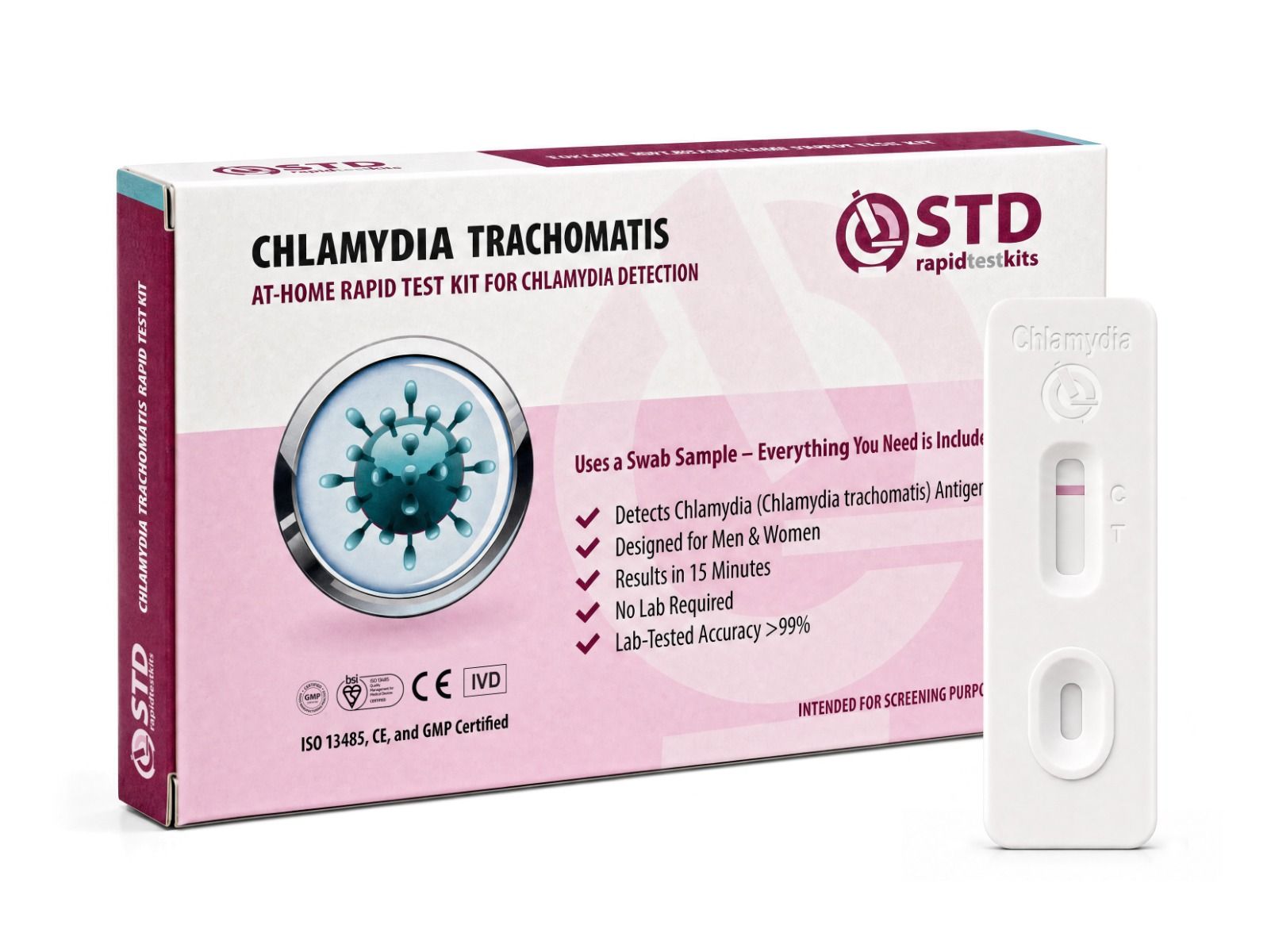
That kind of quiet attention is what prevents the worst version of an avoidable problem. A negative result is a snapshot. Bodies change, relationships change, and rechecking later in pregnancy when something feels off is a reasonable response to that snapshot becoming outdated. No symptoms are required, and no clinician's approval is required either. An at-home rapid swab test in the third trimester delivers a result in about 15 minutes and can be run privately before the next prenatal visit.
No symptoms required. No clinician's approval required. A repeat test in the third trimester is a reasonable response to an early screen that no longer feels current.
Frequently asked questions
- Can someone have chlamydia in pregnancy and feel nothing?
- Yes, and that is by far the most common experience. Discharge changes, mild cramping, and occasional spotting are all normal during pregnancy, which means the signals that might prompt concern in a non-pregnant adult often blend into the background. Screening, rather than symptom-watching, is how this infection actually gets found.
- My early prenatal test was negative. Could the result still be wrong?
- It can be, in two specific ways. If the test was done within roughly 1-2 weeks of an exposure, the bacterial load may not yet be high enough to amplify. And the result is only valid for that moment in time; it cannot reflect any exposure that happens afterward. Both are reasons CDC guidance supports a repeat test in the third trimester for higher-risk pregnancies.
- Why did my clinician not bring up retesting?
- Repeat testing is recommended in the third trimester for patients with specific risk factors (under 25, new or multiple partners, partner of unknown status). Clinicians often follow that guidance literally, which can quietly miss pregnancies where circumstances changed mid-prenatal-care. A patient can always ask for a repeat test; it is a reasonable, evidence-aligned request.
- Are at-home STI tests safe to use during pregnancy?
- For chlamydia, yes. A self-collected vaginal swab during a healthy pregnancy is no more invasive than a swab collected in a clinic. At-home rapid tests use lateral-flow chemistry, which is screening-grade rather than lab-NAAT-grade, so any positive at-home result should be confirmed at the clinic before treatment begins. Negative results should still be paired with a repeat test if the timing was within the window period.
- What happens if a pregnant patient tests positive for chlamydia?
- Chlamydia in pregnancy is treatable with pregnancy-safe oral antibiotics, most commonly azithromycin (per current CDC STI Treatment Guidelines for chlamydial infections in pregnancy). The provider will prescribe what is appropriate, and the patient's sexual partner needs concurrent treatment to prevent reinfection. A test of cure is recommended about 3-4 weeks after treatment, with retesting again around 3 months later.
- Can an untreated chlamydia infection harm the baby?
- It can. The two most common neonatal complications are conjunctivitis (typically appearing 5-14 days after birth) and pneumonia (typically appearing 2-12 weeks after birth). Untreated infection in late pregnancy has also been linked to higher rates of preterm birth and low birth weight. Catching the infection before delivery makes all of these substantially less likely.
- How long after a suspected exposure should a chlamydia test be done?
- About 10 to 14 days after the suspected exposure gives the most reliable result for a swab-based NAAT or rapid test. Testing earlier risks a negative result that does not yet reflect a real infection. If symptoms appear sooner, do not wait; clinicians can take a sample regardless and weigh the result against the timing.
- Is it too late to find out about a missed chlamydia infection after giving birth?
- No. If a newborn shows signs of eye infection or breathing trouble, testing the infant and the parent can still identify a chlamydia infection that went undiagnosed during pregnancy. Postpartum treatment of the parent also reduces the risk for future pregnancies and current partners.
Clarity over assumption
A single negative chlamydia test early in pregnancy is meaningful, but it is not the final word for the rest of the pregnancy. Exposures change. Bacterial loads take time to build. Recommendations to retest in the third trimester exist precisely because the early screen cannot cover what has not yet happened. The screening schedule is built around that gap.
The simplest response is one more test at the right time, asked for plainly. Whether that happens at a clinic visit or quietly at home, the outcome is the same: a current answer to a current question, in time to act on it.
Action checklist
- If your partner has not been tested since your first prenatal screen, ask for a repeat chlamydia NAAT at the 28-32 week prenatal visit.
- For a private interim check, a lateral-flow rapid swab test is most reliable from about 14 days post-exposure onward.
- Confirm any positive at-home result with a clinic NAAT before starting antibiotics, since lateral-flow chemistry is screening-grade rather than confirmatory.
- U.S. Centers for Disease Control and Prevention. About STIs and Pregnancy. Overview of perinatal STI transmission risks and the rationale for prenatal screening.
- U.S. Centers for Disease Control and Prevention. STI Treatment Guidelines, Pregnant Women. Screening cadence, treatment options, and test-of-cure recommendations specific to pregnancy.
- U.S. Centers for Disease Control and Prevention. STI Treatment Guidelines, Chlamydial Infections. Diagnostic methods, recommended antibiotic regimens, and follow-up testing.
- U.S. Centers for Disease Control and Prevention. About Chlamydia. General fact-sheet on prevalence, asymptomatic infection, and complications.
- U.S. Preventive Services Task Force. Chlamydia and Gonorrhea: Screening Recommendation. Population-level screening recommendation for sexually active women.
