
Published: July 2025 | Last updated: May 2026 | Editorial review and quality control: Martina N.
The morning after a group hookup is when the questions usually start. Did everyone really test recently? What if a condom slipped during the toy switch? Is the irritation from new bedsheets or something else? You do not owe anyone an explanation for asking these questions. You do owe yourself a clear answer about when a test will catch what you are worried about.
This guide covers the testing timeline for each common sexually transmitted infection, what to test for after different kinds of contact, where at-home rapid kits fit alongside a clinic visit, and how to plan retesting. Two facts shape everything that follows. First, every test has a window period: a stretch of time after exposure when the infection is present but not yet detectable. Test inside that window, and a negative result tells you very little. Second, "everyone shared their recent results" describes the moment those samples were taken; any new exposure between that test and your encounter resets the clock.
Key Takeaways
- Chlamydia and gonorrhea become reliably detectable about 7 to 14 days after exposure; HIV and syphilis typically need 3 to 6 weeks for an initial meaningful screen.
- Herpes IgG antibody tests may not turn reliably positive until 12 weeks after exposure. A negative result inside any window period is not the all-clear: plan a follow-up after the window closes.
Was That Risky? Reading the Night Honestly
Group encounters cover a wide range of activities, and STI risk depends more on the kinds of contact that happened than on how many people were in the room. Vaginal, anal, and oral sex each carry their own risk profiles. Skin-to-skin contact transmits herpes and HPV regardless of penetration. Shared toys move the same fluids and skin cells between people, especially without barrier covers or cleaning between uses.
Condoms cut the risk of fluid-borne infections like HIV, gonorrhea, and chlamydia, but they do not cover every body part involved in skin-to-skin transmission. So "we used protection, am I safe?" honestly translates to "I lowered my risk for some infections, not all of them." That is the framing the CDC uses in its screening recommendations.
If anything about the night is bothering you a week later, that is reason enough to test. Symptoms help, but they are not required. Most chlamydia and gonorrhea infections cause no symptoms in the first weeks, and asymptomatic transmission is how STIs spread quietly through groups.
Fluid-borne (condoms help a lot): HIV, gonorrhea, chlamydia, hepatitis B, hepatitis C, trichomoniasis. Consistent condom or barrier use lowers transmission risk substantially during vaginal and anal sex.
Skin-to-skin (condoms help less): Herpes (HSV-1 and HSV-2), HPV, syphilis chancres. These can transmit through contact with areas a condom does not cover (the base of the penis, the vulva, the perineum, the mouth), so a barrier reduces but does not eliminate the risk.
Window Periods: When a Test Can Actually Detect Infection
The window period is the gap between exposure and reliable detection. It varies by pathogen, by what the test measures (the bacterium itself, an antigen, or your antibody response), and by your individual immune timing. The table below summarizes the windows used by U.S. labs and rapid-test manufacturers, drawing on CDC screening guidance and MedlinePlus test information. The "earliest useful test" column is when a positive can become detectable; the "best accuracy window" is when a negative becomes meaningful. The Herpes row references IgG, the long-lived antibody your body produces after seroconversion; it takes longer to appear than antigen-based or NAAT detection because your immune system has to build it.
| Infection | Earliest Useful Test | Best Accuracy Window | Typical Lab Test Type |
|---|---|---|---|
| Chlamydia | 7 days | 14+ days | NAAT (urine or genital swab) |
| Gonorrhea | 7 days | 14+ days | NAAT (urine; genital, throat, or rectal swab) |
| Trichomoniasis | 5 to 7 days | 14+ days | NAAT or rapid antigen |
| Syphilis | 3 weeks | 6 weeks to 3 months | Treponemal antibody (blood) |
| HIV (4th-gen lab antigen/antibody) | 18 days | 45 days | Lab antigen/antibody (blood) |
| HIV (rapid antibody) | 23 days | 90 days | Antibody (blood or oral fluid) |
| Herpes (HSV-2 antibody) | 3 to 6 weeks | 12 to 16 weeks | IgG blood test |
What to Test For After a Group Hookup
If your encounter involved any oral, vaginal, anal, or skin-to-skin contact, the safest screening list covers chlamydia, gonorrhea, syphilis, HIV, and (if symptoms appear or higher-risk exposure happened) herpes. For people with a vagina, trichomoniasis is worth adding. Hepatitis B and C are reasonable inclusions if blood-to-blood contact was possible, including injection-drug use, sharing piercing or tattoo equipment, or rough sex with bleeding.
Two contact types deserve a special note. Oral and anal infections, especially gonorrhea and chlamydia, often live in the throat or rectum without spreading to the genitals, and they cause no obvious symptoms. The reliable way to detect them is a clinician-administered throat or rectal swab, which most at-home rapid kits, including ours, do not include. If oral or anal contact was the main concern, plan on a clinic visit for site-specific swabs alongside any home blood-and-genital-swab testing you do.
Multi-test combination kits make sense after a group encounter because they cover the most common concerns from one sample-collection session. The 6-in-1 below is a good starting point for any-gender screening of HIV, syphilis, hepatitis B, hepatitis C, chlamydia, and gonorrhea. (stdrapidtestkits.com publishes this guide and sells at-home STI kits; we recommend the panel that matches the reader's actual exposure rather than always pushing the broadest kit.)
- Oral contact: at-home blood and genital-swab panel, plus a clinic throat-swab NAAT for pharyngeal gonorrhea and chlamydia.
- Anal contact: at-home blood and genital-swab panel, plus a clinic rectal-swab NAAT for rectal gonorrhea and chlamydia.
- Vaginal or penile-genital contact: at-home blood and genital-swab panel covers the highest-yield infections; add a herpes IgG follow-up at the 12-week mark if exposure was higher-risk.
- Skin-to-skin only (grinding, frottage, shared toys): screen for herpes and HPV regardless of barrier use, since condoms do not fully cover those transmission routes.
- Possible blood-to-blood contact (rough sex with bleeding, shared injection equipment, fresh piercings or tattoos in shared settings): add hepatitis B and hepatitis C to the panel.
The False Negative Trap
A negative result the day after a group hookup is, in most cases, not a meaningful negative. Rapid tests detect either antibodies your body has produced (which take weeks) or pathogen antigen at levels above a detection threshold. If neither has had time to accumulate, the test does not see the infection. The result reads negative even though you are infected.
This is most common with HIV before the 2-week mark, syphilis before 3 weeks, and herpes blood antibody tests before 6 weeks. For chlamydia and gonorrhea, detection becomes reliable between day 7 and 14. Testing earlier than these windows can be useful as a baseline, especially if you want documentation that you tested negative just before the encounter, but the result you should plan around is the one taken after the window closes. CDC HIV testing guidance and NHS STI testing guidance both emphasize this retest pattern.
If you test inside the window period and the result is negative, schedule the retest right then. For HIV and syphilis, that is the 6-week and 3-month marks. For herpes IgG, 12 weeks. Calendar reminders prevent the early-test relief from becoming permanent and keep one negative inside the window from being mistaken for the final answer.
What the At-Home Kit Covers, and What It Does Not
At-home rapid tests are lateral-flow immunoassays. The genital-swab tests in our combo kits look for chlamydia and gonorrhea bacterial antigens; the blood tests look for antibodies to HIV, syphilis, hepatitis B and C, and herpes. They are screening tools, and a reactive (positive) result should always be confirmed by a clinic NAAT, or by a treponemal plus non-treponemal antibody pairing for syphilis.
What at-home rapid kits do not cover well: pharyngeal (throat) gonorrhea, rectal gonorrhea, and rectal chlamydia. These infections are often silent and require a clinician-administered swab at the site for accurate detection. They also do not replace lab-grade NAAT, which is more analytically sensitive than any rapid test, especially for low-bacterial-load asymptomatic infections.
The trade-off is privacy and speed. A home rapid kit gives you an answer in your bathroom in about 15 minutes, with no waiting room and no insurance trail. For a worried-but-asymptomatic reader past the window period, that is often enough to act on. For a symptomatic reader, or one with a recent throat or rectal exposure, the home kit is a starting point that points you toward the clinic for the swabs we cannot send.
Many sexually transmitted infections have no symptoms or only very mild symptoms; the only way to know your status is to get tested.
If Your Result Is Positive: The Next Steps
Most STIs are curable, and the rest are manageable, but the immediate hour after a positive result rarely feels that way. Treat the result as the start of a process, not a verdict.
For chlamydia, gonorrhea, syphilis, or trichomoniasis, the first step is confirmation at a clinic and a single course of antibiotics. The CDC's treatment guidelines are short and standardized. For HIV, the modern path is rapid linkage to antiretroviral therapy; on treatment, the virus becomes undetectable and untransmittable within months. For herpes, antiviral medication shortens outbreaks and reduces shedding. Hepatitis B and C have specific treatment paths your provider will explain.
The other half of next steps is partner notification. Anonymous tools like TellYourPartner.org let you alert exposed partners without revealing your name, and many state and national health departments offer the same service for free. After treatment, retest at three to four weeks to confirm clearance for chlamydia, gonorrhea, and trichomoniasis (a "test of cure" or "test of reinfection"). For HIV and syphilis, follow your clinician's monitoring schedule.
- Confirm the result with a clinic NAAT (for chlamydia, gonorrhea, trichomoniasis), a treponemal plus non-treponemal antibody pairing (for syphilis), or a confirmatory antibody/antigen test (for HIV).
- Start treatment: a single course of antibiotics for chlamydia, gonorrhea, syphilis, or trichomoniasis; rapid linkage to antiretroviral therapy for HIV; antivirals for herpes; and a hepatitis-specific plan from your provider for hepatitis B or C.
- Notify partners using TellYourPartner.org, a state or national health-department service, or a direct message if you are comfortable. The notification can be anonymous.
- Retest at 3 to 4 weeks after treatment for chlamydia, gonorrhea, and trichomoniasis to confirm clearance. For HIV and syphilis, follow the monitoring schedule your clinician sets.
- Pause sex or use barriers consistently until your retest confirms clearance, so you do not pass the infection back to a partner mid-treatment.
Privacy, Discretion, and Testing on Your Terms
Sexual health used to require a waiting room. It still can, when the situation needs lab-grade NAAT or a clinician-administered swab. But for the routine post-encounter screening that most readers reach for after a group hookup, you can order a kit, run it in your bathroom, and read the result before anyone in your household notices the package. Most at-home tests ship in plain packaging within 24 hours and arrive in two to three business days.
Lateral-flow strips occasionally show a faint test line, which can be confusing in the moment. The kit's instruction leaflet explains how to read it, and the safe rule is straightforward: any visible line in the test region should be treated as a reactive (positive) result and confirmed by a clinic NAAT or appropriate antibody panel. A faint line is not a negative; it is a positive that needs confirmation.
One last note. Testing after group sex is not a confession. It is what your most cautious friend would do anyway. Whether the result is negative and reassuring, or positive and treatable, knowing what is going on is what gets you back to feeling like yourself.
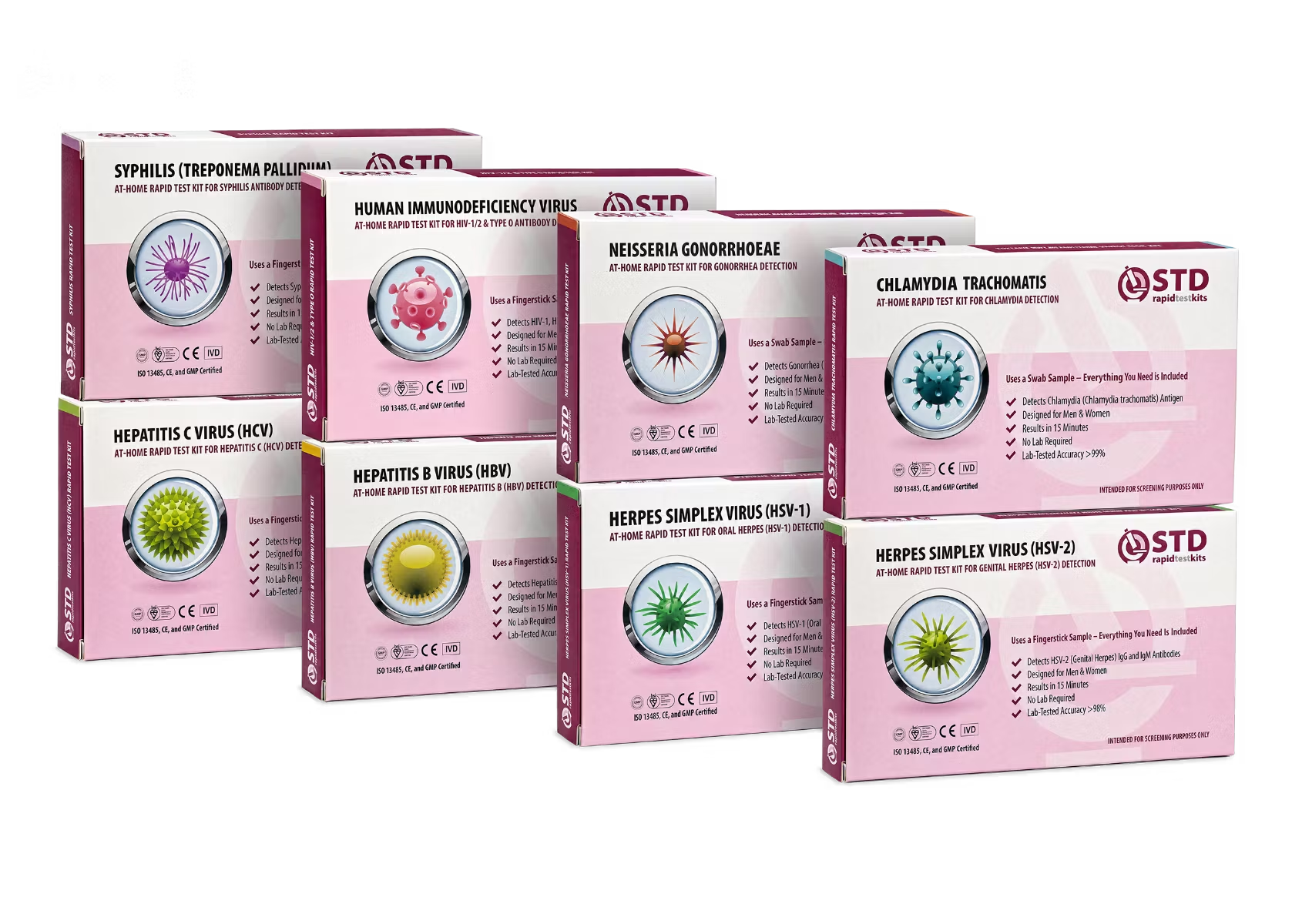
Plain outer packaging with no clinical branding. Typical dispatch within 24 hours and arrival in two to three business days in the U.S. Each rapid test reads in about 15 minutes once you collect the sample. Results stay in your bathroom unless you choose to share them.
FAQs
- How soon after group sex can I trust a negative test?
- It depends on what you are testing for. Chlamydia and gonorrhea become reliably detectable about 7 to 14 days after exposure. HIV with a 4th-generation lab test is solid by 45 days; rapid antibody HIV testing needs up to 90 days for a final clear. Syphilis takes 3 to 6 weeks. Herpes IgG can take up to 12 to 16 weeks for some people to seroconvert. If you test inside the window, plan a follow-up afterwards.
- Everyone in the group shared recent test results. Do I really still need to test?
- Yes. A test result is a snapshot of one moment. If anyone had a new exposure between that test and your encounter, their result no longer reflects the night you were together. Window periods also mean someone could have tested truly negative on Tuesday and become detectable by Friday. Testing yourself is not distrust; it is how the math actually works.
- Should I test for HIV right after the encounter or wait?
- Both, ideally. A baseline test in the first few days establishes that you were negative going in, which matters if any later result is positive. Then plan the follow-up at 18 to 45 days for a 4th-generation lab antigen/antibody test, or 90 days for a rapid antibody test. If the exposure was very high-risk, ask a clinician about post-exposure prophylaxis (PEP) immediately; per CDC guidance, PEP must be started within 72 hours of exposure to be effective.
- What if my throat or rectum is the concern? Can your at-home kit cover that?
- No. Our at-home rapid kits use genital self-swabs and fingerstick blood; they do not include throat or rectal swabs. Pharyngeal and rectal gonorrhea or chlamydia need a site-specific swab administered at a clinic, and they often spread silently from those sites. If oral or anal contact was the main exposure, book a clinic visit for site-specific NAAT, and use a home kit for the adjacent screening (HIV, syphilis, genital chlamydia and gonorrhea, hepatitis).
- Can I get an STI even if everyone used condoms?
- Yes, for skin-to-skin infections like herpes and HPV, which transmit through contact with areas a condom does not cover (the base of the penis, the vulva, the perineum, the mouth). Condoms are highly effective for fluid-borne infections like HIV, gonorrhea, and chlamydia, but not perfect; slipping or breakage happens. Group settings can also involve transitions (oral to vaginal, partner to partner) where the barrier is removed or replaced unevenly.
- What about shared toys? How risky and what should I test for?
- Shared toys move bodily fluids between partners directly. Without a fresh barrier (a condom changed between users) or thorough cleaning, they can transmit chlamydia, gonorrhea, trichomoniasis, herpes, HPV, and bloodborne infections like hepatitis B and HIV. Test the same panel you would for unprotected genital contact, and pay attention to whichever sites the toy actually contacted (genital, oral, rectal).
- If someone in the group tests positive later, am I exposed?
- Treat it as a real exposure and retest, even if your earlier result was negative. Window periods may have masked the infection on the first round. If they test positive for chlamydia, gonorrhea, or syphilis, ask a clinician about presumptive treatment; some providers will treat known partners empirically rather than waiting for your retest, especially for chlamydia and gonorrhea. If HIV exposure is on the table, PEP is an option within 72 hours of the encounter.
- Should I avoid sex until my window closes and I retest?
- If practical, yes; that breaks the chain. If not, use barriers consistently and tell new partners you are mid-window so they can make an informed choice. Two-way honesty is what "safer" actually means in this stretch. Once your follow-up testing comes back clean, and your partner from the encounter has done the same, you can return to your usual routine.
- U.S. Centers for Disease Control and Prevention. STI Treatment Guidelines, screening recommendations, and recommended panels by population.
- U.S. Centers for Disease Control and Prevention. HIV testing overview: antigen/antibody timing, rapid antibody tests, and NAT window periods.
- U.S. Centers for Disease Control and Prevention. Post-exposure prophylaxis (PEP) for HIV: who should take PEP, the 72-hour window, and how it is prescribed.
- U.K. National Health Service. Sexually transmitted infections (STIs): symptoms, testing pathways, and treatment overview.
- Mayo Clinic. Sexually transmitted diseases (STDs): symptoms and causes overview, including transmission routes and presentation.
- U.S. National Library of Medicine, MedlinePlus. Sexually Transmitted Infection (STI) Tests: how each test works, sample types, and accuracy expectations.
