Chastity Cages and STDs: Hygiene, Symptoms, and When to Test
Why locking up doesn't stop infection, and how to test smart



- Chastity devices block access, not contact. Skin-to-skin, oral, and toy-based play can still transmit STIs regardless of the cage.
- If you are sexually active with one or more partners, screen for STIs every 3 to 6 months and test sooner if anything looks, feels, or smells off after an unlock.
Published: September 2025 | Last updated: May 2026 | Editorial review and quality control: Martina N.
Wearing a chastity cage does not stop sexually transmitted infections, and it can make early symptoms harder to see. The device covers the exact tissue where many STIs first show up: the head and shaft of the penis, the urethral opening, and the surrounding skin. If you are sexually active, share toys, or play with partners, your exposure risk stays roughly the same as anyone else's, but your ability to notice an infection early drops sharply. This guide walks through what symptoms tend to hide under a cage, when to test, how to handle hygiene, and what a useful testing rhythm looks like for short-term and long-term wearers.
Why this matters if you are locked
Chastity is not just a kink for many people, it is a daily lifestyle. Whether you favor weekend lockups or stay caged for weeks at a time, your body keeps doing the same things underneath: sweating, producing urethral fluids, reacting to pressure, heat, and friction. None of those processes pause because there is a metal or plastic device in the way. And if you have a sexual partner, share toys, or take part in group scenes, the routes that STIs use to spread are still wide open.
The structural problem is visibility. A chastity cage covers or compresses the exact tissue where the earliest signs of infection appear: small ulcers, focal redness, a single drop of discharge at the meatus (the urethral opening), a faint odor change. According to the U.S. Centers for Disease Control and Prevention's overview of common STIs, several infections including chlamydia and gonorrhea can be present with very mild symptoms or none at all, which makes the small early signs the most useful ones a wearer might catch. When those signs are hidden under hardware, the timeline from "barely anything" to "clearly a problem" can quietly stretch from days into weeks.
A cage does not change how often infections happen. It changes how quickly you can see them, which means a routine unlock-and-inspect schedule does most of the work that visible genitals would do on their own.
The symptoms that get missed under a cage
When the genitals are not easily visible, three things happen at once. You see the area less often, you touch and inspect it less precisely, and you tend to attribute anything you do notice to the device. That last point is the trap. The cage causes its own minor irritations (pressure marks, redness from the base ring, occasional chafing from the bars) so the brain has a ready-made explanation for almost any new sensation.
The longer a device stays on, the more moisture pockets, micro-irritation, and minor skin damage accumulate. Each of those is a potential entry point for bacteria. If unlocks are infrequent, mild infection can be advanced by the time the skin is fully visible again. The practical fix is to give the area honest inspection time during every unlock and to lower the threshold for "this is worth checking" when something seems different.
| Symptom under the cage | Possible cause | Why it gets missed |
|---|---|---|
| Small amount of urethral discharge | Chlamydia, gonorrhea, non-gonococcal urethritis | Trapped inside the device or wiped away; mistaken for sweat, residual urine, or arousal fluid |
| Small ulcers, blisters, or punched-out sores | Herpes simplex, primary syphilis | Hidden under the base ring or cage bars; assumed to be friction sores or pressure spots |
| Persistent itching or new odor | Yeast overgrowth, bacterial imbalance, trichomoniasis in a partner | Masked by humidity, poor airflow, and the smell of warm skin under metal or silicone |
| Localized redness, swelling, or pain on one side | Skin infection, balanitis, early STI inflammation | Assumed to be pressure marks or a poorly fitted ring |
| Painful urination | Chlamydia, gonorrhea, urinary tract infection | Blamed on dehydration or the cage angle compressing the urethra |
Why chastity is not protection from STDs
This is the misconception that catches the most people out. A cage prevents penetration. It does not prevent contact. Many STIs spread through skin-to-skin transmission rather than through ejaculation. CDC guidance on genital herpes notes that HSV transmission occurs through contact with infected skin or mucous membranes, including during periods of asymptomatic viral shedding when the carrier has no visible sores. Human papillomavirus behaves similarly. So does primary syphilis, which spreads through direct contact with a chancre that the carrier may never see.
Cages also leave significant skin exposed. The pubic mound, scrotum, perineum, and inner thighs are uncovered by every common cage design. Any kink that involves oral contact, grinding, frottage (body rubbing), or mutual skin contact brings those areas into play. HSV antibody testing is a useful way to clarify exposure status weeks after a contact event, but it does not protect against same-day transmission.
Power-exchange dynamics often layer on extra risk that is easy to forget about. Shared toys, restraint scenes, group play, and urethral sounding each open up additional transmission routes. Toys that touch one body and then another can carry chlamydia, gonorrhea, HPV, or trichomoniasis, and urethral inserts can introduce bacteria directly past the skin barrier.

How hygiene affects STD risk, not just skin health
Hygiene under a cage is doing two jobs at once. It keeps skin comfortable, and it protects the barrier that stops bacteria and viruses from finding new entry points. Trapped sweat, dead skin cells, residual urine, and moisture all weaken the stratum corneum (the outermost protective layer of skin), especially under compression from a tight ring or tube. Add friction and microtears, and a partner's fluid, your own hands, or a contaminated toy now has an easier path in. NHS guidance on balanitis highlights that warm, moist conditions and inadequate cleaning are common contributing factors to inflammation of the glans, which can both mimic and worsen STI presentations.
Long-term wearers who delay cleaning sometimes develop localized yeast overgrowth, chronic irritation, or low-grade bacterial inflammation that complicates STI detection later. Some of those conditions look like sexually transmitted infections, so when a clinician examines you, the underlying picture is harder to read. Good hygiene narrows the differential and lowers actual infection risk at the same time.
Once daily: rinse the device and visible skin in the shower with mild unscented soap. Dry thoroughly with a clean towel or cool airflow before re-locking. Every 24 to 72 hours: remove the cage fully, disassemble the ring and tube, wash all components separately, and inspect every surface of skin under good light. Every visit to a new partner or kink event: do a full unlock and skin check before re-locking. If anything new appears (a sore, a color change, a smell that lingers after washing), keep the cage off and re-evaluate over the next 24 hours.
When to test (even if you feel fine)
The hardest part of the cage-and-testing equation is that the most common STIs are often silent in their first weeks. CDC chlamydia data notes that the majority of chlamydia infections in men and women produce no symptoms at all in the early phase, and gonorrhea behaves the same way in a meaningful share of cases. For someone whose only window into their genitals is a Sunday morning unlock, silent infections can persist undetected for cycles longer than they should.
For people who are sexually active with a partner or partners outside a closed monogamous relationship, screening every 3 to 6 months is a sensible default. That is consistent with the CDC's general STI screening guidance for adults at elevated risk, and the same rhythm applies whether the person is locked, free, or alternating. Wearers who attend kink events, do toy-sharing scenes, or have new partners in a given window should also test within 2 to 3 weeks of an exposure event, and again at the end of the relevant infection's window period (for example, around 12 weeks for HIV antibody testing, longer for full seroconversion confirmation of HSV-2).
Test sooner than scheduled if any of the following show up: new burning during urination, persistent itching that is not relieved by washing, any visible sore or blister, any discharge that is not clear and minimal, or a smell that does not normalize after a thorough clean. None of these has to mean an STI, but each one deserves a check rather than an assumption.
Testing rhythm at a glance
- Baseline cadence: every 3 to 6 months if sexually active outside a closed monogamous relationship.
- After a new partner, shared toy, or kink event: test within 2 to 3 weeks, then retest at the end of the relevant window period.
- After any new genital symptom: test promptly, before assuming it is cage-related friction.
- Common window periods: HIV antibody (about 12 weeks for fourth-generation tests), HSV-2 seroconversion (up to 12 to 16 weeks).
Testing while caged vs testing after removal
It is technically possible to test while still locked, but it is rarely the right call. Most home and clinic tests need clear access to either the urethral opening, the penis shaft, or a clean urine sample. A device that compresses the urethra or traps moisture against the skin can produce false readings: contaminated swabs, pressure-related changes in the meatus that confuse a visual exam, or simply an inability to position the swab correctly.
Blood-based tests are easier to do while caged because they only need a fingerstick. The HIV antibody home test, syphilis antibody testing, and hepatitis B and C screens all run from a small blood sample and do not require genital access. For everything else, particularly chlamydia and gonorrhea swab-based testing, plan an unlock.
Most home-testing instructions suggest letting the area decompress for several hours before sampling so that pressure-related redness or fluid changes do not interfere with the result. A practical schedule is: unlock the night before, clean the area with water and mild soap, sleep without the device, and run the test the following morning. Avoid putting ointments or creams on the genitals in the 12 to 24 hours before sampling unless your provider specifically instructs otherwise, because some lubricants and topical products can interfere with lateral-flow chemistry.
If you have noticed something concerning, write down when it appeared, what it looked like, and how it changed across two or three unlocks. Bring that note with you to a clinician or use it to choose which home panel to order. A small written record beats trying to remember whether the redness was on the left side or the right when you saw it three days ago.
Unlock the night before, clean the area with water and mild soap, sleep without the device, and run the test in the morning. Skip ointments and creams for 12 to 24 hours before sampling. If the area is visibly inflamed or sore, hold off on the test until the irritation settles, otherwise the visual portion of any clinic exam will be harder to read.
What can still get through: risk by exposure type
It helps to be specific about which exposure routes a cage actually neutralizes and which it leaves wide open. A chastity device prevents penetrative vaginal or anal sex by the wearer. Preventing penetration is its only protective function. Every other transmission route remains available, and several of them are common in kink play.
Solo wearers are not exempt from this calculus. Without a partner involved the risks shrink considerably, but they do not vanish. A toy that was used with a former partner and not properly cleaned can reintroduce bacteria. A urethral insert that was rinsed but not sterilized can carry skin flora past the meatus into the urethra. Exposure can also come from a lapse in cleaning after a public event or a shared session at a play space.
| Exposure type during a locked scene | STIs that can transmit | Why the cage does not stop it |
|---|---|---|
| Receiving oral sex while locked | Herpes (HSV-1 and HSV-2), gonorrhea, syphilis, HPV | Saliva and mucosal contact reach exposed skin around the cage and any tissue not fully enclosed |
| Skin-to-skin rubbing of pubic area, thighs, scrotum | Herpes, syphilis chancre, HPV | These regions are not covered by any common cage design |
| Sharing toys (vibrators, plugs, urethral sounds) | Chlamydia, gonorrhea, trichomoniasis, HIV (rare but possible with blood contact), HPV | Bacteria and viruses can persist on toy surfaces and on lubricant residue between uses |
| Performing oral sex on a partner while locked | Pharyngeal gonorrhea or chlamydia, syphilis, herpes, HPV | The cage covers the wearer's genitals only; the mouth and throat are still exposed |
| Moisture and bacterial buildup under the device with prolonged wear | Yeast, bacterial balanitis, secondary infection of any existing microtears | Heat and humidity promote skin breakdown and pathogen growth in pre-existing abrasions |
Many people who have chlamydia or gonorrhea do not know they are infected because they have no symptoms. Without testing, infections can go undiagnosed and untreated.
What to do if you test positive
Most bacterial STIs (chlamydia, gonorrhea, syphilis, trichomoniasis) are curable with a short course of antibiotics. Viral STIs (herpes, HIV, hepatitis B, HPV) are manageable with modern treatment, and most people with them live full sex lives once the medical side is sorted. The immediate priorities are practical: stop wearing the device while tissue heals, complete any prescribed medication, notify recent partners, and plan retests where they are recommended.
Heat, pressure, and trapped moisture from a cage slow healing of any genital lesion and can turn a manageable bacterial inflammation into something that needs a second round of treatment, so the unlock during treatment is medical rather than optional. For partner notification, most local health departments and clinics will help with anonymous contact if direct conversation feels difficult. The CDC's STI treatment and partner services guidance outlines the standard options.
For follow-up testing, after treatment for chlamydia or gonorrhea, the CDC recommends a test of reinfection at around three months because reinfection rates are high, especially if a partner did not also get treated. For HIV exposure, repeat antibody testing at the end of the window period (around 12 weeks for fourth-generation tests) is the standard. If you ordered a multi-STI home panel and want a follow-up, retest the relevant infection on the schedule the clinician recommends rather than re-running the full panel right away.
- Stop wearing the device until symptoms are fully resolved and your clinician confirms healing.
- Complete the full course of medication, even if symptoms clear early.
- Notify recent partners; many clinics offer anonymous notification if direct contact feels difficult.
- Retest at the schedule your clinician recommends (typically 3 months for chlamydia and gonorrhea reinfection, 12 weeks for HIV antibody confirmation).
Before you lock back up: recovery, rest, and reset
Taking the device off for a treatment course or a healing window is not a failure of the kink, it is part of running the kink responsibly. Healing time lets the tissue rehydrate, allows any minor abrasion to close cleanly, and gives you an honest look at the baseline state of your skin without the daily noise of pressure marks and friction. Many long-term wearers find that a deliberate health-driven pause also resets the psychological framing, so when they go back in they are doing it from clarity rather than from inertia.
A few practical resets for after a positive test or a significant symptom event: re-evaluate the device fit (a slightly larger ring or different tube length can stop recurring chafing), audit your cleaning routine (replace tools or cloths that have been in heavy rotation), and decide whether your testing rhythm needs to tighten given the partners or events on the calendar. None of those changes are dramatic.
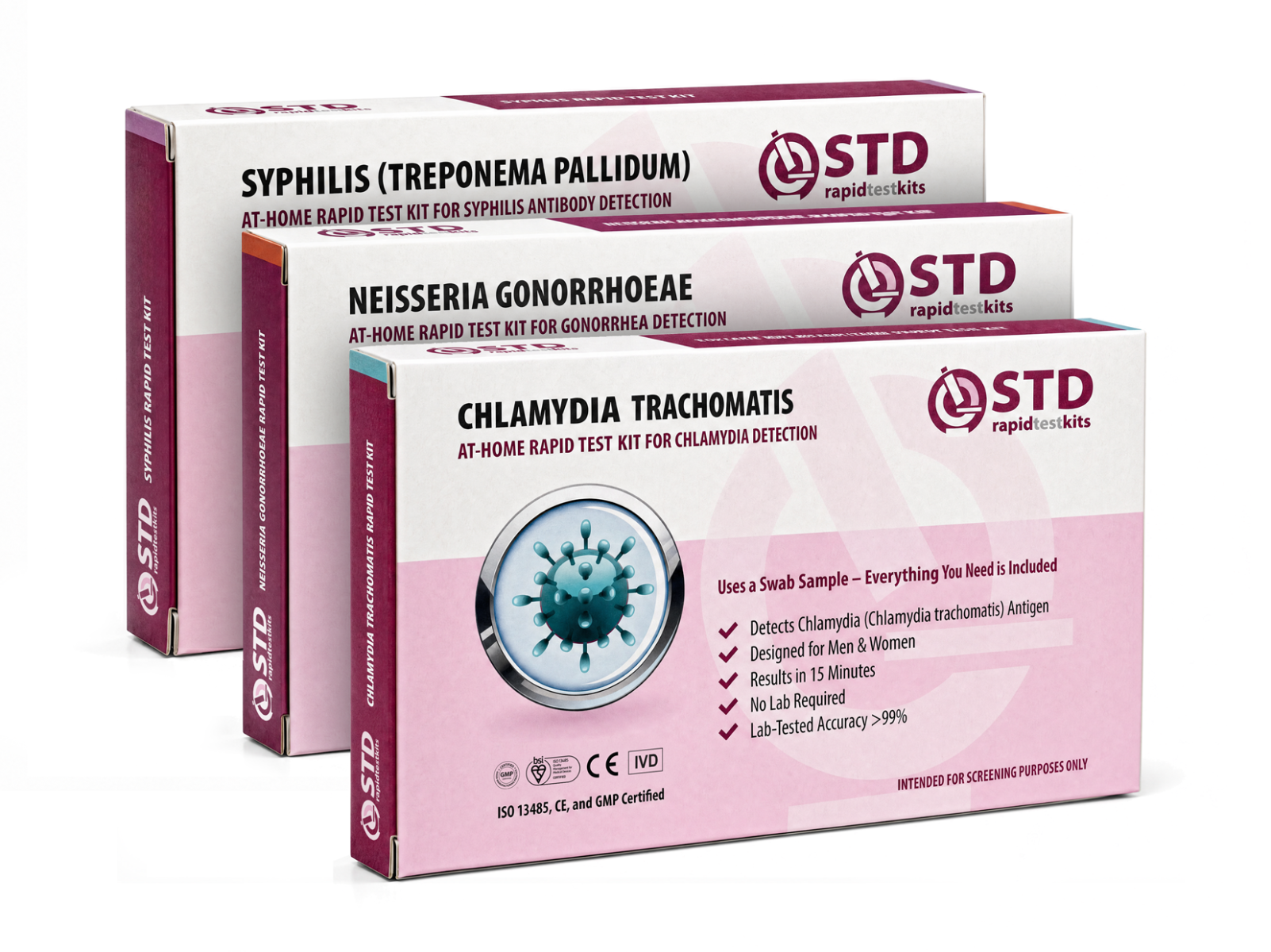
If something feels off and you cannot get to a clinic immediately, home testing closes the gap. STD Rapid Test Kits offers single-infection and combination panels that ship discreetly and return results at home. The value of testing comes from doing it before symptoms force the issue.

FAQs
- Can I really get an STI if I am locked the entire time?
- Yes. The cage prevents penetrative sex by the wearer. It does not prevent oral exposure, skin-to-skin contact, shared-toy transmission, or contact with a partner's fluids on uncovered skin. Most common STIs spread through routes that have nothing to do with whether the wearer can get an erection or penetrate.
- How often should I be testing if I wear a cage long-term?
- If you are sexually active with one or more partners, test every 3 to 6 months as a baseline. Test sooner if you have a new partner, attend a kink event, share toys, or notice any change during an unlock. The cage does not change the testing frequency, but the reduced visibility makes sticking to a schedule more important.
- Is some discharge normal while wearing a cock cage?
- A small amount of clear or slightly milky fluid from arousal or normal urethral secretions can appear, especially with prolonged stimulation. Colored discharge (yellow, green, brown), thick or pus-like discharge, or any discharge that smells strongly is not normal. Colored or odorous discharge is a reason to test promptly for chlamydia, gonorrhea, and trichomoniasis.
- Can I test for STIs without taking the cage off?
- Blood-based tests (HIV, syphilis, hepatitis B and C, HSV antibodies) can be done while locked because they only need a fingerstick. Swab-based and urine-based tests for chlamydia and gonorrhea need an unlock to collect a clean sample. A few hours of decompression before sampling produces a more reliable result.
- What is the riskiest mistake chastity wearers make around STIs?
- Attributing every new symptom to the device. Cage-related irritation does exist, but burning during urination, ulcers, persistent itching, and odor changes deserve a real investigation rather than the default explanation of pressure or friction. Misattribution lengthens the time between onset and treatment.
- I am in a closed relationship. Do I still need regular testing?
- Once both partners have tested negative and the relationship is genuinely closed, routine retesting is less critical. Testing remains useful at the start of a new relationship, after any concern, and on a longer cadence (annually or every two years) as a baseline. If either partner has had any exposure outside the relationship, return to a 3 to 6 month rhythm until both have re-tested clean.
- Can the cage itself cause an infection?
- The cage does not introduce STIs on its own, but it can create conditions that allow non-STI infections (yeast, bacterial balanitis, urinary tract infections) and that worsen any existing skin injury. Trapped sweat, limited airflow, and microtears from rubbing are the main culprits. Daily cleaning and regular full removals are the strongest counter-measures.
- Are there specific STIs I should worry more about while caged?
- The infections most easily missed under a device are the ones that present on uncovered skin or with subtle symptoms: herpes (often a single small ulcer that is hidden under hardware), syphilis (a painless chancre that resolves on its own and is easy to miss), and silent chlamydia or gonorrhea that may produce only a trace of discharge. Routine screening catches these before they progress.
- U.S. Centers for Disease Control and Prevention. Sexually transmitted infections: overview of common infections, symptoms, and screening recommendations.
- U.S. Centers for Disease Control and Prevention. Genital herpes fact sheet and transmission information, including asymptomatic viral shedding.
- U.S. Centers for Disease Control and Prevention. Chlamydia screening and treatment guidelines, including test-of-reinfection recommendations.
- National Health Service (NHS). Balanitis: causes, symptoms, and hygiene-related risk factors for inflammation of the glans.
- U.S. Centers for Disease Control and Prevention. STI treatment guidelines and partner services information for people diagnosed with a sexually transmitted infection.
- World Health Organization. Fact sheets on sexually transmitted infections, screening, and the public-health importance of asymptomatic detection.