At-Home STD Tests: How Accurate They Are, How They Work, and What Results Mean
Rapid cassette vs mail-in lab kits: accuracy, timing, and reading results.
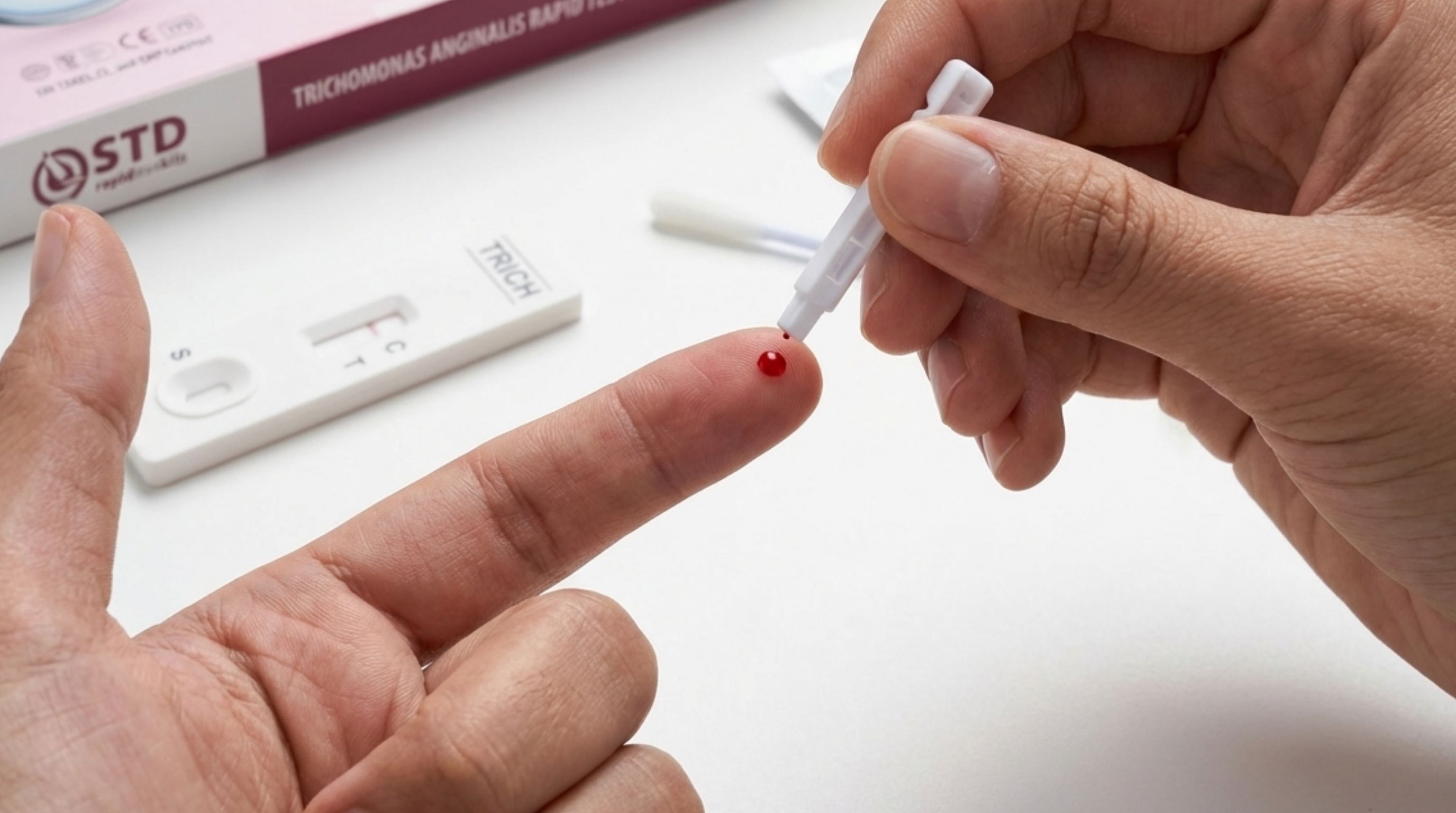



- Rapid at-home STD tests achieve up to 99% accuracy when used after the correct window period; mail-in kits add broader panels in exchange for 2-5 day waits at a CLIA-certified lab.
- Testing too early after exposure produces a false negative regardless of test quality. Chlamydia needs 14 days; hepatitis C needs 8-11 weeks; HIV needs a 12-week confirmatory retest for full certainty.
Published: October 2025 | Last updated: May 2026 | Editorial review and quality control: Martina N.
How do at-home STD tests work, and are they accurate?
At-home STD tests come in two forms: rapid cassette tests that read a result in 10 to 20 minutes, and mail-in kits a lab processes in 2 to 5 days. Both reach up to 99% accuracy for the infections they cover, as long as you test after the correct window period and follow the collection steps exactly.
At-home STD testing has become one of the most important shifts in sexual health access in recent memory. What used to require a clinic appointment, a waiting room, and a conversation you weren't ready to have now happens in your bathroom, on your schedule, with results in minutes or days depending on the type of kit you use. As the market has expanded, so has the confusion, partly because "at-home STD testing" now covers two meaningfully different technologies that most people, and most articles, treat as the same thing. They aren't. Understanding which type you're using, and why it matters, is the difference between a result you can trust and one that leaves you with more questions than you started with.
The short version: both types of at-home STD tests work. Both are highly accurate when used correctly and at the right time after an exposure. What differs is how they work, how quickly they deliver results, and which infections each type covers most reliably. The longer version, which includes the science, the timing, the sample-collection mechanics, and exactly what to do with whatever result you get, follows below.
Key Takeaways
- Rapid at-home STD tests achieve up to 99% accuracy when used after the correct window period; mail-in kits add broader panels in exchange for 2-5 day waits at a CLIA-certified lab.
- Testing too early after exposure produces a false negative regardless of test quality. Chlamydia needs 14 days; hepatitis C needs 8-11 weeks; HIV needs a 12-week confirmatory retest for full certainty.
Rapid Cassette Tests vs. Mail-In Lab Kits: Not the Same Thing
Search "at-home STD test" and almost every result you find will be about mail-in kits: services like Everlywell, myLAB Box, or LetsGetChecked, where you collect a sample at home and mail it to a certified laboratory for analysis. Results come back in two to five days via an app or email. These are legitimate, accurate, and widely used. They are also only one category of at-home STD testing, and for many people, not the most practical one.
The other category, rapid cassette tests, works differently. You collect your sample, apply it to a test device, and read a result in ten to twenty minutes. No mailing or third-party lab involved; the entire process happens at home, in real time. This is the technology used in hospital emergency departments for rapid diagnostics, in HIV clinics for same-day results, and increasingly by people who need an answer today rather than next week. The category gets less coverage in brand-comparison content that dominates search results, which leaves most readers underinformed about a technology that most directly removes every logistical barrier to testing.
Both technologies have legitimate clinical uses and strong accuracy profiles. The choice between them comes down to what you need: rapid cassette testing for immediate results and maximum privacy with no shipping or lab involvement; mail-in testing for broader infection panels or when you prefer laboratory confirmation as the first step. This guide covers both, with particular attention to rapid testing, since that is where most guides leave readers without enough information.
| Feature | Rapid Cassette Test | Mail-In Lab Kit |
|---|---|---|
| Time to results | 10-20 minutes | 2-5 business days |
| Lab involvement | None, result read at home | CLIA-certified lab processes your sample |
| Technology | Lateral flow immunoassay | NAAT / PCR / ELISA depending on infection |
| Privacy | Maximum, no sample leaves your home | High, discreet shipping, but sample is mailed |
| Infections covered | All major STIs (see Table 2) | Varies by panel; typically broader on less common infections |
| Accuracy range | Up to 99% for covered infections, per kit IFU | Up to 99%+ depending on infection and collection quality |
| Best for | Immediate results, maximum privacy, couples testing together | Broader panels, laboratory confirmation, some insurance coverage |
How Each Technology Works
You're in your bathroom, holding the kit, and the instructions are telling you to apply a blood drop to a cassette or mail a swab to an address you've never heard of. What's happening inside either of those processes is worth understanding, because it explains why accuracy figures vary by infection, why timing matters so much, and why following the collection instructions exactly is the single most important thing you can do for a reliable result.
Rapid cassette tests use a method called lateral flow immunoassay. When you apply your sample (a blood drop from a finger prick, a vaginal or cervical swab, or a urethral swab depending on the infection), it travels along a nitrocellulose membrane coated with specific antibodies engineered to bind to the target infection's proteins or to the antibodies your immune system has produced in response to infection. If the target is present in your sample, it binds to those antibodies and creates a visible colored line on the test strip. One line means negative (the control line confirms the test ran correctly). Two lines mean positive. The reaction completes in ten to twenty minutes and happens entirely within the device, with no external processing required. This is the same immunoassay technology used in emergency-department rapid diagnostics; the form factor differs, the underlying science is the same.
Mail-in lab kits typically use more sensitive molecular methods. For bacterial infections like chlamydia and gonorrhea, most lab kits use Nucleic Acid Amplification Testing (NAAT), a technique that amplifies trace amounts of the pathogen's genetic material until it reaches a detectable threshold. The U.S. Preventive Services Task Force identifies NAAT as the preferred screening method for chlamydia and gonorrhea because of its high sensitivity and broad specimen flexibility. It can sometimes detect infections a few days earlier in the window period than an immunoassay can. For blood-based infections like HIV, syphilis, and hepatitis, labs typically use ELISA (enzyme-linked immunosorbent assay), an antibody and antigen detection method that requires laboratory equipment to process but achieves very high accuracy rates. Modern fourth-generation HIV ELISA detects both p24 antigen and HIV antibodies, closing the early-window gap. For syphilis, labs run a non-treponemal screen (RPR or VDRL) and confirm reactive results with a treponemal test like TP-PA or FTA-ABS.
Once a mail-in sample reaches the lab, its first stop is called accessioning. Technicians scan the barcode, log it into the lab information system, confirm the right test was ordered, and inspect for leaks, broken tubes, or mislabels. Samples that fail this check get a recollection request rather than a guessed result. Cleared samples route to the right department: molecular diagnostics for NAAT, serology for antibody and antigen tests, microbiology where bacterial culture is needed. From there, automated workflows take over inside a tightly controlled pipeline.
The practical implication of these differences is small for most real-world testing scenarios. If you test after the window period has closed and follow the collection instructions correctly, both technologies deliver highly reliable results. The sensitivity gap becomes clinically meaningful only when testing very close to the edge of a window period, and in those situations the safer move is waiting a few more days and retesting.
Your sample travels along a membrane coated with antibodies tuned to the target infection. If the target is present, it binds and creates a visible colored line. One line (control only) = negative. Two lines (any intensity) = positive. Reaction completes in 10-20 minutes, with no lab involved.
Which Infections Can You Test for at Home?
At-home rapid testing covers all ten of the most clinically significant STIs: chlamydia, gonorrhea, syphilis, HIV 1 and 2, oral herpes (HSV-1), genital herpes (HSV-2), hepatitis B, hepatitis C, HPV (for women), and trichomoniasis (for women). That list covers the vast majority of what sexually active people need to screen for. Combo kits combine multiple tests into a single collection session: six, seven, eight, or ten infections in one panel.
There are limitations worth knowing upfront. HPV testing at home is currently validated for women only; the available test detects the high-risk HPV strains (16 and 18) associated with cervical cancer using a vaginal swab, and there is no equivalent validated home test for men. Trichomoniasis rapid testing at home is similarly validated for women only. Throat and rectal infections (gonorrhea in the throat from oral sex, or rectal chlamydia from anal sex) require site-specific swabbing that home kits don't cover; if you've had oral or anal exposure specifically, clarify this with a clinic. Mycoplasma genitalium, an emerging STI increasingly linked to urethritis and pelvic inflammatory disease, is not yet covered by most rapid home kits. Herpes testing at home is most sensitive during or shortly after an active outbreak when viral load is highest; blood-based antibody tests in the same kit will detect past infection but cannot pinpoint whether that infection is currently active or resolved.
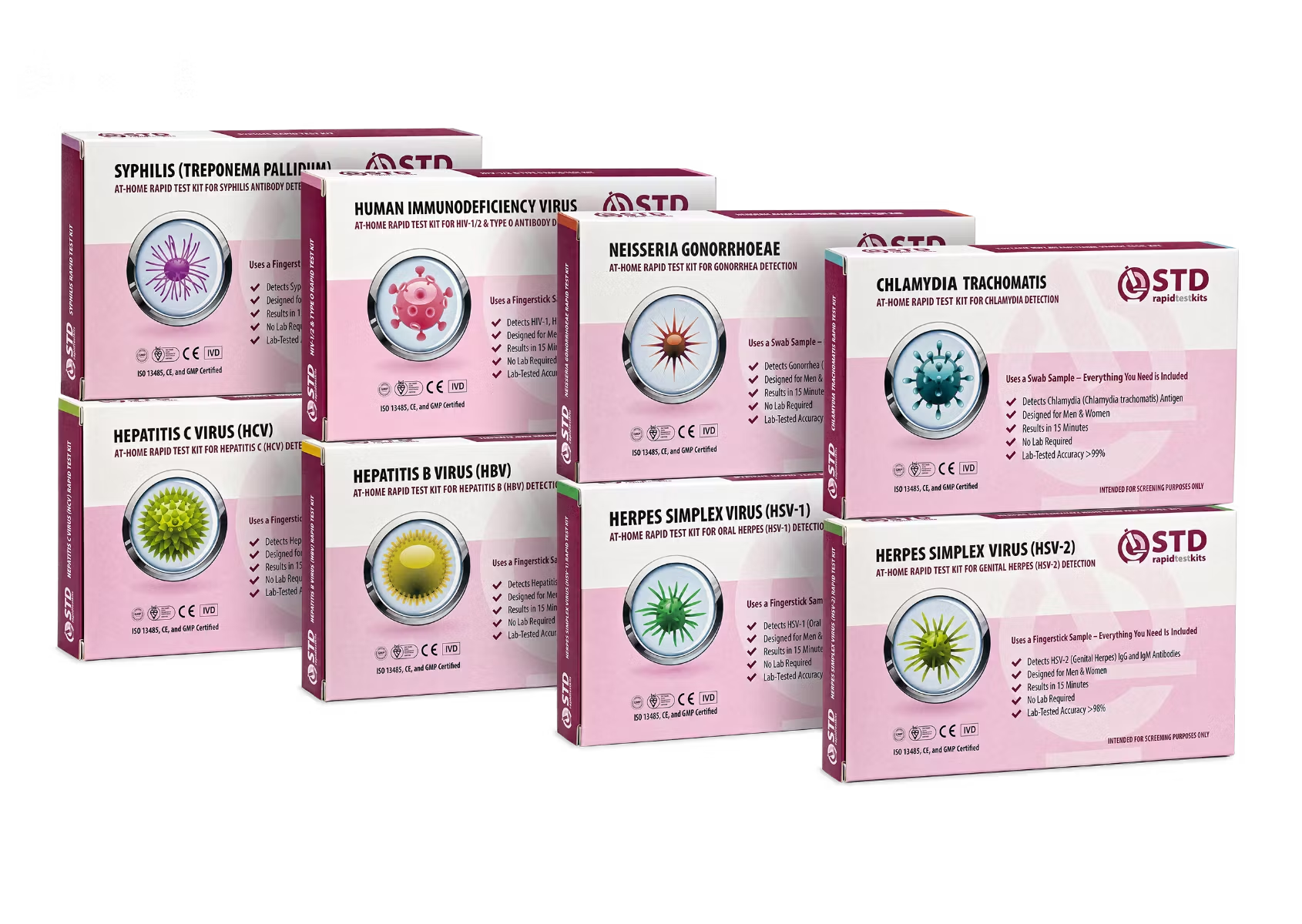
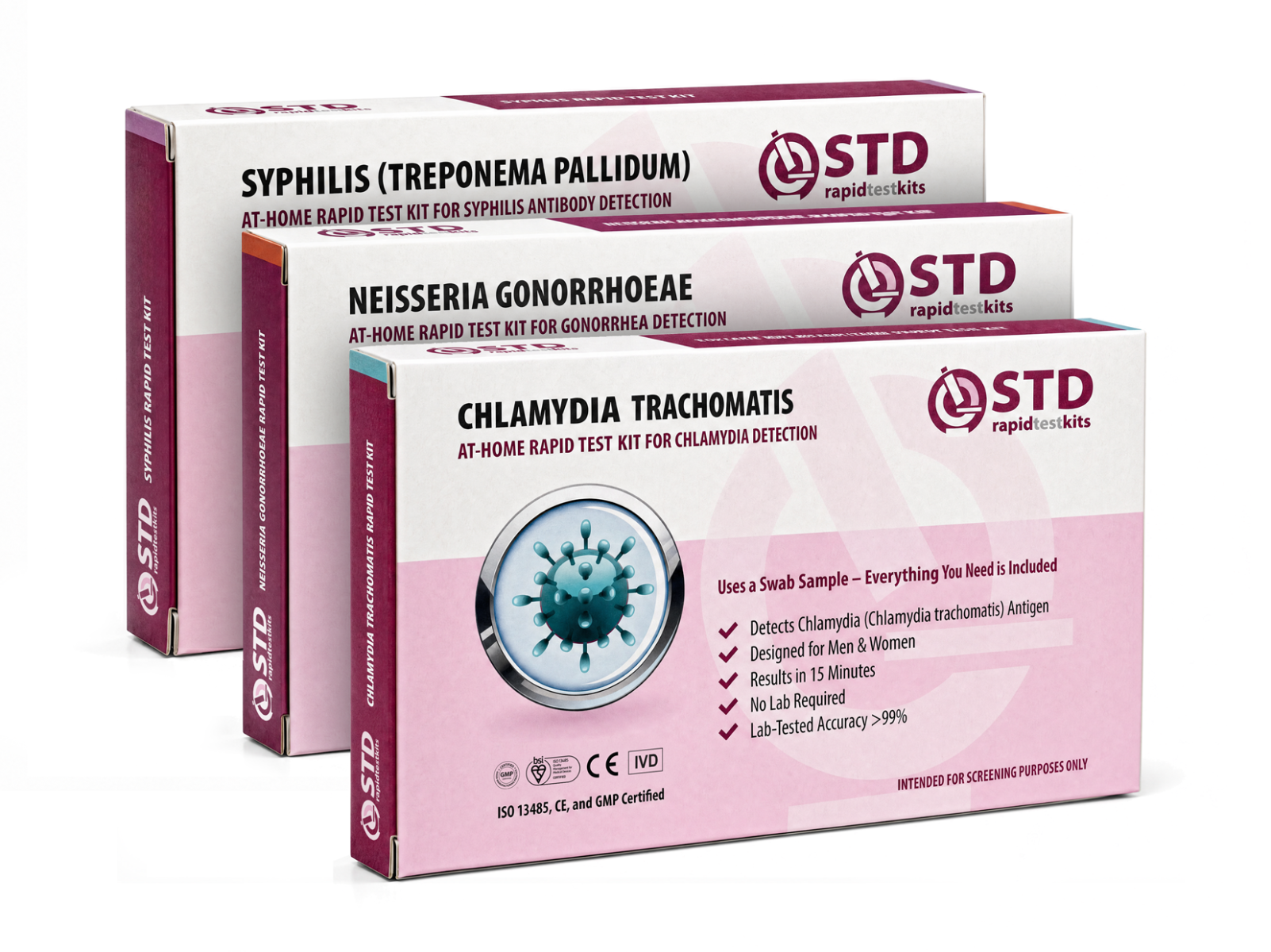
Across single-infection tests and combo panels, our at-home STI test kits cover all ten infections, with multi-test panels (such as the 8-in-1 for men and women, and the women's 10-in-1) bundling several into a single private session.
| Infection | Rapid Test Available? | Sample Type | Key Consideration |
|---|---|---|---|
| Chlamydia | Yes | Vaginal or urethral swab | Test from 14 days post-exposure |
| Gonorrhea | Yes | Urethral or vaginal swab | Throat/rectal exposure may need clinic |
| Syphilis | Yes | Finger-prick blood | Confirm positive with clinical test |
| HIV 1 & 2 | Yes | Finger-prick blood | Retest at 12 weeks for certainty |
| Herpes HSV-1 | Yes | Finger-prick blood | Most sensitive during active outbreak |
| Herpes HSV-2 | Yes | Finger-prick blood | Most sensitive during active outbreak |
| Hepatitis B | Yes | Finger-prick blood | Test from 6 weeks post-exposure |
| Hepatitis C | Yes | Finger-prick blood | Longest window: 8-11 weeks |
| HPV (high-risk strains) | Yes, women only | Vaginal swab | No validated home test for men |
| Trichomoniasis | Yes, women only | Vaginal swab | No validated rapid home test for men |
How Accurate Are At-Home STD Tests? What the Research Says
The accuracy question is the one most people want answered, and the one most content handles vaguely. Here is the research-grounded version. Rapid at-home STD tests for the major infections perform comparably to clinic-based immunoassay testing when used correctly after the window period has closed. The peer-reviewed literature converges on a consistent finding: when samples are collected correctly and tests are timed appropriately, home-based STD testing performs comparably to clinical testing.
A randomized controlled trial published in Sexually Transmitted Infections, one of the most-cited studies in this field, found that self-collected vaginal swabs demonstrated 91.9% sensitivity for chlamydia and 100% sensitivity for gonorrhea, with 99.8% specificity for both. A separate review published in Current Opinion in Infectious Diseases showed home-based STI screening achieved markedly higher uptake than clinic-based screening, including 1.57 times higher rates of testing while asymptomatic. This second finding matters enormously: the infections that do the most silent damage are the ones caught only by people who test without waiting for symptoms to appear.
Accuracy in STD testing has two dimensions. Sensitivity measures how reliably a test catches real infections (a highly sensitive test produces few false negatives). Specificity measures how reliably it avoids false positives (a highly specific test rarely flags an infection that isn't there). Good rapid tests optimize for both. For exact per-kit sensitivity and specificity figures, check the product page or instructions for use of the specific test you order; these vary by assay and are validated independently for each infection. For HIV specifically, blood-based rapid tests achieve sensitivity above 99% after the window period in published evaluations, comparable to laboratory-processed results.
Behind every reliable home result is a chain of quality controls. U.S. labs that process mail-in STD samples must be certified under the Clinical Laboratory Improvement Amendments (CLIA), which set federal standards for personnel qualifications, instrument calibration, sample handling, and proficiency testing. Lab batches include known positive and negative control samples to confirm the assay is performing within tolerance, and borderline results are repeated to rule out random error. The two variables that meaningfully affect accuracy in practice, and that are entirely within your control, are timing and technique. Testing within the window period produces a false negative because the biology has not reached detectable levels yet; the kit functions correctly, the infection simply has not accumulated enough markers for any test to identify. Testing with an inadequate sample (not enough blood on the strip, a swab that didn't reach the correct anatomical site, or contamination from other fluids) compromises the result regardless of kit quality. Reading the full collection instructions before you begin is the single most impactful thing you can do for result reliability.
Editorial disclosure: this guide is published by stdrapidtestkits.com, which sells at-home STI testing kits. Product references below are chosen for fit with reader concerns, not for commercial benefit alone.
In 2024, the combined cases of chlamydia, gonorrhea, and syphilis decreased 9% compared with 2023, marking the third consecutive year of combined decline.
Testing Windows: The Most Important Variable Nobody Explains Clearly
You've just had an exposure you're not sure about. The instinct is to test immediately, to know right now. That instinct is biologically counterproductive, and acting on it produces a result that tells you nothing useful. Every infection requires time to reach detectable levels in your body: either the pathogen itself needs to replicate to a threshold the test can identify, or your immune system needs time to mount the antibody response the test is looking for. Testing before that window closes means the test has nothing to find, and a negative result in that scenario is meaningless rather than reassuring.
This is a feature of human immunology. An HIV test performed two days after exposure is asking a question the biology cannot yet answer; the test itself is fine, the timing makes it useless. HIV detection in particular varies by test generation: per the CDC HIV testing guidance, a lab NAAT can detect viral nucleic acid roughly 10 to 33 days after exposure, a fourth-generation antigen-antibody ELISA detects p24 antigen and antibodies in the 18 to 45 day range, and antibody-only tests can take up to 90 days. The correct response to an anxiety-driven urge to test immediately is to mark your calendar for when the window period ends. If you genuinely cannot wait, you can test now as a baseline, but plan to retest once the relevant window has passed and treat the interim negative as provisional rather than conclusive.
| Infection | Test From | Why the Window Exists | Retest Recommended? |
|---|---|---|---|
| Chlamydia | 14 days after exposure | Bacterial load takes ~2 weeks to reach detectable levels | No, if negative after 14 days and no new exposure |
| Gonorrhea | 3 weeks after exposure | Bacterial antigen load at the urethral or vaginal sample site takes approximately 3 weeks to reach the threshold detectable by lateral-flow antigen testing | No, if negative after 3 weeks and no new exposure |
| Syphilis | 6 weeks after exposure | Antibody production to Treponema pallidum develops slowly | Consider retest at 3 months if high-risk exposure |
| HIV 1 & 2 | 6 weeks after exposure (first indicator) | Immune response to HIV develops over weeks; p24 antigen detectable earlier than antibodies | Yes, retest at 12 weeks for definitive certainty |
| Herpes HSV-1 & HSV-2 | 6 weeks (earliest; sensitivity rises by 12-16 weeks) | IgG antibodies to HSV take 4-6 weeks to first appear and can keep rising for 12-16 weeks | Consider retest at 12-16 weeks if initial negative but symptoms present |
| Hepatitis B | 6 weeks after exposure | Surface antigen (HBsAg) becomes detectable by 6 weeks post-exposure | No, if negative after 6 weeks and vaccinated; yes if unvaccinated |
| Hepatitis C | 8-11 weeks after exposure | Longest antibody development window of the major infections | Yes, negative before 11 weeks should be confirmed at 6 months |
Should You Test Now, or Wait for the Window to Close?
After a worrying exposure, the urge is to test immediately. Whether that is actually useful depends on how long it has been and whether you have symptoms. Use the quick flow below as a starting point, then confirm the exact timing for your situation against the window-period table above.
Should You Test Now, or Wait?
Do you have new symptoms right now, such as unusual discharge, sores, burning when you urinate, or pelvic pain?
Yes: Test now and contact a provider. Symptoms deserve prompt evaluation regardless of the window period, and some need a physical exam a home kit cannot provide.
Has it been at least 14 days since the exposure you are worried about?
Yes: You can test reliably for chlamydia and gonorrhea now. For HIV, syphilis, and hepatitis, plan a follow-up test once their longer windows close.
Has it been 12 weeks (about 3 months) since the exposure?
Yes: Every major window period has closed. A negative across your panel now is a reliable answer with no retest needed unless there is a new exposure.
No: Test now as a baseline if waiting is hard, then retest after 12 weeks to be sure. Treat the early negative as provisional, not a clearance.
Guidance only. A healthcare provider can advise based on your specific exposure and symptoms.
Reading Your Results: What Each Outcome Means
One practical note before getting into result interpretation: if you've had unprotected sex with a partner multiple times over several weeks, use your most recent exposure as the starting point for the window-period calculation. And for HIV specifically, the 6-week test is a strong first indicator that catches the majority of true positives, while the 12-week retest is the definitive standard that closes any remaining uncertainty.
Reading a rapid test result is where most people's confidence collapses, and the cause is usually unfamiliarity with the rules rather than ambiguity in the result itself. Two minutes of context here prevents misreading in both directions.
A negative result (one line visible on the strip) means the test did not detect the target infection in your sample at the time of testing. If you tested after the full window period has passed, a single-line negative is highly reliable. If you tested within the window period, a negative is provisional: the test found nothing detectable at this moment, which is different from being clear. A negative result also tells you nothing about infections the specific test doesn't cover. If you used a single-infection chlamydia test, you have no information about gonorrhea, syphilis, HIV, or anything else. This is the most compelling argument for multi-infection combo panels: a negative across eight or ten infections tested simultaneously is a meaningfully different level of reassurance than a single-infection negative.
A positive result (two lines on the strip) means the test detected the target infection in your sample. Two lines mean positive regardless of how faint the second line is. A faint positive line is still a positive. The intensity of the line reflects the concentration of the target in your sample, separate from the certainty of the detection. At this point, the next step depends on the infection. For bacterial STIs (chlamydia, gonorrhea, syphilis), a clinical confirmation test and treatment prescription are the immediate priorities. For viral infections (HIV, herpes, hepatitis), a positive rapid result begins a medical conversation; it is a confirmed signal that warrants follow-up with a healthcare provider. The guide on what to do when your home STD test comes back positive covers the next steps in full.
Mail-in lab kits introduce two additional result categories worth knowing. A reactive result, common on HIV and syphilis screens, means a screening signal was present but is not yet a confirmed diagnosis pending a more specific follow-up assay. An indeterminate or equivocal result means the signal is real but too weak for the assay to call confidently, usually resolved by a different, more specific test. Both labels exist so a careful clinician can make the right next-step call; resist interpreting them yourself.
An invalid result (no lines at all, or lines appearing in the wrong positions) means the test did not run correctly. This is almost always a sample collection issue: insufficient blood on the strip, a swab applied incorrectly, or a kit stored outside its recommended temperature range. Treat invalid results as meaningless rather than negative. Retest with a new kit, re-read the collection instructions carefully, and pay particular attention to the control line. If that line doesn't appear, the test cannot be trusted in either direction.
Reading your result at a glance
- One line (control only) = negative. Reliable after the full window period; provisional within it.
- Two lines (any intensity) = positive. A faint second line counts. Follow up with a healthcare provider.
- No control line = invalid, not negative. Retest with a new kit and re-read the collection instructions first.
How Your Result Reaches You, and Why to Double-Check a Negative
With a rapid cassette test, the result is the set of lines on the strip in front of you, so there is no delivery step to wait on. Mail-in kits return results through a secure online portal or encrypted email, usually within two to five business days, and clinic tests may come back by portal, by phone, or at an in-person visit. Before a lab result reaches you, it is reviewed by a laboratory scientist or physician, and positive results often arrive with counseling and next-step instructions, including a treatment plan or referral.
The one habit worth building is to confirm a negative rather than assume it. Many clinics use a no-news-is-good-news policy, which quietly depends on the result actually being filed and delivered. Lost paperwork, portal-delivery glitches, and missed phone calls are documented sources of unreported results. Log in or call to verify your outcome, and for at-home mail-in services, check that the result loaded to your account before you treat the testing as finished.
A no-news-is-good-news policy only works if your result was actually filed and sent. Log in to the patient portal or call the clinic to verify your outcome rather than assuming silence means negative. For at-home mail-in kits, confirm the result posted to your account, and remember that a negative taken inside the window period is provisional until you retest after the window closes.
After a Positive Result: The Practical Sequence
A positive at-home STD test is medical information, and medical information, however uncomfortable, is always better than its absence. Panic and paralysis are the two least useful responses to that information. What follows is the practical sequence broken down by infection type.
For bacterial infections (chlamydia, gonorrhea, and syphilis), a positive rapid result should be confirmed by a healthcare provider with a clinical-grade test before treatment begins. Confirmation matters because prescribing treatment requires a clinical-grade result, and false positives on syphilis tests in particular occur occasionally due to cross-reactivity with certain autoimmune conditions or other infections. Once confirmed, all three bacterial STIs are curable. Chlamydia and gonorrhea typically clear completely with the correct antibiotic course. Syphilis is fully treatable at every stage, with outcomes that improve significantly with earlier detection. Partner notification is also part of this step: everyone with a recent sexual contact needs the same information and the same opportunity to test and treat. Many U.S. states and the UK NHS sexual-health clinics offer anonymous partner-notification services if you don't want to make the conversation yourself.
For viral infections (HIV, herpes HSV-1 or HSV-2, hepatitis B, hepatitis C), a positive result opens a medical management conversation rather than a medical emergency. HIV in 2026 is a chronic condition that is highly manageable with treatment; people diagnosed early and treated consistently live life expectancies comparable to the general population. Herpes, which the WHO estimates affects roughly 64% of people under 50 globally for HSV-1 and 13% (520 million people aged 15-49) for HSV-2, is manageable with antiviral medication that reduces both outbreak frequency and transmission risk. Hepatitis C is now curable in the majority of cases with a short course of direct-acting antivirals, making early detection one of the highest-value interventions in all of infectious-disease medicine.
1. Avoid unprotected sexual contact until you have clarity on your status. 2. Contact a healthcare provider for clinical-grade confirmation before any treatment begins (especially for syphilis, where false positives occasionally occur). 3. Notify recent sexual partners so they have the same opportunity to test and treat. 4. Save your kit packaging and the result image if your provider asks to see it.
At-Home vs. Clinic Testing: A Genuinely Honest Comparison
There's a version of this comparison that exists primarily as a disclaimer, where an article acknowledges at-home testing's merits before quietly steering readers toward a clinic. The framing here is different. At-home rapid testing and clinic-based testing are genuinely different tools with different strengths, and the right choice depends on your specific situation rather than a general hierarchy of medical prestige.
At-home rapid testing wins on every dimension where access and privacy are the primary concerns. No appointment, no waiting room, no paperwork in a shared medical system, no conversation with a provider you didn't choose. Results in minutes, with no sample leaving your home. For the significant proportion of people whose barriers to testing are practical (stigma, privacy concerns, cost, transportation, or scheduling), at-home testing removes every one of them simultaneously. A randomized controlled trial comparing home and clinic-based STI screening found that women in the home testing group completed significantly more total tests, and 1.57 times more tests while asymptomatic, than those in the clinic group. The public-health outcome that matters comes from increased testing volume, regardless of where the test is administered.
Clinic-based testing has genuine advantages in specific situations: when you need a comprehensive panel covering infections beyond the major ten, when visible symptoms need physical examination, when you need to test specifically for throat or rectal infections, or when a positive rapid result requires clinical confirmation before treatment. A clinic also offers immediate access to treatment and in-person counseling, useful for some people and unnecessary for others. Cost and insurance handling differ too: clinic testing is often covered by insurance, but the explanation of benefits may surface on a shared plan, which can be a privacy issue. Title X clinics across the U.S. offer confidential, sliding-scale-fee STI testing regardless of ability to pay, and many county public-health departments run free HIV and syphilis testing days. At-home kits offer transparent flat pricing and discreet shipping; the trade-off is paying upfront rather than running it through insurance.
The practical framework: for routine screening after new or multiple partners, for peace of mind after an unprotected exposure, or for couples establishing baseline status together, at-home rapid testing covers the ground completely and does so with fewer barriers than any alternative. For confirmatory testing, physical examination, or coverage of unusual exposures, a clinic adds value that home testing cannot replicate.
| Situation | At-Home Rapid Test | Clinic Visit |
|---|---|---|
| Routine screening after new partner | Ideal: faster, private, no appointment | Also fine, but adds friction |
| Peace of mind after unprotected exposure | Ideal once window period has passed | Available, but not faster |
| Stigma, privacy, or scheduling barriers | Significantly better; removes all three | May create or reinforce barriers |
| Confirming a positive rapid result | Not sufficient alone for treatment | Required for prescription and treatment |
| Visible sores, unusual discharge, or pain | Test at home, then also seek a provider | Physical examination needed |
| Throat or rectal exposure specifically | Limited; clarify with kit instructions | Site-specific swabbing more reliable |
| Couples testing together | Ideal: mutual, private, simultaneous | Logistically harder to coordinate |
| Mycoplasma genitalium or uncommon STIs | Not covered by most rapid kits | Broader infection panel available |
Getting Your Sample Right: The Steps That Decide Result Quality
Nothing slows or wastes a test like a poorly collected sample, and rejection is more common than most people realize. The kit instructions exist for one reason: every variable they specify (urine volume, swab depth, blood-drop size, temperature range) maps to a value the assay was validated against. Drift outside that range and the chemistry stops behaving predictably.
For self-collected swabs, do not douche, use strong soaps, or apply ointments to the area in the hours before collection, since residue can interfere with the assay. Insert the swab to the depth the instructions specify and rotate for the full count; a shallow swipe collects too few cells. For fingerstick blood, warm your hands under hot water first, hydrate, and let the lancet draw freely without milking the finger, which dilutes the sample with tissue fluid. Fill to the indicated line on the dropper or strip, not less. For mail-in urine collection, aim for the first portion of the stream (the first-catch) and avoid urinating for at least an hour beforehand to keep the sample concentrated.
Mail or hand off your sample the same day you collect it whenever the kit allows. Bacterial DNA on a swab and certain antibodies in a blood tube remain stable only within the kit's specified temperature range. A swab left in a hot mailbox for two days can produce a false negative even when the infection is genuinely present. If you cannot ship the same day, store the sealed kit in a cool, dry place out of direct sunlight and ship the next morning.
1. Leaky or unsealed containers. A swab cap that pops off or a urine cup that is not screwed tight contaminates the specimen.
2. Wrong collection volume or timing. Urine collected right after a recent bathroom trip, or a fingerstick that produced a single drop instead of filling the line, both fall outside the assay's validated input.
3. Mismatched or missing labels. A barcode that does not scan or a name that does not match the order form forces the lab to discard the sample. Double-check the label before you seal the bag.
Who Should Test, How Often, and Which Kit to Start With
The CDC recommends annual STD screening for all sexually active people under 25, and for adults over 25 with new or multiple partners. That recommendation sets the floor for screening frequency. The ceiling is whatever your exposure pattern justifies. If you've had unprotected sex with a new partner, experienced a condom failure, received a notification from a previous partner, or have any symptoms without an obvious explanation, each one is an independent reason to test outside your regular schedule.
The population that benefits most from accessible at-home testing is the one that currently tests least: people who know they should be tested but face real barriers to doing so. Stigma, geographic access, cost compared to a clinic visit, and the practical friction of scheduling an appointment during working hours are real obstacles. The CDC reports STI rates declining for three consecutive years in its latest provisional data. The trajectory matters: more accessible testing options correlate with more people who otherwise would have skipped the conversation getting tested at the right time.
When to Test Outside Your Routine Schedule
- The CDC recommends at least annual STD screening for all sexually active people under 25, and for adults over 25 with new or multiple partners.
- Test after unprotected sex with a new partner, once the relevant window period has passed.
- Test after a condom failure, or if a previous partner notifies you that they tested positive.
- Test promptly if you have unexplained symptoms such as unusual discharge, sores, or burning when you urinate.
FAQs
- What's the difference between a rapid at-home STD test and a mail-in kit?
- A rapid cassette test gives you results in 10-20 minutes at home using lateral flow immunoassay technology, the same method used in hospital rapid diagnostics. A mail-in kit has you collect a sample and send it to a CLIA-certified lab, with results typically back in 2-5 days via app or email. Mail-in kits often use NAAT or PCR methods that have slightly higher sensitivity at the very edge of window periods; rapid tests offer immediate results with no sample leaving your home. Both are accurate for the infections they cover when used after the appropriate window period.
- How soon after sex can I test for STDs?
- The answer depends entirely on the infection. The shortest window is for chlamydia, detectable from 14 days after exposure. Gonorrhea takes 3 weeks; syphilis, HIV, herpes, and hepatitis B all take 6 weeks as a first indicator; hepatitis C takes 8-11 weeks. Testing immediately after an exposure, before any window has closed, produces a false negative regardless of test quality. The biology needs time to reach detectable levels. Mark your calendar for the correct window date and test then.
- Are at-home STD tests really as accurate as clinic tests?
- For the major infections, yes, when you test after the window period and follow the collection instructions. The accuracy gap between home and clinic testing is smaller than most people expect. The bigger variable is timing, not the location of the test. If your sample is collected correctly and the window has closed, the same immunoassay chemistry runs the same way whether the test is read in your bathroom or in a hospital triage room. Mail-in kits route to the same CLIA-certified labs that clinicians use, so the underlying analysis is identical.
- What does a faint second line on a rapid test mean?
- It means positive. The intensity of the line reflects the concentration of the target in your sample, separate from the certainty of the detection itself. Any visible second line, however faint, should be treated as a positive and followed up with a healthcare provider for clinical confirmation. A faint line is a positive result.
- Can an at-home STD test give a false positive?
- It's uncommon with high-quality kits, but it can happen, most notably with syphilis tests, which can occasionally cross-react with certain autoimmune conditions or other infections. This is why a positive rapid result should be confirmed clinically before treatment begins. A false positive treated as definitive means you may receive medication you don't need; confirmation protects against that. A false negative from testing within the window period is more common than a false positive and more likely to cause real harm by providing false reassurance.
- What happens after a positive result at home?
- For bacterial infections (chlamydia, gonorrhea, syphilis): contact a healthcare provider to confirm the result and get a treatment prescription; all three are curable with the right course of antibiotics. For viral infections (HIV, herpes, hepatitis B or C): a positive result starts a management conversation. All four are treatable; hepatitis C is now curable in the majority of cases. In all cases, avoid unprotected sexual contact until you have clarity on your status, and notify recent partners so they have the same opportunity to test and treat that you do.
- If I tested negative, do I need to retest?
- Only if your window period hasn't fully closed. A negative after the full window period for all infections on your panel is a reliable negative, with no retest required unless there's a new exposure. For HIV specifically, a 12-week confirmatory retest is the definitive standard even after a negative at 6 weeks. For hepatitis C, a negative result before 11 weeks should be confirmed at 6 months. For all others, a post-window negative is a genuine negative.
- Are my at-home STD test results confidential?
- Yes. Both at-home and clinic-based tests are protected by privacy laws like HIPAA in the U.S. Rapid lateral-flow kits keep the entire process inside your home, with no result reported anywhere. Mail-in kits report to you through a secure portal; reportable positive results for HIV, syphilis, gonorrhea, and chlamydia go to public health for treatment support and voluntary contact tracing, with privacy protections built in.
The Guessing Game Ends When You Test
Most people who should be testing aren't. The barrier is usually logistical: every version of testing they know about comes with friction that the situation already makes hard enough. At-home rapid testing removes that friction. There's no appointment to schedule, no waiting room to sit in, no paperwork to fill out, and no sample leaving your home. Results arrive in twenty minutes, in your own space. For many people, this is the difference between testing and not testing at all.
A negative result after a full window period is a reliable answer; a positive result gives you the information you need to act, and most STIs are curable or highly manageable when caught early. Whichever panel fits your situation, the guide below points you to a sensible starting kit.
Which Kit Should You Start With?
Are you worried about one specific recent exposure and want the most common bacterial STIs covered?
Yes: Start with a 3-in-1 chlamydia, gonorrhea, and syphilis rapid kit, and test once each infection's window period above has passed.
Do you want a single private session that screens for the broadest set of infections?
Yes: Choose an 8-in-1 panel (for men and women) or a women's 10-in-1 panel, and mark your earliest valid testing date on the calendar before you order.
Are you testing together as a couple?
Yes: Order separate kits, time them to the same window, and read the results together.
No: Order early so the kit arrives before your window date, and confirm any negative taken inside the window with a retest once the window closes.
Guidance only. Match the panel to your exposure, and test after the relevant window period closes.
Our article was constructed based on current advice from the most prominent public health and medical organizations, and then molded into simple language based on the situations that people actually experience, such as treatment, reinfection by a partner, no-symptom exposure, and the uncomfortable question of whether it "came back." In the background, our pool of research included more diverse public health advice, clinical advice, and medical references, but the following are the most pertinent and useful for readers who want to verify our claims for themselves.
- U.S. Centers for Disease Control and Prevention. Sexually Transmitted Infections Surveillance 2024 (Provisional). Reports a 9% combined decline in chlamydia, gonorrhea, and syphilis cases from 2023, the third consecutive annual decline.
- U.S. Centers for Disease Control and Prevention. HIV testing recommendations, window-period guidance (NAAT 10-33 days, fourth-generation antigen-antibody 18-45 days, antibody-only up to 90 days), and screening interval policy.
- U.S. Preventive Services Task Force. Recommendation on chlamydia and gonorrhea screening, with NAAT identified as the preferred test method.
- U.S. Centers for Disease Control and Prevention. Clinical Laboratory Improvement Amendments (CLIA) program, the federal standards for laboratory testing performance and quality control in the United States.
- Cook RL, et al. Home screening for sexually transmitted diseases in high-risk young women: randomised controlled trial. Sexually Transmitted Infections, 2007. Reports 91.9% sensitivity for chlamydia and 100% for gonorrhea on self-collected vaginal swabs, with 99.8% specificity for both.
- World Health Organization. Herpes simplex virus fact sheet. Estimates 64% global prevalence of HSV-1 in adults under 50, and 13% (520 million people aged 15-49) for HSV-2.