
Published: September 2025 | Last updated: April 2026 | Editorial review and quality control: Martina N.
A new red spot near the vulva is one of those small discoveries that can rocket from “huh” to “what if” in about ninety seconds. The internet does not help. The midnight rabbit hole pulls you toward the scariest possible diagnosis, even when the most likely cause is the new razor sitting on your bathtub.
Here is the calmer version. Red bumps and spots in the genital area come from a wide range of sources, and the majority are not sexually transmitted. Ingrown hairs, contact dermatitis, yeast irritation, and folliculitis cause far more red marks than herpes or syphilis ever will. The catch is that some patterns do point to an STI, and a few are worth catching early. This article walks through how to tell the difference, when an at-home test is the right move, and when to skip the kit and book a clinic visit instead.
Are red spots on the vagina always a sign of an STI?
No. Most red spots and bumps in the vulvar area come from non-STI causes: ingrown hairs, contact dermatitis, yeast irritation, or friction. STI-related lesions do exist (herpes blisters, syphilis chancres, HPV warts, molluscum bumps), and they tend to follow specific exposure timelines and have distinct shapes. If a spot persists past a week, blisters and weeps, recurs in the same place, or appears anywhere from a few days (herpes) to several weeks (syphilis, molluscum) after unprotected sex, an STI test is the only way to be certain.
Key Takeaways
- Most red spots near the vulva are not STIs. Ingrown hairs, contact dermatitis, and yeast irritation are far more common than herpes, syphilis, or HPV.
- A spot that blisters, recurs in the same place, or appears days to weeks after unprotected sex needs a test. An at-home blood or swab kit is a private way to confirm or rule out the most likely STI causes.
What red spots actually look like, by cause
People often describe genital red spots as if every cause looks the same. They do not. The shape, the timing, and what the spot does in the next few days carry most of the diagnostic information. Below is a comparison gallery that shows the most common patterns side by side. None of these images replace a clinician’s look, and none of them are good for self-diagnosis on their own. They are useful for narrowing down what category of cause you might be dealing with so you can decide how urgent the next step is.
Two anchor points to keep in mind while you read. First, blisters that pop into open shallow ulcers in a cluster strongly suggest genital herpes, especially if a tingling or burning came first. Second, a single round painless ulcer with a firm raised border is the textbook look of a primary syphilis chancre and warrants prompt clinical evaluation, because syphilis is treatable with one or a few injections in the early stage but progresses if untreated.
STIs that actually cause red spots near the vulva
Four sexually transmitted infections account for nearly every STI-related red spot in the vulvar area. Each has its own typical look, timeline, and best testing approach.
Genital herpes (HSV-1 or HSV-2). The classic presentation is a small cluster of clear-fluid blisters that pop into shallow open ulcers, often with prodromal symptoms (the warning sensations of tingling, burning, or itching that arrive a day or two before the bumps show). The first outbreak is usually the most severe; subsequent reactivations tend to be smaller and shorter. According to the CDC herpes overview, most people with genital herpes do not know they have it because their symptoms are mild or mistaken for something else. When symptoms do appear, the typical first-outbreak window is within a few days to two weeks of the exposure that caused them.
Primary syphilis. A primary syphilis lesion (called a chancre) is a single round painless ulcer with a firm raised border, usually 1 to 2 centimeters wide. In women the chancre often forms inside the vaginal canal or on the cervix where it cannot be seen, which is one reason syphilis is so often missed in the primary stage. Per the CDC syphilis overview, the infection develops in four stages (primary, secondary, latent, tertiary). The chancre typically appears within the first few weeks of exposure, then heals on its own in 3 to 6 weeks even without treatment, before the infection moves into a secondary stage with a body rash.
HPV genital warts. The strains of human papillomavirus that cause genital warts (mostly types 6 and 11) produce small flesh-colored or pale-pink soft bumps that can be flat or slightly raised, sometimes textured like cauliflower. They are usually painless and may itch. The cancer-causing strains of HPV are different from the wart-causing ones; per the WHO cervical cancer fact sheet, HPV types 16 and 18 alone cause about 76% of cervical cancers worldwide. Screening for these high-risk strains is done by cervical swab rather than by visual exam.
Molluscum contagiosum. A pox-family virus that causes small, pearl-like raised pink or flesh-colored bumps with a tiny dimple in the center. It can be sexually transmitted in adults but is also spread by skin-to-skin contact in non-sexual settings. The CDC molluscum overview notes that lesions typically resolve over months without treatment, often within six months to a year.
Two infections worth noting that almost never cause visible red spots themselves: chlamydia and gonorrhea. Both can cause mild irritation, increased discharge, or burning with urination, but neither produces the kind of bump or sore most people picture when they search for an answer. They are still worth testing for after any unprotected exposure because they often have no symptoms at all in women.
Non-STI causes (the ones most people land on)
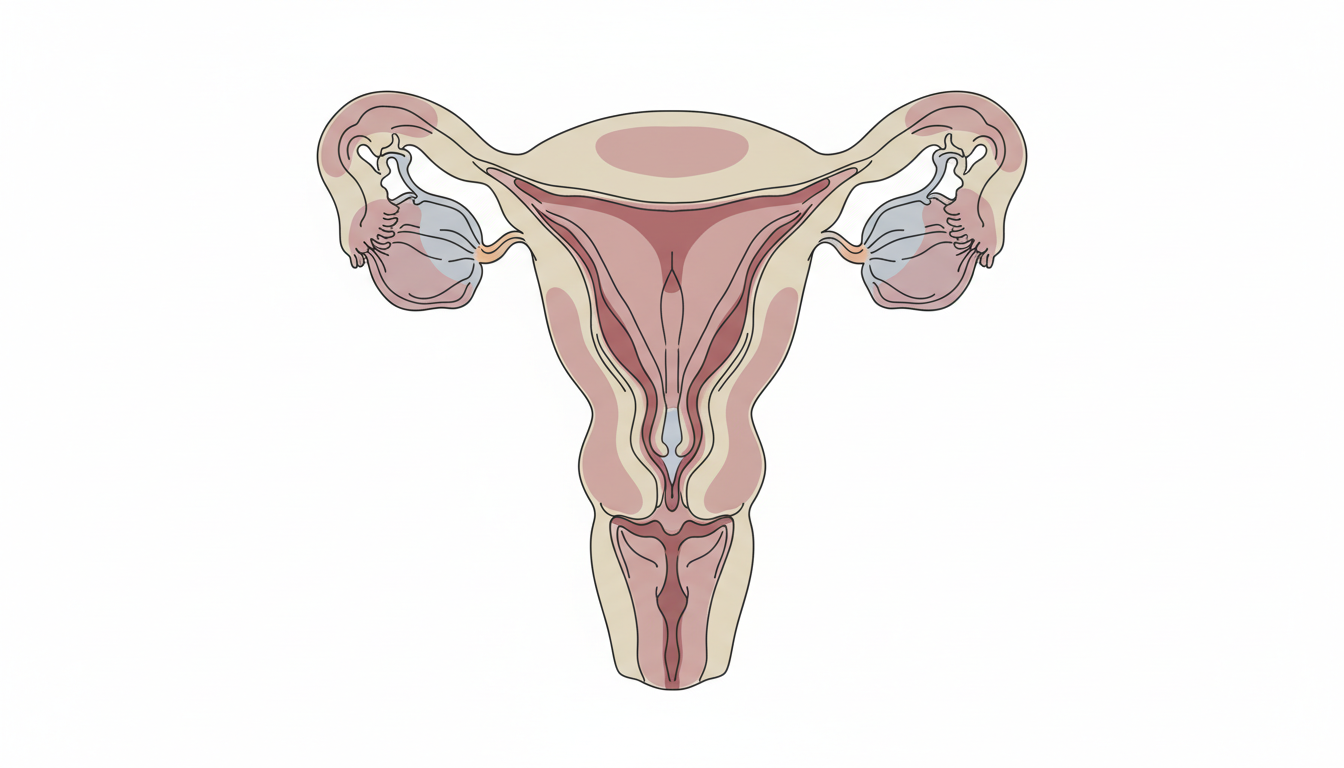
Before you assume the worst, walk through this list. The majority of red spots near the vulva belong to one of these categories.
Folliculitis and ingrown hairs. The single most common cause of red bumps on the bikini line and outer labia. Shaving or waxing nicks the hair, the hair grows back into the follicle, and the follicle becomes inflamed and red. Often tender, sometimes pus-filled. According to Cleveland Clinic guidance on folliculitis, mild cases generally clear with home care: warm compresses, antibacterial cleansers, and not shaving the area while it heals.
Contact dermatitis. An itchy red rash triggered by something the skin reacted to: a new laundry detergent, scented panty liners, a fragranced wash, latex condoms, or even residue from a partner’s skincare product. Symptoms typically appear within hours to a day or two of exposure and resolve once the trigger is removed. The pattern is usually diffuse redness rather than discrete bumps.
Yeast irritation. A vaginal yeast infection often produces a thick white discharge along with redness and itching of the surrounding skin. The redness comes partly from the inflammation and partly from scratching. Mayo Clinic guidance on yeast infections notes that they often follow a course of antibiotics, hormonal shifts during the menstrual cycle, or pregnancy.
Eczema, psoriasis, and lichen sclerosus. Chronic skin conditions can show up in the genital area as red itchy patches or pale shiny patches that come and go. These typically need a clinician to diagnose because they look like other things and respond to specific topical treatments rather than antifungals or antibiotics.
Pubic lice and scabies. Both cause intense itching with small red bites or burrow tracks, and both spread through close skin contact (sometimes sexual, sometimes not). Pubic lice are sexually transmitted in most adult cases. Scabies, an infestation of tiny mites, spreads through prolonged skin contact and is treated with prescription topical scabicide. The intense nighttime itch is the giveaway clue.
Friction and bug bites. Underwear seams, cycling, sweaty workouts, or unfamiliar friction during sex can produce red marks that look alarming and resolve within a few days without any treatment.
If a single red bump appeared the day after you shaved, sits on a hair follicle, and is gone within a week, you can skip the testing step. The same goes for diffuse itching that started the day after switching detergent and stops once you switch back. Save the at-home kit for the patterns that do not match a clear non-STI explanation.
Quick decision table: STI pattern or skin pattern?
Use this as a sorting tool, not a diagnosis. If your spot matches an STI row, plan to test. If it matches a non-STI row, watch it for a week. Either way, anything that does not heal within 10 to 14 days is worth a clinician’s look.
| Pattern | What it looks like | Painful? | Timing | Best next step |
|---|---|---|---|---|
| Genital herpes | Cluster of small fluid-filled blisters that pop into shallow ulcers | Often, with tingling first | First outbreak typically within a couple of weeks of exposure | Lesion swab if active, blood antibody after 12 weeks |
| Primary syphilis | Single round firm painless ulcer | No | Typically within the first few weeks of exposure | Clinic for treponemal blood test and treatment |
| HPV warts | Soft flesh-colored bumps, sometimes cauliflower-textured | Usually no | Weeks to months | Clinic for visual diagnosis and removal options |
| Molluscum | Small raised pink bumps with central dimple | No | Variable, often weeks after contact | Clinic for visual diagnosis |
| Folliculitis | Single red bump centered on a hair follicle | Tender | Hours to days post-shave | Warm compress, stop shaving the area |
| Yeast irritation | Diffuse redness with thick white discharge and itching | Itching, sometimes burning | Variable | OTC antifungal trial, clinician swab if recurrent |
| Contact dermatitis | Diffuse red itchy patches, sometimes scaly | Itchy | Hours to days after a new product | Stop the product, resolves in 1 to 2 weeks |
When to test, and which test to use
Three questions decide whether an at-home test is the right tool: what infection you are screening for, how long it has been since the suspected exposure, and what kind of sample the test needs.
Herpes (HSV-1, HSV-2). A blood antibody test detects the immune response that builds up after infection. The window period is 12 weeks for most people, with some taking longer to seroconvert. If you have an active lesion, a swab sent to a lab is more sensitive than antibody testing during a first outbreak, because antibodies have not had time to build up yet.
Syphilis. A treponemal antibody blood test (the specific blood marker for syphilis) is reliable from about 6 weeks after exposure and remains positive for life once you have had syphilis (even after successful treatment). For an active suspected chancre, see a clinician promptly, because primary syphilis treatment with a single penicillin injection is more effective the earlier it is given.
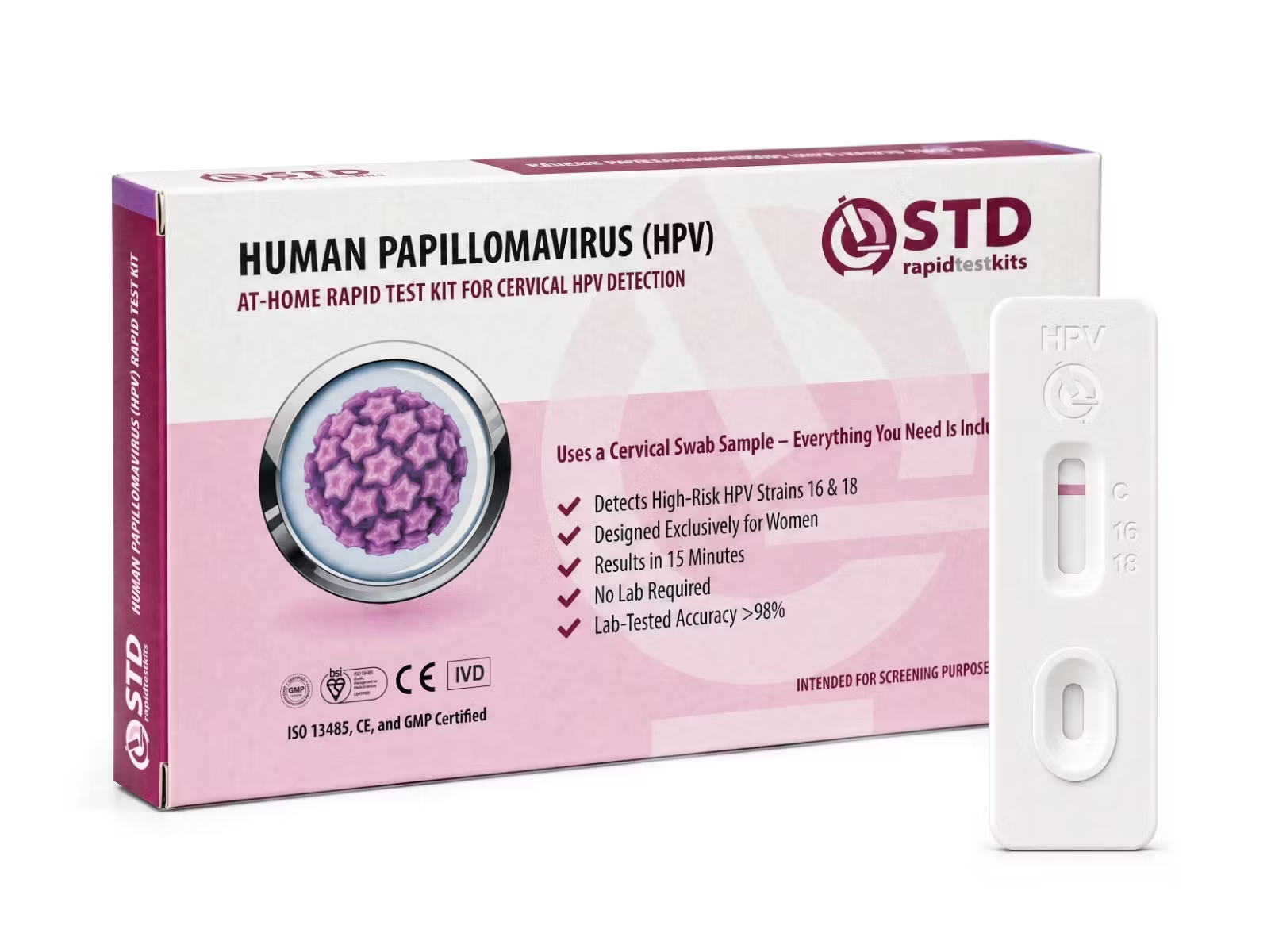
HPV. Visible warts are diagnosed by clinical visual exam, not by a home kit. Our vaginal-swab HPV test screens for the high-risk HPV strains associated with cervical cancer (mostly 16 and 18), which is a separate question from whether you have the wart-causing low-risk strains. Both questions are worth answering, but a home kit can only answer one of them.
Molluscum. Diagnosed by clinical visual exam. There is no home test, and most lesions clear without treatment over months.
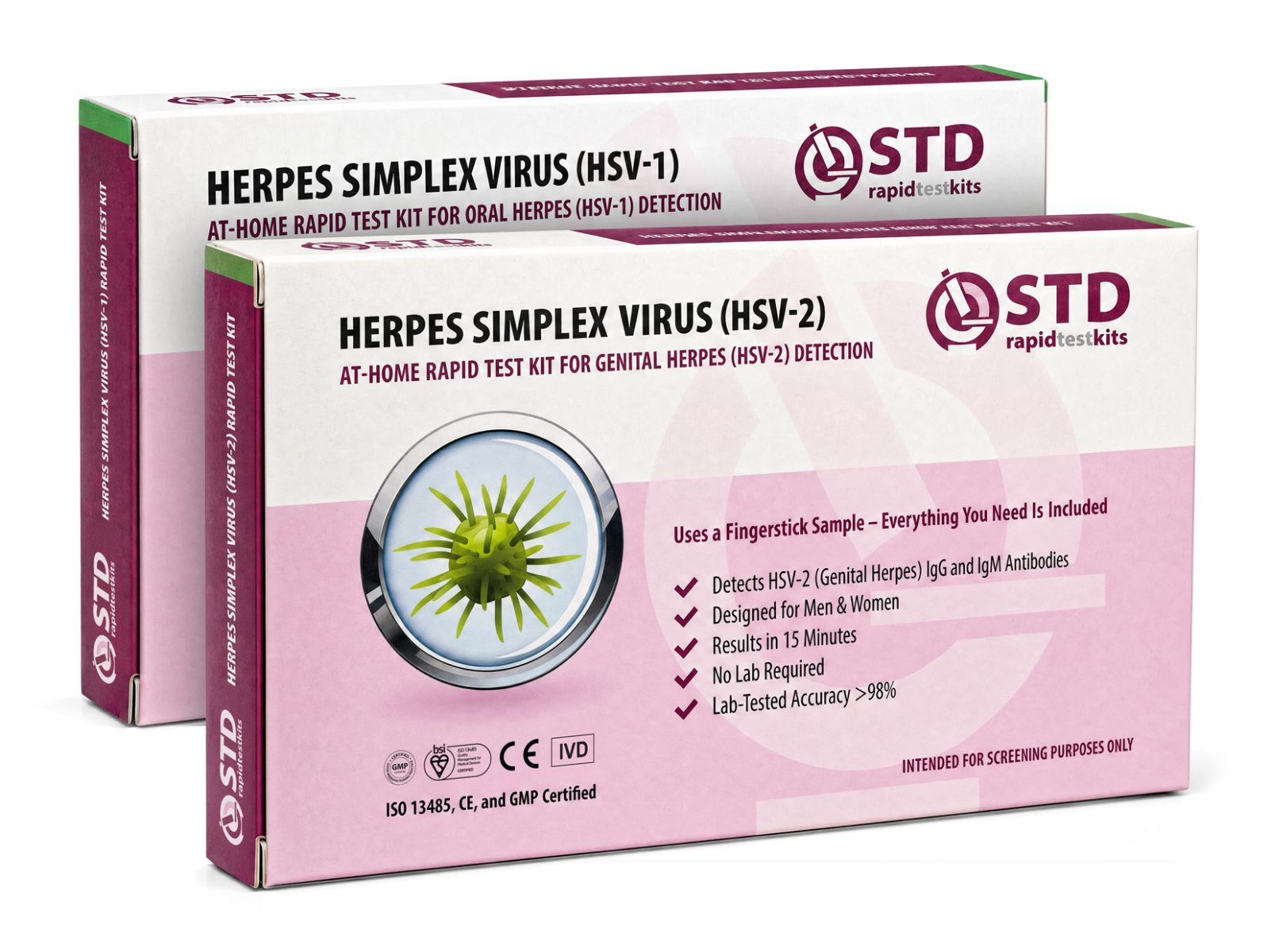
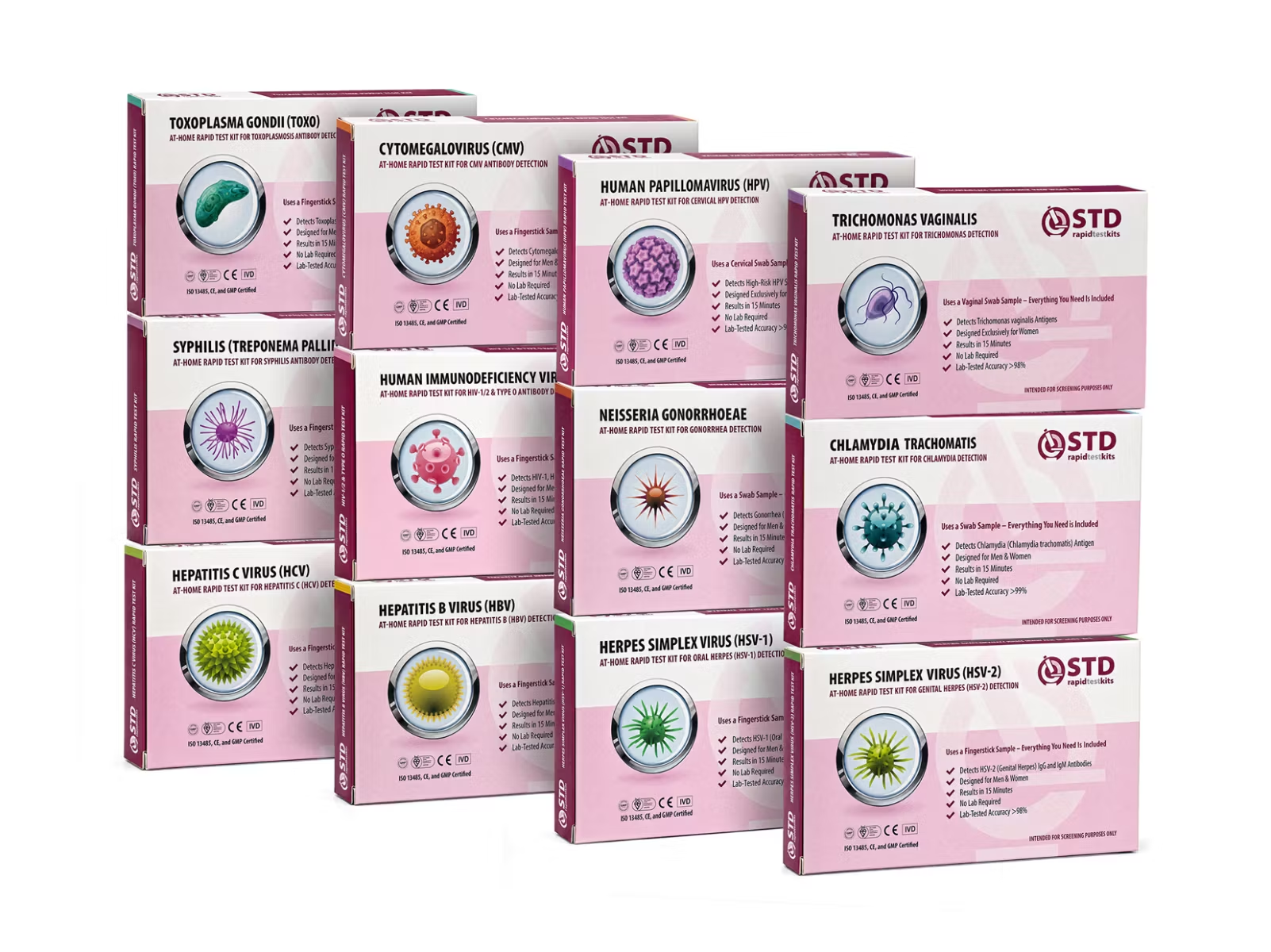
This article is published by stdrapidtestkits.com, which sells at-home rapid test kits. We recommend products that fit a reader’s actual concern, not whichever kit is closest to the topic. The herpes blood test below is the right tool for someone wondering whether a recurrent or healing genital lesion is HSV. The 10-test combo at the end is the right tool for someone who wants to clear the full menu after an unprotected exposure.
What at-home rapid tests can and cannot tell you
Our at-home kits are lateral-flow rapid tests, not lab NAAT or PCR. The two technologies are complementary rather than equivalent, and knowing the difference helps you choose right.
What lateral-flow rapid tests do well. Detect a positive result quickly, privately, and without a clinic visit, after the relevant window period has passed. Antibody-based blood tests for HIV, syphilis, hepatitis B, hepatitis C, and herpes are all lateral-flow chemistry, and they perform well at picking up the immune response once it has built up. Self-collected swab tests for chlamydia, gonorrhea, trichomoniasis, and HPV use the same sample type a lab would, with lateral-flow detection chemistry on the strip.
What rapid tests do not replace. Two situations call for a lab or clinic instead of a home kit. The first is testing within the window period: if you took the test too soon after exposure, a negative result does not yet rule out the infection, and you need to retest after the window closes. The second is conditions that are diagnosed visually rather than by sample: HPV warts, molluscum bumps, and active herpes lesions during a first outbreak are all assessed more reliably by a clinician’s eye and sometimes a lesion swab sent to a reference lab.
A positive at-home result is also worth confirming. Lateral-flow chemistry can occasionally produce false positives, especially for low-prevalence infections, and a confirmatory lab test gives you a second data point before you start treatment.
Go to a clinic, urgent care, or sexual-health service rather than testing at home if any of the following apply: a single painless ulcer that might be a syphilis chancre (treatment is most effective early), an active blistering outbreak you suspect is herpes (a lesion swab during the active phase is more sensitive than a blood antibody test), visible warts that need removal, fever with the genital symptoms, swollen tender lymph nodes in the groin, severe pelvic pain, or any spot that has not healed in 14 days.
What a clinician will check for
If you do go to a clinic with red spots, the workup is fairly predictable. The provider will ask about timing (when did the spot appear), context (recent shaving, new products, new partners, last unprotected sex), associated symptoms (fever, discharge, itching, pain), and any previous similar episodes. They will then look at the spot. The combination of where it sits, what shape it has, whether it weeps fluid, and whether nearby lymph nodes are swollen narrows the differential quickly.
Lab tests follow the visual exam. A swab of an active lesion can be sent for HSV PCR (a lab test that detects herpes virus DNA directly from a lesion swab; the gold-standard herpes test for active outbreaks), and the same swab can be checked for bacterial co-infection. A blood draw checks for syphilis (RPR or treponemal antibody), HIV, and hepatitis. A vaginal swab or urine sample tests for chlamydia and gonorrhea. If the rash does not look like infection, a small skin biopsy can rule out lichen sclerosus, eczema, or other dermatologic conditions.
You can collect many of these same samples at home with a rapid lateral-flow kit. The tradeoff is speed and privacy at home versus higher analytical sensitivity at a lab. For most reassurance-driven testing after a known exposure, a home kit gives a useful answer; for a specific active lesion or a positive home result you want confirmed, the clinic is the right next stop.
Have a rough timeline ready: when the spot appeared, when your last unprotected sexual encounter was, what (if anything) changed in your products or shaving routine, whether you have other symptoms (fever, discharge, swollen lymph nodes), and whether the spot has changed shape or size in the days since you noticed it. The visit goes faster when this information is organised before you walk in.
What happens if you ignore an STI
The hardest pitch to make for testing is the silent infection. None of the STIs in this article hurt your day-to-day life immediately. The cost of ignoring them is paid quietly, sometimes years later.
Herpes. Untreated herpes is uncomfortable but not dangerous in most adults. The bigger issue is transmission: HSV sheds asymptomatically a meaningful fraction of the time, so partners can be exposed even between visible outbreaks. Daily suppressive antiviral therapy reduces both outbreak frequency and the rate of asymptomatic shedding, which is why a confirmed diagnosis is worth having.
Syphilis. The four-stage progression of untreated syphilis is the clearest example in sexual health of why early diagnosis matters. Primary and secondary syphilis are easily treatable. Latent and tertiary syphilis can damage the cardiovascular system, the nervous system, and other organs years after the original exposure. A single positive blood test catches it in the easy-to-treat window.
HPV. Most HPV infections clear on their own within 1 to 2 years. The fraction that persist and involve high-risk strains can progress to cervical, vulvar, vaginal, anal, or oropharyngeal cancer over a decade or more. Routine cervical screening (Pap or HPV test) catches the precancerous changes long before cancer develops, which is why screening guidelines exist even for women with no symptoms.
Chlamydia and gonorrhea (often missed because they cause no visible spots). Untreated, both can ascend to the upper reproductive tract and cause pelvic inflammatory disease, scarring of the fallopian tubes, chronic pelvic pain, and tubal-factor infertility. The asymptomatic course is exactly what makes these infections so consequential when missed.
Most people who have genital herpes do not know it because they have no symptoms or only mild symptoms. Symptoms, when they occur, can include painful blisters or open sores in the genital area.
Your step-by-step action plan
If you have just noticed something and you are reading this with one hand on your phone and the other on a hand mirror, here is the practical sequence.
Five steps from spot to answer
- Note the timing. When did it appear, and how does that line up with your last unprotected sexual encounter? STI bumps follow predictable windows; a bump that appeared the morning after you shaved is almost certainly not an STI.
- Do not pop, scratch, or treat blindly. Squeezing a lesion can spread a viral infection, scar the skin, and complicate diagnosis. Skip OTC antibiotic ointments unless a clinician prescribed one.
- Match the pattern to the table above. If your spot matches an STI row, plan to test. If it matches a non-STI row, watch it for 7 to 10 days.
- Test from home if the pattern fits a screen-from-home infection (herpes, syphilis, chlamydia, gonorrhea, trichomoniasis, HPV, HIV, hepatitis). Use a kit that covers what you actually want to rule out.
- Go to a clinic if you have a single painless ulcer, an active blistering outbreak, visible warts, fever, severe pain, or any spot that has not healed in 14 days.
Myths worth clearing up
Five things people believe about genital red spots that are not true.
“If it does not hurt, it is not an STI.” Painlessness actually makes a syphilis chancre or HPV warts more likely than a herpes outbreak (which usually does hurt). Whether a lesion hurts or not tells you very little about its cause.
“Red bumps are always from shaving.” Folliculitis is the most common cause, but it resolves within a week or two. A bump that lingers, recurs in the same place, or weeps fluid has moved beyond simple folliculitis.
“You cannot get herpes if there is no visible outbreak.” Herpes sheds asymptomatically. A partner can transmit HSV between outbreaks, and a meaningful share of new herpes infections come from partners who did not know they were infected.
“If my partner has no symptoms, they are clear.” Most STIs are asymptomatic in most carriers most of the time. Symptoms are the exception, not the rule. The only reliable way to know either of you is uninfected is for both partners to test.
“I am in a long-term monogamous relationship, so it cannot be an STI.” A primary HSV outbreak can occur years after the original infection, particularly under stress or hormonal change. HPV can persist subclinically for a decade before producing warts. A new lesion in a long-term relationship does not automatically prove recent infidelity. It is, however, a reason to test, because some non-STI causes look similar.
The painless-equals-harmless idea is the riskiest of these. Syphilis, HPV, and chlamydia are all routinely silent for months. Waiting until something hurts is exactly how the disease progresses to a stage that is harder to treat. A recent unprotected exposure plus any new lesion deserves a test, even if you feel fine.
Frequently asked questions
- Can red spots on my vagina mean herpes?
- The most reliable pattern is a cluster of bumps that comes back in the same spot. A single bump on a hair follicle that resolves and never returns is almost certainly not herpes. Confirmation requires a blood antibody test 12 weeks after the suspected exposure, or a swab of an active lesion sent to a lab during a visible outbreak.
- What if my red spot is not painful?
- Painless does not equal harmless. Primary syphilis presents as a single round painless ulcer, and HPV warts are typically painless. The CDC syphilis overview specifically notes that the chancre is one of the reasons primary syphilis is missed in women, where it often sits inside the vaginal canal and goes unnoticed.
- Could it just be from shaving or a new soap?
- Often, yes. Folliculitis from ingrown hairs is the most common non-STI cause of red bumps in the bikini area, and contact dermatitis from a new soap, detergent, or scented product is close behind. Both usually clear with home care: a warm compress, removing the irritant, and not shaving the area while it heals.
- How long after sex do STI bumps usually appear?
- It varies by infection. Herpes blisters typically appear within a few days to two weeks after exposure (with the first outbreak often the most severe). A primary syphilis chancre typically appears within the first few weeks after exposure. HPV warts can take weeks to months. Molluscum bumps often take weeks after the contact that caused them.
- Can I test for these STIs at home?
- Yes for most of them. A rapid blood-antibody test detects herpes, syphilis, HIV, and hepatitis after the relevant window period. Our vaginal-swab HPV kit screens for high-risk HPV strains, and combo kits cover chlamydia, gonorrhea, and trichomoniasis. Visible warts and molluscum bumps are diagnosed by visual exam, so see a clinician for those specifically.
- Should I pop a bump or treat it with a cream?
- No on the popping. Squeezing a vulvar bump risks scarring, secondary bacterial infection, and spreading a viral lesion. On creams, OTC antifungal cream is reasonable if you suspect yeast (thick discharge, diffuse itching). Skip antibiotic ointments unless a clinician prescribed one, and skip home remedies (essential oils, garlic) entirely.
- What about the same bump coming back in the same spot?
- That pattern points to genital herpes. HSV reactivates along the same nerve pathway it used the first time, so recurrent outbreaks tend to appear in roughly the same area. Pimples and ingrown hairs come and go randomly across the bikini line.
- When should I skip the home test and go straight to a clinic?
- Go to a clinic if you have a single painless ulcer that might be a syphilis chancre (early treatment is more effective), an active blistering outbreak (a lesion swab during the active phase is more sensitive than a blood antibody test), visible warts that need removal, any spot accompanied by fever or swollen lymph nodes, or anything that has not healed in 14 days.
- U.S. Centers for Disease Control and Prevention. About Genital Herpes overview, including the observation that most people with genital herpes do not know they have the infection because symptoms are mild or mistaken for something else.
- U.S. Centers for Disease Control and Prevention. About Syphilis overview, including the four-stage progression (primary, secondary, latent, tertiary).
- U.S. Centers for Disease Control and Prevention. Molluscum Contagiosum overview, including the typical self-resolving course over months.
- World Health Organization. Cervical cancer fact sheet, including the role of high-risk HPV strains 16 and 18 in causing approximately 76% of cervical cancers worldwide.
- U.K. National Health Service. Sexually Transmitted Infections (STIs) overview, with practical symptom guidance and clinic-referral guidance for visible lesions.
- Cleveland Clinic. Folliculitis overview, including symptom description and home-care guidance (warm compresses, antibacterial cleansers, and not shaving the area while it heals).
- Mayo Clinic. Yeast infection symptoms and causes, including the link to antibiotics, hormonal shifts, and pregnancy.
