
Published: October 2025 | Last updated: May 2026 | Editorial review and quality control: Martina N.
People rarely search for anonymous STD testing because they are curious. They search because they want answers without exposure, and the language around what is actually anonymous, what is merely confidential, and what gets logged into a billing system is genuinely confusing. The honest version is shorter than most articles make it. Truly anonymous testing exists, but it is narrow in scope and not available everywhere. Confidential testing is the standard: your name is recorded, your results are protected by federal law, and there are specific moments where traces can still surface. At-home testing sits outside that whole system, which is why it has grown so quickly.
This article walks through what each option actually means, where insurance becomes a privacy variable, and how to make a testing decision without fear driving it.
Key Takeaways
- Anonymous testing means no name is attached, ever. Confidential testing means your name is recorded but protected by HIPAA. Most U.S. clinic testing is confidential rather than anonymous.
- At-home STD test kits offer the closest thing to full anonymity because no insurance claim, ID check, or clinic record is created.
Anonymous vs. Confidential: The Distinction Most Sites Skip
The two words get used interchangeably in healthcare marketing, but they describe very different things. Anonymous testing means your identity is never tied to your sample or your result. You are usually given a number or a code, and even the clinic cannot match the result back to a named person without your consent. Confidential testing means your identity is fully recorded, but it is protected from disclosure by the federal HIPAA Privacy Rule (U.S. Department of Health and Human Services).
Both protect you from casual disclosure. Neither is a perfect shield. Confidential records can be subpoenaed in narrow legal situations, and insurance billing can create a parallel paper trail visible to whoever holds the policy. Anonymous testing avoids those entirely because there is no record to find. The trade-off is that anonymous testing is usually limited to specific infections, most commonly HIV, and is typically offered through public health departments rather than private clinics.
| Type | What It Means | Your Name Attached? | Typical Availability |
|---|---|---|---|
| Anonymous Testing | No identifying information tied to the sample or result | No | Limited; usually HIV at public health clinics |
| Confidential Testing | Identity recorded, results protected under HIPAA | Yes | Standard at most clinics and labs |
| At-Home Testing | You buy directly; no clinic record is created | Only with the seller, not in a medical chart | Widely available online |
Where Anonymous Testing Actually Exists in the U.S.
Anonymous testing is not the default in American healthcare. Most clinics, labs, and primary care offices use confidential testing because continuity of care depends on being able to match a result back to a patient. That is good medicine, but it is the opposite of invisibility. If anonymity is your priority, you need to know where the exceptions live.
State and county public health departments are the most common source of anonymous testing, but the menu is narrow. Anonymous HIV testing is available in many jurisdictions through public health departments and community-based organizations, while testing for chlamydia, gonorrhea, syphilis, and other infections is typically confidential (CDC, STI Information). Some federally funded clinics offer free or low-cost services with reduced documentation requirements.
For a full-panel screen covering multiple infections at once, most in-person options will record your name. The realistic path to maximum privacy for a multi-infection screen is at-home testing.
| Testing Method | Anonymous? | Best For |
|---|---|---|
| Public Health Clinic (HIV) | Often yes | Free or low-cost single-infection testing |
| Public Health Clinic (full panel) | Usually no | Affordable broad screening with confidentiality |
| Private Clinic or PCP | No, confidential only | Continuity of care, fast in-person follow-up |
| At-Home Test Kit | Effectively yes | Maximum discretion, no clinic visit |
The Insurance Question Most People Are Quietly Afraid to Ask
Insurance is where privacy gets complicated, and it is the single most common reason people delay testing. The clinic does not breach your privacy; billing does. When a covered service is processed, the insurer typically sends an Explanation of Benefits, or EOB, to the policyholder. If you are on a parent or spouse's plan, the EOB can list dates of service, the type of service in general categories (lab work, screening, office visit), and the amount billed.
The EOB usually does not include the specific result or the specific infection screened, but for many people even the line item is more than they want shared. Some states have passed confidential communication laws requiring insurers to send EOBs directly to the patient on request for sensitive services, though coverage varies. Planned Parenthood and similar organizations can walk patients through how to request confidential communications from an insurer or how to access sliding-scale fees that bypass insurance entirely (Planned Parenthood, STDs and Safer Sex).
If avoiding the EOB matters to you, the cleanest solutions are paying out of pocket at the clinic, using a sliding-scale public health clinic that does not bill insurance, or testing at home where no insurance claim is created in the first place. We sell at-home rapid test kits, so the products linked below reflect our own catalog rather than the full market.
Do STD Tests Show Up on Your Medical Record?
If you test through a traditional healthcare provider, yes, the result becomes part of your medical record. That sounds alarming, but the practical implications are narrower than the fear suggests. Medical records are not public documents. Employers cannot pull them. Partners cannot request them. Parents usually cannot access records for an adult child, even if the adult child is on the parent's insurance plan, because adult medical records are protected by HIPAA regardless of who pays for care.
The realistic exposure paths are narrow: a court subpoena tied to specific legal matters (rare), an EOB visible to the policyholder, or your own decision to share records with another provider. Routine sharing between unrelated providers does not happen automatically. A confidential result is still on file somewhere, so if your personal threshold is that the test should leave no clinical trace at all, an at-home kit is the only option that meets that bar, because the only record is the order in the company's system, not a clinical chart.
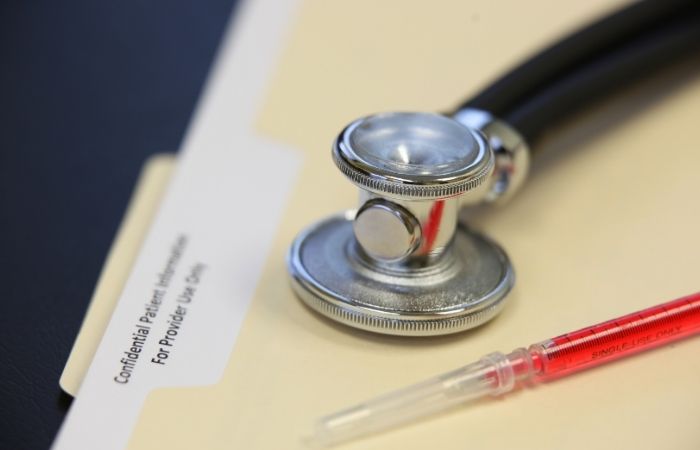
A confidential clinic result sits on file, but the realistic ways anyone outside your care team learns about it are limited to three:
- A court subpoena tied to specific legal matters (rare).
- An Explanation of Benefits sent to the policyholder when insurance is billed.
- Your own decision to share records with another provider.
How At-Home Testing Sidesteps the Privacy Problem Entirely
The reason at-home testing has expanded so quickly is structural, not marketing. By removing the clinic visit and the insurance claim, you remove the two most common sources of accidental disclosure. The process is straightforward:
- Order privately. You buy directly from the company, usually with a credit or debit card. No insurance involvement.
- Discreet delivery. Reputable kits ship in plain unmarked packaging with a generic return address.
- Sample at home. You collect a fingerstick blood drop or a self-swab in the privacy of your bathroom.
- Private results. Rapid lateral-flow kits give a result on the cassette in about 15 minutes. Results are not auto-uploaded to any medical chart.
This is a parallel option that exists alongside clinic-based testing. At-home rapid tests use the same antibody and antigen biology as the lateral-flow tests used in many clinics. They are not laboratory NAAT tests, which are more sensitive in early infection, so a clinic-administered NAAT is still the gold standard for confirming a suspected acute infection. For screening, routine reassurance, and moments when privacy is the priority, at-home rapid tests close the gap between no testing and a full clinic visit.

When a Clinic Is Still the Right Call
At-home testing is a strong privacy option, but it is not the right answer for every situation. There are moments when a clinic visit serves you better, even if it means giving up some of the discretion.
If you have symptoms that feel urgent, including pelvic pain, unusual discharge, sores, fever, or burning when you urinate, a clinic can evaluate you in person, run a NAAT when appropriate, and prescribe treatment the same day. Antibiotic treatment for chlamydia, gonorrhea, and syphilis is straightforward and short, but it requires a prescription. Antiviral treatment for herpes and HIV is more complex and also clinic-prescribed.
If a rapid at-home test comes back positive, the next step is a confirmatory test at a clinic or lab. In standard clinical practice, a positive screening result is followed up with a more sensitive laboratory test, typically a NAAT for bacterial infections, before treatment decisions are finalized. CDC screening recommendations describe when and how often different at-risk groups should be screened (CDC, STI Screening Recommendations). That follow-up usually has to happen in a confidential clinical setting, but you choose when, where, and how.
Skip the at-home route and see a clinician same-day if you have any of these:
- Active symptoms: pelvic pain, unusual discharge, sores, burning urination, or fever.
- A positive rapid test result that needs confirmation.
- A prescription need for antibiotics or antiviral treatment.

Privacy Is a Spectrum, Not a Yes-or-No Question
Privacy in STD testing lives on a spectrum, not a binary choice between exposed and invisible. You are choosing how much of a footprint you want to leave and which kind of footprint is acceptable to you.
The table below sketches the spectrum. None of these options are wrong. The right one depends on what you are optimizing for: cost, speed, follow-up care, anonymity, or some specific weighting of all four.
| Option | Trace Level | Best For |
|---|---|---|
| Insurance + Clinic | Highest (chart + EOB) | Routine care, symptoms, continuity |
| Clinic, self-pay | Moderate (chart only, no EOB) | Privacy from insurer, full panel |
| Public health clinic, anonymous HIV | Low (no name, only a code) | Free or low-cost HIV screening |
| At-home rapid test kit | Minimal (purchase only) | Maximum discretion across infections |
What Actually Happens After You Test
The anxiety around testing is rarely about the test itself. It is about what happens if the result is positive. People imagine an automatic chain of notifications, calls to partners, parents alerted somehow, employers somehow finding out. None of that is how it works.
If a test is positive, you are the one who decides what happens next. Treatment is a conversation between you and a clinician, not an announcement. For some infections, particularly HIV and syphilis, public health departments may conduct contact tracing, where partners are notified that they may have been exposed and should consider testing. Under CDC partner notification guidelines, the original patient's name is not disclosed to the partner; the program informs the partner of possible exposure only. The goal is prevention, not outing anyone.
For curable bacterial infections like chlamydia, gonorrhea, and syphilis, treatment is short and direct: usually a single-dose or short-course antibiotic. For chronic infections like HIV, herpes, and hepatitis B or C, treatment is long-term and effective, with modern therapies that can dramatically reduce transmission risk and, in the case of HIV, suppress the virus to undetectable levels.
Testing at home first gives you something a clinic visit does not: time to process the result, research follow-up options, and decide when and how to talk to a partner on your own timeline.
Why Delaying Costs More Than Privacy Protects
Most people who search for anonymous testing are not avoiding it forever; they are waiting for a path that feels safe enough to take. The longer that delay stretches, the more anxiety compounds, and the more a manageable situation can become a complicated one.
The WHO reports that more than one million curable STIs are acquired every day worldwide, the majority asymptomatic, which is precisely why screening matters and why people often need testing before they feel sick (WHO, STI Fact Sheet). Untreated chlamydia and gonorrhea can lead to pelvic inflammatory disease and infertility. Untreated syphilis progresses through stages, and the late stages cause serious cardiovascular and neurological damage. Untreated HIV without antiretroviral therapy progresses to AIDS. None of these outcomes are inevitable; all of them are preventable with timely testing and treatment.
WHO estimates more than one million curable STIs are acquired every day worldwide, and the majority cause no noticeable symptoms. Routine screening matters because most people will need testing before they feel sick.
FAQs
- Can I really get tested for an STD without giving my name?
- Yes, in specific situations. True anonymous testing is most commonly offered for HIV through public health departments and community organizations. For broader panels covering multiple infections, the closest equivalent is at-home testing, where no clinic chart and no insurance claim are created. The only person in the loop is you and the company that ships the kit.
- Is confidential testing the same as anonymous?
- No. Confidential means your name is recorded but protected from disclosure by HIPAA. Anonymous means your name is never recorded at all. Both protect you from casual exposure, but only anonymous testing leaves no record that could theoretically be subpoenaed or accidentally surfaced through billing.
- If I am on my parents' insurance, will they find out I got tested?
- If you are 18 or older, your medical records are protected from your parents under HIPAA. The exposure path is the Explanation of Benefits, which insurers often send to the policyholder. The EOB usually lists service categories, not specific results. To avoid the EOB entirely, pay out of pocket, use a sliding-scale public clinic, or test at home where no insurance claim is generated.
- Will an STD test stay on my medical record forever?
- If you tested at a clinic, the result is in your medical record indefinitely, but it is not public. Employers, partners, and most family members cannot access it. If having any clinical record makes you uncomfortable, at-home testing leaves only a purchase record with the seller and no chart entry at all.
- What is the most discreet way to get a multi-STD screen?
- An at-home rapid test kit. Reputable companies ship in plain unmarked packaging with no contents listed on the label, and results are read at home in about 15 minutes. There is no waiting room, no ID check, no insurance involvement, and no clinic record.
- Do clinics always ask for ID?
- Most private clinics and labs do, especially for full STD panels. Some public health clinics, particularly those offering anonymous HIV testing, may not require ID. Policies vary by state and county. If avoiding ID is part of your goal, at-home testing is the most consistent option.
- If I test positive at home, does that compromise my privacy?
- No. You still control what happens next. You will likely need a confirmatory test and, for most infections, a prescription for treatment, which means a clinical interaction at some point. The timing, location, and provider are your choice. The at-home test bought you time, not a permanent commitment to privacy.
- Are at-home rapid tests as accurate as clinic tests?
- Rapid lateral-flow tests use the same antibody or antigen biology as many in-clinic rapid tests. They are highly accurate after the window period for the infection in question, which varies from a couple of weeks for chlamydia and gonorrhea to several months for HIV and herpes. Laboratory NAAT tests are more sensitive in very early infection, so a positive at-home result should be confirmed with a clinical NAAT or antibody panel.
- U.S. Centers for Disease Control and Prevention. STI information, screening recommendations, and public health testing options.
- U.S. Centers for Disease Control and Prevention. HIV overview, including public health testing services and partner notification programs.
- U.S. Department of Health and Human Services. HIPAA Privacy Rule, individual rights, and protections for medical records.
- Planned Parenthood. Guidance on STD testing access, insurance considerations, and confidential communications.
- World Health Organization. Sexually transmitted infections fact sheet covering global incidence and screening priorities.
- U.S. Centers for Disease Control and Prevention. STI Screening Recommendations and Treatment Guidelines.
